


Introduction
Reinsurance helps insurance companies share their risks with another insurer. Instead of bearing the full burden of large or unexpected losses, an insurer passes on part of the risk to a reinsurance company. This helps insurance companies stay financially strong and ensures they can pay claims to policyholders even during major losses. Understanding reinsurance, its different types, and its benefits shows how the insurance industry stays stable and resilient.
Understanding What is Reinsurance
Insurance companies help people and businesses deal with financial risks, but some risks are so big that one company cannot safely handle them alone. This is where reinsurance becomes important.
- Reinsurance is an arrangement in which an insurance company shares part of its risk with another insurance company. The first company (the insurer) passes on a portion of the risk to a reinsurer. Simply put, reinsurance is insurance for insurance companies.
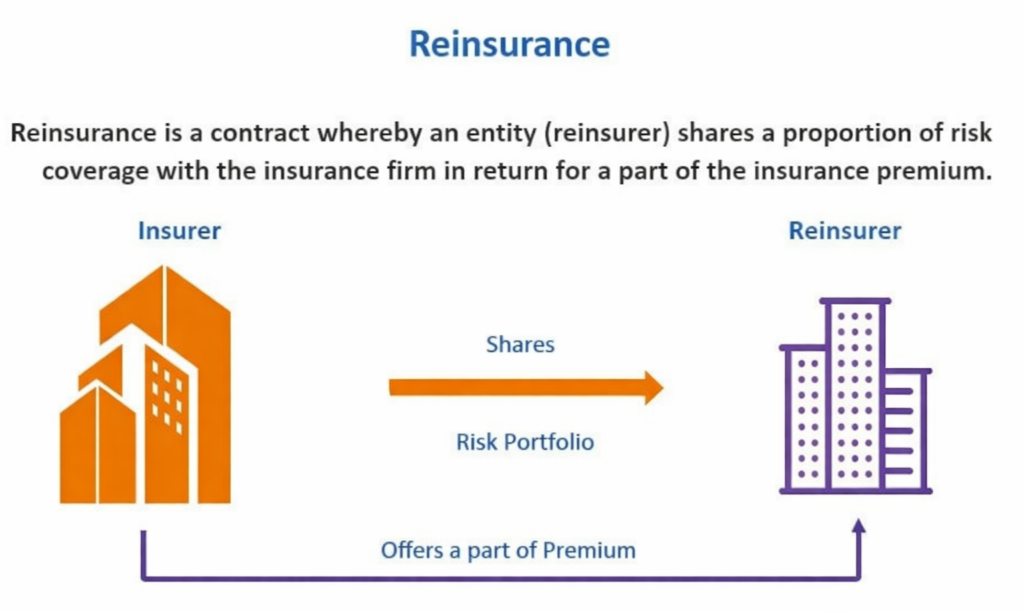
- By sharing large risks, insurers protect themselves from heavy losses caused by unexpected or very large claims. This allows them to remain financially stable and confidently provide coverage for big and complex projects such as airports, factories, power plants, or stadiums—risks that would be too large for a single insurer to manage on its own.
Benefits of Reinsurance
The benefits of reinsurance extend beyond individual insurers and contribute to the overall resilience of the global insurance system. Some of the key advantages include:
- Sharing Large Risks
- Big and uncertain risks like power plants, factories, or infrastructure projects are hard for one insurer to handle alone.
- Reinsurance spreads these risks among several companies, reducing pressure on any single insurer.
- Financial Safety
- Reinsurance protects insurers from heavy losses during disasters such as floods, earthquakes, or major accidents.
- By passing on part of the risk, insurers can stay financially strong and continue paying claims.
- Stability in the Insurance Market
- During crises, reinsurers absorb a part of the losses, preventing shocks to the insurance system.
- This keeps the market stable and protects smaller insurance companies.
- Greater Trust for Customers
- Customers feel more secure knowing their insurer is backed by reinsurers.
- This trust encourages more people and businesses to buy insurance.
- Better Risk Balance
- Reinsurance helps insurers avoid over-exposure to risky areas or industries, such as disaster-prone regions.
- Risks are spread across different regions and markets, creating balance.
- Reduced Capital Pressure
- Since some risk is transferred, insurers do not need to keep very large reserves of capital.
- This frees up money to expand services and launch new insurance products.
- Ability to Cover Big Projects
- With reinsurance support, insurers can offer coverage for large and complex projects like airports, ports, or energy plants.
- Without reinsurance, such policies would be too risky to offer.
- More Predictable Financial Results
- Insurance losses can vary sharply from year to year.
- Reinsurance smooths these ups and downs, leading to more stable financial performance.
- Access to Global Expertise
- Reinsurers bring international experience, advanced risk assessment, and technical knowledge.
- Insurers benefit from better decision-making and improved risk management.
Different Types of Reinsurance
| Type | Key Feature | Best Suited For |
|---|---|---|
| Facultative Reinsurance | Covers individual risks separately and is negotiated case by case | Large, unique, or unusual risks |
| Treaty Reinsurance | Covers a whole portfolio of policies under a single agreement | Regular and ongoing risk-sharing |
| Proportional Reinsurance | Premiums and losses are shared between insurer and reinsurer in a fixed ratio | Predictable and stable risks |
| Non-proportional Reinsurance | Reinsurer pays only when losses exceed a specified threshold | High-severity or catastrophic risks |
| Excess of Loss Reinsurance | Reinsurer covers claims beyond an agreed loss limit | Natural disasters and major industrial losses |
Facultative Reinsurance
- Covers one specific risk at a time, not a whole group of policies.
- Used for large, unique, or unusual risks such as a big factory, stadium, or special industrial project.
- Each contract is negotiated separately, which makes it flexible but also time-consuming.
Treaty Reinsurance
- Covers an entire set or portfolio of policies under one agreement.
- Saves time because insurers do not need to negotiate each policy individually.
- Helps insurers manage regular and standard risks in a smooth and consistent manner.
Proportional Reinsurance
- The insurer and reinsurer share premiums and claims in a fixed proportion.
- For example, if the reinsurer takes 40% of the risk, it also receives 40% of the premium and pays 40% of any claims.
- Both gains and losses are shared fairly between the two parties.
Non-Proportional Reinsurance
- The reinsurer steps in only when losses cross a fixed limit.
- Mainly used to protect insurers from severe or catastrophic events like earthquakes or floods.
- Helps reduce financial stress during extreme losses.
Excess of Loss Reinsurance
- A special type of non-proportional reinsurance.
- The insurer pays claims up to a set amount, and the reinsurer covers losses above that limit.
- For example, if the insurer covers losses up to ₹50 crore, the reinsurer pays anything beyond this.
- Protects insurers from rare but very large claims, ensuring financial stability.
Conclusion
Reinsurance plays a vital role in strengthening the insurance industry by allowing insurers to share risks and protect themselves from large and unexpected losses. By spreading risks across multiple companies and regions, reinsurance ensures financial stability, market continuity, and confidence among policyholders. It enables insurers to support large infrastructure and industrial projects, manage catastrophic events, and deliver predictable financial outcomes. Through its various forms—such as facultative, treaty, proportional, and non-proportional reinsurance—it offers flexibility and protection tailored to different risk profiles. Overall, reinsurance acts as a backbone of the insurance system, promoting resilience, trust, and long-term sustainability in an increasingly uncertain world.














