Tribal communities in Madhya Pradesh are protesting the Ken-Betwa River Linking Project because they fear it could force them to leave their homes, destroy their ancestral forests, and threaten their traditional culture and way of life.
Context
Ken–Betwa Link Project (KBLP)
NABARD 2021-2024 Cutoff Analysis | What we can Learn? #nabard_grade_a_exam #nabard_cutoffTap to play · from the C4S channel
- The Ken-Betwa River Linking Project is a major water project for the Bundelkhand region of Madhya Pradesh and Uttar Pradesh. Its main aim is to reduce water shortages and provide more water for irrigation.
- Under the project, water from the Ken River basin will be transferred to the Betwa River basin. This will be done through the Daudhan Dam, a connecting canal, and other supporting structures.
- It is the first priority project under the National Perspective Plan for Interlinking of Rivers to move towards actual implementation.
- The project will be developed in two phases:Phase I:
It will include the construction of the Daudhan Dam, along with the Low-Level Tunnel, High-Level Tunnel, Ken-Betwa Link Canal, and powerhouses.Phase II:
It will include three major works: Lower Orr Dam, Bina Complex Project, and Kotha Barrage.
A clean PDF of this page with the C4S header — it opens right away, and the link comes to your WhatsApp too.
Benefits of The Ken-Betwa Link Project (KBLP)
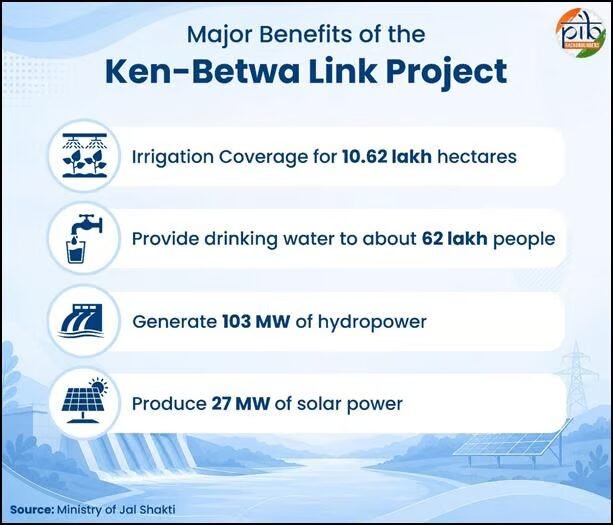
- The project is expected to provide more water for irrigation and drinking, create jobs, and improve infrastructure in the water-scarce Bundelkhand region of Madhya Pradesh and Uttar Pradesh.
- It can help farmers deal with droughts, increase agricultural production and income, and reduce the need for people to migrate to other places in search of work.
- Better roads, bridges and connectivity associated with the project could also benefit nearby villages by improving access to markets, schools and healthcare.
- Overall, the project aims to improve water availability and economic opportunities while also trying to manage its environmental and social impacts responsibly.
Assessment and Clearance
- The environmental effects of the Ken-Betwa Link Project (KBLP) were studied in detail as part of the legal process required before the project could proceed.
- The project has received the required government clearances, including Environmental Clearance (2017), Wildlife Clearance (2016), Ministry of Tribal Affairs Clearance (2017), and Forest Clearance (2023). These approvals come with specific conditions and measures to reduce environmental damage.
- The project is also taking steps such as planting compensatory forests, protecting wildlife and biodiversity, and implementing environmental management plans to reduce and manage its impact on forests, wildlife and local ecosystems.
Concerns and Criticism
- Water diversion: Some people worry that diverting Ken River water could reduce the amount of water available to parts of Bundelkhand that already depend on the river.
- Impact on downstream areas: If the river’s natural flow decreases, it could affect drinking water, irrigation, farming and groundwater recharge in downstream areas, including parts of Banda, Mahoba and Chhatarpur.
- Damage to forests and wildlife: The construction of the Daudhan Dam could submerge large areas of land, lead to forest loss and disturb the natural flow of the Ken River. Concerns have also been raised about its impact on Panna National Park and Tiger Reserve and the loss of trees.
- Questions about environmental studies: Critics argue that the environmental assessments may not have fully considered the possible effects on downstream villages, farming, water availability and local ecosystems. Some research has also raised concerns that large-scale river-water transfers could influence local climate and rainfall patterns.
- Fair distribution of water: A key concern is whether Bundelkhand’s water needs should be met first before water is transferred from the region to another basin.
- Displacement of people: The project is expected to affect thousands of families in Chhatarpur and Panna. Some affected communities have protested over compensation, rehabilitation and whether they will receive enough benefits from the project.
Conclusion
The Ken-Betwa Link Project is an important effort to address the long-standing water shortages and socio-economic challenges of the Bundelkhand region. It can improve irrigation, agriculture, drinking water availability, and infrastructure in the region. However, the success of the project will depend on how carefully its environmental and social impacts are managed. Measures such as protecting wildlife at the landscape level, planting new forests to compensate for forest loss, and providing fair and transparent rehabilitation to affected families will be essential. Proper implementation can help ensure that the long-term benefits for farmers and communities are greater than the environmental and social costs, while also supporting sustainable agriculture and power generation.