The Indian Ocean Region (IOR) has emerged as the maritime epicenter of global geopolitics, accounting for 75% of global oil shipments, 50% of global container traffic, and 30% of global trade volume. In response to rising maritime challenges and China’s increasing dominance in the region, India launched the SAGAR Vision (Security and Growth for All in the Region) in 2015, under the leadership of Prime Minister Narendra Modi.
Introduction
SAGAR is not merely a maritime security strategy; it is a comprehensive geopolitical vision that aims to secure India’s maritime interests, strengthen regional cooperation, enhance Blue Economy initiatives, and establish India as the net security provider in the Indian Ocean Region (IOR).
Historical Background of India's Maritime Strategy
NABARD 2021-2024 Cutoff Analysis | What we can Learn? #nabard_grade_a_exam #nabard_cutoffTap to play · from the C4S channel
Ancient Maritime Power
- The Chola Dynasty (9th-13th century) had established naval dominance in Southeast Asia.
- Ancient Indian ports like Lothal, Calicut, and Kolkata played a key role in global trade routes.
Post-Independence Era
- After independence in 1947, India’s maritime focus remained limited due to land-based threats from Pakistan and China.
- However, after the 2008 Mumbai terror attacks, the need for strong maritime security and regional cooperation became a national priority.
Emergence of SAGAR
- With China’s String of Pearls Strategy and Belt and Road Initiative (BRI) gaining ground, India launched the SAGAR Vision in 2015 to counter China’s growing influence and strengthen India’s strategic control over the Indian Ocean Region.
A clean PDF of this page with the C4S header — it opens right away, and the link comes to your WhatsApp too.
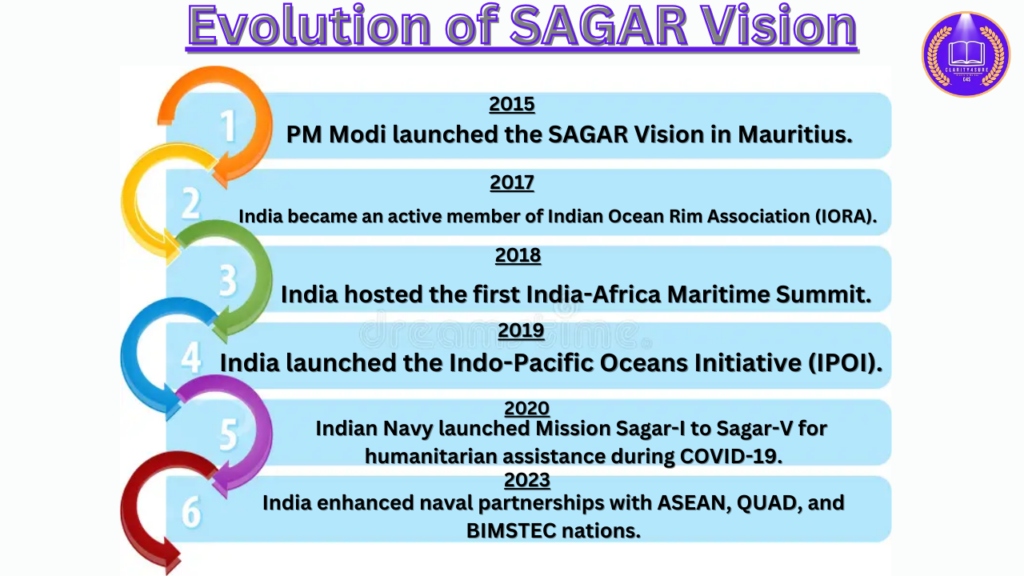
Evolution of SAGAR Vision
| Year | Development |
|---|---|
| 2015 | PM Modi launched the SAGAR Vision in Mauritius. |
| 2017 | India became an active member of Indian Ocean Rim Association (IORA). |
| 2018 | India hosted the first India-Africa Maritime Summit. |
| 2019 | India launched the Indo-Pacific Oceans Initiative (IPOI). |
| 2020 | Indian Navy launched Mission Sagar-I to Sagar-V for humanitarian assistance during COVID-19. |
| 2023 | India enhanced naval partnerships with ASEAN, QUAD, and BIMSTEC nations. |
Core Pillars of SAGAR Vision
The SAGAR Vision (Security and Growth for All in the Region) is built on five core pillars that focus on maritime security, economic growth, environmental sustainability, and regional collaboration in the Indian Ocean Region (IOR).
Maritime Security
- Ensuring freedom of navigation and maritime safety.
- Enhancing naval capabilities to counter piracy, terrorism, smuggling, and illegal fishing.
- Strengthening Maritime Domain Awareness (MDA) through advanced surveillance systems and satellite-based monitoring.
- Collaborating with regional navies and coast guards for joint patrols and intelligence sharing.
- Establishing Indian Navy’s Information Fusion Centre (IFC-IOR) for real-time threat monitoring in the Indian Ocean.
Sustainable Blue Economy
- Promoting fisheries, marine tourism, and offshore renewable energy projects.
- Enhancing port-led development through the Sagarmala Project.
- Encouraging deep-sea exploration, aquaculture, and marine biotechnology.
- Developing coastal infrastructure and shipping lanes to boost trade and connectivity.
- Supporting small island nations in utilizing their marine resources for economic growth.
Capacity Building and Humanitarian Assistance
- Providing technical, financial, and logistical support to Indian Ocean littoral countries.
- Enhancing maritime infrastructure, coast guard training, and naval exercises for regional partners.
- Conducting disaster relief operations and humanitarian assistance missions during natural calamities.
- Launching Mission SAGAR (I to V) to assist nations like Maldives, Seychelles, Madagascar, and Mauritius during the COVID-19 pandemic.
- Supporting African nations in building maritime infrastructure and fisheries management systems.
Disaster Risk Management and Environmental Protection
- Strengthening disaster response mechanisms for cyclones, tsunamis, and oil spills.
- Promoting climate-resilient infrastructure and coastal protection projects.
- Combating marine pollution, plastic waste, and illegal fishing practices.
- Supporting small island nations like Maldives, Seychelles, and Mauritius to tackle rising sea levels and climate change impacts.
- Enhancing early warning systems and quick response teams for maritime disasters.
Regional Connectivity and Maritime Cooperation
- Strengthening ties with Indian Ocean Rim Association (IORA) and Indian Ocean Naval Symposium (IONS).
- Enhancing collaboration with ASEAN, BIMSTEC, QUAD (India, USA, Japan, Australia), and African nations.
- Developing strategic maritime corridors to connect Africa, the Middle East, and Southeast Asia.
- Establishing naval bases and listening posts in Andaman & Nicobar Islands, Chabahar Port (Iran), Duqm Port (Oman), and Mauritius.
- Promoting freedom of navigation in the Indo-Pacific region and ensuring rule-based maritime order.
| Pillar | Description |
|---|---|
| Maritime Security | Protecting sea lanes, countering piracy, and enhancing naval strength. |
| Sustainable Blue Economy | Promoting fisheries, marine tourism, and renewable energy projects. |
| Capacity Building | Providing technical and financial assistance to IOR nations. |
| Disaster Risk Management | Strengthening humanitarian aid and disaster relief (HADR) operations. |
| Regional Connectivity | Developing port infrastructure, shipping lanes, and maritime logistics. |
| Countering China’s Influence | Strengthening India’s strategic presence in IOR to curb China’s dominance. |
Geopolitical Significance of SAGAR in Indian Ocean Region (IOR)
The SAGAR Vision (Security and Growth for All in the Region) holds immense geopolitical significance for India and the Indian Ocean Region (IOR). As the Indian Ocean is the world’s busiest trade route, controlling 75% of global oil shipments and 50% of global container traffic, India’s strategic presence in the region is crucial for global maritime security and economic growth.
| Region | Importance for India |
|---|---|
| Western Indian Ocean (Africa) | Access to African resources and countering Chinese influence in Djibouti. |
| Eastern Indian Ocean (ASEAN Nations) | Securing the Malacca Strait, which handles 40% of global trade. |
| Southern Indian Ocean (Island Nations) | Strengthening ties with Mauritius, Maldives, Seychelles, and Madagascar. |
| Arabian Sea (Middle East) | Ensuring energy security and trade routes from the Persian Gulf. |
Why is the Indian Ocean Region (IOR) Geopolitically Important?
| Factors | Geopolitical Significance |
|---|---|
| Global Trade Hub | 75% of global oil shipments and 50% of container traffic pass through IOR. |
| Strategic Sea Routes | Includes critical chokepoints like Strait of Malacca, Strait of Hormuz, and Bab el-Mandeb. |
| Energy Security | Middle Eastern oil supply routes pass through IOR. |
| Maritime Security | Threats from piracy, terrorism, and illegal fishing. |
| China’s Rising Influence | China’s String of Pearls Strategy and Belt and Road Initiative (BRI) pose a security challenge to India. |
| Small Island Nations | Influence over Maldives, Seychelles, Mauritius, and Sri Lanka is key for regional control. |
Role of SAGAR in Strengthening India’s Position in IOR
Strategic Control Over Critical Maritime Routes
- The Indian Ocean connects Africa, the Middle East, and Southeast Asia, making it the world’s busiest energy trade route.
- SAGAR Vision allows India to secure key sea lanes and chokepoints like:
- Strait of Malacca (40% of global trade passes through it)
- Strait of Hormuz (25% of global oil supply passes through it)
- Bab el-Mandeb (connects Red Sea to the Arabian Sea)
Countering China’s String of Pearls Strategy
China is expanding its presence in the Indian Ocean through the String of Pearls Strategy, where it is building military and commercial ports around India to encircle it strategically. These include:
| China’s Port Strategy | India’s Counter-Strategy through SAGAR |
|---|---|
| Gwadar Port (Pakistan) | Chabahar Port (Iran) |
| Hambantota Port (Sri Lanka) | Colombo Port Agreement with Sri Lanka |
| Djibouti Naval Base (Africa) | Naval Bases in Seychelles and Madagascar |
| Kyaukpyu Port (Myanmar) | Sittwe Port (Myanmar) |
| Maldives-China Agreement | India-Maldives Defense Pact |
Strengthening Regional Maritime Alliances
SAGAR Vision aims to unite like-minded countries in IOR to counter China’s dominance and ensure freedom of navigation.
| Regional Organization | India’s Role |
|---|---|
| Indian Ocean Rim Association (IORA) | Enhancing economic cooperation and trade routes |
| Indian Ocean Naval Symposium (IONS) | Strengthening naval coordination |
| BIMSTEC (Bay of Bengal Initiative) | Improving regional connectivity |
| QUAD Alliance (India, US, Japan, Australia) | Countering China’s influence in the Indo-Pacific |
| Indo-Pacific Oceans Initiative (IPOI) | Securing maritime routes from Africa to the Pacific |
India’s Naval Dominance in the Region
- SAGAR Vision strengthens India’s Navy and Coast Guard to protect its Exclusive Economic Zone (EEZ).
- Development of Naval Bases in Andaman & Nicobar Islands, Seychelles, and Mauritius.
- Information Fusion Centre for Indian Ocean Region (IFC-IOR) for real-time surveillance and intelligence sharing.
- Deployment of advanced submarines, aircraft carriers (like INS Vikrant), and surveillance aircraft (like P-8I Poseidon).
Supporting Blue Economy and Port Infrastructure Development
- Promoting fisheries, marine tourism, and offshore energy projects in IOR nations.
- Building coastal infrastructure and port development projects through the Sagarmala Project.
- Developing strategic ports like Chabahar (Iran), Duqm (Oman), and Sittwe (Myanmar) to increase India’s maritime influence.
Disaster Management and Humanitarian Assistance
India’s Mission SAGAR (I to V) provided medical and humanitarian assistance to Maldives, Seychelles, Madagascar, and Mauritius during the COVID-19 pandemic.
- Strengthening disaster response mechanisms for cyclones, tsunamis, and oil spills.
- Establishing quick-response teams for search and rescue operations in IOR.
Safeguarding Energy Security
- 65% of India’s crude oil imports come through the Indian Ocean Region (IOR).
- Securing energy shipping routes from the Persian Gulf and Africa.
- Countering China’s dominance over energy routes in the South China Sea.
Role of SAGAR in India's Maritime Diplomacy
- The SAGAR Vision (Security and Growth for All in the Region) plays a crucial role in enhancing India’s maritime diplomacy in the Indian Ocean Region (IOR).
- It aims to establish India as the “Net Security Provider” by ensuring freedom of navigation, maritime security, and regional stability.
- Through strategic partnerships with regional organizations like Indian Ocean Rim Association (IORA), Indian Ocean Naval Symposium (IONS), BIMSTEC, and QUAD (India, US, Japan, Australia), India strengthens cooperation and counters China’s String of Pearls strategy.
- Under SAGAR, India has developed strategic naval bases in Andaman & Nicobar Islands, Seychelles, and Mauritius, while enhancing infrastructure at Chabahar Port (Iran), Duqm Port (Oman), and Sittwe Port (Myanmar) to secure critical sea lanes.
- It also promotes the Blue Economy by boosting fisheries, marine tourism, and port-led infrastructure development through the Sagarmala Project.
- Additionally, SAGAR plays a key role in Humanitarian Assistance and Disaster Relief (HADR) through Mission SAGAR (I to V), providing aid to Maldives, Madagascar, Seychelles, and Mauritius during the COVID-19 pandemic and natural disasters.
- By deploying advanced naval capabilities like INS Vikrant (Aircraft Carrier) and P-8I Poseidon Surveillance Aircraft, India strengthens its maritime surveillance and intelligence sharing through the Information Fusion Centre (IFC-IOR).
- Moreover, SAGAR secures energy shipping routes passing through Strait of Malacca, Strait of Hormuz, and Bab el-Mandeb, ensuring India’s energy security and maritime trade protection.
- Overall, SAGAR Vision serves as the foundation of India’s Maritime Diplomacy, enhancing regional cooperation, countering Chinese influence, promoting economic growth, and positioning India as a global maritime power in the Indian Ocean Region (IOR).
| Initiative | India’s Role |
|---|---|
| Indian Ocean Rim Association (IORA) | Strengthening economic ties and security cooperation. |
| Indian Ocean Naval Symposium (IONS) | Naval coordination and intelligence sharing. |
| QUAD Alliance (India, US, Japan, Australia) | Countering China’s influence in Indo-Pacific. |
| BIMSTEC (Bay of Bengal Initiative) | Enhancing regional connectivity and trade. |
| ASEAN-India Maritime Forum | Promoting maritime infrastructure development. |
Blue Economy and Sustainable Development under SAGAR
- Under the SAGAR Vision (Security and Growth for All in the Region), India aims to promote a sustainable Blue Economy in the Indian Ocean Region (IOR) by harnessing marine resources while ensuring environmental protection and economic growth.
- It focuses on fisheries development, marine tourism, offshore renewable energy, deep-sea mining, and port-led infrastructure development through the Sagarmala Project.
- India also supports small island nations like Maldives, Seychelles, and Mauritius in climate-resilient infrastructure, coastal protection, and disaster management.
- By promoting sustainable fishing practices, reducing marine pollution, and enhancing coastal livelihoods, SAGAR ensures economic prosperity, environmental conservation, and regional stability in the Indian Ocean Region.
| Sector | Key Initiatives |
|---|---|
| Fisheries and Marine Resources | Sustainable fisheries and deep-sea exploration. |
| Port Infrastructure Development | Sagarmala Project for port-led development. |
| Renewable Energy | Offshore wind farms and ocean thermal energy conversion. |
| Marine Tourism | Developing cruise tourism and coastal infrastructure. |
Countering China's Influence: The Strategic Angle of SAGAR
| China’s Strategy | India’s Counter-Strategy |
|---|---|
| String of Pearls | Strategic Naval Bases in Andaman & Nicobar Islands |
| Gwadar Port (Pakistan) | Chabahar Port Development in Iran |
| Djibouti Naval Base (Africa) | Naval Alliances with Seychelles and Mauritius |
| Belt and Road Initiative (BRI) | QUAD and Indo-Pacific Oceans Initiative (IPOI) |
Major Projects under SAGAR Vision
- Sagarmala Project –
- Port-led development and coastal industrialization.
- Mission Sagar I to V –
- Humanitarian aid during COVID-19 to African and Indian Ocean nations.
- Indian Navy’s Information Fusion Centre (IFC-IOR) –
- Real-time maritime surveillance and intelligence sharing.
- Project Mausam –
- Reviving ancient Indian maritime routes.
Challenges and Roadblocks in Implementing SAGAR
- Chinese Aggression in IOR
- Piracy and Maritime Terrorism
- Climate Change and Rising Sea Levels
- Lack of Maritime Infrastructure in Small Island Nations
- Limited Financial Resources
Future Roadmap of SAGAR Vision
Free live session
NABARD Grade A 2026: what the 2025 cut-offs changed, and the 90-day plan
In 4 days · Sun, 4 Oct at 7:30 PM IST
- Strengthening QUAD and Indo-Pacific partnerships.
- Expanding India’s Blue Economy initiatives.
- Building new naval bases in Madagascar and Mauritius.
- Enhancing India’s shipbuilding industry.
Conclusion
The SAGAR Vision is not just a maritime strategy but a global vision for a secure and prosperous Indian Ocean Region (IOR). By balancing security, economic growth, and environmental sustainability, India aims to emerge as the net security provider and maritime leader in the Indo-Pacific region.