Context
The United States and Israel launched a joint military operation against Iran, triggering a multi-front regional war.
What is the Conflict?
The United States and Israel initiated a large-scale military offensive—Operation Epic Fury (Operation Genesis)—targeting Iran’s nuclear and ballistic missile infrastructure. The operation reportedly resulted in the assassination of Iran’s Supreme Leader Ali Khamenei and several senior officials.
The campaign, launched under former US President Donald Trump and Israeli Prime Minister Benjamin Netanyahu, marks a shift from decades of shadow conflict to direct, high-intensity warfare.
Iran responded with Operation Truthful Promise 4, launching large-scale drone and missile attacks on Israel and US-allied Gulf states.
Historical Background
- 1979 Rupture:
- Before 1979, Iran and Israel maintained close strategic relations. However, after the Iranian Revolution, the new Islamic government cut diplomatic ties with Israel and adopted a strong anti-Western stance. The regime referred to the United States as the “Great Satan” and Israel as the “Little Satan,” blaming them for regional exploitation and framing its ideology around anti-colonial and anti-imperialist ideas.
- Iran’s Nuclear Revelation:
- Tensions increased significantly in the early 2000s when the international community discovered that Iran had been running a secret nuclear programme.
- Regional Expansion:
- After the US-led removal of Iraq’s Saddam Hussein, who had been a major rival of Iran, a power vacuum emerged in the region. Iran used this opportunity to expand its influence by building the “Axis of Resistance,” a network of allied proxy groups across the Middle East, including Hezbollah in Lebanon, Hamas in Gaza, and the Houthis in Yemen, aimed at countering US and Israeli influence.
- JCPOA Agreement:
- To limit Iran’s advancing and covert nuclear programme, the P5+1 countries (China, France, Germany, Russia, the United Kingdom, and the United States), along with the European Union and Iran, signed the Joint Comprehensive Plan of Action (JCPOA) in 2015. The agreement offered relief from international sanctions in exchange for strict limits on Iran’s uranium enrichment activities.
- US Withdrawal (2018):
- The United States withdrew from the JCPOA in 2018, arguing that the agreement was seriously flawed because it did not address Iran’s ballistic missile programme or its support for the “Axis of Resistance.” In response, Iran significantly increased its uranium enrichment activities, bringing it closer to weapons-grade capability.
- Collapse of the “Axis of Resistance” (2023–24):
- Following the Hamas attack in October 2023, Israel launched a multi-front military campaign that weakened Hamas, targeted and eliminated key Hezbollah leaders, and contributed to the fall of Syria’s Bashar al-Assad, which reduced Iran’s important regional support structures.
- Operation Midnight Hammer (June 2025):
- In June 2025, Israel carried out pre-emptive strikes on Iran’s nuclear facilities at Natanz and Isfahan. The United States later joined the operation, using B-2 bombers and bunker-buster bombs to attack the heavily fortified Fordow nuclear site. The US stated that these strikes caused major damage to Iran’s nuclear infrastructure and were intended to delay its nuclear programme by disrupting key enrichment facilities and capabilities.
What are the Implications of the US and Israel-Iran War?
Global
- Threat to Global Energy Security:
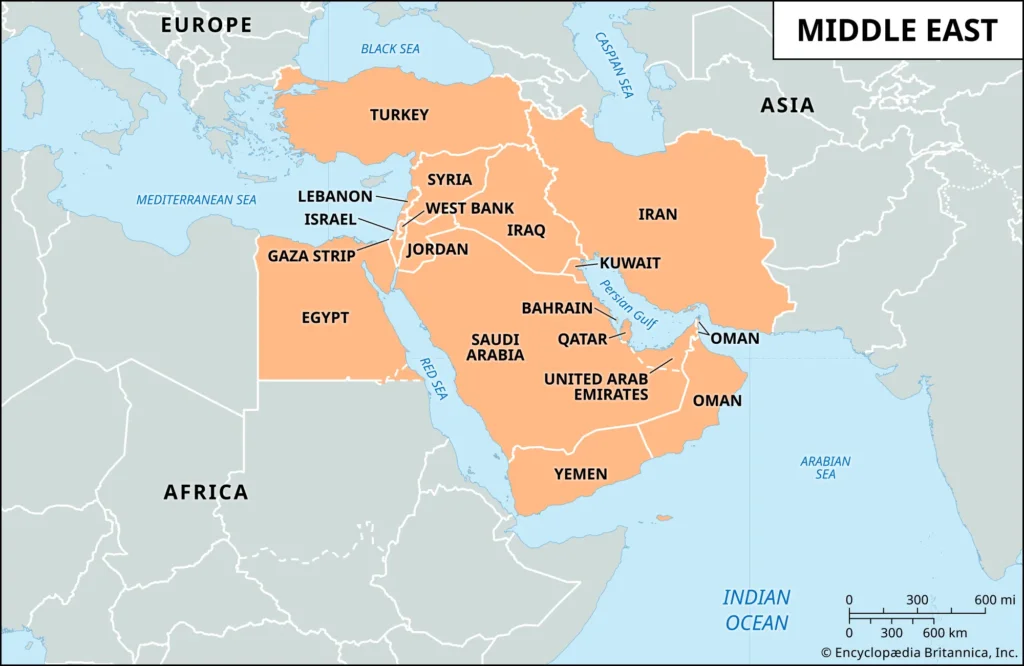
- The escalation of the conflict directly affects the Strait of Hormuz, which is one of the world’s most important maritime chokepoints. The strait carries around 20 million barrels of crude oil every day, which is about 20% of global oil consumption, and also handles around 20–30% of global Liquefied Natural Gas (LNG) shipments. If Iran blocks or mines this route, global energy markets could be severely disrupted, leading to a sharp rise in crude oil prices.
- Geopolitical Polarization:
- The conflict could pull other major global powers into the situation. Russia and China may strengthen their strategic ties with Iran, while the United States may consolidate support from its Western and Arab allies. This could further deepen divisions in the global geopolitical order.
- Disruption of Global Supply Chains:
- The increasing militarization of airspace and sea routes in West Asia is disrupting key trade routes that connect Asia and Europe. This disruption is increasing global freight and insurance costs.
- Commodity and Market Volatility:
- Due to the conflict, several major traders have temporarily suspended energy shipments, which has increased the “war premium” in global markets. As a result, gold prices have risen because investors are seeking safer assets, and stock markets in Dubai and Abu Dhabi have halted trading.
India
- Energy Security and Economy:
- India is the third-largest consumer of crude oil in the world and imports around 85–88% of its oil requirements. About 2.5–2.7 million barrels of oil per day from countries such as Iraq, Saudi Arabia, the UAE, and Kuwait pass through the Strait of Hormuz. Additionally, about 80–85% of India’s LPG and nearly 60% of its LNG imports also move through this route. Although India’s immediate crude oil needs are currently manageable, likely due to strategic petroleum reserves and diversified imports from countries like Russia, India does not have large strategic reserves for LPG and LNG. Since spot availability of LPG and LNG is limited, supply disruptions would be difficult to manage. If the disruption in the Strait of Hormuz continues for a long time, oil prices could rise above USD 100 per barrel, significantly increasing India’s import bill. In the short term, reserves and diversified suppliers may help, but a prolonged conflict could increase the current account deficit, raise inflation, and put pressure on the economy.
- Safety of the Indian Diaspora:
- West Asia is home to nearly 9 million Indian expatriates who contribute significantly to remittances sent back to India. Ensuring the safety of these citizens is the government’s top priority. If the situation worsens, India may need to carry out large-scale evacuation operations similar to Operation Rahat or Operation Ajay.
- Diplomatic Tightrope:
- India maintains strong strategic relations with the United States and Israel, while also having important historical, energy, and connectivity ties with Iran. Taking sides in the conflict could harm India’s interests. Therefore, India faces the challenge of promoting peace and condemning civilian casualties while maintaining balanced relations with all its strategic partners.
- Disruption of Connectivity Corridors:
- The increasing militarization of the Gulf region is affecting India’s key connectivity projects. Operations at Iran’s Chabahar Port are at risk, and the proposed India–Middle East–Europe Economic Corridor (IMEC) faces serious challenges because of damage to port infrastructure in the Arabian Peninsula.
What Measures can India take to Mitigate the Impact of the US and Israel-Iran Conflict?
- Activation of Strategic Buffers:
- The government should be ready to use the Strategic Petroleum Reserves (SPR) to protect the domestic market from sudden increases in oil prices. At the same time, it should actively look for alternative sources of LPG and LNG from countries outside the Gulf region, such as the United States or Australia.
- Evacuation Contingency Readiness:
- The government should prepare detailed evacuation Standard Operating Procedures (SOPs) in coordination with the Ministry of Civil Aviation and the Indian Navy to create safe routes for evacuating Indian citizens living in the region.
- Large-Scale Airlift Preparedness:
- The Indian Air Force and Air India should remain on standby to carry out large-scale evacuation flights if required, similar to the evacuation operations conducted during Operation Ganga in Ukraine.
- Naval Security Measures:
India should strengthen the presence of the Indian Navy in the Arabian Sea and the Gulf of Oman. Missions such as Operation Sankalp may need to be expanded to protect Indian merchant ships operating near conflict areas. - Strategic Autonomy in Diplomacy:
- India needs to carefully manage its diplomatic approach. While maintaining strong relations with the United States and Israel, it should also continue back-channel communication with Iran and Oman to secure safe passage for Indian vessels and support efforts to keep commercial shipping routes free from military activity.
- Subsidies and Tax Interventions:
- To ensure that the rise in global fuel prices does not directly burden ordinary citizens, the central and state governments may need to reduce excise duties and Value Added Tax (VAT) on petrol and diesel to absorb part of the price shock.
- Advocating for De-escalation at the UN:
- India should continue to emphasize that the current period is not one for war and must consistently call for de-escalation at international platforms such as the United Nations. While condemning civilian casualties, India should avoid taking a strongly partisan position that could alienate either the US-Israel group or Iran, and instead focus on encouraging dialogue and restoring global trade and supply chains.
Conclusion
The 2026 West Asian escalation exposes India’s vulnerability in energy security and diaspora safety. By maintaining its strategic autonomy and acting as a stabilising, non-partisan voice for peace — embodying the role of a Vishwa Bandhu (global friend) — India can safeguard its interests while reinforcing that this is not an era of war.
FAQ’s
- What is Operation Epic Fury and Operation Lion’s Roar?
These are military operations carried out by the United States and Israel in 2026 targeting Iran’s leadership and important strategic facilities. The operations have significantly increased tensions in West Asia. - Why is the Strait of Hormuz important for global energy security?
The Strait of Hormuz is a key route for global energy transport. Around 20% of the world’s oil and about 20–30% of global LNG shipments pass through it, so any disruption in this route can lead to sharp increases in global energy prices. - What is the JCPOA and why did the US withdraw from it?
The Joint Comprehensive Plan of Action (JCPOA) was a nuclear agreement signed in 2015 that limited Iran’s uranium enrichment in return for relief from international sanctions. The United States withdrew from the deal in 2018, arguing that it did not address Iran’s missile program and its support for regional proxy groups. - How does the conflict affect India’s energy security?
India imports more than 85% of its crude oil, and a large portion of it passes through the Strait of Hormuz. Because of this dependence, any disruption in the region can affect India’s oil supply and lead to higher fuel prices. - Why is strategic autonomy important for India in this conflict?
Strategic autonomy helps India maintain balanced relations with different global powers involved in the conflict. This approach allows India to protect its energy needs, ensure the safety of its citizens abroad, and safeguard its trade interests.