The Great 2026 Capital Flight Explained Simply
An everyday person’s guide to understanding India’s biggest economic headache of the year — told in stories, not jargon.
The Wedding Party That Suddenly Went Empty
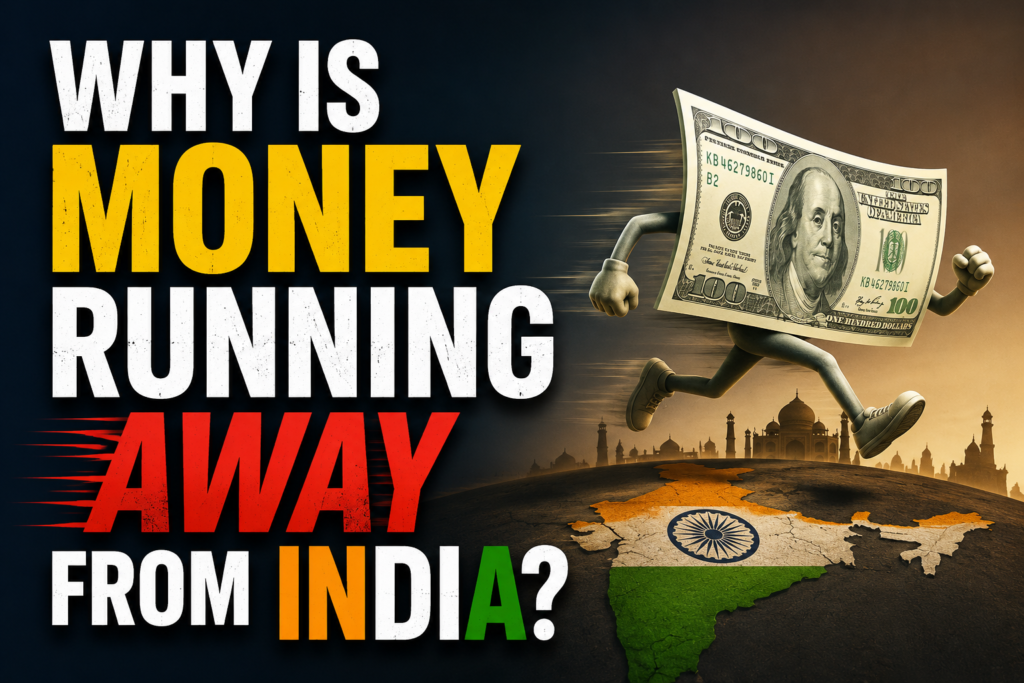
Imagine you’re hosting a grand wedding. The hall is glittering, the food is famous, the DJ is loud — and for years, guests from every neighbourhood have been queueing up to attend. Suddenly, in 2026, something strange happens. Wealthy guests start quietly slipping out of the back door. Not just one or two — over ₹2 lakh crore worth of them.
That, in a nutshell, is what’s happening with India’s economy right now.
The “guests” are foreign investors. The “wedding hall” is the Indian stock market, bond market, and economy. And the back door they’re using is something economists call capital outflow.
Let’s unpack this — without putting you to sleep with textbook definitions.
So, What Exactly Is “Capital Outflow”?
Think of money in an economy like water in a swimming pool. Every day, water flows in (foreign investments, exports, remittances from NRIs) and water flows out (imports, repaying loans, investors taking their money home).
When more water leaves than enters — for weeks or months on end — the pool starts emptying. That’s capital outflow.
In extreme cases, when investors panic and rush for the exit together like people fleeing a fire, we call it capital flight. And that’s exactly the situation India is staring at in 2026.
The Four Ways Money Sneaks Out
- The “Renter” Investors Leaving (FPI Outflow) — Foreign Portfolio Investors are like tenants. They buy Indian stocks or bonds today and can sell them tomorrow. Economists call their money “hot money” because it moves at the speed of a WhatsApp forward. In 2026, these tenants are emptying their flats and flying out.
- The “Homeowner” Investors Holding Back (FDI Outflow) — Foreign Direct Investors build actual factories, hire workers, plant roots. They’re harder to scare off — but even they are now buying property elsewhere instead of in India.
- Loan Repayments — When Indian companies and the government repay foreign loans, dollars naturally leave the country.
- NRI Withdrawals — Your uncle in Dubai keeping his savings in an Indian bank? He might quietly move it to a Singapore account if he thinks the rupee will fall further.
Why Are Investors Running for the Exit?
1. The Middle East Is on Fire — and India’s Wallet Burns With It
India buys most of its oil from abroad. When the US-Iran conflict erupted, oil prices shot up. India’s Current Account Deficit (basically, the gap between what we sell to the world and what we buy from it) is now threatening to double to 2% of GDP.
Analogy: Imagine your monthly grocery bill suddenly doubles because of a war thousands of kilometres away. Your savings drain faster, and any investor watching your bank account thinks, “Better pull my money out before things get worse.”
2. America Is Paying Better Interest — Why Risk India?
US government bonds are giving over 4% returns — and they’re considered the world’s safest investment. So why would a New York fund manager risk his money in Indian markets when Uncle Sam is offering nearly the same returns with zero drama?
Analogy: You used to keep money in a small-town cooperative bank because it gave 9% interest while big banks gave 4%. Now the big bank is offering 8% — with all the safety of an SBI. You’d switch too, wouldn’t you?
3. India’s Tax Rules Make Foreign Investors Cry
When a foreign investor makes money selling Indian shares, India taxes them heavily:
Long-term gains: 12.5% plus surcharge
Short-term gains: 20%
And indexation benefits (a way to adjust for inflation) have been removed
Analogy: Imagine a hotel that charges you a hefty fee not just to stay, but also to leave. Even if the rooms are amazing, you’d think twice before checking in. India is currently that hotel for foreign money.
4. The West Is Pulling Capital Back Home
Countries like the US and EU are offering massive subsidies to bring factories backourts — Commercial disputes today take years. Foreign companies need predictability — they should know their contract will be enforced in months, not
decades. Bring petrol, diesel, gas under GST — Right now, oil sits outside the GST net, which means factories can’t claim input tax credit. It’s like running a kitchen where you have to pay tax on the gas cylinder and the cooked food. Wasteful. Unified labour codes across states — Centre passes laws, but states drag their feet on rules. Foreign manufacturers want one rulebook,
not 28.Transparent screening for border-country investments — Replace vague “case-by-case” decisions with a clear scoring system. Deepen the corporate bond market — Right now, India is too equity-heavy. A robust bond market gives foreign investors a calmer place to park money. Front-load infrastructure spending — Roads, ports, and trains that work on schedule = factories that work on schedule = foreign investors who stay.
5. The Rupee Is Wobbling
The rupee touched a record low of ₹96.14 per USD in May 2026. When investors expect the rupee to keep falling, they sell Indian stocks quickly — because every day they delay, their dollar returns shrink.
Analogy: If you knew petrol prices would jump tomorrow, you’d fill your tank today. Foreign investors are doing the opposite — emptying their Indian “tank” before it loses more value.
6. China Is Suddenly Looking Sexy Again
Chinese stocks became super cheap, and President Xi Jinping personally told American CEOs at the Beijing Summit that “China’s door will open wider.” Global fund managers immediately executed what’s been nicknamed the “Sell India, Buy China” trade.
Analogy: Imagine you’ve been paying premium prices at a fancy restaurant for years. Then a competitor next door slashes prices in half and the chef personally invites you in. Many diners would switch tables — at least for a meal or two.
7. Too Many Compliance Headaches
SEBI tightened disclosure rules. Tax authorities sent retrospective demands to gaming and e-commerce companies. Every new rule feels like a fresh form to fill.
Analogy: Imagine joining a gym where the rules keep changing every month — sometimes you need new shoes, sometimes a new ID card, sometimes a doctor’s certificate. Eventually, you just quit. The result? Foreign ownership of Indian stocks fell to a 14-year low of 16.13% in March 2026.
So What? Why Should You, an Ordinary Indian, Care?
Because when foreign money runs away, your life gets more expensive. Here’s how the domino falls:
| What Happens | What It Means for You |
| Rupee falls | Your iPhone, foreign holidays, and imported medicines get costlier |
| Forex reserves shrink (down nearly $38 billion since the Iran conflict) | India has less cushion for a crisis — like a family eating into its emergency fund |
| Interest rates rise (10-year bond yields hit 7.06%) | Your home loan EMI goes up |
| Trade deficit widens | Government has less money for roads, schools, hospitals |
| Capex slows | Companies postpone expansion → fewer jobs |
| Subsidy bill swells | Government cuts development spending to feed subsidies — your local infrastructure suffers |
| Tech startups freeze hiring | Funding for Indian tech startups fell 18% to $11.7 billion — fewer fresh-grad jobs |
Analogy: Imagine your family suddenly loses its biggest source of income. You’d cut down on Swiggy orders, postpone the kids’ new bikes, maybe even delay that house renovation. India is currently doing the same — at a national scale.
What Is the Government Doing About It?
The government isn’t sitting on its hands. Some real moves:
- 12-week FDI clearance deadline — No more proposals lost in babudom for years.
- 100% FDI in insurance — Up from 74%. Global insurance giants can now fully own Indian companies, provided they reinvest premiums in India.
- Doubled overseas investor limit (5% → 10%) under the Portfolio Investment Scheme.
- S&P upgraded India’s credit rating from BBB- to BBB — a thumbs-up that should bring some confidence back.
- Jan Vishwas Bill 2026 — Decriminalised 784 minor compliance offences across 23 ministries. Less fear, more business.
- Trust-based digital customs — AI-driven cargo scanning, single-window clearance, fewer port delays.
Analogy: The wedding host is now upgrading the buffet, removing entry fees, and personally calling guests to assure them the back door is sealed. Whether it works depends on whether the guests trust the host enough to come back.
What More Needs to Be Done?
Experts say band-aid solutions won’t work. India needs deep, structural reforms:
- Switch to residence-based capital gains tax — Stop taxing foreign investors who just want to rotate their money. Make exits painless so re-entry is attractive.
- AI-powered fast-track courts — Commercial disputes today take years. Foreign companies need predictability — they should know their contract will be enforced in months, not decades.
- Bring petrol, diesel, gas under GST — Right now, oil sits outside the GST net, which means factories can’t claim input tax credit. It’s like running a kitchen where you have to pay tax on the gas cylinder and the cooked food. Wasteful.
- Unified labour codes across states — Centre passes laws, but states drag their feet on rules. Foreign manufacturers want one rulebook, not 28.
- Transparent screening for border-country investments — Replace vague “case-by-case” decisions with a clear scoring system.
- Deepen the corporate bond market — Right now, India is too equity-heavy. A robust bond market gives foreign investors a calmer place to park money.
- Front-load infrastructure spending — Roads, ports, and trains that work on schedule = factories that work on schedule = foreign investors who stay.
- The Bigger Picture:
- A Moment of ChoiceIndia is at a crossroads. The global money pool is shrinking and getting more political — the West is hoarding capital, China is competing aggressively, and oil-rich geopolitics keeps throwing curveballs.The lesson? Short-term fixes (raising interest rates, dipping into forex reserves, courting NRI deposits) are like splashing water on a burning kitchen. They help — briefly. But unless India fixes the wiring (taxes, courts, labour laws, energy markets), the fire will keep returning.
- The lesson?
- Short-term fixes (raising interest rates, dipping into forex reserves, courting NRI deposits) are like splashing water on a burning kitchen. They help — briefly. But unless India fixes the wiring (taxes, courts, labour laws, energy markets), the fire will keep returning.
- The good news:
- capital flight, painful as it is, can also be a wake-up call. Every great economic reform in Indian history — from 1991 liberalisation to GST — came from a crisis. 2026 might just be another such moment. The wedding hall isn’t burning down. But the host needs to stop assuming guests will keep showing up no matter what. In a world where capital has many doors to choose from, India must make its door the most welcoming.
The wedding hall isn’t burning down. But the host needs to stop assuming guests will keep showing up no matter what. In a world where capital has many doors to choose from, India must make its door the most welcoming.