
Daily Current Affairs (DCA) 02 & 03 July, 2026
Free live session
NABARD Grade A 2026: what the 2025 cut-offs changed, and the 90-day plan
The 2025 cycle was the toughest on record at every stage. This session reads those numbers properly and turns them into a week-by-week plan for Phase 1.
Today · 7:30 PM IST · 75 minutes · free
In the news4
Delegation of Financial Powers to DRDO (DFP-2026)
Context
Defence Minister Shri Rajnath Singh on 29 June 2026 released the Delegation of Financial Powers to DRDO (DFP-2026) in New Delhi — a revised financial-governance framework to grant DRDO enhanced financial autonomy for accelerated defence R&D. Alongside, he also released the Delegation of Financial Powers to Defence Services (DFPDS-2026) to expedite defence procurement. Key features of DFP-2026: dedicated funding for trial campaigns, testing, and evaluation; authority to sanction pre-project R&D; and separate schedules for Extra-Mural Research Projects (EMRPs), Defence Innovation Accelerator-Centres of Excellence (DIA-CoEs), and Technology Development Fund (TDF) grants. The reform aligns with Aatmanirbhar Bharat and aims to reduce procedural delays in translating DRDO innovation to Armed Forces induction.
Objectives
- Speed up research, development, testing, and induction of indigenous defence technologies.
- Enhance financial efficiency + accountability + self-reliance.
- Encourage industry-academia-startup-MSME collaboration.
- Support Aatmanirbhar Bharat vision.
Key features of DFP-2026
| Feature | Detail |
|---|---|
| Enhanced Financial Autonomy | Higher-level delegation for quicker project approval + execution |
| Dedicated Funding for Trials | First-time provision for trial campaigns + testing + evaluation |
| Pre-Project R&D Funding | Authorises grants for early-stage research before formal project approval |
| Separate Schedules | For EMRPs, DIA-CoEs, TDF — clearer + streamlined grant management |
| Empowered Project Directors | Reduces administrative bottlenecks; faster decision-making |
| Retained Safeguards | Subject to fund availability + rule/regulation compliance |
What is DRDO?
| Aspect | Detail |
|---|---|
| Full Form | Defence Research and Development Organisation |
| Established | 1958 (merged 3 institutions) |
| HQ | DRDO Bhawan, New Delhi |
| Under | Department of Defence Research and Development (DDR&D), Ministry of Defence |
| Chairman DRDO + Secretary DDR&D | Dr. Samir V. Kamat |
| Labs | 50+ laboratories across India |
| Vision | Empowering India with cutting-edge defence tech |
Practice MCQs
Q1. With reference to the Delegation of Financial Powers to DRDO (DFP-2026) released on 29 June 2026, consider the following statements:
- DFP-2026 was released by Defence Minister Shri Rajnath Singh in New Delhi.
- The framework aims to enhance efficiency, accountability, and timely execution of strategic defence R&D projects.
- It segregates financial powers for Extra-Mural Research Projects (EMRPs), DIA-CoEs, and TDF under separate schedules.
- The framework eliminates all internal approval hierarchies and grants unrestricted financial autonomy.
How many of the above statements are correct?
(a) Only one (b) Only two (c) Only three (d) All four (e) None
(Statement 4 is wrong; the framework retains internal approval hierarchies + safeguards (subject to availability of funds + compliance) — it does NOT grant unrestricted financial autonomy.)
Q2. With reference to the key features of DFP-2026, consider the following statements:
- It introduces, for the first time, dedicated financial provisions for trial campaigns, testing and evaluation.
- It authorises the sanction of pre-project R&D initiatives before formal project approval.
- It empowers project directors and reduces administrative bottlenecks.
- It applies only to defence procurement and not to research and development activities.
How many of the above statements are correct?
(a) Only one (b) Only two (c) Only three (d) All four (e) None
(Statement 4 is wrong; DFP-2026 is specifically for DRDO’s R&D activities — procurement is covered by the SEPARATE DFPDS-2026 released alongside.)
Answer Key
- (c) — Statement 4 wrong: Retains approval hierarchies; not unrestricted autonomy.
- (c) — Statement 4 wrong: DFP-2026 for R&D; DFPDS-2026 for procurement.
Akashvani Marks 90 Years — Launches "Swar Prerna Veethika" Ahead of 2027 Radio Centenary
Context
Akashvani (All India Radio) on 1 July 2026 inaugurated “Swar Prerna Veethika” — a permanent photo gallery honouring India’s legendary musicians associated with the broadcaster — as part of its 90-year celebrations and in the run-up to the centenary of radio broadcasting in India in 2027. The gallery was inaugurated by Padma Vibhushan Pandit Hariprasad Chaurasia at the Akashvani Rang Bhavan Auditorium, Akashvani Bhavan, New Delhi, in the presence of Prasar Bharati CEO Shri Gaurav Dwivedi. Akashvani, officially launched as All India Radio on 8 June 1936, adopted the name “Akashvani” in 1956 (from Rabindranath Tagore’s 1938 Bengali poem for Kolkata’s shortwave inauguration). Today it runs 460+ stations covering 92% of India’s area, broadcasts in 23 official languages + 146 dialects, and reaches 100+ countries through External Services.
Swar Prerna Veethika
| Aspect | Detail |
|---|---|
| Inauguration Date | 1 July 2026 |
| Venue | Akashvani Rang Bhavan Auditorium, Akashvani Bhavan, New Delhi |
| Inaugurator | Padma Vibhushan Pt. Hariprasad Chaurasia (flute maestro) |
| Type | Permanent photo gallery |
| Purpose | Honour legendary musicians associated with Akashvani + civilian-honour recipients |
| Next Phase | Portraits to be added; similar galleries at Akashvani centres nationwide |
| Prasar Bharati CEO | Shri Gaurav Dwivedi |
What is Akashvani?
- Official name: All India Radio (AIR).
- India’s premier national public radio broadcaster.
- Parent: Prasar Bharati — autonomous statutory corporation.
- Doordarshan is Prasar Bharati’s TV wing.
- Among world’s largest multi-lingual, multi-cultural broadcasting networks.
What is Prasar Bharati?
- Autonomous statutory public service broadcaster of India.
- Established: 23 November 1997 under Prasar Bharati Act, 1990.
- Two Wings: Akashvani (AIR) + Doordarshan (DD).
- HQ: New Delhi.
- CEO: Shri Gaurav Dwivedi.
- Recommendations: Chanda Committee (1966) + P.C. Joshi Committee (1985) + Verghese Committee (1978).
Key Terms
- What is Akashvani? Official on-air name for All India Radio (AIR) — India’s national public radio broadcaster; adopted 1956.
- What is Swar Prerna Veethika? Permanent photo gallery at Akashvani Bhavan honouring legendary musicians; inaugurated 1 July 2026.
- What is Prasar Bharati? Autonomous public service broadcaster established 23 November 1997 under Prasar Bharati Act 1990; runs Akashvani + Doordarshan.
- What is Vividh Bharati? AIR’s commercial entertainment service launched 1957; runs FM Gold + FM Rainbow.
- What is the External Services Division? AIR’s foreign broadcasting arm — reaches 100+ countries in 27 languages; a soft-power diplomacy tool.
- What is WAVES OTT? Prasar Bharati’s OTT platform for public broadcasting content.
Practice MCQs
Q1. With reference to “Swar Prerna Veethika” inaugurated by Akashvani, consider the following statements:
- It was inaugurated on 1 July 2026 as part of Akashvani’s 90-year celebrations.
- It was inaugurated by Padma Vibhushan Pandit Hariprasad Chaurasia at Akashvani Bhavan, New Delhi.
- It is a permanent photo gallery celebrating India’s legendary musicians associated with Akashvani.
- Swar Prerna Veethika was inaugurated to mark the 50-year anniversary of Akashvani.
How many of the above statements are correct?
(a) Only one (b) Only two (c) Only three (d) All four (e) None
(Statement 4 is wrong; the inauguration marks 90 years of Akashvani + the run-up to the 2027 centenary of radio broadcasting — NOT the 50-year anniversary.)
Q2. With reference to the history of Akashvani (All India Radio), consider the following statements:
- Radio broadcasting in India began in June 1923 with the Radio Club of Bombay.
- The Indian State Broadcasting Service (ISBS) was established on 1 April 1930 by the British colonial government.
- All India Radio (AIR) was officially named on 8 June 1936.
- The name “Akashvani” was formally adopted as the on-air name in 1976.
How many of the above statements are correct?
(a) Only one (b) Only two (c) Only three (d) All four (e) None
(Statement 4 is wrong; the name “Akashvani” was adopted in 1956 — NOT 1976.)
Answer Key
- (c) — Statement 4 wrong: 90-year celebration + 2027 centenary, not 50-year.
- (c) — Statement 4 wrong: Name “Akashvani” adopted 1956, not 1976.
Himalayan Ray-Finned Fish (Schizothorax pelzami)
Context
Members of the Sangno clan (Nyishi tribe) of East Kameng district, Arunachal Pradesh launched a community-led translocation drive to conserve the endangered Himalayan Ray-Finned Fish (Schizothorax pelzami) — locally called “Ngarsing” in the Nyishi language. The clan translocated 52 fingerlings from the Lapabung stream (Talo village) to a stretch of the Richaso stream (Weshi village) that is inaccessible to the predatory Mahseer (“tiger of the water”). A 5-year blanket fishing ban in the Richaso stream is proposed. The species — commonly known as the Transcaspian marinka — belongs to the Cyprinidae family (carp + minnow) and is classified as Endangered by IUCN. Long-term community goals include eco-angling + stream-trail trekking tourism.
Species at a glance
| Aspect | Detail |
|---|---|
| Scientific Name | Schizothorax pelzami |
| Common Name | Transcaspian marinka |
| Local Nyishi Name | Ngarsing |
| Family | Cyprinidae (carp + minnow) |
| Infraclass | Teleostei (modern bony fishes) |
| IUCN Status | Endangered |
| Native Distribution | Sub-Himalayan + Transcaspian zones (Afghanistan, Turkmenistan, Iran) + Himalayan streams |
What is the Mahseer?
- Called “tiger of the water” in Himalayan + sub-Himalayan rivers.
- Aggressive, fast-swimming predator.
- Prized sport fish across northern India.
- Preys heavily on smaller native fish.
- Genera: Tor (Golden Mahseer) — Tor putitora is the Himalayan Golden Mahseer.
Nyishi tribe context
- Largest ethnic group in Arunachal Pradesh.
- Spread across Papum Pare, East Kameng, West Kameng, Kra Daadi, Kurung Kumey, and Lower Subansiri districts.
- Nyishi language belongs to Sino-Tibetan family.
- Traditional community fishing is central to livelihoods.
Related conservation frameworks
| Framework | Detail |
|---|---|
| Wildlife (Protection) Act, 1972 | Central law governing wildlife protection |
| Biological Diversity Act, 2002 | Governs access + benefit-sharing for biological resources |
| CITES | Convention on International Trade in Endangered Species |
| IUCN Red List | Global inventory of species’ conservation status |
| NBSAP (National Biodiversity Strategy & Action Plan) | India’s biodiversity roadmap |
| PBRs (People’s Biodiversity Registers) | Community-level biodiversity documentation |
Practice MCQs
Q1. With reference to the Himalayan Ray-Finned Fish (Schizothorax pelzami), consider the following statements:
- It is commonly known as the Transcaspian marinka.
- It is locally called “Ngarsing” in the Nyishi language of Arunachal Pradesh.
- It belongs to the Cyprinidae family (carp and minnow).
- It is classified as Least Concern on the IUCN Red List.
How many of the above statements are correct?
(a) Only one (b) Only two (c) Only three (d) All four (e) None
(Statement 4 is wrong; Schizothorax pelzami is classified as ENDANGERED on the IUCN Red List — NOT Least Concern.)
Q2. With reference to the community-led conservation initiative by the Sangno clan, consider the following statements:
- The Sangno clan belongs to the Nyishi tribe of Arunachal Pradesh.
- The initiative is in East Kameng district, Arunachal Pradesh.
- 52 fingerlings were translocated from the Lapabung stream (Talo village) to the Richaso stream (Weshi village).
- The initiative was launched by the Government of Kerala.
How many of the above statements are correct?
(a) Only one (b) Only two (c) Only three (d) All four (e) None
(Statement 4 is wrong; the initiative is a COMMUNITY-LED effort by the Sangno clan of Arunachal Pradesh — NOT launched by the Government of Kerala.)
Answer Key
- (c) — Statement 4 wrong: IUCN Endangered, not Least Concern.
- (c) — Statement 4 wrong: Community-led in AP, not Kerala government.
Exam Relevance
| UPSC Prelims & Mains | Very High — GS-III (Environment, Biodiversity, Species in News, Community Conservation), Essay |
| State PCS (esp. AP + NE states) | Critical — Direct subject — Sangno clan, Nyishi, AP fauna |
| Forest Service (IFS/IFoS) | Critical — Direct subject — Schizothorax, IUCN, Mahseer, Cyprinidae |
Vikram-1: India's First Private Orbital Rocket to Launch
Context
Hyderabad-based Skyroot Aerospace announced on 2 July 2026 a launch window of 12 July – 4 August 2026 for Vikram-1 — India’s first privately developed orbital-class rocket — from Satish Dhawan Space Centre-SHAR, Sriharikota. The mission, named Aagaman (“the Arrival”), is Skyroot’s second flight after the successful suborbital Vikram-S (Mission Prarambh, 18 November 2022) — India’s first private rocket to reach space. Vikram-1 will target a 450 km Low Earth Orbit at 60° inclination, carrying small satellites up to 350 kg.
Mission Aagaman at a glance
| Aspect | Detail |
|---|---|
| Rocket | Vikram-1 — Test Flight-1 |
| Mission Name | Aagaman (Sanskrit for “Arrival”) |
| Announced by | Skyroot Aerospace (2 July 2026) |
| Launch Window | 12 July – 4 August 2026 |
| Launch Site | Satish Dhawan Space Centre-SHAR, Sriharikota (First Launch Pad) |
| Target Orbit | 450 km altitude, 60° inclination, Low Earth Orbit (LEO) |
| Type | Partially commercial (domestic + international customer payloads) |
Vikram-1 rocket specifications
| Feature | Detail |
|---|---|
| Height | ~Seven storeys |
| Configuration | Multi-stage orbital launch vehicle |
| Structure | All-carbon composite |
| Propulsion | In-house developed — 3D-printed engines + high-thrust solid-fuel boosters |
| Manufacturing | Rapid-fabrication + high launch cadence design |
Mission objectives
- Capture real-time in-flight performance data across:
- Propulsion.
- Stage separation.
- Guidance, Navigation, Control (GNC).
- Overall vehicle performance.
- Validate designs for future variants.
- Build foundation for a reliable, high-cadence commercial launch programme.
Vikram-S (Mission Prarambh) — first Skyroot flight
| Aspect | Detail |
|---|---|
| Launch Date | 18 November 2022 |
| Mission Name | Prarambh (“Beginning”) |
| Type | Suborbital |
| Peak Speed | Mach 5+ |
| Significance | India’s first privately built rocket to reach space |
Practice MCQs
Q1. With reference to Mission Aagaman and Vikram-1, consider the following statements:
- Vikram-1 is India’s first privately developed orbital-class rocket.
- It is developed by Hyderabad-based Skyroot Aerospace.
- The launch window for Mission Aagaman is 12 July to 4 August 2026 from Satish Dhawan Space Centre, Sriharikota.
- Mission Aagaman is Skyroot’s first-ever rocket launch.
How many of the above statements are correct?
(a) Only one (b) Only two (c) Only three (d) All four (e) None
(Statement 4 is wrong; Skyroot’s first rocket launch was Vikram-S (Mission Prarambh) on 18 November 2022 — Aagaman is its SECOND mission.)
Q2. With reference to Vikram-1’s specifications, consider the following statements:
- Vikram-1 is a seven-storey-tall, multi-stage orbital launch vehicle.
- It is built with an all-carbon composite structure.
- It can carry small satellites weighing up to 350 kg to Low Earth Orbit (LEO).
- Vikram-1’s maiden mission targets a geostationary orbit at 36,000 km altitude.
How many of the above statements are correct?
(a) Only one (b) Only two (c) Only three (d) All four (e) None
(Statement 4 is wrong; Vikram-1’s maiden mission targets a Low Earth Orbit at 450 km altitude with 60° inclination — NOT geostationary orbit at 36,000 km.)
Answer Key
- (c) — Statement 4 wrong: Vikram-S was Skyroot’s first launch; Aagaman is the 2nd.
- (c) — Statement 4 wrong: LEO at 450 km, not geostationary.
Banking/Finance2
How & Why Farmers Producers Organization are formed? FPO #fpo #upsc #nabardgradea #agriculturenotesTap to play · from the C4S channel
Mission SAKSHAM — RBI's Capacity-Building Push for Urban Cooperative Banks (UCBs)
Context
Mission SAKSHAM (Sahakari Bank Kshamta Nirman) — a sector-wide, mission-mode, all-India capacity-building initiative for Urban Cooperative Banks (UCBs) — was launched by RBI Governor Shri Sanjay Malhotra on 28 April 2026 (announced in the MPC of 6 February 2026). Over 24 months, it will train ~1.40 lakh (140,000) participants across UCBs through in-person + e-learning modules in over a dozen Indian languages + English. Target groups: board members, senior executives, and officers in assurance functions (risk, compliance, audit), IT, and cybersecurity. SAKSHAM = “capable/competent”. Shri Swaminathan Janakiraman, Deputy Governor, RBI, writing in Business Standard on 3 July 2026, positioned it alongside the RBI’s 4-tier UCB regulatory framework, the NUCFDC (Umbrella Organisation, live since March 2024), and the January 2026 Discussion Paper on Licensing of New UCBs — collectively aimed at preserving UCBs’ cooperative promise while building governance, prudential + tech capabilities.
Mission SAKSHAM at a glance
| Aspect | Detail |
|---|---|
| Full Form | Sahakari Bank Kshamta Nirman |
| Meaning | SAKSHAM = “Capable / Competent” |
| Launched by | RBI Governor Shri Sanjay Malhotra |
| Launch Date | 28 April 2026 (first announced in MPC 6 Feb 2026) |
| Duration | 24 months |
| Delivery Modes | In-person + e-learning |
| Languages | English + more than a dozen Indian regional languages |
| Framework Type | Capacity-building + certification |
| Designed in Consultation with | NUCFDC (Umbrella Organisation) + national + state cooperative federations |
Objectives
- Enhance managerial + operational capabilities.
- Improve compliance culture.
- Strengthen institutional resilience.
- Build continuous learning ecosystem for systemic stability + healthy growth of UCB sector.
What are Urban Cooperative Banks (UCBs)?
- Primary Cooperative Banks as defined under Section 5(ccv) read with Section 56 of Banking Regulation Act, 1949.
- Located in urban + semi-urban areas.
- Registered under State Cooperative Societies Act OR Multi-State Cooperative Societies Act, 2002.
- Dual control: RBI (banking) + Registrar of Cooperative Societies (RCS/CRCS) (registration + management).
4-Tier Regulatory Framework (based on N.S. Vishwanathan Committee 2021)
| Tier | Deposit Size |
|---|---|
| Tier 1 | ≤ ₹100 crore (incl. all unit + salary earners’ UCBs) |
| Tier 2 | ₹100 crore – ₹1,000 crore |
| Tier 3 | ₹1,000 crore – ₹10,000 crore |
| Tier 4 | > ₹10,000 crore |
Capital requirements
| Aspect | Tier 1 | Tier 2-4 |
|---|---|---|
| Minimum Net Worth | ₹2 cr (single district) / ₹5 cr (others) | ₹5 crore |
| CRAR | 9% | 12% |
What is NUCFDC?
| Aspect | Detail |
|---|---|
| Full Form | National Urban Co-operative Finance and Development Corporation Limited |
| Status | Umbrella Organisation (UO) for UCBs |
| Set Up | March 2024 (functional since February 2024) |
| Inaugurated by | Union Cooperation Minister Shri Amit Shah |
| RBI Approval | NBFC + Self-Regulatory Organisation (SRO) for UCB sector |
| CEO | Shri Prabhat Chaturvedi |
| Role | Shared services, capital support, liquidity, technology, capacity building, standards |
| Products | Sahakar Digipay (PoS/NPCI-compliant), Cyber insurance (with New India Assurance + Aon) |
Practice MCQs
Q1. With reference to Mission SAKSHAM launched by the RBI, consider the following statements:
- Mission SAKSHAM stands for “Sahakari Bank Kshamta Nirman”.
- It is a sector-wide capacity-building and certification framework for Urban Cooperative Banks (UCBs).
- It aims to train approximately 1.40 lakh participants over 24 months through in-person and e-learning modules in Indian regional languages and English.
- Mission SAKSHAM was launched by the Union Finance Minister.
How many of the above statements are correct?
(a) Only one (b) Only two (c) Only three (d) All four (e) None
(Statement 4 is wrong; Mission SAKSHAM was launched by RBI Governor Shri Sanjay Malhotra on 28 April 2026 — NOT the Union Finance Minister.)
Q2. With reference to the target participants and objectives of Mission SAKSHAM, consider the following statements:
- It targets board members, senior executives, and officers handling risk, compliance, audit, IT, and cybersecurity functions.
- It seeks to enhance managerial + operational capabilities, improve compliance culture, and strengthen institutional resilience.
- It has been designed in consultation with the NUCFDC and national and state cooperative federations.
- Mission SAKSHAM excludes IT and cybersecurity personnel from its training scope.
How many of the above statements are correct?
(a) Only one (b) Only two (c) Only three (d) All four (e) None
(Statement 4 is wrong; IT and cybersecurity personnel are EXPLICITLY INCLUDED as target groups.)
Answer Key
- (c) — Statement 4 wrong: Launched by RBI Governor, not FM.
- (c) — Statement 4 wrong: IT + cybersecurity explicitly included.
The RBI's Financial Stability Report (FSR), June 2026
Context
The Reserve Bank of India released the June 2026 Financial Stability Report (FSR) on 30 June 2026 — reflecting the collective assessment of the Sub-Committee of the Financial Stability and Development Council (FSDC) on risks to India’s financial stability. Governor Shri Sanjay Malhotra’s foreword emphasizes that the domestic financial system is “resilient underpinned by strong bank and non-bank balance sheets” despite elevated global risks. Key highlights: GNPA at multi-decadal low of 1.8% (March 2026); strong stress-test resilience; but concerns flagged on global public debt, bond market fragilities, stretched asset valuations, leveraged NBFIs, stablecoin monetary-sovereignty risk, AI-driven volatility, and structural issues in the insurance sector (3 PSU general insurers below solvency; rising surrenders + claims + distribution costs).
What is the FSR?
| Aspect | Detail |
|---|---|
| Full Name | Financial Stability Report |
| Publisher | Reserve Bank of India (RBI) |
| Frequency | Biannual — June + December |
| First Edition | March 2010 (post-Lehman crisis) |
| Reflects | Collective assessment of Sub-Committee of FSDC |
| Sub-Committee Chair | RBI Governor |
| Contributors | RBI + SEBI + IRDAI + PFRDA + IBBI + Ministry of Finance |
| June 2026 Edition Released | 30 June 2026 |
| Foreword by | Governor Shri Sanjay Malhotra |
What is the FSDC?
- Full Form: Financial Stability and Development Council.
- Established: December 2010 — India’s apex macroprudential body.
- Type: Non-statutory body under Ministry of Finance.
- Chaired by: Union Finance Minister.
- Members: RBI Governor, SEBI Chairman, IRDAI Chairman, PFRDA Chairman, IBBI Chairman, Finance Secretary, CEA, Secretaries of DFS/DEA/Revenue/MCA.
- Sub-Committee of FSDC: Chaired by RBI Governor; provides operational-level inputs to the FSR.
- India was one of the earliest EMs to establish a macroprudential oversight body post-Lehman.
Global assessment (June 2026 FSR)
| Risk | Detail |
|---|---|
| Global Risk Level | Elevated despite West Asia interim peace deal |
| Rising Geopolitical Conflicts + Fragmentation | Increased risk of adverse external shocks |
| AI Optimism | May mask underlying vulnerabilities + create job + regulatory uncertainties |
| Persistent Supply Chain Uncertainties | Could tighten financial conditions, revive inflation |
| Public Debt | Elevated globally |
| Bond Market | Fragile — stretched asset valuations |
| Leveraged NBFIs | Key global vulnerability |
| Tighter Monetary Policy in AEs | May keep global financial conditions restrictive |
Indian domestic assessment
| Sector | Status |
|---|---|
| Banking | Resilient — GNPA at multi-decadal low 1.8% (March 2026) |
| NBFCs | Healthy — strong capital, asset quality, profitability |
| Life Insurance | Solvency above threshold; structural concerns on surrenders + mis-selling |
| General Insurance (PSU) | 3 of 4 below solvency 1.5 — “direct financial stability concern” |
| General Insurance (Private) | Rising claims (health + motor) pressure |
| Corporate Sector | Improving asset quality; large borrower GNPA 2.4% → 1.2% |
| Financial Markets | Functioning in an orderly manner |
Banking sector — key metrics (March 2026)
| Metric | Value |
|---|---|
| GNPA Ratio (SCBs) | 1.8% (multi-decadal low) |
| Annual Slippage Ratio (FY25-26) | 1.2% — declined steadily over 4 years |
| Agriculture GNPA | 5.1% (highest among sectors); 37.2% of total SCB GNPAs |
| Share of Large Borrowers in Credit | 44.5% |
| Large Borrower GNPA | 1.2% (March 2026) — from 2.4% (Sept 2024) |
Stress test scenarios (macro)
| Scenario | GNPA Projection (March 2028) |
|---|---|
| Baseline | 1.9% |
| Adverse (Medium Stress) | ~3.8% |
| Severe Stress | ~4.1% |
Even under severe stress, capital ratios projected to remain comfortably above regulatory thresholds.
Insurance sector — structural risks flagged
| Concern | Detail |
|---|---|
| Life Insurance Surrenders | Rising — weaker persistency; ALM uncertainty |
| General Insurance Claims | Rising in health + motor |
| Distribution Costs | Private life insurers’ commission ratio doubled since FY22 |
| PSU General Insurers Solvency | National + Oriental + United India Insurance — below 1.5 — “direct financial stability concern” |
| New India Assurance | Only PSU non-life at 1.84 solvency |
| Mis-selling Risk | Elevated due to commission-driven sales |
| Underwriting Margins | Negative across much of the sector |
| ICRA Capital Estimate | ₹38,900-39,800 crore needed by March 2027 to restore PSU solvency |
Fintech sector
- Fintech lending grew 36.1%.
- Concern: elevated impairment among borrowers with unsecured loans from 5+ lenders.
Emerging risks flagged
| Risk | Detail |
|---|---|
| Stablecoins | Widespread adoption of foreign-currency-denominated stablecoins could undermine monetary sovereignty, weaken policy transmission, facilitate money laundering |
| AI Concentration | Market optimism on AI may mask underlying vulnerabilities |
| Fintech Multi-lending | Unsecured loans from 5+ lenders elevate impairment risk |
| Cyber Risk | Rising due to digital adoption |
| Climate Risk | Growing systemic concern |
| Regulatory Supervision Gaps | AI raises regulatory + supervisory uncertainty |
Beyond prudential regulation
Financial stability is NOT limited to prudential regulation. It also depends on:
- Fair business conduct.
- Better customer experience.
- Efficient financial services.
- Greater financial inclusion.
- A dynamic, resilient financial ecosystem supporting households, businesses, and long-term growth.
Interpretive significance
- FSR is RBI’s forward-looking systemic risk assessment — not just entity-level.
- “FSR is where RBI says what it is worried about before it acts.”
- Sectors flagged in FSR often see regulatory tightening within 12 months.
- Early-warning system for systemic issues.
Historical evolution
| Year | Milestone |
|---|---|
| 2008 | Lehman Brothers collapse |
| December 2010 | FSDC established |
| March 2010 | First FSR published |
| 2010 onwards | Biannual publication (June + December) |
Related concepts (RBI + FSDC ecosystem)
| Framework | Detail |
|---|---|
| FSDC (2010) | Apex macroprudential body chaired by Union FM |
| Sub-Committee of FSDC | Chaired by RBI Governor; contributes to FSR |
| Systemic Risk Survey (SRS) | Semi-annual RBI survey of financial market participants |
| Macro Stress Tests | Simulate baseline + adverse + severe scenarios |
| Financial Stability Board (FSB) | Global counterpart body (established 2009) at Basel |
Governance snapshot
| Position | Incumbent |
|---|---|
| RBI Governor | Shri Sanjay Malhotra |
| Deputy Governors | 4 (Financial Stability: Shri M. Rajeshwar Rao) |
| Union Finance Minister (FSDC Chair) | Smt. Nirmala Sitharaman |
| SEBI Chair | Shri Tuhin Kanta Pandey |
| IRDAI Chair | Shri Ajay Seth |
| PFRDA Chair | Shri S. Ramann |
Key Terms
- What is the FSR? RBI’s biannual (June + December) publication — assesses risks + resilience of India’s financial system.
- What is FSDC? Financial Stability and Development Council — India’s apex macroprudential body established 2010; chaired by Union FM.
- What is the Sub-Committee of FSDC? Sub-body chaired by RBI Governor; provides operational inputs to FSR.
- What is GNPA? Gross Non-Performing Asset — loan account overdue 90+ days; expressed as % of total loans.
- What is CRAR? Capital-to-Risk Weighted Assets Ratio — measure of bank capital adequacy; minimum 9% under Basel III.
- What is a stress test? Simulation of adverse economic scenarios to check bank resilience.
- What is a macroprudential body? Institution overseeing system-wide stability, not just individual institutions.
- What is a NBFI? Non-Bank Financial Institution — includes NBFCs, insurance, pension funds, mutual funds.
- What is Systemic Risk Survey (SRS)? Semi-annual RBI survey of market participants on perceived risks.
- What are stablecoins? Cryptocurrencies pegged to fiat currencies; RBI has flagged them as a monetary sovereignty risk.
- What is the FSB? Financial Stability Board — global regulator coordination body established 2009; based in Basel.
- What is slippage ratio? Ratio of fresh NPAs to total advances during a period — measure of new credit stress.
- What is persistency? Ratio of policies remaining in force to those issued; life insurance metric.
Practice MCQs
Q1. With reference to the RBI’s Financial Stability Report (FSR), consider the following statements:
- It is a biannual publication released in June and December.
- It reflects the collective assessment of the Sub-Committee of the Financial Stability and Development Council (FSDC).
- The Sub-Committee of the FSDC is chaired by the RBI Governor.
- The first FSR was published in January 2020 in response to the COVID-19 pandemic.
How many of the above statements are correct?
(a) Only one (b) Only two (c) Only three (d) All four (e) None
(Statement 4 is wrong; the first FSR was published in March 2010 following the Lehman Brothers crisis of 2008 — NOT in January 2020.)
Q2. With reference to the Financial Stability and Development Council (FSDC), consider the following statements:
- FSDC was established in December 2010 as India’s apex macroprudential body.
- It is chaired by the Union Finance Minister.
- Its members include the RBI Governor, SEBI Chairman, IRDAI Chairman, PFRDA Chairman, and IBBI Chairman.
- FSDC is a statutory body created under the Reserve Bank of India Act, 1934.
How many of the above statements are correct?
(a) Only one (b) Only two (c) Only three (d) All four (e) None
(Statement 4 is wrong; FSDC is a NON-STATUTORY administrative body under the Ministry of Finance — NOT created under the RBI Act, 1934.)
Q3. With reference to the FSR June 2026 findings on the banking sector, consider the following statements:
- The Gross Non-Performing Asset (GNPA) ratio of Scheduled Commercial Banks declined to a multi-decadal low of 1.8% in March 2026.
- Under stress test baseline scenario, GNPA may rise marginally from 1.8% (March 2026) to 1.9% (March 2028).
- Under adverse stress scenarios, GNPA could increase to 3.8-4.1%.
- The agriculture sector has the LOWEST GNPA ratio at 5.1%.
How many of the above statements are correct?
(a) Only one (b) Only two (c) Only three (d) All four (e) None
(Statement 4 is wrong; agriculture has the HIGHEST GNPA at 5.1% — accounting for 37.2% of total SCB GNPAs — NOT the lowest.)
Q4. With reference to the FSR June 2026 findings on the insurance sector, consider the following statements:
- Life insurers’ solvency ratio remains above the minimum threshold.
- Three of India’s four state-owned general insurers (National, Oriental, United India) have remained below the regulatory solvency ratio of 1.5.
- Private life insurers’ commission ratio has more than doubled since FY22, raising concerns of mis-selling.
- All four PSU general insurers reported profits in FY26.
How many of the above statements are correct?
(a) Only one (b) Only two (c) Only three (d) All four (e) None
(Statement 4 is wrong; only New India Assurance among the 4 PSU general insurers reported profit in FY26 — the other three reported significant losses.)
Q5. With reference to global and emerging risks flagged in FSR June 2026, consider the following statements:
- Global financial stability risks remain elevated due to persistent supply chain uncertainties, elevated public debt, and bond market fragilities.
- The RBI warned that widespread adoption of foreign-currency-denominated stablecoins could undermine monetary sovereignty and weaken policy transmission.
- Fintech lending grew 36.1%, with concerns about impairment among borrowers with unsecured loans from five or more lenders.
- The FSR concluded that global markets are completely insulated from any future shocks.
How many of the above statements are correct?
(a) Only one (b) Only two (c) Only three (d) All four (e) None
(Statement 4 is wrong; the FSR explicitly warned that global financial stability risks REMAIN ELEVATED — NOT that markets are completely insulated.)
Q6. With reference to Governor Sanjay Malhotra’s foreword and broader themes, consider the following statements:
- Governor Malhotra said financial stability, like price stability, is a “necessary condition” for boosting growth but not sufficient on its own.
- He said the outlook for inflation is benign with greater confidence in durable alignment with the RBI’s target.
- Financial stability, according to the RBI, extends beyond prudential regulation and requires fair business conduct, better customer experience, and greater financial inclusion.
- The FSR is prepared solely by the SEBI without any RBI input.
How many of the above statements are correct?
(a) Only one (b) Only two (c) Only three (d) All four (e) None
(Statement 4 is wrong; the FSR is prepared under the Sub-Committee of the FSDC, chaired by the RBI Governor — NOT by SEBI.)
Answer Key
- (c) — Statement 4 wrong: First FSR in March 2010, not January 2020.
- (c) — Statement 4 wrong: FSDC is non-statutory, not created under RBI Act.
- (c) — Statement 4 wrong: Agriculture has HIGHEST GNPA, not lowest.
- (c) — Statement 4 wrong: Only New India Assurance reported profit; 3 PSU insurers reported losses.
- (c) — Statement 4 wrong: Global risks remain elevated, not insulated.
- (c) — Statement 4 wrong: FSR is by RBI/FSDC-SC, not SEBI.
Exam Relevance
| Exam | Relevance |
|---|---|
| RBI Grade B (Phase I + II) | CRITICAL — Direct subject — FSR, FSDC, stress tests, GNPA, systemic risk; Phase II FM + ESI essay-worthy |
| SEBI / NABARD / SIDBI / IRDAI Grade A | Very High — FSR is inter-regulatory; direct relevance |
| Banking (SBI PO, IBPS, RBI Assistant) | Very High — Recurring GA: FSR, GNPA, FSDC, systemic risk |
| UPSC Prelims & Mains | Very High — GS-II (Governance, Bodies), GS-III (Economy, Financial Sector), Essay |
| State PCS | High — Economy, financial regulation GA |
| SSC, Railway, Insurance | Very High — FSR, FSDC, RBI, GNPA |
Every day of the month in one file. Enter your details once — the download opens right away.
We already have your details, so no form: tap to open.
Download the July 2026 PDFDownload the July 2026 revision sheet PDFAgriculture2
ICRISAT + Partners Develop Two High-Oleic Groundnut Varieties — ICGV 201214 & ICGV 181030
Context
The Variety Identification Committee (VIC) of the All India Coordinated Research Project on Groundnut (AICRP-G) under ICAR has identified two new high-oleic groundnut varieties — ICGV 201214 (ICGG 107) and ICGV 181030 (ICDh 181030) — for national release. The decision was taken at the AICRP-G Annual Group Meeting held at Pune, 21–23 April 2026. Both are medium-duration Spanish bunch varieties developed by ICRISAT — ICGV 201214 jointly with Junagadh Agricultural University (JAU), and ICGV 181030 jointly with the University of Agricultural Sciences (UAS), Dharwad. ICGV 181030 is the FIRST high-oleic groundnut variety approved for cultivation in Odisha and the Northeastern States. The varieties promise higher yields, premium oil quality (78–81% oleic acid), longer shelf life, and support India’s efforts to reduce edible oil import dependence.
Announcement + approval
- Approving Body: Variety Identification Committee (VIC) of AICRP-G under ICAR
- Venue: AICRP-G Annual Group Meeting, Pune
The two varieties
- ICGV 201214 (alternate name ICGG 107) — jointly developed by ICRISAT + Junagadh Agricultural University, Gujarat.
- ICGV 181030 (alternate name ICDh 181030) — jointly developed by ICRISAT + University of Agricultural Sciences (UAS), Dharwad, Karnataka.
ICGV 201214 — specifications
- Type: Medium-duration Spanish bunch.
- Season: Kharif.
- Zone recommended: Zone II (Gujarat + Rajasthan).
- Oleic acid: 81%.
- Oil content: 53%.
- Protein content: 27%.
- Kernel: Bold and attractive — preferred by both farmers and market.
- Yield performance: +19% kernel yield over widely grown check variety JL 501 (across 3 years of multi-location testing).
- Oil content advantage: Consistently higher oil content than zonal check varieties.
ICGV 181030 — specifications
- Type: Medium-duration Spanish bunch.
- Season: Kharif.
- Zones recommended: Zone II (Gujarat, Rajasthan, Maharashtra) + Zone IV (Jharkhand, Odisha, West Bengal, Northeastern States).
- Oleic acid: ~78%.
- Yield vs Girnar 3 (Zone IV): +7% pod yield over 3 years.
- Yield advantage (Zone II): +12% yield advantage.
- Special significance: FIRST high-oleic variety approved for Odisha + NE States.
What is High-Oleic groundnut?
- Kernels with ≥78% oleic acid are classified as high-oleic.
- Oleic-to-linoleic (O/L) ratio: ≥10:1.
- Shelf life: 5–10× longer than normal groundnut.
- Health: Reduces cardiovascular disease (CVD) risk; improves HDL:LDL ratio; oleic acid is the same monounsaturated fat as in olive oil.
- Superior oxidative stability — resists rancidity.
- Highly sought by food processors, manufacturers, and health-conscious consumers.
- Commands premium pricing across the value chain.
- Benchmark set globally by SunOleic 95R (US-bred; ~80% oleic acid).
AICRP-G Groundnut Cultivation Zones (India)
- Zone I (North): Punjab, Haryana, HP, J&K, western UP, north Rajasthan.
- Zone II (Northwest): Gujarat, Rajasthan, Maharashtra, MP.
- Zone III (South): Karnataka, TN, Kerala, AP, Telangana.
- Zone IV (East): Jharkhand, Odisha, WB, Northeastern States, Bihar.
About ICRISAT
- Full Form: International Crops Research Institute for the Semi-Arid Tropics.
- Founded: 28 March 1972 (under Memorandum of Agreement between Government of India and CGIAR).
- HQ: Patancheru, Hyderabad, India.
- Type: CGIAR-affiliated non-profit, apolitical intergovernmental research centre; has status of “International Organisation” under UN (Privileges and Immunities) Act, 1947.
- Focus Crops: Chickpea, Pigeonpea, Groundnut, Sorghum, Pearl Millet, Finger Millet, Small Millets.
- Director General: Dr. Himanshu Pathak (took charge 6 March 2025) — first Indian to hold this position (2nd Indian-origin CGIAR head after Dr. M.S. Swaminathan at IRRI).
- Coverage: Dryland tropics — India, Africa, Asia.
About ICAR
- Full Form: Indian Council of Agricultural Research.
- Founded: 16 July 1929 (as Imperial Council of Agricultural Research).
- HQ: New Delhi (Krishi Bhavan).
- Under: Department of Agricultural Research and Education (DARE), Ministry of Agriculture and Farmers’ Welfare.
- Type: Autonomous body registered under Societies Registration Act, 1860.
- Institutes: 102 ICAR institutes + 71 State Agricultural Universities.
- Director General: Dr. Mangi Lal (M.L.) Jat — appointed by ACC on 17 April 2025; three-year term; previously DDG (Research) at ICRISAT.
Development partners
- Junagadh Agricultural University (JAU): Founded 2004; Gujarat; developed Girnar-series high-oleic varieties.
- UAS Dharwad: Founded 1986; Karnataka; major crop-improvement institute.
Key persons quoted in the news
- Dr. Janila Pasupuleti — Principal Scientist – Groundnut Breeding, ICRISAT.
- Dr. Raman Babu — Global Research Program Director – Accelerated Crop Improvement (ACI), ICRISAT.
- Dr. Himanshu Pathak — Director General, ICRISAT.
India’s edible oil context
- Edible oil import dependence: ~56–60% (up from ~15% in 1995–96; ~16 MMT annually).
- Edible oil import bill (annual): ~₹1.5 lakh crore.
- Groundnut rank: India is 2nd largest producer globally (after China); 1st in castor, safflower, sesame, niger; 3rd in rapeseed-mustard; 5th in soybean.
- Groundnut production: ~5–8 million tonnes/year.
- Largest groundnut producer state: Gujarat.
- Other major producers: Rajasthan, AP, TN, Karnataka, MP.
- Rain-fed cultivation: ~76% of oilseed area is rain-fed.
- Oilseeds share of GCA: 14.3% of Gross Cropped Area.
Related national initiatives
- NMEO-Oilseeds (Nov 2024): National Mission on Edible Oils – Oilseeds; ₹10,103 crore; 7-year duration (2024-25 to 2030-31); target = Atmanirbharta in edible oils.
- NMEO-Oil Palm (2021): ₹11,040 crore; focus on North-East + island territories.
- Aatmanirbhar Bharat — Oilseeds: Reduce edible oil import dependency.
- PSS (Price Support Scheme): Government procurement of oilseeds at MSP.
- PDPS (Price Deficiency Payment Scheme): Compensates farmers for price deficiency below MSP.
- Customs duty hike (2024): Crude edible oils raised from 5.5% → 16.5%; refined edible oils raised from 13.75% → 35.75%.
Previous high-oleic varieties in India (all by ICRISAT + partners)
- Girnar 4 (ICGV 15083) — with ICAR-DGR (Directorate of Groundnut Research), Junagadh; released 2020.
- Girnar 5 (ICGV 15090) — with ICAR-DGR, Junagadh; released 2020.
- GG 40 (ICGV 16668) — with Junagadh Agricultural University.
- GG 39 (ICGV 16697) — with Junagadh Agricultural University.
Key Terms
- What is ICRISAT? International Crops Research Institute for the Semi-Arid Tropics — founded 28 March 1972; HQ Patancheru, Hyderabad; CGIAR-affiliated non-profit intergovernmental research centre for dryland crops.
- What is ICAR? Indian Council of Agricultural Research — founded 16 July 1929; HQ New Delhi; India’s apex agricultural research body under DARE, Ministry of Agriculture.
- What is AICRP-G? All India Coordinated Research Project on Groundnut — ICAR’s national research coordination network for groundnut.
- What is a Spanish bunch groundnut? A type of groundnut with compact bunch growth habit; medium duration (100–110 days); popular for uniform maturity and easy mechanised harvest.
- What is oleic acid? Monounsaturated omega-9 fatty acid — the main fat in olive oil; high-oleic groundnuts contain ≥78% oleic acid.
- What is a Kharif crop? Crops sown at onset of southwest monsoon (June–July) and harvested Sept–Oct.
- What is CGIAR? Consortium of International Agricultural Research Centres — global agri-research network; ICRISAT is one of its 15 centres.
- What is NMEO? National Mission on Edible Oils — GoI umbrella scheme with two components (Oilseeds + Oil Palm) for edible oil self-reliance.
- Who is Dr. Janila Pasupuleti? Principal Scientist – Groundnut Breeding, ICRISAT.
- Who is Dr. Himanshu Pathak? Director General, ICRISAT (since 6 March 2025); first Indian to lead ICRISAT.
- Who is Dr. M.L. Jat? Director General, ICAR + Secretary DARE (since April 2025); previously DDG (Research) at ICRISAT.
Practice MCQs
Q1. With reference to the two high-oleic groundnut varieties identified for national release, consider the following statements:
- The two varieties are ICGV 201214 and ICGV 181030.
- They were identified by the Variety Identification Committee (VIC) of the All India Coordinated Research Project on Groundnut (AICRP-G) under ICAR.
- Both varieties were developed with ICRISAT as one of the partners.
- Both varieties were identified for release at the AICRP-G Annual Group Meeting held in New Delhi.
How many of the above statements are correct?
(a) Only one (b) Only two (c) Only three (d) All four (e) None
(Statement 4 is wrong; the AICRP-G Annual Group Meeting was held at PUNE from 21–23 April 2026 — NOT in New Delhi.)
Q2. With reference to ICGV 181030, consider the following statements:
- It was jointly developed by ICRISAT and the University of Agricultural Sciences (UAS), Dharwad.
- It is a medium-duration Spanish bunch variety recommended for Zone II (Gujarat, Rajasthan, Maharashtra) and Zone IV (Jharkhand, Odisha, West Bengal, Northeastern States).
- It is the first high-oleic groundnut variety recommended for cultivation in Odisha and the Northeastern States.
- Its oleic acid content is only about 40%.
How many of the above statements are correct?
(a) Only one (b) Only two (c) Only three (d) All four (e) None
(Statement 4 is wrong; ICGV 181030 contains approximately 78% oleic acid — NOT 40%. High-oleic groundnuts are defined as those with ≥78% oleic acid.)
Q3. With reference to ICGV 201214, consider the following statements:
- It was jointly developed by ICRISAT and Junagadh Agricultural University.
- It contains 81% oleic acid, 53% oil, and 27% protein.
- It is a medium-duration Spanish bunch variety recommended for Kharif cultivation in Zone II (Gujarat and Rajasthan).
- It has been recommended for cultivation exclusively in the Northeastern States.
How many of the above statements are correct?
(a) Only one (b) Only two (c) Only three (d) All four (e) None
(Statement 4 is wrong; ICGV 201214 has been recommended for Zone II (Gujarat + Rajasthan) — NOT the Northeastern States.)
Q4. With reference to the significance of high-oleic groundnut, consider the following statements:
- Groundnut kernels with ≥78% oleic acid are considered high-oleic.
- High-oleic groundnut oil has 5–10 times the shelf life of normal groundnut oil.
- Consumption of oleic-rich diets reduces cardiovascular disease risk and improves the HDL:LDL ratio.
- High-oleic groundnut oil has poorer oxidative stability than conventional groundnut oil.
How many of the above statements are correct?
(a) Only one (b) Only two (c) Only three (d) All four (e) None
(Statement 4 is wrong; high-oleic groundnut oil has SUPERIOR oxidative stability — NOT poorer stability.)
Q5. With reference to ICRISAT and ICAR, consider the following statements:
- ICRISAT was founded on 28 March 1972 and is headquartered in Patancheru, Hyderabad.
- ICRISAT is affiliated with CGIAR and focuses on dryland crops such as chickpea, pigeonpea, groundnut, sorghum, and millets.
- ICAR was founded on 16 July 1929 as the Imperial Council of Agricultural Research and is headquartered in New Delhi.
- ICRISAT is a Government of India department directly under the Ministry of Agriculture.
How many of the above statements are correct?
(a) Only one (b) Only two (c) Only three (d) All four (e) None
(Statement 4 is wrong; ICRISAT is a non-profit, apolitical intergovernmental research centre affiliated with CGIAR — NOT a Government of India department under the Ministry of Agriculture. ICAR is the Indian government body.)
Q6. With reference to India’s edible oil context and related schemes, consider the following statements:
- India imports approximately 56–60% of its edible oil requirement, with an annual import bill of ~₹1.5 lakh crore.
- Groundnut is a major oilseed in India, with Gujarat as the largest producer.
- The National Mission on Edible Oils – Oilseeds (NMEO-Oilseeds) was approved by the Union Cabinet in November 2024 with an outlay of ₹10,103 crore.
- India is a net exporter of edible oils, with no dependence on imports.
How many of the above statements are correct?
(a) Only one (b) Only two (c) Only three (d) All four (e) None
(Statement 4 is wrong; India is a NET IMPORTER of edible oils with ~56–60% import dependence — NOT a net exporter.)
Q7. With reference to key personalities in Indian agricultural research (2026), consider the following statements:
- Dr. Himanshu Pathak took charge as Director General of ICRISAT on 6 March 2025 and is the first Indian to hold this position.
- Dr. M.L. Jat, previously Deputy Director General (Research) at ICRISAT, was appointed as the Director General of ICAR and Secretary DARE in April 2025.
- Dr. Janila Pasupuleti is the Principal Scientist for Groundnut Breeding at ICRISAT.
- Dr. Himanshu Pathak is the second Indian-origin scientist to head a CGIAR institute after Dr. M.S. Swaminathan, who led IRRI from 1982–88.
How many of the above statements are correct?
(a) Only one (b) Only two (c) Only three (d) All four (e) None
(All statements are correct.)
Answer Key
- (c) — Statement 4 wrong: Pune, not New Delhi.
- (c) — Statement 4 wrong: 78% oleic acid, not 40%.
- (c) — Statement 4 wrong: For Zone II only, not NE States.
- (c) — Statement 4 wrong: Superior oxidative stability, not poorer.
- (c) — Statement 4 wrong: ICRISAT is CGIAR intergovernmental, not GoI department.
- (c) — Statement 4 wrong: India is a net importer, not exporter.
- (d) — All statements correct.
Exam Relevance
- NABARD Grade A: CRITICAL — Direct subject; oilseeds, ICAR, ICRISAT, edible oil self-reliance, agri research; Phase II descriptive.
- UPSC Prelims & Mains: Very High — GS-III (Agriculture, Food Security, S&T); Prelims (species + institutions); Essay.
- State PCS (esp. Gujarat, Rajasthan, Karnataka, Odisha, NE states): Very High — Direct subject; regional oilseed cultivation.
Balwaan Krishi Expands South India Operations with New Logistics & Distribution Hubs in Chennai and Visakhapatnam
Context
Balwaan Krishi, a Jaipur-headquartered farm-equipment startup targeting small and marginal farmers, has launched two new logistics and distribution hubs — one in Chennai and another in Visakhapatnam — to accelerate its South India expansion across Tamil Nadu, Andhra Pradesh, Telangana, Karnataka, and Kerala. The Chennai facility spans 14,000 sq ft, involves an investment of ₹50 lakh, and will anchor supply-chain operations for all 38 districts of Tamil Nadu through a 34-dealer network, while simultaneously acting as the primary distribution gateway into Andhra Pradesh with 59 dealer partners stretching from Visakhapatnam in the north to key agri-belts in the south. Each operational cluster is projected to generate 5–8 direct + indirect jobs across warehousing, logistics, and field support. The expansion reflects Balwaan’s strategy to build ground-level physical presence, faster delivery, and localised farmer engagement in South India’s diverse farming landscape.
Product focus — Tamil Nadu
- Focus products: power weeders, brush cutters, sprayers, water pumps, and harvesting equipment.
- Growth channels: Farmer Producer Organisations (FPOs), cooperatives, and agri-input dealer networks across all districts.
Product focus — Andhra Pradesh
- Focus products: power tillers, power weeders, battery-operated sprayers, and harvesters.
- Growth channels: on-ground dealer demonstrations, localised farmer engagement, and tie-ups with government programmes.
About Balwaan Krishi
- Type: Small farm-machinery / agritech startup.
- Founded: 2016.
- Founders: Rohit Bajaj + Shubham Bajaj (brothers).
- Headquarters: Jaipur, Rajasthan (22 Godam Circle, Industrial Area).
- Website: balwaan.com
- Mission: Empower small and marginal farmers (who form ~86% of India’s farming community) through affordable, mechanised farm equipment.
- Business model: Blended B2B + B2C — dealer network + e-commerce.
- Farmers served: 10+ lakh (over 1 million).
- E-commerce presence: Amazon, Flipkart, Moglix, BigHaat, IndustryBuying, Tractor Junction.
- Manufacturing hub: Jaipur (new state-of-the-art hub commissioned September 2025).
- Existing regional hubs (pre-July 2026): Maharashtra, Assam, West Bengal; regional warehouses added September 2025 in Madhya Pradesh, Andhra Pradesh, Tamil Nadu, Northeast, and Kashmir.
- Product range: Sprayers, seeders, brush cutters, power weeders, water pumps, power tillers, harvesters, battery-operated equipment.
- Distinction: Launched India’s first ISI-marked agricultural equipment range (July 2023).
Key government schemes on farm mechanisation
- SMAM (Sub-Mission on Agricultural Mechanisation): Launched 2014–15. Provides 40–50% subsidy on tractors, power tillers, combine harvesters to small and marginal farmers. Merged with Rashtriya Krishi Vikas Yojana (RKVY) in September 2022. About 14.2 lakh machines distributed since inception.
- Custom Hiring Centres (CHCs): Rent-based access to modern equipment for small farmers; SMAM 2026 reforms prioritise CHCs and FPOs over individual ownership.
- Formation & Promotion of 10,000 FPOs Scheme: Launched February 2020; ₹6,865 crore outlay; implementing agencies include NABARD, SFAC, NCDC.
- PM-KUSUM: Solar pumps for irrigation.
- Agriculture Infrastructure Fund (AIF): ₹1 lakh crore corpus; interest subvention for warehousing, cold chains, primary processing.
- e-NAM: National agri-marketplace.
About FPOs (Farmer Producer Organisations)
- FPO: Legal entity formed by farmers (registered as Producer Company under Companies Act, 2013 / cooperative society).
- Aim: Aggregate small-holder produce, provide bulk input procurement, market access, value addition, credit access.
- Central scheme: Formation and Promotion of 10,000 FPOs (launched Feb 2020, PM Modi at Chitrakoot); target = 10,000 new FPOs by 2027-28; outlay = ₹6,865 crore.
- Nodal implementing agencies: NABARD, SFAC (Small Farmers’ Agri-Business Consortium), NCDC (National Cooperative Development Corporation).
Key Terms
- Who is Balwaan Krishi? Jaipur-based farm-machinery startup founded in 2016 by Rohit Bajaj and Shubham Bajaj; India’s first company to launch ISI-marked farm equipment (2023).
- What is a power weeder? Small motorised machine for removing weeds in row crops; alternative to manual weeding.
- What is a brush cutter? Handheld motorised tool for cutting shrubs, weeds, and grasses.
- What is a power tiller? Small walking tractor used for ploughing, puddling, and land preparation, especially on small holdings.
- What is a knapsack sprayer? Backpack-mounted sprayer for applying pesticides, fungicides, or fertilisers on crops.
- What is an FPO? Farmer Producer Organisation — collective of farmers registered as a producer company or cooperative to aggregate produce and improve bargaining power.
- What is SMAM? Sub-Mission on Agricultural Mechanisation — GoI scheme (since 2014-15) providing 40–50% subsidy on farm machinery to small and marginal farmers; merged with RKVY in September 2022.
- What is a Custom Hiring Centre (CHC)? Village-level facility that rents out modern farm machinery to small farmers who can’t afford to buy.
- Who is Rohit Bajaj? Co-founder of Balwaan Krishi; MBA-turned-agri-entrepreneur.
- What is ISI mark? Standardisation mark of the Bureau of Indian Standards (BIS); indicates product conformity to Indian Standards.
- What is JM Financial Private Equity? PE arm of JM Financial group; lead investor in Balwaan Krishi.
- What are Krishna delta and Godavari delta? Fertile alluvial deltas of Andhra Pradesh formed by the Krishna and Godavari rivers; major rice bowls of South India.
Practice MCQs
Q1. With reference to Balwaan Krishi’s July 2026 South India expansion, consider the following statements:
- Balwaan Krishi has launched new logistics and distribution hubs in Chennai and Visakhapatnam.
- The Chennai facility spans 14,000 sq ft with an investment of ₹50 lakh.
- The Chennai hub will anchor supply-chain operations for all 38 districts of Tamil Nadu through 34 dealer partners.
- The Chennai hub will also act as the primary distribution gateway into Andhra Pradesh with 59 dealer partners.
How many of the above statements are correct?
(a) Only one (b) Only two (c) Only three (d) All four (e) None
(All statements are correct as per the news report.)
Q2. With reference to Balwaan Krishi, consider the following statements:
- It was founded in 2016 by Rohit Bajaj and Shubham Bajaj.
- It is headquartered in Jaipur, Rajasthan.
- It has served over 10 lakh farmers and partnered with over 2,000 dealers.
- It is majority-owned by the Government of India through the Ministry of Agriculture.
How many of the above statements are correct?
(a) Only one (b) Only two (c) Only three (d) All four (e) None
(Statement 4 is wrong; Balwaan Krishi is a private-sector agritech startup backed by JM Financial Private Equity and other private investors — NOT a Government of India entity.)
Q3. With reference to India’s farm mechanisation landscape, consider the following statements:
- As of August 2022, approximately 47% of agricultural activities in India were mechanised.
- India’s mechanisation level is lower than that of China (~60%) and Brazil (~75%).
- Small and marginal farmers account for about 86% of India’s operational holdings.
- India’s average land holding size is greater than 5 hectares.
How many of the above statements are correct?
(a) Only one (b) Only two (c) Only three (d) All four (e) None
(Statement 4 is wrong; India’s average land holding is LESS THAN 1.1 hectares — NOT greater than 5 hectares. This is precisely why mechanisation of small holdings is a policy priority.)
Q4. With reference to the Sub-Mission on Agricultural Mechanisation (SMAM), consider the following statements:
- SMAM was launched in 2014-15 by the Ministry of Agriculture and Farmers’ Welfare.
- It provides a subsidy of 40–50% of the cost of tractors, power tillers, or combine harvesters to small and marginal farmers.
- It was merged with the Rashtriya Krishi Vikas Yojana (RKVY) in September 2022.
- Under SMAM, no equipment can be provided through Custom Hiring Centres.
How many of the above statements are correct?
(a) Only one (b) Only two (c) Only three (d) All four (e) None
(Statement 4 is wrong; Custom Hiring Centres (CHCs) are a KEY component of SMAM, enabling small farmers to rent equipment they can’t afford to buy. SMAM 2026 reforms explicitly prioritise CHCs and FPOs over individual ownership.)
Q5. With reference to Farmer Producer Organisations (FPOs), consider the following statements:
- FPOs are typically registered as producer companies under the Companies Act, 2013.
- The Central Sector Scheme for Formation and Promotion of 10,000 FPOs was launched in February 2020 with an outlay of ₹6,865 crore.
- NABARD, SFAC, and NCDC are among the implementing agencies for the FPO scheme.
- FPOs are prohibited from procuring agricultural inputs in bulk for their member-farmers.
How many of the above statements are correct?
(a) Only one (b) Only two (c) Only three (d) All four (e) None
(Statement 4 is wrong; bulk input procurement (fertilisers, seeds, pesticides) is a CORE function of FPOs, giving members significant cost savings and access to better-quality products — NOT prohibited.)
Q6. Regarding Balwaan Krishi’s product focus in South India, match the state with the primary product focus:
- Tamil Nadu — Power weeders, brush cutters, sprayers, water pumps, harvesting equipment.
- Andhra Pradesh — Power tillers, power weeders, battery-operated sprayers, harvesters.
- Tamil Nadu — Growth through FPOs, cooperatives, and agri-input dealer networks.
- Andhra Pradesh — Growth through dealer demonstrations, localised engagement, and government-scheme tie-ups.
How many of the above pairings are correct?
(a) Only one (b) Only two (c) Only three (d) All four (e) None
(All four pairings are correct per the news report.)
Answer Key
- (d) — All four correct.
- (c) — Statement 4 wrong: Private startup, not GoI entity.
- (c) — Statement 4 wrong: Average holding <1.1 ha, not >5 ha.
- (c) — Statement 4 wrong: CHCs are core to SMAM.
- (c) — Statement 4 wrong: Bulk input procurement is a core FPO function.
- (d) — All four pairings correct.
Exam Relevance
- NABARD Grade A: Very High — Direct subject: farm mechanisation, small & marginal farmers, FPOs, SMAM, dealer networks; ARD paper (Phase II) + descriptive.
- UPSC Prelims & Mains: High — GS-III (Agriculture, Farm Mechanisation, Rural Economy); Essay on rural development.
- State PCS (esp. Tamil Nadu, AP, Telangana, Karnataka, Rajasthan): High — Regional agri-industry, state-level implementation.
Facts To Remember20
RBI-Integrated Ombudsman Scheme (RB-IOS) 2026 Comes into Effect
The Reserve Bank of India launched the RBI-Integrated Ombudsman Scheme (RB-IOS) 2026 from 1 July 2026, replacing the 2021 framework. It provides a free, faster, and non-adversarial complaint resolution mechanism for banks, NBFCs, PPI issuers, and credit information companies. Compensation limits were raised to ₹30 lakh for financial loss and ₹3 lakh for mental harassment.
CCEA Reduces Broken Rice Content in PDS Rice
The Cabinet Committee on Economic Affairs approved stricter quality norms for rice distributed under Pradhan Mantri Garib Kalyan Anna Yojana and other welfare schemes. Broken rice content in raw rice was reduced from 25% to 10%, while parboiled rice was cut from 16% to 5%. The move improves rice quality, supports ethanol production, and reduces logistics costs.
Ravi Shankar Appointed RBI Executive Director
Ravi Shankar was appointed Executive Director of the Reserve Bank of India with effect from 1 July 2026. He will head the Department of Statistics and Information Management (DSIM). With over 30 years of RBI experience, he will oversee economic statistics and survey operations.
JP Nadda Launches Aarogya Setu 2.0
Jagat Prakash Nadda launched Aarogya Setu 2.0 and multiple digital health initiatives in New Delhi. The initiatives include Ayushman App, NHCX, UHI, Drug Registry, and Bharat Health Terminology Service. These platforms strengthen India’s digital public health infrastructure under ABDM.
MIB Announces Two Major Film Industry Reforms
The Ministry of Information and Broadcasting announced a High-Level Study Group and Model State Cinema Regulations. The study group, chaired by Prasoon Joshi, will examine opportunities and challenges in Indian cinema. The reforms aim to improve global competitiveness and expand cinema infrastructure.
Government Retains Small Savings Scheme Rates
The Ministry of Finance kept interest rates unchanged for all Small Savings Schemes for Q2 FY27. This marks the ninth consecutive quarter without revision. Schemes such as PPF, NSC, and Sukanya Samriddhi Account continue at existing rates.
Amit Shah Launches FCRA 2.0 Portal and e-OCI System
Amit Shah launched the FCRA 2.0 portal and electronic OCI card ecosystem in New Delhi. The platforms simplify compliance, enable online processing, and improve governance through AI-powered and API-based systems. The initiative promotes faster and paperless citizen services.
India Identifies 25 Tiger Reserves for Recovery
The Government of India identified 25 tiger reserves for priority recovery through science-based interventions. The decision was announced during the 18-year celebration of tiger reintroduction at Sariska Tiger Reserve. Key challenges include habitat fragmentation, low prey density, and Left Wing Extremism.
 Scheme to knowPMJDY at 10: Accounts, Deposits, Women’s Share, Digital Payments and Achievements of Jan Dhan Yojana (2014-2024)Pradhan Mantri Jan Dhan Yojana (PMJDY), the National Mission for Financial Inclusion launched on 28 August 2014,…
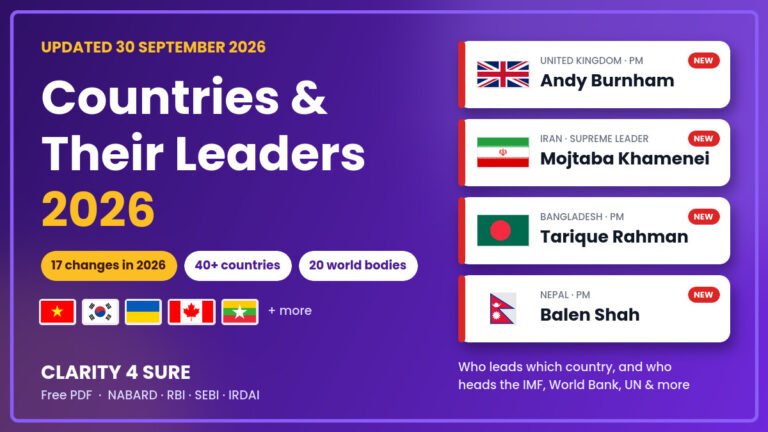 Free sheet · Static GKCountries & Their Leaders 2026Who leads which country in 2026, with all 17 changes marked. Get the article and the PDF free on WhatsApp.Get it free on WhatsApp →
Rajnath Singh Releases DFP-2026 for DRDO
Rajnath Singh released Delegation of Financial Powers to DRDO (DFP-2026). The reform enhances financial and functional autonomy for defence R&D projects. It aims to accelerate indigenous defence technology development.
Haryana–Rajasthan Yamuna Water Agreement Signed
The Centre signed a water-sharing agreement with Haryana and Rajasthan to implement the Yamuna Water Project. The ₹34,102 crore project aims to resolve the long-pending interstate water dispute. It will provide drinking water and irrigation benefits to multiple districts.
India and Saudi Arabia Sign Water Cooperation MoU
India and Saudi Arabia signed an MoU on water resource cooperation during Saudi Water Week. The agreement focuses on sustainable water management, irrigation, and technical knowledge exchange. It strengthens bilateral strategic cooperation.
Punjab & Sind Bank Launches New Digital Initiatives
Punjab & Sind Bank launched digital banking initiatives on its 119th Foundation Day. New offerings include the Navjyoti HR app and PSB Bharat Connect Account. These initiatives promote customer convenience and digital transformation.
SEBI Forms Expert Group on Debenture Trustees
Securities and Exchange Board of India formed an expert group led by Ananta Barua to review debenture trustee regulations. The panel will recommend reforms to strengthen investor protection. Public feedback is invited until 15 July 2026.
SBI Life and IIT Bombay Partner for AI Cyber Defence
SBI Life Insurance partnered with Indian Institute of Technology Bombay to establish the Bharat AI & Cyber Innovation Hub. The centre will develop indigenous AI-driven cybersecurity solutions. It aims to strengthen digital resilience in insurance.
Ravi Agrawal Reappointed CBDT Chairman
Ravi Agrawal was reappointed Chairman of the Central Board of Direct Taxes for six months. His term now extends until 31 December 2026. He continues to lead India’s direct tax administration.
DGCA Conducts India’s First Satellite Landing Trial
The Directorate General of Civil Aviation completed India’s first SLS approach trial on an Airbus A320 using GAGAN at Udaipur Airport. The test demonstrated satellite-guided precision landing capability. It marks a major aviation technology milestone.
Theatre Legend Vijaya Mehta Passes Away
Vijaya Mehta passed away at 92 in Mumbai. She was a pioneering figure in Marathi theatre and cinema. Her contributions earned her the Padma Shri in 1987.
International Day of Parliamentarism Observed on June 30
The United Nations observes International Day of Parliamentarism annually on 30 June. The 2026 theme is “The Future of Human Rights is Written in Parliaments.” The day highlights the role of legislatures in democracy and governance.
National Doctors’ Day Observed on July 1
India celebrates National Doctors’ Day on 1 July to honor doctors and healthcare workers. The day commemorates the birth and death anniversary of Bidhan Chandra Roy. The 2026 theme is “Behind the Mask: Who Heals the Healers?”
National Chartered Accountants Day Observed on July 1
National Chartered Accountants Day marks the foundation of the Institute of Chartered Accountants of India in 1949. The 2026 celebration marks ICAI’s 78th foundation year. The day recognizes the role of chartered accountants in financial governance.
Related on Clarity 4 Sure
 Daily quizDaily Current Affairs Quiz: 02 & 03 July 2026
 Daily current affairsDaily Current Affairs (DCA) 01 July, 2026
 AgricultureICAR Network Programme on Precision Agriculture (NePPA): Domains, Technologies Developed and Facts
 Agri BusinessNational Mission on Edible Oils: NMEO-Oilseeds and NMEO-Oil Palm Explained