
Daily Current Affairs (DCA) 14 April, 2026
Free live session
NABARD Grade A 2026: 45-Day Final Revision Plan + Daily Targets
 🔒 Register to watchLast Sunday’s session · recording
Tomorrow · 7:30 PM IST
National Affairs2
Habitat Shift of the Ganges River Dolphin (2026)
- Context: A drastic reduction in water flow in the Chambal River is forcing endangered Ganges River Dolphins to migrate downstream toward the Yamuna confluence.
- Critical Threshold: Dolphins require a minimum of 3 meters of water depth to survive, a level the Chambal is currently failing to maintain due to upstream irrigation and industrial extraction.
BACKGROUND CONCEPT
The “Susu”: India’s National Aquatic Animal
- Indicator Species: The Ganges River Dolphin is a biological indicator of the health of the entire river ecosystem. If the dolphin thrives, the river is healthy.
- Echolocation: Being essentially blind, these dolphins use ultrasonic sounds to navigate and hunt. They emit clicks that bounce off objects, creating a “mental map” of their surroundings.
- Habitat: They are strictly freshwater mammals. Unlike oceanic dolphins, they cannot survive in saline water.
- Vulnerability: They are found in the Ganges-Brahmaputra-Meghna and Karnaphuli-Sangu systems across India, Nepal, and Bangladesh.
CONCEPT BUILDER
Why the Habitat Shift is Alarming:
- Connectivity & Gene Pool: Dams and barrages act as physical barriers, fragmenting dolphin populations. This leads to inbreeding and a narrowed gene pool, making the species more susceptible to disease and climate shifts.
- Synergistic Biodiversity Loss: Low water levels create “land bridges” to river islands. This allows terrestrial predators (dogs, jackals) to reach previously safe nesting grounds of rare birds like the Indian Skimmer and Black-bellied Tern, destroying their eggs.
- Anthropogenic Pressure: The migration toward the Yamuna confluence puts dolphins in areas with higher pollution levels and heavier boat traffic, increasing the risk of accidental strikes and entanglement in fishing nets.
MCQs
Q.1) Why is the Ganges River Dolphin commonly referred to as the “Susu”?
[1] It is a local term meaning “Guardian of the Water.”
[2] It refers to the unique sound the dolphin makes when breathing.
[3] It is the name of the first village where it was discovered in 1801.
[4] It refers to the chocolate brown color of the dolphin calves.
Q.2) Which of the following river systems is NOT a natural habitat for the Ganges River Dolphin?
[1] Brahmaputra-Meghna
[2] Karnaphuli-Sangu
[3] Indus-Jhelum
[4] Ganges-Son
Q.3) Consider the following statements regarding the Ganges River Dolphin:
- It is India’s National Aquatic Animal and is listed as ‘Critically Endangered’ by the IUCN.
- It is a strictly freshwater species and cannot survive in the ocean.
- Females are generally larger in size than males.
Which of the statements given above is/are correct?
[1] 1 and 2 only
[2] 2 and 3 only
[3] 1 and 3 only
[4] 1, 2, and 3
Q.4) The recent migration of dolphins from the Chambal to the Yamuna confluence is primarily attributed to:
[1] An increase in the population of prey fish in the Yamuna.
[2] Drastic reduction in Chambal’s water flow below the 3-meter survival threshold.
[3] A sudden rise in the water temperature of the Chambal River.
[4] The implementation of a new dolphin safari project in the Yamuna.
Q.5) How does low water level in rivers like the Chambal indirectly affect birds like the Indian Skimmer?
[1] The birds lose their primary source of drinking water.
[2] Land bridges allow land predators to reach and destroy island nesting sites.
[3] The dolphins compete with the birds for the same nesting space.
[4] The lack of water prevents the birds from cooling their feathers.
[ANSWERS]
Q.1: [2] | Q.2: [3] (The Indus has a separate species, the Indus River Dolphin) | Q.3: [2] (Status is Endangered, not Critically Endangered) | Q.4: [2] | Q.5: [2]
Arunachal Pradesh
Context:
In April 2026, China attempted to “standardize” names of locations in Arunachal Pradesh. India officially rejected this, calling it a mischievous attempt to manufacture baseless narratives. China claims Arunachal Pradesh as “Zangnan” (South Tibet), while India maintains it is an integral, inalienable part of the Indian Union.
BACKGROUND CONCEPT
The Border Dispute & The McMahon Line
- The McMahon Line: Proposed at the 1914 Simla Convention between British India and Tibet. It serves as the effective border between India and China in the eastern sector.
- China’s Stance: Beijing rejects the McMahon Line, labeling it an “illegal colonial imposition.” They argue that since Tibet was not a sovereign state in 1914, it had no authority to sign a boundary treaty.
- Geopolitics of Renaming: China uses “standardized names” to create a digital and cartographic trail to support its claims in international forums—a tactic often termed “Salami Slicing” or “Lawfare.”
CONCEPT BUILDER
Evolution of Arunachal Pradesh:
- Ancient Context: Known as the Prabhu Mountains in the Mahabharata. Archaeological sites like Ita Fort and Bhismaknagar prove long-standing cultural and administrative ties with the Indian heartland.
- NEFA Era: Prior to 1972, it was the North-East Frontier Agency, managed directly by the Ministry of External Affairs.
- Statehood: 1972: Renamed Arunachal Pradesh and made a Union Territory.
- 1987: Became the 24th State of India.
Geographic and Strategic Importance:
- The “Water Tower”: Home to the Lohit River (Brahmaputra tributary) and massive hydroelectric potential (e.g., Kalai-II project).
- Biodiversity: Features Namdapha National Park, spanning from subtropical forests to alpine meadows.
- Security: Shares international borders with Bhutan, Myanmar, and China.
MCQs
Q.1) What was Arunachal Pradesh administratively known as prior to becoming a Union Territory in 1972?
[1] South Tibet Region
[2] Eastern Himalaya Province
[3] North-East Frontier Agency (NEFA)
[4] Brahmaputra Frontier Tract
Q.2) China rejects the McMahon Line primarily because:
[1] It was drawn using inaccurate satellite data.
[2] It considers the 1914 Simla Convention an illegal colonial imposition.
[3] The line passes through the middle of the Itanagar capital.
[4] It excludes the Lohit River basin from Tibet.
Q.3) Which of the following sites in Arunachal Pradesh is associated with 14th-century archaeological remains?
[1] Tawang Monastery
[2] Ita Fort
[3] Namdapha National Park
[4] Kalai-II Project site
Q.4) Consider the following statements regarding the geography of Arunachal Pradesh:
- It shares international borders with Bhutan, Myanmar, and China.
- The Lohit River is a major tributary of the Brahmaputra.
- Traditional “Jhum” (slash and burn) cultivation is no longer practiced in the state.
Which of the statements given above is/are correct?
[1] 1 and 2 only
[2] 2 and 3 only
[3] 1 and 3 only
[4] 1, 2, and 3
Q.5) In the context of the naming dispute, why does India reject China’s “standardization” of names in Arunachal Pradesh?
[1] Because the names are written in a difficult script.
[2] Because renaming is viewed as a mischievous attempt to manufacture baseless territorial claims.
[3] Because India wants to rename Chinese cities in retaliation.
[4] Because it violates the 1987 Statehood Act.
[ANSWERS]
Q.1: [3] | Q.2: [2] | Q.3: [2] | Q.4: [1] (Jhum is still a significant practice) | Q.5: [2]
Banking/Finance2
How & Why Farmers Producers Organization are formed? FPO #fpo #upsc #nabardgradea #agriculturenotesTap to play · from the C4S channel
Context:
On April 11, 2026, the Unified Payments Interface (UPI) celebrated its 10th anniversary. Since its pilot launch in 2016, it has matured from a bold experiment into the primary nervous system of India’s economy, setting an all-time high of 22.64 billion transactions in March 2026.
What Makes UPI Unique?
UPI is an instant, real-time payment system developed by the National Payments Corporation of India (NPCI). It operates under the regulatory framework of the Reserve Bank of India (RBI).
- VPA (Virtual Payment Address): The “secret sauce” of UPI. Users can send or receive money using a simple ID (e.g.,
name@bank) without ever revealing their account number or IFSC code. - Interoperability: Unlike closed “wallets” where both parties need the same app, UPI allows a PhonePe user to pay a Google Pay merchant instantly.
- The India Stack: UPI is the “Payments Layer” of the India Stack, sitting atop the JAM Trinity (Jan Dhan, Aadhaar, and Mobile).
Background Concept: Digital Public Infrastructure (DPI)
To truly understand UPI’s success, one must understand Digital Public Infrastructure (DPI). DPI refers to blocks or platforms such as digital identification, payment infrastructure, and data exchange solutions that help countries deliver vital services to their people.
- Open Standards: Just as the internet is built on open protocols like HTTP, UPI is built on open APIs. This encourages competition among apps (GPay, Paytm, PhonePe) while maintaining a shared “highway.”
- Financial Democracy: By making transactions “free” for consumers and small merchants (the Zero MDR policy), India bypassed the expensive credit card networks that dominate Western economies.
- Real-Time Settlement: While many international bank transfers take days, UPI settles funds between banks in seconds, 24/7/365.
Exam Angle: Common Trap Areas
- NPCI vs. RBI: NPCI is the developer/umbrella organization; RBI is the regulator. Do not swap them in descriptive answers.
- Wallet vs. Interface: UPI is not a wallet. It is an interface that moves money directly between bank accounts.
- European Entry: While many countries are in talks, France was the official “first entry” for UPI into Europe.
- UPI Lite: This is specifically for small-value on-device transactions to reduce the success-rate burden on bank servers.
MCQ
Q1) Which international body recognized UPI as the world’s largest real-time payment system by volume?
[1] World Bank [2] WTO [3] IMF [4] ADB
Q2) The “JAM Trinity” is the foundation of UPI. What does “M” stand for?
[1] Money [2] Mobile [3] MUDRA [4] Management
Q3) India’s UPI daily transaction volume recently surpassed which global giant?
[1] Mastercard [2] Visa [3] PayPal [4] SWIFT
Answers: Q1: [3], Q2: [2], Q3: [2]
Context:
On April 13, 2026, the Reserve Bank of India (RBI) returned the universal banking license applications of Ujjivan Small Finance Bank and Jana Small Finance Bank. This move serves as a critical reminder that while the path to becoming a full-service bank is open, the regulatory bar for portfolio resilience remains exceptionally high.
The “Return” Order
The RBI’s decision centers on the qualitative evolution of the banks’ balance sheets rather than just quantitative milestones.
- The Action: Applications returned for Ujjivan and Jana SFBs.
- The Primary Reason: High concentration in microfinance; a lack of sufficient loan book diversification.
- The Status of Peers: AU Small Finance Bank successfully secured approval in 2025, setting the gold standard for this transition.
BACKGROUND CONCEPT
SFB vs. Universal Bank: The Transition Path
- Small Finance Banks (SFBs): Created to further financial inclusion by providing basic banking activities to unserved sections (small farmers, micro-industries).
- The 60% Rule: SFBs must lend at least 60% of their Adjusted Net Bank Credit (ANBC) to the Priority Sector (PSL).
- Universal Banks: These are “full-service” banks (like SBI or HDFC) that have no restricted area of operations. They have higher capital requirements but more flexibility in corporate lending and international operations.
- Eligibility for Conversion: Per RBI guidelines (April 2024), an SFB can apply for a Universal Bank license if it has:
- A minimum net worth of ₹1,000 crore.
- Scheduled status with a satisfactory track record for 5 years.
- Listed status on a stock exchange.
- Net profit in the last two financial years and a Gross NPA ≤ 3% and Net NPA ≤ 1% for the last two years.
MCQs
Q.1) As per the recent RBI communication in April 2026, why was Ujjivan SFB’s application for a universal bank license returned?
[1] Failure to maintain the minimum CRAR (Capital Adequacy Ratio).
[2] High percentage of Gross Non-Performing Assets (GNPA).
[3] Insufficient diversification of the loan portfolio.
[4] Lack of a listed entity on the stock exchange.
Q.2) What is the minimum net worth required for a Small Finance Bank to apply for conversion into a Universal Bank?
[1] ₹200 crore
[2] ₹500 crore
[3] ₹1,000 crore
[4] ₹2,000 crore
Q.3) Which of the following Small Finance Banks has successfully received RBI approval to transition into a Universal Bank as of 2025-26?
[1] Jana Small Finance Bank
[2] AU Small Finance Bank
[3] Equitas Small Finance Bank
[4] Capital Small Finance Bank
Q.4) Upon converting to a Universal Bank, the Priority Sector Lending (PSL) target for the entity would typically change from 75% to:
[1] 50%
[2] 40%
[3] 60%
[4] 25%
Q.5) The “Diversification” mentioned by the RBI for Ujjivan and Jana SFBs primarily refers to reducing the dominance of which sector in their loan books?
[1] Infrastructure lending
[2] Unsecured Microfinance loans
[3] Foreign exchange trading
[4] Government securities
[ANSWERS]
Q.1: [3] | Q.2: [3] | Q.3: [2] | Q.4: [2] | Q.5: [2]
Every day of the month in one file. Enter your details once — the download opens right away.
We already have your details, so no form: tap to open.
Download the April 2026 PDFDownload the April 2026 revision sheet PDFAgriculture1
Context:
The recent volatility in West Asia has served as a wake-up call for India’s agricultural sector. With a 70% import dependency for fertilizers and their feedstocks, India’s food security is currently tethered to global geopolitical stability.
The Critical Numbers: A Fiscal and Environmental Snapshot
The current subsidy regime has created a “perfect storm” of economic and ecological challenges.
| Parameter | Data Detail | Strategic Impact |
| Import Dependency | 70% (Includes finished products and raw materials) | High vulnerability to maritime chokepoints like the Strait of Hormuz. |
| Urea Economics | Domestic Price: <$70/t vs. Global Price: $795/t | Massive arbitrage (over 10x) drives smuggling and industrial diversion. |
| Efficiency Gap | Granular Urea: 35-40% NUE | 60% of applied urea is wasted, polluting air and groundwater. |
| Climate Impact | 273x potency | Nitrous oxide from excess nitrogen is far more damaging than $CO_2$. |
The Current Framework: A Hybrid System
India currently manages fertilizers through a dual-track approach that yields mixed results.
- Urea (Strict Control): The government fixes the Maximum Retail Price (MRP). Manufacturers are reimbursed for the gap between production cost and this low MRP.
- P&K (Semi-Deregulated): Under the Nutrient Based Subsidy (NBS), a fixed subsidy is provided per nutrient, allowing for some price flexibility.
- The DBT Paradox: Subsidy is released to companies via Aadhaar-authenticated PoS machines. While this tracks sales, it does not stop the “over-purchase” of cheap urea.
Core Challenges: The Triple Burden
The existing policy creates three primary categories of distress:
- Fiscal Instability: The Union Budget is at the mercy of global LNG (Liquefied Natural Gas) prices, which fuel domestic urea plants.
- Ecological Decay: The skewed N-P-K ratio (Nitrogen-Phosphorus-Potassium) leads to soil acidification and “dead” soil microbiomes.
- Governance Leakage: The price gap encourages urea diversion to the plywood and dye industries, essentially “subsidizing” private industrial profit with taxpayer money meant for farmers.
The Path Forward: From Subsidy to Empowerment
To secure “Fertilizer Sovereignty,” experts suggest a shift toward Direct Benefit Transfer (DBT) and technological innovation.
- Quantitative Rationing: Reducing urea supply to states by 10-15% and using land records to allocate specific quotas per farmer.
- Direct Cash Transfer: Merging PM-KISAN with fertilizer subsidies to provide a per-acre payment. This allows the market price of fertilizers to find its true level, discouraging waste.
- Alternative Nutrients: Promoting Triple Super Phosphate (TSP) over DAP can eliminate unnecessary nitrogen content.
- The Liquid Revolution: Shifting the subsidy focus to Liquid Urea, which boasts a 90% Nutrient Use Efficiency (NUE) when applied via drip irrigation (fertigation).
MCQs
Q.1) What is the primary reason for the low Nutrient Use Efficiency (NUE) of traditional granular urea in India?
[1] High cost of application
[2] Loss due to leaching and atmospheric volatilization
[3] Lack of moisture in Indian soils
[4] High moisture content in the urea bags
Q.2) Which “Trinity” of data is essential for implementing the proposed ‘Direct Cash Transfer’ in fertilizer policy?
[1] PAN, GST, and Land Records
[2] Aadhaar, Bank Accounts (PM-KISAN), and Land Records
[3] Soil Health Cards, Weather Data, and PDS IDs
[4] KCC numbers, Satellite imagery, and Rainfall data
Q.3) Why is Triple Super Phosphate (TSP) considered a better alternative to DAP (Di-ammonium Phosphate) in the current reform context?
[1] It is cheaper to import from West Asia.
[2] It saves on the 18% Nitrogen content found in DAP, reducing the urea subsidy burden. [3] It can be applied without using water.
[4] It does not require a Point of Sale (PoS) verification.
Answers: Q.1: [2] | Q.2: [2] | Q.3: [2]
Related on Clarity 4 Sure



 Scheme to knowKavach: Indian Railways’ Automatic Train Protection System – Versions, Deployment and FactsKavach (Hindi for "shield" or "armour") is the indigenous Automatic Train Protection (ATP) system of Indian Railways.…
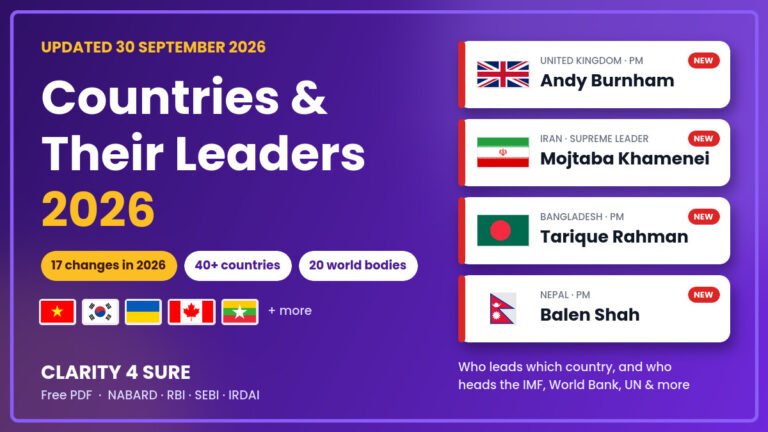 Free sheet · Static GKCountries & Their Leaders 2026Who leads which country in 2026, with all 17 changes marked. Get the article and the PDF free on WhatsApp.Get it free on WhatsApp →