Daily Current Affairs (DCA) 15 April, 2026
Free live session
NABARD Grade A 2026: 45-Day Final Revision Plan + Daily Targets
 🔒 Register to watchLast Sunday’s session · recording
8 of the top 10 in NABARD Grade A 2025, Rank 1 included, and Rank 1 back to back before that in 2021 and 2022: all prepared with C4S. Watch last Sunday's session on the 45-day final revision plan now, then join the next one live on Zoom.
Tomorrow · 7:30 PM IST · 75 minutes · free
International1
Military Escalation In The Middle East: Human Development Impacts Across Asia And The Pacific: UNDP Report
Context:
According to the United Nations Development Programme (UNDP) report released on April 14, 2026, the ongoing military escalation in West Asia poses a significant threat to India’s socioeconomic stability. The report highlights how India’s deep integration with the Gulf region—through energy, trade, and labor—makes it highly susceptible to external shocks.
Socioeconomic Impact on India
The conflict is projected to cause a measurable decline in India’s developmental progress:
- Poverty Escalation: The number of people pushed into poverty is expected to rise from roughly 400,000 to 2.5 million.
- Poverty Rate: Under the most severe 28-day conflict scenario, India’s poverty rate is estimated to climb to 24.2% (from a pre-crisis level of 23.9%).
- HDI Stagnation: India is projected to lose between 0.03 and 0.12 years of Human Development Index (HDI) progress due to the crisis.
Key Economic Vulnerabilities
The report identifies three primary channels through which the conflict affects the Indian economy:
1. Energy and Agriculture
- Import Dependency: India meets 90% of its oil needs through imports, with over 40% of crude and 90% of LPG coming from West Asia.
- Fertilizer Crisis: More than 45% of India’s fertilizer imports originate in West Asia. Furthermore, 85% of domestic urea production relies on imported regasified LNG.
- Kharif Season Risk: While India currently holds a buffer of 6.114 million tonnes of urea, a prolonged disruption in June would severely impact the Kharif (monsoon) sowing season.
2. Trade and Supply Chain
- Market Exposure: West Asian markets account for 14% of India’s exports and 20.9% of its imports.
- Logistics: Disruptions in the Strait of Hormuz are expected to drive up raw material costs for medical devices by 50%, while wholesale medicine prices have already increased by 10–15%.
- Commodity Impact: Roughly $48 billion in non-oil exports—including basmati rice, tea, apparel, and gems and jewelry—are at risk due to freight surcharges and route diversions.
3. Remittances and Labor
- Largest Global Exposure: India has the largest absolute exposure to Gulf labor markets, with 9.37 million Indians residing in GCC countries as of late 2024.
- Remittance Inflow: These migrants contribute 38–40% of India’s total inward remittances. A slowdown in the Gulf economy directly weakens the purchasing power of millions of households in India.
MSMEs and Informal Employment
A critical concern highlighted by the UNDP is the impact on the informal sector, which accounts for roughly 90% of Indian employment.
- Small firms in hospitality, food processing, construction, and steel manufacturing are particularly vulnerable to rising input costs and supply shortages.
- Limited financial buffers and constrained access to credit mean that MSMEs may face reduced working hours or business interruptions, leading to widespread job losses for informal and migrant workers.
Multiple Choice Questions (MCQs)
1. According to the UNDP report, what is the estimated rise in the number of people living in poverty in India post-crisis?
- A) 1.5 million
- B) 2.5 million
- C) 5.0 million
- D) 8.8 million
2. India relies on West Asian countries for what percentage of its total LPG imports?
- A) 40%
- B) 45%
- C) 85%
- D) 90%
3. Which critical farming input in India is 85% dependent on imported regasified LNG for domestic production?
- A) Potash
- B) Phosphate
- C) Urea
- D) Pesticides
4. What percentage of India’s total inward remittances is contributed by the 9.37 million Indians residing in GCC countries?
- A) 14–20%
- B) 38–40%
- C) 50–55%
- D) 20.9%
5. Why are MSMEs in India considered particularly vulnerable to the West Asia conflict according to the report?
- A) They are primary exporters of crude oil
- B) They operate with limited financial buffers and rely on imported energy inputs
- C) They are excluded from the GST framework
- D) They primarily employ highly skilled, formal labor with high credit access
Answers
- B) 2.5 million (Rising from a base of approximately 400,000.)
- D) 90% (While crude oil imports from the region are at 40%, LPG is much higher at 90%.)
- C) Urea (Domestic production is heavily reliant on imported LNG.)
- B) 38–40% (Representing a significant portion of India’s foreign exchange and household income.)
- B) They operate with limited financial buffers and rely on imported energy inputs (Given that 90% of employment is informal, this sector lacks the resilience to absorb sudden price shocks.)
National Affairs5
How & Why Farmers Producers Organization are formed? FPO #fpo #upsc #nabardgradea #agriculturenotesTap to play · from the C4S channel
Amaravati Quantum Reference Facilities (AQRF)
Context:
The launch of the Amaravati Quantum Reference Facilities (AQRF) on April 14, 2026, signifies India’s strategic pivot from being a software-heavy tech player to a sovereign hardware manufacturer. This initiative is the anchor of the broader “Amaravati Quantum Valley” project, aimed at making India self-reliant in the “deep tech” space.
Two Specialized Nodes: 1S and 1Q
The AQRF is split into two distinct facilities to serve both academic and industrial needs:
- Amaravati 1S (SRM University, Neerukonda): Focused on education and research, this facility allows students and scientists to deconstruct quantum systems and learn the hardware fundamentals.
- Amaravati 1Q (Medha Towers, Gannavaram): Focused on commercialization and testing, this node provides industrial-grade testbeds for startups and corporations to certify quantum devices.
The “Sovereign Hardware” Strategy
Most quantum computers globally are “black boxes”—proprietary systems where the internal hardware is hidden. AQRF breaks this by:
- Open Access: Providing researchers direct access to critical components like cryogenic systems, amplifiers, and control electronics.
- Supply Chain Localization: Building a domestic supply chain for specialized equipment, such as dilution refrigerators (which cool processors to $-273^\circ\text{C}$) and superconducting circuits.
- National Consortium: The project is a joint effort involving TIFR (Tata Institute of Fundamental Research), IISc (Indian Institute of Science), and the DRDO.
Why Quantum Hardware Matters
Traditional computers use bits (0 or 1). Quantum computers use qubits, which can exist in multiple states simultaneously due to superposition and entanglement. This allows them to solve complex problems—like drug discovery, climate modeling, and breaking high-level encryption—millions of times faster than today’s supercomputers.
MCQs
Q.1) Which of the following best describes the ‘Amaravati 1Q’ facility?
[1] An educational hub for undergraduate students.
[2] An industrial testbed at Medha Towers for testing and certifying quantum devices.
[3] A manufacturing unit for traditional silicon semiconductors.
[4] A research center for agricultural quantum biology.
Q.2) The AQRF initiative is a key component of which long-term state roadmap?
[1] Vision 2020
[2] Digital India 2.0
[3] Swarna Andhra 2047
[4] PM-Gati Shakti
Q.3) Why is ‘Cryogenics’ a critical part of the quantum supply chain mentioned in the AQRF plan?
[1] It is used to power the quantum processors.
[2] It is necessary to cool quantum processors to near absolute zero ($-273^\circ\text{C}$) to keep qubits stable.
[3] It prevents the computers from catching fire during heavy processing.
[4] It is required for the high-speed cooling of data center servers.
Q.4) Which national defense organization is part of the consortium executing the AQRF?
[1] ISRO
[2] DRDO
[3] HAL
[4] BARC
Answers: Q.1: [2] | Q.2: [3] | Q.3: [2] | Q.4: [2]
Ambedkar Jayanti
Context:
The commemoration of Ambedkar Jayanti (April 14) is a reminder of the intellectual and moral foundation upon which modern India is built. Dr. B.R. Ambedkar was not just the “Chief Architect” of the Constitution; he was a global pioneer in the fields of economics, legal philosophy, and human rights.
The Intellectual Powerhouse
While often remembered for his social activism, Babasaheb was one of the most sophisticated economists and legal minds of the 20th century.
- The RBI Connection: His thesis, The Problem of the Rupee: Its Origin and Its Solution, provided the conceptual framework for the Hilton Young Commission, which eventually led to the establishment of the Reserve Bank of India (RBI) in 1935.
- Labor Reforms: As the Labor Member in the Viceroy’s Executive Council (1942–46), he was responsible for reducing working hours from 12 to 8 hours a day, introducing Equal Pay for Equal Work, and establishing the concept of Provident Fund and Labor Unions.
- The Hindu Code Bill: His resignation in 1951 over the stalled Hindu Code Bill remains a landmark moment in Indian feminism. He viewed the legal empowerment of women—specifically regarding inheritance and marriage—as inseparable from the total reform of Indian society.
Key Milestones & Constitutional Safeguards
Ambedkar’s vision was to transform India from a “political democracy” into a “social democracy.”
- The Poona Pact (1932): A historic agreement with Mahatma Gandhi that abandoned separate electorates for the “Depressed Classes” in exchange for increased reserved seats in provincial legislatures.
- Article 17: A crowning achievement of the Constitution, which formally abolishes untouchability and forbids its practice in any form.
- Article 32: He famously described the “Right to Constitutional Remedies” as the “Heart and Soul of the Constitution,” ensuring that fundamental rights are enforceable by the judiciary.
The Weapons of Change
His writings served as the ideological backbone for the anti-caste movement:
- Mooknayak (1920) & Bahishkrit Bharat (1927): Journals used to amplify the voices of the marginalized.
- Annihilation of Caste (1936): Originally a speech he was never allowed to give, it argued that social reform must precede political and economic reform.
- The Buddha and His Dhamma: This final work redefined Buddhism as a path of social justice, emphasizing Liberty, Equality, and Fraternity.
MCQs
Q.1) Dr. B.R. Ambedkar’s seminal work ‘The Problem of the Rupee’ is credited with influencing the establishment of which Indian institution?
[1] The Finance Commission
[2] The Reserve Bank of India (RBI)
[3] The Planning Commission
[4] The Securities and Exchange Board of India (SEBI)
Q.2) Which significant event took place at Deekshabhoomi, Nagpur, on October 14, 1956?
[1] The signing of the Poona Pact
[2] The launch of the Mahad Satyagraha
[3] The conversion of Dr. Ambedkar and his followers to Buddhism
[4] The final drafting of Article 17
Q.3) Dr. Ambedkar resigned from the Union Cabinet in 1951 primarily due to the failure of which legislative measure?
[1] The First Amendment Bill
[2] The Hindu Code Bill
[3] The Minimum Wages Act
[4] The Representation of the People Act
Q.4) Which article did Dr. Ambedkar describe as the ‘Heart and Soul’ of the Indian Constitution?
[1] Article 14 (Equality before law)
[2] Article 17 (Abolition of untouchability)
[3] Article 21 (Right to life)
[4] Article 32 (Constitutional Remedies)
Answers: Q.1: [2] | Q.2: [3] | Q.3: [2] | Q.4: [4]
Startup India Fund of Funds 2.0 (FoF 2.0)
Context:
The notification of the Startup India Fund of Funds 2.0 (FoF 2.0) on April 13, 2026, represents a strategic evolution in India’s venture capital landscape. By committing ₹10,000 crore, the government is shifting its focus from general startup support to specialized areas like Deep Tech and Indigenous Manufacturing.
How the “Fund of Funds” Model Works
A “Fund of Funds” does not provide money directly to a startup. Instead, it acts as a Cornerstone Investor to provide credibility and capital to professional investment firms.
- Level 1: The Government (DPIIT) allocates money to the SIDBI (Small Industries Development Bank of India), which manages the FoF.
- Level 2: SIDBI invests in SEBI-registered Alternative Investment Funds (AIFs)—essentially private Venture Capital (VC) firms.
- Level 3: These AIFs raise additional private capital (usually 2x to 4x of the government’s contribution) and then invest the combined pool into Individual Startups.
Strategic Shifts in FoF 2.0
While the original 2016 scheme laid the groundwork, the 2.0 version introduces several high-impact changes:
- Finance Commission Alignment: The ₹10,000 crore corpus is synchronized across the 16th and 17th Finance Commission cycles, ensuring long-term fiscal predictability.
- Focus on Deep Tech: There is a specific mandate to fund startups in “globally competitive technologies” (Quantum, AI, Space-tech). This aligns perfectly with the Amaravati Quantum Reference Facility (AQRF) initiative you reviewed.
- Support for “Smaller” AIFs: To democratize the VC ecosystem, FoF 2.0 encourages smaller, niche funds that often focus on tier-2/3 cities or specialized sectors like Agri-tech.
- Co-investment Framework: For the first time, an umbrella framework allows government and institutional investors to co-invest directly alongside VCs in high-potential startups, providing a “double-booster” of capital.
MCQs
Q.1) Which Nodal Department is responsible for the oversight of the Startup India Fund of Funds 2.0 (FoF 2.0)?
[1] Department of Financial Services (DFS)
[2] Department for Promotion of Industry and Internal Trade (DPIIT)
[3] Department of Economic Affairs (DEA)
[4] Department of Science and Technology (DST)
Q.2) Under the FoF 2.0 model, the government invests in which specific type of entities to reach individual startups?
[1] Public Sector Banks
[2] SEBI-registered Alternative Investment Funds (AIFs)
[3] Local Municipal Corporations
[4] Foreign Stock Exchanges
Q.3) The FoF 2.0 corpus is spread across which two Finance Commission cycles?
[1] 14th and 15th
[2] 15th and 16th
[3] 16th and 17th
[4] 17th and 18th
Q.4) What is a new ‘Key Feature’ introduced in FoF 2.0 that distinguishes it from the previous version?
[1] Investment only in state-owned startups.
[2] A Co-investment Framework for institutional investors.
[3] A ban on investing in manufacturing startups.
[4] The requirement to only use cash for transactions.
Answers: Q.1: [2] | Q.2: [2] | Q.3: [3] | Q.4: [2]
e-SafeHER Programme
Context:
Launched on April 13, 2026, the e-SafeHER Programme is a strategic collaboration between the Ministry of Electronics and Information Technology (MeitY), C-DAC, and the Reliance Foundation. It represents a significant step toward securing India’s rural digital frontier by focusing specifically on the safety of women.
Programme Overview
The initiative is anchored under MeitY’s Information Security Education and Awareness (ISEA) framework, which is currently in its third phase (Phase III). It aims to bridge the “security divide” for women who are rapidly entering the digital economy.
- Primary Goal: To empower one million women as “Cyber Sakhis” by 2029.
- Operational Hub: C-DAC Hyderabad leads the technical development and localization of content.
- Outreach Partner: Reliance Foundation leverages its grassroots network and Self-Help Groups (SHGs) for delivery.
The “Cyber Sakhi” Model
The heart of the programme is the peer-led, community-based model.
- Selection: Active women members from local Self-Help Groups (SHGs) are identified.
- Training: They undergo intensive training in cyber hygiene, financial fraud prevention, and safe social media usage.
- Peer Education: These “Cyber Sakhis” (Cyber Friends) then educate other women in their villages, creating a localized, trusted safety net.
MCQs
1. Which organization is the primary technical partner responsible for developing the localized training modules for e-SafeHER?
- A) NITI Aayog
- B) C-DAC (Centre for Development of Advanced Computing)
- C) ISRO
- D) National Informatics Centre (NIC)
2. The e-SafeHER programme is a specialized initiative under which larger MeitY framework?
- A) Digital India Bhashini
- B) Information Security Education and Awareness (ISEA)
- C) Cyber Surakshit Bharat
- D) Pradhan Mantri Gramin Digital Saksharta Abhiyan (PMGDISHA)
3. What is the target number of women to be empowered by the year 2029 under this initiative?
- A) 100,000
- B) 500,000
- C) 1 Million
- D) 5 Million
4. How does the programme reach the “remotest rural regions” without building new infrastructure?
- A) By using mobile satellite vans.
- B) By leveraging existing Women’s Self-Help Groups (SHGs).
- C) By setting up temporary tents in village markets.
- D) By mailing physical handbooks to every household.
5. Which two states were selected for the initial phased implementation of e-SafeHER?
- A) Gujarat and Maharashtra
- B) Uttar Pradesh and Bihar
- C) Madhya Pradesh and Odisha
- D) Kerala and Tamil Nadu
Answers
- B) C-DAC
- B) ISEA
- C) 1 Million
- B) Leveraging SHGs
- C) Madhya Pradesh and Odisha
Exercise DUSTLIK
Context:
The 7th edition of Exercise DUSTLIK (2026) marks another milestone in the growing strategic partnership between India and Uzbekistan. This year’s exercise is particularly significant as it continues to evolve from a basic infantry training program into a complex, multi-domain military engagement.
Core Overview
Exercise DUSTLIK is an annual bilateral exercise that alternates hosting duties between the two nations. It provides a unique opportunity for the Indian Army to operate in the strategic landscapes of Central Asia.
- 2026 Host: Uzbekistan (Gurumsaray Field Training Area, Namangan).
- Participants: Indian Armed Forces and Uzbekistan Armed Forces.
- Previous Edition: Held in Pune, India (2025).
Strategic Objectives
The exercise is designed to address common security challenges in the region, particularly focusing on:
- Semi-Mountainous Warfare: Training in terrains that mirror the geographical realities of both Central Asia and Northern India.
- Counter-Terrorism Operations: Enhancing the ability to neutralize Unlawful Armed Groups through joint special operations.
- Inter-Service Synergy: For the first time in recent editions, there is a heightened focus on integrating Air Force components alongside Army units to ensure comprehensive battlefield coordination.
Multiple Choice Questions (MCQs)
1. Where is the 7th edition (2026) of Joint Military Exercise DUSTLIK being conducted?
- A) Pune, India
- B) Namangan, Uzbekistan
- C) Pithoragarh, India
- D) Termez, Uzbekistan
2. Exercise DUSTLIK primarily focuses on which type of combat environment?
- A) Desert and arid plains
- B) High-altitude glacial warfare
- C) Semi-mountainous terrain
- D) Amphibious and maritime operations
Answers
- B) Namangan, Uzbekistan (Specifically the Gurumsaray Field Training Area.)
- C) Semi-mountainous terrain (This reflects the shared geography of the participating nations.)
Every day of the month in one file. Enter your details once — the download opens right away.
We already have your details, so no form: tap to open.
Download the April 2026 PDFDownload the April 2026 revision sheet PDFBanking/Finance5
Context:
The IMF’s World Economic Outlook (April 14, 2026) presents a rare “divergence” in the global landscape: while the world economy faces a significant slowdown, India has received a marginal upgrade.
This upgrade is primarily driven by a “Trade-Off” between Geopolitical Conflict and Trade Liberalization.
India’s FY27 Upgrade: The “Sovereign Trade” Boost
The IMF raised India’s FY27 growth forecast to 6.5% (a 10-basis point increase from its January estimate).
- The US Tariff Factor: A landmark reduction in additional US tariffs on Indian goods—slashing them from 50% to 10%—is the primary driver. This move significantly lowers the cost of Indian exports to the world’s largest economy, offsetting the global energy crisis.
- Momentum Carryover: The IMF also revised India’s FY26 (2025-26) growth to 7.6%, noting that strong momentum from the previous year is acting as a buffer against the West Asia shocks.
- Domestic Resilience: Unlike many other emerging markets, India’s domestic consumption remains robust, supported by the rural demand shifts analyzed by Chandrasekar K.
Comparison of FY27 India Projections (%)
India remains a “relative bright spot,” but there is a clear range of expert opinions:
| Institution | Forecast (%) | Sentiment |
| S&P Global | 7.1 | Most Optimistic (Base Case) |
| RBI | 6.9 | Bullish on Domestic Demand |
| ADB | 6.9 | Bullish on US Tariff Impact |
| World Bank | 6.6 | Moderate Resilience |
| IMF | 6.5 | Cautiously Optimistic (Upgraded) |
| OECD | 6.1 | Concern over Global Trade |
MCQs
Q.1) What is the primary reason the IMF upgraded India’s FY27 growth forecast despite the West Asia conflict?
[1] Discovery of new domestic oil reserves
[2] Reduction in US tariffs on Indian goods from 50% to 10%
[3] A sudden increase in the birth rate
[4] Complete cessation of all imports
Q.2) According to S&P Global, a sustained rise in crude oil to $130 per barrel could cut India’s growth by how much?
[1] 10 basis points
[2] 40 basis points
[3] 80 basis points
[4] 200 basis points
Q.3) The IMF’s 2026 global growth forecast was pared down to what percentage in the April 2026 WEO?
[1] 3.4%
[2] 3.3%
[3] 3.1%
[4] 2.0%
Q.4) Which category of nations did the IMF identify as likely to feel the “deleterious impact” of the West Asia conflict most severely?
[1] G7 Advanced Economies
[2] Emerging Markets and Developing Economies (EMDEs) [3] Nordic Countries
[4] Landlocked African Nations
Answers: Q.1: [2] | Q.2: [3] | Q.3: [3] | Q.4: [2]
Context:
The upgrade of Shriram Finance (SFL) by Fitch Ratings to BBB- (Investment Grade) from BB+ is a significant milestone for India’s non-banking financial sector. This shift, occurring on April 14, 2026, is directly tied to a massive capital infusion from Japan’s MUFG Bank.
Why the “BBB-” Rating Matters
In the world of credit ratings, moving from BB+ to BBB- represents the leap from “Speculative” (Junk) grade to “Investment Grade.”
| Metric | Pre-Infusion (BB+) | Post-Infusion (BBB-) |
| Category | Speculative / High-Yield | Investment Grade |
| Debt-to-Equity | 4.2x | 2.5x |
| Funding Access | Standard NBFC channels | Lower cost of funds; Global markets |
| Short-Term IDR | B | F3 |
Strategic Impact & Synergy
Fitch views SFL as a key growth vehicle for MUFG in India’s fast-growing SME and retail lending segments.
- Lower Borrowing Costs: Investment-grade status typically allows a company to borrow money at lower interest rates, directly boosting profitability.
- Market Dominance: SFL maintains a dominant franchise in used commercial vehicle financing.
- Local Domestic Ratings: Domestically, agencies like CRISIL, ICRA, and India Ratings have already upgraded SFL to AAA/Stable, the highest possible local credit rating.
Multiple Choice Questions (MCQs)
1. Which global bank’s 20% stake acquisition triggered the Fitch rating upgrade for Shriram Finance?
- A) SoftBank
- B) MUFG Bank
- C) HSBC
- D) DBS Bank
2. To what specific rating did Fitch upgrade Shriram Finance’s Long-Term Issuer Default Rating (IDR)?
- A) AA+
- B) BBB-
- C) AAA
- D) BB+
3. What was the impact of the ₹40,000 crore capital infusion on Shriram Finance’s debt-to-tangible equity ratio?
- A) It increased from 2.5x to 4.2x
- B) It remained stagnant at 3.0x
- C) It declined from 4.2x to 2.5x
- D) It was reduced to 0.5x
4. According to Fitch, what is Shriram Finance’s core established local franchise segment?
- A) High-end Real Estate lending
- B) Used Commercial Vehicle financing
- C) Personal loans for government employees
- D) Infrastructure project financing
5. How will MUFG Bank exercise shareholder oversight in Shriram Finance?
- A) By taking over the CEO position
- B) By nominating two board directors and placing six employees
- C) By merging Shriram Finance into its domestic branches
- D) By restricting all lending to the SME sector
Answers
- B) MUFG Bank (The Japanese lender invested nearly ₹40,000 crore for a 20% stake.)
- B) BBB- (This moves the company into the investment-grade category.)
- C) It declined from 4.2x to 2.5x (The lower leverage significantly strengthens the company’s capital base.)
- B) Used Commercial Vehicle financing (This remains one of SFL’s strongest standalone credit profiles.)
- B) By nominating two board directors and placing six employees (This structure ensures strategic coordination and governance.)
Context:
The Reserve Bank of India (RBI) launched its medium-term strategy, Utkarsh 2029, in April 2026. This roadmap governs the central bank’s priorities for the three-year period ending in March 2029, focusing on digital transformation, global leadership, and financial inclusion.
The 6 Pillars of Utkarsh 2029
The strategy is built upon 49 specific deliverables categorized under these foundational pillars:
- Robust Regulations: Strengthening the stability of the financial system.
- Customer Centricity & Inclusive Finance: Prioritizing user protection and reaching the unbanked.
- Competitive Markets: Fostering efficiency in financial markets.
- Effective Technology: Adopting cutting-edge tech for banking operations.
- Future-Ready Organisation: Internal capacity building and modernization.
- Global Integration: Expanding the footprint of Indian payment systems like UPI internationally.
Strategic High-Impact Projects
Under this framework, the RBI is focusing on several high-tech initiatives:
1. Unified Lending Interface (ULI)
Similar to how UPI transformed payments, ULI is designed to transform credit. It provides a “plug-and-play” digital architecture that allows for the seamless flow of data (land records, satellite data, etc.) from multiple providers to lenders. This reduces the time for credit appraisal, particularly for small farmers and rural borrowers.
2. Project Sa-Mudra
This framework aims to overhaul the currency management system. It focuses on modernizing the logistics of physical currency distribution and management using advanced tracking and automated systems to ensure efficiency and security.
3. CBDC (Digital Rupee) & Global Expansion
A primary goal is to scale the Central Bank Digital Currency (CBDC). By using the Digital Rupee for cross-border transactions, the RBI aims to reduce the cost and time associated with international remittances. Additionally, the strategy pushes for the global acceptance of UPI, linking it with the fast-payment systems of other nations.
4. Indigenous AI & LLM
The RBI plans to build its own Large Language Model (LLM). This AI tool will be used internally to enhance data analysis, regulatory supervision, and operational efficiency, ensuring that the central bank remains technologically sovereign.
Multiple Choice Questions (MCQs)
1. What is the primary focus of the ‘Unified Lending Interface (ULI)’ mentioned in Utkarsh 2029?
- A) International stock trading
- B) Streamlining digital credit access for underserved segments
- C) Managing physical cash logistics
- D) Monitoring social media for financial rumors
2. Which project under Utkarsh 2029 is specifically dedicated to the modernization of currency management?
- A) Project Sa-Mudra
- B) Project Digital Rupee
- C) Project ULI
- D) Project Bhashini
3. How many ‘deliverables’ and ‘pillars’ form the core structure of Utkarsh 2029?
- A) 50 deliverables and 5 pillars
- B) 49 deliverables and 6 pillars
- C) 30 deliverables and 10 pillars
- D) 100 deliverables and 3 pillars
4. The RBI’s plan to develop an indigenous Large Language Model (LLM) is intended for:
- A) Public use as a search engine
- B) Internal operational efficiency and data analysis
- C) Managing the personal bank accounts of citizens
- D) Replacing all physical bank branches
5. What is a key objective of expanding the CBDC (Central Bank Digital Currency) under this strategy?
- A) To eliminate the use of physical currency by 2028
- B) To make cross-border payments more efficient and cost-effective
- C) To provide free internet to all rural areas
- D) To replace the Unified Payments Interface (UPI)
Answers
- B) Streamlining digital credit access for underserved segments (ULI aims to digitize the appraisal process for rural and small-scale credit.)
- A) Project Sa-Mudra (This framework handles the modernization of the physical currency cycle.)
- B) 49 deliverables and 6 pillars (As outlined in the official April 2026 notification.)
- B) Internal operational efficiency and data analysis (The AI tool is designed to assist the RBI’s regulatory and supervisory functions.)
- B) To make cross-border payments more efficient and cost-effective (CBDC is seen as a way to simplify international settlements.)
SEBI Launches Three New IT Platforms
Context:
In March 2026, the Securities and Exchange Board of India (SEBI) introduced three specialized IT platforms designed to modernize the regulatory landscape. These initiatives, launched under the leadership of Chairman Tuhin Kanta Pandey, focus on transparency, speed, and advanced security oversight.
SEBI’s New Regulatory Technology (RegTech) Suite
The three platforms address distinct operational challenges within the Indian capital markets:
1. SUPCOMS 2.1 (Single Universal Platform for Communications)
This platform marks a major shift in how SEBI interacts with regulated entities.
- The Shift: It moves away from fragmented, traditional email-based communication.
- The Benefit: All interactions—queries, submissions, and responses—are centrally tracked and accessible. This ensures a “single version of truth” and significantly improves the ease of doing business by reducing lost communications.
2. e-Adjudication Portal
This portal digitizes the quasi-judicial arm of SEBI, which handles legal disputes and enforcement actions.
- Paperless Proceedings: The entire lifecycle of an adjudication matter—from the issuance of notices to the final order—is managed digitally.
- Efficiency: It eliminates physical paperwork, allowing for faster hearings and more transparent tracking of legal cases for the involved parties.
3. Cyber-Sec Audit Compliance (C-SAC)
Recognizing the growing threat of cyber-attacks on financial infrastructure, SEBI launched this AI-powered oversight tool.
- Automated Analysis: Instead of manual reviews, C-SAC uses Artificial Intelligence to scan cyber audit reports submitted by stock exchanges, depositories, and other entities.
- Actionable Insights: It automatically flags compliance gaps and potential risk areas, allowing SEBI to intervene before a security vulnerability can be exploited.
Multiple Choice Questions (MCQs)
1. Which SEBI platform is specifically designed to replace traditional email-based communication with a centralized digital thread?
- A) C-SAC
- B) SCORES 2.0
- C) SUPCOMS 2.1
- D) e-Adjudication Portal
2. The e-Adjudication Portal launched by SEBI primarily facilitates which type of proceedings?
- A) Initial Public Offering (IPO) approvals
- B) Quasi-judicial and enforcement matters
- C) Annual General Meetings of listed companies
- D) Recruitment of SEBI officers
3. What is the primary technological driver behind the C-SAC (Cyber-Sec Audit Compliance) platform?
- A) Blockchain
- B) Artificial Intelligence (AI)
- C) Quantum Computing
- D) Edge Computing
4. What is a key objective of the newly launched IT platforms according to SEBI?
- A) To increase the physical paperwork for stockbrokers
- B) To boost the ease of doing business and strengthen cybersecurity
- C) To decentralize all regulatory data across different states
- D) To eliminate the need for any audits in the financial sector
5. Which entity’s cyber audit reports will be analyzed by the C-SAC platform?
- A) Only individual retail investors
- B) SEBI-regulated entities like stock exchanges and intermediaries
- C) Foreign central banks
- D) Ministry of External Affairs
Answers
- C) SUPCOMS 2.1 (It serves as a single universal platform for all external communications.)
- B) Quasi-judicial and enforcement matters (The portal makes the adjudication process paperless and transparent.)
- B) Artificial Intelligence (AI) (AI is used for the automated analysis of complex audit reports.)
- B) To boost the ease of doing business and strengthen cybersecurity (These are the dual goals of the March 2026 digital push.)
- B) SEBI-regulated entities like stock exchanges and intermediaries (C-SAC is designed to monitor the security compliance of the infrastructure it regulates.)
Agriculture1
Digital tracking of urea sales
Context:
The Ministry of Chemicals and Fertilizers is developing a centralized digital platform to reform how urea and DAP (Diammonium Phosphate) are sold and tracked in India. This move, as reported by Mint, aims to curb the massive diversion of subsidized fertilizers for industrial use and hoarding, which cost the national exchequer ₹1.24 trillion in subsidies last fiscal year.
What is Urea?
Urea is an organic compound with the chemical formula CO(NH₂)₂. It is a colorless, odorless, and highly water-soluble substance. Urea is one of the most important nitrogen-containing compounds and plays a vital role in both biological systems and agriculture.
Urea was first synthesized artificially by Friedrich Wöhler in 1828, marking a major milestone in organic chemistry.
The Digital Tracking Mechanism
The core of the reform is a new mobile application that will transition the fertilizer supply chain from a traditional retail model to a “Digital-First” approach.
- Biometric Authentication: Sales will require authentication through Aadhaar-based biometrics or mobile OTPs to ensure that the person buying the fertilizer is a verified farmer.
- Advance Ordering: Farmers will be able to check real-time availability at nearby retailers and place advance orders via the app. This is designed to eliminate the “panic buying” and long queues often seen during the Kharif and Rabi sowing peaks.
- Phased Integration: While the initial pilot focuses on sales tracking, the system will eventually integrate land records and crop details to calculate a “fertilizer entitlement” based on the farmer’s actual acreage.
Learning from the States
The Centre’s plan is modeled after successful state-level interventions that have already managed to align supply with actual demand:
- Haryana’s “Meri Fasal Mera Byora”: This system serves as the primary blueprint. It links Aadhaar to land and crop data to prevent farmers from buying more urea than their land technically requires.
- Telangana & Rajasthan: These states have also implemented similar inventory management systems that have successfully reduced “leakage” to non-agricultural sectors (such as plywood or dye manufacturing).
MCQs
Q.1) The new digital fertilizer tracking system is heavily modeled after which state’s “Meri Fasal Mera Byora” system?
[1] Punjab
[2] Haryana
[3] Uttar Pradesh
[4] Gujarat
Q.2) Approximately what percentage of India’s total DAP (Diammonium Phosphate) needs are met through imports?
[1] 15%
[2] 32%
[3] 60%
[4] 90%
Q.3) What is the primary method proposed for verifying a farmer’s identity during a fertilizer sale on the new app?
[1] Voter ID card
[2] Ration Card
[3] Aadhaar-based biometric or OTP authentication
[4] PAN card verification
Q.4) Why is the conflict in West Asia cited as a reason for the “urgency” of these fertilizer reforms?
[1] West Asia is India’s largest export market for wheat.
[2] West Asia provides nearly two-thirds of India’s urea imports.
[3] The conflict has led to a shortage of farm laborers in India.
[4] West Asia is the primary supplier of tractors to India.
Answers: Q.1: [2] | Q.2: [3] | Q.3: [3] | Q.4: [2]
Facts To Remember16
VP C. P. Radhakrishnan Releases Constitution in Sindhi
Vice President C. P. Radhakrishnan released the updated Constitution of India in Sindhi on April 10, 2026. The edition is available in both Devanagari and Persian scripts to promote linguistic inclusivity. It enhances accessibility, democratic participation, and aligns with the vision of Viksit Bharat 2047.
Doordarshan–ICCR Sign MoU for Cultural Promotion
Doordarshan and Indian Council for Cultural Relations signed an MoU to promote Indian culture globally. ICCR will provide cultural content while Doordarshan ensures multi-platform dissemination. The agreement enables long-term content sharing and will remain valid for three years.
Gujarat Signs MoU for Indo-Taiwan Industrial Park
The Gujarat government signed an MoU with Allegiance International to develop an industrial park in Sanand-Dholera. The project focuses on boosting semiconductor and electronics manufacturing. It is expected to attract over ₹1,000 crore in FDI over five years.
HUDCO & NBCC Sign MoUs for Delhi Projects
Housing and Urban Development Corporation and NBCC (India) Limited signed two MoUs for redevelopment and asset monetisation. Projects include redevelopment at Bhikaji Cama Place and funding support initiatives. The collaboration leverages financing and execution strengths of both entities.
 Scheme to knowMission Amrit Sarovar: Objectives, Progress, Implementation and Exam FactsMission Amrit Sarovar is a rural water conservation mission launched on 24 April 2022, during Azadi Ka Amrit Mahotsav,…
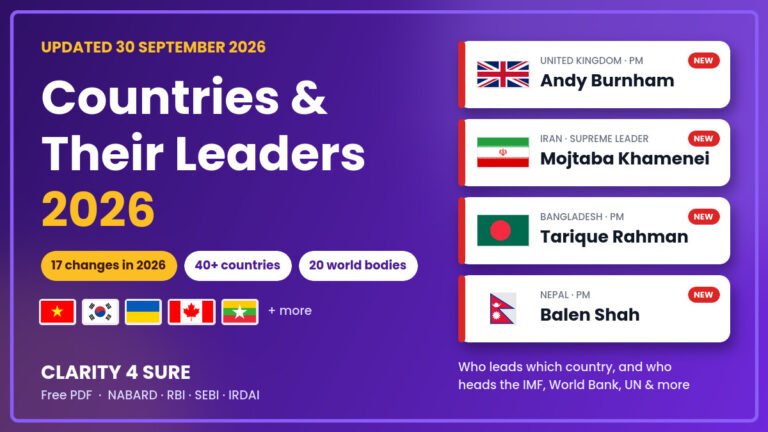 Free sheet · Static GKCountries & Their Leaders 2026Who leads which country in 2026, with all 17 changes marked. Get the article and the PDF free on WhatsApp.Get it free on WhatsApp →
India–Uzbekistan Exercise DUSTLIK 2026 Begins
India and Uzbekistan launched the 7th edition of Exercise DUSTLIK 2026 in Namangan. The exercise focuses on joint operations in semi-mountain terrain and tactical drills. It enhances interoperability and defence cooperation between both nations.
India–Myanmar Sign MoU for School Project
India and Myanmar signed an MoU to construct a school in Nay Pyi Taw. The project focuses on early childhood development under India’s Neighbourhood First policy. It strengthens bilateral ties and supports local community infrastructure.
Paytm Introduces Biometric UPI & Cardless ATM
Paytm enabled biometric authentication for UPI payments and ATM withdrawals. The system enhances security under RBI’s new 2-factor authentication rules. Transaction limits are ₹5,000 for UPI and ₹10,000 for cardless ATM withdrawals.
CARI Bengaluru Gets ISO 15189:2022 Accreditation
The Central Ayurveda Research Institute, Bengaluru, became the first CCRAS institute to receive ISO 15189:2022 accreditation. The certification ensures global standards in medical laboratory quality and competence. It marks a transition to a centre of excellence in diagnostics.
Ismaïl Omar Guelleh Re-elected President of Djibouti
Ismaïl Omar Guelleh was re-elected for a sixth term in Djibouti. He secured 97.81% votes amid opposition boycott. The result reflects continued political dominance in the country.
NASA Artemis II Crew Returns to Earth
NASA successfully completed the Artemis II mission. The crew travelled around the moon and returned after a 10-day journey. The mission set records for distance and conducted a historic ISS communication.
Asian Wrestling Championships 2026
The 2026 Asian Wrestling Championships were held in Bishkek, Kyrgyzstan. India ranked 5th with 17 medals, while Iran topped the standings. The event featured 324 wrestlers across multiple disciplines.
Asian Boxing Championships 2026
The Asian Boxing Championships 2026 took place in Ulaanbaatar, Mongolia. India secured 2nd position with 16 medals, while Kazakhstan topped the table. The event also served as a qualifier for major global competitions.
Asha Bhosle Passes Away
Legendary singer Asha Bhosle passed away at 92. She recorded over 12,000 songs in multiple languages across an eight-decade career. She was honoured with the Padma Vibhushan and Dadasaheb Phalke Award.
Col. Sonam Wangchuk Passes Away
Mahavir Chakra awardee Sonam Wangchuk passed away at 61. He played a key role in the 1999 Kargil War in Ladakh. His contributions earned him national recognition and honour.
National Safe Motherhood Day – April 11
National Safe Motherhood Day is observed on April 11 in India. It promotes maternal healthcare and safe delivery practices. The day honours Kasturba Gandhi and raises awareness on maternal welfare.
World Parkinson’s Day – April 11
World Parkinson’s Day is observed on April 11 to raise awareness about Parkinson’s disease. It commemorates James Parkinson who first described the disease. The 2026 theme is “Bridge the Care Gap”.