
Daily Current Affairs (DCA) 19 September, 2025
National Affairs3
Context:
In June 2025, India ranked 99th out of 167 countries in the Sustainable Development Goals (SDG) Index, its best-ever performance, improving from 109 in 2024. While progress is evident in basic services and infrastructure, SDG 3 (Good Health and Well-being) remains a major challenge, with India off-track on several health targets.
Key Highlights:
- Maternal Mortality Ratio (MMR): 97 per 100,000 live births (Target: 70).
- Under-5 Mortality Rate: 32 per 1,000 live births (Target: 25).
- Life Expectancy: 70 years (Target: 73.63 years).
- Out-of-Pocket Expenditure: 13% of total consumption (Target: 7.83%).
- Immunisation Coverage: 93.23% (Target: 100%).
Challenges Identified
- Access barriers: Poor infrastructure, affordability gaps.
- Non-economic factors: Malnutrition, poor hygiene, sanitation.
- Cultural barriers: Stigma around physical & mental health, low awareness.
Recommendations for Accelerated Progress
- Universal Health Insurance: Reduce catastrophic health costs, improve equity.
- Strengthening Primary Health Care: Better coordination between primary, secondary, and tertiary levels; leverage digital health tools (telemedicine, e-records).
- Health Education in Schools:
- Early lessons on nutrition, hygiene, reproductive health, road safety, mental health.
- Global models: Finland’s school reforms (1970s), Japan’s compulsory health education.
- Reorientation of PDS-type interventions for nutrition: Targeting protein-rich diets and maternal health.
Policy Significance
- India’s SDG progress highlights infrastructure gains, but health gaps remain critical bottlenecks.
- Embedding health education in schools can create long-term behavioural change.
- Aligning reforms with Viksit Bharat 2047 vision requires universal healthcare + preventive education.
Context:
The publication, in February 2024, of a household consumption survey by the National Sample Survey (NSS) Office, after a gap of over a decade, has made it possible to estimate the poverty rate in India.
What is Primary Food Consumption?
- The basic minimum food intake required to ensure energy, protein, and micronutrient sufficiency for a healthy life.
- Components:
- Cereals (carbohydrates)
- Pulses (protein)
- Vegetables (vitamins & minerals)
- Fats (energy)
- Milk/curd (calcium & micronutrients)
- Metric Used: Thali Index – a standard South Asian meal (rice/roti, dal, vegetables, curd, salad).
Features of Primary Food Consumption
- Balanced Nutrition: Goes beyond calorie sufficiency; ensures carbs–protein–micronutrient balance.
- Universal Baseline: Sets a minimum desirable consumption level for all citizens.
- Affordability Sensitive: Considers residual spending power after non-food essentials (rent, transport, health).
- Equity-Oriented: Benchmarks disparities in food access.
- Policy-Relevant: Provides a realistic yardstick for PDS design and subsidy targeting.
Current Reality (NSS 2024 Survey)
- Food affordability gap:
- Nearly 50% of rural India cannot afford 2 thalis/day.
- About 20% of urban India also fall short.
- PDS impact: Reduces deprivation but insufficient to fill the protein gap.
- Cereal equality: Rich and poor consume nearly the same cereals → PDS success in cereals.
- Pulses gap: Bottom 5% consume half the pulses of the top 5% → protein deprivation persists.
Public Distribution System (PDS)
- Achievements:
- Equalised cereal consumption across socio-economic groups.
- Gaps:
- Protein deficiency remains unaddressed.
- Pulses missing from PDS in adequate measure.
- Inefficiencies:
- 80% coverage → even non-poor get cereals.
- High FCI stocking, fiscal strain.
- Urban vs Rural:
- Urban subsidies more progressive.
- Rural subsidies disproportionately benefit higher-expenditure households.
- Policy Overhang: Cereal entitlements exceed actual needs → wasteful subsidy burden.
Challenges in Equalising Food Consumption
- Fiscal Stress: Large cereal subsidies crowd out funds for nutrition diversification.
- Nutritional Deficit: Protein-energy malnutrition, anaemia, stunting persist despite cereal sufficiency.
- Logistics: Storage, buffer stocking, and transport of pulses are more complex.
- Targeting Errors: Leakages, wrong inclusion/exclusion reduce efficiency.
- Behavioural Factors: Food habits and awareness may limit uptake of nutrient-rich foods.
Restructuring PDS for Nutrition Security
- Rationalise Cereal Entitlement:
- Reduce rice/wheat quotas to match actual consumption of bottom deciles.
- Diversify Food Basket:
- Add pulses, millets, fortified oils, iodised salt.
- Promote balanced nutrition, not just cereal sufficiency.
- Remove Top-End Subsidies:
- Withdraw subsidies for top 20% consumption fractile.
- Free fiscal space for nutrition support.
- Dynamic Targeting:
- Use Aadhaar + SECC data for updated beneficiary lists.
- Leverage Technology:
- GPS-enabled grain movement, DBT for pulses, e-POS systems for accountability.
Context:
Just around a third of rivers across the globe had water within the normal range in 2024 and almost 60 per cent of them either showed too much or too little water for the sixth year running, according to the ‘The Status of Global Water Resources in 2024 Report’ from the World Meteorological Organisation (WMO) released.
Key Global Findings:
- River Flow:
- Only 1/3rd of global rivers had water within the normal range in 2024.
- Nearly 60% of rivers showed too much or too little water for the sixth consecutive year.
- Temperature & Climate:
- 2024 was the hottest year on record.
- Much of the world faced droughts, while other regions suffered devastating floods.
- Lakes:
- Surface temperatures were anomalously high.
- Nearly all of the 75 main lakes globally saw above-average water levels.
- Glaciers:
- Third straight year of widespread glacier loss.
- Many small-glacier regions nearing peak water point (maximum runoff, after which water availability declines due to shrinkage).
- Water Scarcity:
- 3.6 billion people currently face inadequate access to water for at least one month annually.
- Projected to rise to 5 billion by 2050 (UN estimate).
Regional Trends
- Wetter than normal: Kazakhstan, Southern Russia, Pakistan, Northern India, Southern Iran, North-Eastern China.
- Above/much-above normal river discharge: Ganges, Godavari, Indus basins.
- Middle East & Central Asia: Lake levels much below normal.
- South-East Asia: Typhoon Yagi among deadliest extreme events in 2024.
- Afghanistan, Iran, Pakistan: Severe impacts from intense spring rains.
Key Messages from WMO
- Water under pressure: Growing demand, climate extremes, and ecosystem strain threaten global water security.
- Cascading impacts: Both too much water (floods) and too little water (droughts) are disrupting lives and livelihoods.
- Urgent Action Needed: Stronger global monitoring, improved data sharing, and adaptive water management policies.
Banking/Finance5
How & Why Farmers Producers Organization are formed? FPO #fpo #upsc #nabardgradea #agriculturenotesTap to play · from the C4S channel
Context:
On September 2025, RBI issued a revised Master Direction for PAs. Major fintechs like PhonePe, Paytm, and Cred have stopped offering rent payment via credit cards as a result.
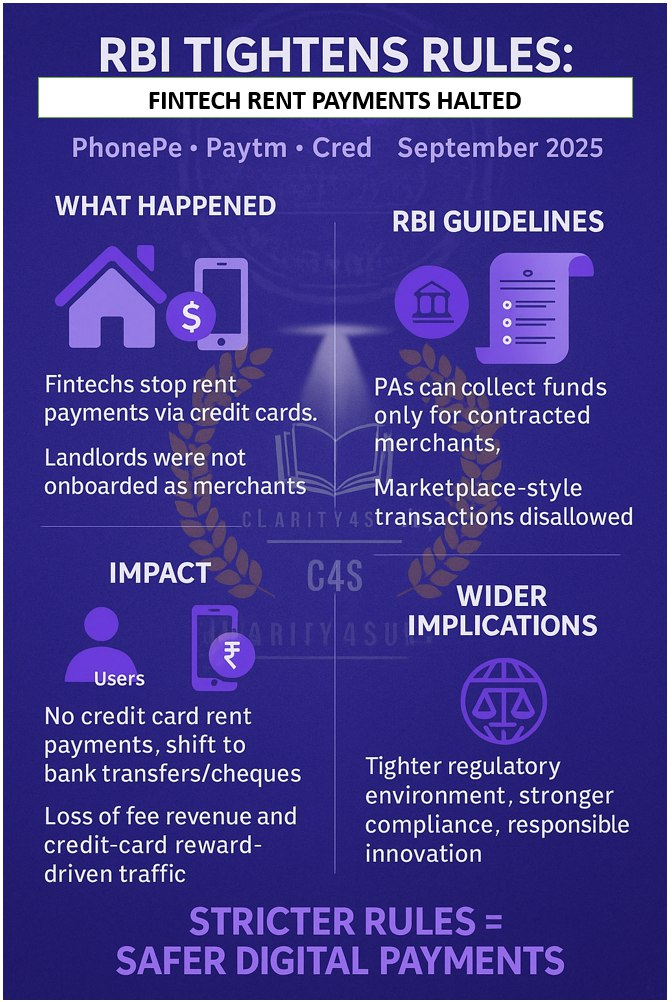
What Changed?
- Merchant-only aggregation
- A PA can aggregate funds only for merchants with whom it has a direct contractual relationship.
- Rent payments to landlords not registered as merchants with full KYC are now disallowed.
- Ban on Marketplace-style PA Business
- PAs cannot act as a marketplace themselves.
- Their role is limited to providing payment facilitation for onboarded merchants.
- Merchant Due Diligence
- PAs, not acquiring banks, are now directly responsible for verifying merchant KYC.
- Funds must be settled only into the onboarded merchant’s bank account.
Why RBI Did This?
- Prevent misuse of credit cards: Rent payments were functioning like disguised peer-to-peer (P2P) transfers.
- Curb fraud and money laundering: Fake “rent” payments were sometimes used for cash flow management or illicit transfers.
- Strengthen accountability: Ensures traceability of funds and merchant legitimacy.
- Regulatory simplification: Moves from multiple licenses and micro-rules → one unified PA licence, principle-based framework.
Impact
On Fintechs
- Loss of a high-volume, fast-growing use case (rent payments via cards).
- Reduced fee income and lower credit card transaction volumes.
- Need to re-onboard landlords as merchants → high cost, less attractive for casual landlords.
On Users
- No more earning credit card reward points / cashback on rent.
- Limited ability to convert rent into EMIs via fintech apps.
- Must switch back to bank transfers, UPI, cheques, or BBPS for rent payments.
Exam Relevance
- Payment Aggregator (PA): Entity that facilitates digital payments between merchants and customers without requiring merchants to set up their own payment infrastructure.
- Marketplace ban: PAs cannot run e-commerce-like setups; they only process payments for contracted merchants.
- KYC mandate: Full merchant verification required, strengthening AML (Anti-Money Laundering) safeguards.
Context:
On September 18, 2025, the Securities and Exchange Board of India (SEBI) concluded its investigation into allegations by U.S.-based shortseller Hindenburg Research against the Adani Group. The case mainly involved Adani Ports & SEZ Ltd. and Adani Power Ltd.
Background:
- Hindenburg Report (Jan 2023):
- U.S.-based short-seller Hindenburg Research accused the Adani Group of stock price manipulation, accounting irregularities, and use of offshore shell companies.
- Impact:
- Adani Group companies lost over $100 billion in market capitalization within weeks.
- Concerns raised about transparency, corporate governance, and investor protection in Indian markets.
Role of SEBI in the Case
- Market Watchdog: Ensured that any alleged manipulation or irregularity in Adani stocks was thoroughly probed.
- Investor Protection: Addressed concerns of lakhs of investors impacted by stock volatility.
- Regulatory Oversight: Investigated FPIs linked to the Adani Group to check for round-tripping of funds.
- Judicial Accountability: Submitted reports directly to the Supreme Court, enhancing transparency.
- Policy Impact: Case led to discussions on tightening rules on disclosure norms, FPI transparency, and corporate governance.
Important SEBI Acts and Regulations (For Exams)
| Act/Regulation | Year | Purpose/Key Provisions | Exam Relevance |
|---|---|---|---|
| SEBI Act | 1992 | Establishes SEBI as market regulator; protects investors, promotes fair trading, regulates intermediaries. | Foundation of SEBI’s powers, must know sections like Section 11 (functions of SEBI). |
| Securities Contracts (Regulation) Act – SCRA | 1956 | Governs listing, recognition of stock exchanges, and trading of securities. SEBI empowered to regulate stock exchanges. | Important for listing rules, delisting, recognition of stock exchanges. |
| Depositories Act | 1996 | Provides framework for dematerialisation and working of depositories like NSDL, CDSL. | Related to demat accounts, electronic shareholding. |
| Companies Act (SEBI-linked provisions) | 2013 | Covers corporate disclosures, corporate governance, issue of securities, shareholder protection. | SEBI coordinates with MCA, exam focus on disclosure & governance norms. |
| Prevention of Fraudulent and Unfair Trade Practices (PFUTP) Regulations | 2003 | Prevents price rigging, insider trading, circular trading, misleading disclosures. | Invoked in Adani–Hindenburg type probes. |
| Listing Obligations and Disclosure Requirements (LODR) Regulations | 2015 | Prescribes disclosure norms for listed companies (quarterly results, shareholding patterns, related-party transactions, corporate governance). | Core for corporate governance & transparency. |
| Foreign Portfolio Investors (FPI) Regulations | 2019 | Regulates investment by foreign institutional investors (FIIs/FPIs). Defines categories of FPIs. | Key for exam after Adani–Hindenburg controversy. |
Context:
On September 18, 2025, the Employees’ Provident Fund Organisation (EPFO) introduced two major digital reforms to improve transparency and member convenience.Union Labour Minister Mansukh Mandaviya announced the launch of “Passbook Lite” on the EPFO members’ portal and direct online access to Annexure K.
Key Highlights:
- Passbook Lite Facility:
- Provides a summarised view of contributions, withdrawals, and current balance.
- Removes the need for dual login (earlier required separate login for “passbook portal”).
- Reduces password sync issues and technical delays.
- The detailed graphical passbook will still be available in the existing portal.
- Annexure K Online Access:
- Annexure K = PF transfer certificate generated when employees change jobs and accounts are shifted via Form 13.
- Previously, it was shared only between PF offices and available to members only on request.
- Now, employees can directly download Annexure K in PDF from the members’ portal.
- Members can also track transfer applications online, ensuring greater transparency.
About EPFO
- Statutory Body: Established under the Employees’ Provident Funds and Miscellaneous Provisions Act, 1952.
- Ministry: Functions under the Ministry of Labour & Employment, Government of India.
- Purpose: Provides social security benefits to employees in the organised sector through:
- Employees’ Provident Fund (EPF) – retirement savings.
- Employees’ Pension Scheme (EPS) – pension benefits.
- Employees’ Deposit Linked Insurance (EDLI) – insurance cover.
Context:
PhonePe received final authorisation from the Reserve Bank of India (RBI) to function as an online payment aggregator (PA). Enables PhonePe to directly onboard merchants, especially small and medium enterprises (SMEs), and expand its digital financial services.
What is a Payment Aggregator (PA)?
- A Payment Aggregator facilitates merchants to accept digital payments from customers by integrating multiple payment methods (cards, UPI, wallets, net banking) into a single gateway.
- RBI Regulation: Introduced in March 2020 under RBI’s Guidelines on Regulation of Payment Aggregators and Payment Gateways.
- Requirement: Non-bank entities must obtain RBI authorisation to operate as a PA.
Significance of RBI Approval for PhonePe
- Expansion to SMEs:
- Focus on small and medium businesses that are underserved by traditional digital payment solutions.
- Supports India’s digital financial inclusion agenda.
- Merchant Benefits:
- Secure, reliable, and compliant payment gateway.
- Smooth checkout experience for customers.
- Instant onboarding and developer-friendly plug-ins for fast integration.
- Strategic Edge:
- Strengthens PhonePe’s position in the fast-growing digital payments ecosystem.
- Competes with other RBI-authorised players like Razorpay, PayU, and Cashfree.
RBI’s Role and Regulatory Relevance
- RBI’s Objective: To ensure customer safety, fraud prevention, and orderly development of digital payments.
- Key Guidelines:
- PA/PG Framework (2020): Mandated authorisation for non-bank PAs.
- Minimum Net Worth Requirement: ₹15 crore at the time of application, rising to ₹25 crore by the end of the third financial year.
- Governance & Compliance: Fit-and-proper criteria, escrow account maintenance, grievance redressal mechanism.
Context:
The Reserve Bank of India conducted two variable rate repo (VRR) auctions on Friday to infuse liquidity in the banking system.
RBI’s Liquidity Management Strategy
- RBI is targeting a system liquidity surplus of ₹1.5–2 lakh crore to ensure:
- Smooth monetary transmission of repo rate cuts into lending and deposit rates.
- Adequate short-term liquidity for banks.
Cash Reserve Ratio (CRR) Reduction
- CRR Cut: To be implemented in four tranches of 25 bps each on
- Sept 6, Oct 4, Nov 1, Nov 29 (2025).
- Impact: Will release about ₹2.5 lakh crore of primary liquidity into the banking system by Dec 2025.
Key Concepts for Exams
- Variable Rate Repo (VRR):
- Short-term liquidity tool under RBI’s Liquidity Adjustment Facility (LAF).
- Repo operations conducted at market-determined rates via auction (unlike fixed-rate repo at the policy repo rate).
- Liquidity Management Tools of RBI:
- Repo & Reverse Repo
- Variable Rate Repo (VRR) & Variable Rate Reverse Repo (VRRR)
- Cash Reserve Ratio (CRR)
- Open Market Operations (OMOs)
- Significance of VRR:
- Provides flexibility in liquidity injection.
- Ensures banks borrow at competitive rates.
- Helps RBI fine-tune short-term liquidity mismatches.
ARD notes, the monthly current affairs PDF and a descriptive English sample — all free, on WhatsApp.
Get it on WhatsApp — one tap or just leave your numberFacts To Remember4
CM launches new curricula for govt. schools replacing initiatives introduced by AAP
Chief Minister Rekha Gupta launched three new curricula – Rashtraneeti, Science of Living, and New Era of Entrepreneurial Ecosystem & Vision (NEEEV) – for the Delhi government schools.
Antim wins bronze, opens India’s tally
Antim Panghal (53kg) redeemed some pride after her ignominious Paris Olympics performance as she claimed a bronze medal at the World wrestling championships in Zagreb and joined Vinesh Phogat in winning two Worlds bronze medals.
Sachin finishes fourth; Neeraj disappoints
Defending champion Neeraj Chopra endured a nightmarish outing at the World Championships’ men’s javelin throw final to end a disappointing eighth even as debutant compatriot Sachin Yadav logged in a personal best to finish a creditable fourth.
Neysa Empanelled as Cloud Service Provider under IndiaAI Mission
The empanelment is expected to accelerate Neysa’s growth, both in India and in international markets. Neysa, an AI Cloud services startup founded by Sharad Sanghi, has been officially empanelled under the IndiaAI Mission as one of its approved Cloud service providers.