Daily Current Affairs (DCA) 23 July, 2026
Free live session
NABARD Grade A 2026: 45-Day Final Revision Plan + Daily Targets
 🔒 Register to watchLast Sunday’s session · recording
Tomorrow · 7:30 PM IST
Banking/Finance3
RBI Bulletin (July 2026)
Context
The RBI Bulletin, July 2026 (released 22 July) states that the Indian economy has navigated external uncertainties and supply chain pressures well, underpinned by healthy demand conditions and resilient industrial and services performance. India remains among the fastest-growing major economies and sustained economic momentum through June.
Key Observations from the Bulletin
- Global Economy: Facing economic uncertainty, supply chain disruptions, fragmented trade, and West Asia tensions.
- Domestic Growth: Industrial and services sectors remained strong; economic activity stayed robust in June.
- Agriculture: Uneven southwest monsoon may affect farming, but adequate foodgrain stocks could limit food inflation.
- Inflation: Retail inflation edged up in June, while core inflation remained subdued.
- Liquidity: Liquidity improved further, supporting strong credit growth.
External Sector
- Trade: Exports and imports grew strongly in Q1 2026–27; expected to improve further with the India–UK CETA and other trade agreements.
- External Stability: Forex reserves remained comfortable and external vulnerability indicators stayed stable.
- Capital Flows: FDI increased, while FPI inflows turned positive in June–July 2026.
- FCNR(B) Deposits: Concessional swap measures led to $17.4 billion in FCNR(B) deposits (8 June–17 July 2026).
- Overall: Rising foreign investment reflects improving investor confidence in the Indian economy.
Key Concepts
- RBI Bulletin: A monthly publication of the RBI carrying speeches, articles and statistics; its flagship “State of the Economy” article reviews current macro conditions (author views, not official RBI stance).
- Headline vs Core Inflation: Headline CPI includes all items; core inflation excludes volatile food and fuel (and here, precious metals) — a better gauge of underlying demand pressure.
- Supply Chain Disruption: Breaks in the flow of inputs/goods across borders, raising costs and delaying production — a cost-push inflation source.
- Liquidity Conditions: The availability of funds in the banking system, managed by the RBI through the LAF, repo/reverse repo, OMOs and CRR.
- Credit Growth: Expansion of bank lending — a lead indicator of investment and consumption demand.
- External Vulnerability Indicators: Metrics like the CAD/GDP ratio, external debt to GDP, short-term debt to reserves, and import cover of reserves.
- FDI vs FPI: FDI is stable, long-term, non-debt-creating; FPI is volatile portfolio investment (“hot money”).
Exam Relevance
- RBI Grade B (ESI + F&M): Extremely high relevance — RBI publications, State of the Economy, inflation types, liquidity management tools, credit growth, external sector indicators, FCNR(B)/swap facility; near-certain question material
The Nifty500 Ahimsa Index
Context
NSE Indices Limited, in collaboration with the Ahimsagain Foundation, launched the Nifty500 Ahimsa Index on 10 July 2026. It tracks 326 companies (as of 30 June 2026) from the Nifty 500 universe that follow Ahimsa — non-violence towards animals.
About the Index
What It Is
- India’s first specialised, rules-based equity index designed to screen and track companies free from animal cruelty.
- Offers ethical investors a structured way to direct capital away from industries that harm animals.
- A thematic/ethical benchmark, adding to India’s growing ESG-linked index space.
Launched By
- NSE Indices Limited (the index services arm of NSE), in partnership with the Ahimsagain Foundation, using its proprietary Ahimsa Investment Movement (AIM) screening framework.
Aim
- Provide retail and institutional investors a transparent benchmark aligning portfolios with compassion and ethical values.
- Serve as an underlying asset base for passive investment products — ETFs, index funds, and structured offerings.
Key Features
1. AIM Banding Framework
- Screens Nifty 500 companies based on products, services, and business practices.
- Classifies firms into Green, Orange, and Red bands.
- Only Green-band companies are included.
2. Sector Inclusions
- Includes IT, automobiles, capital goods, and telecom companies.
- Top holdings include Bharti Airtel, Infosys, M&M, TCS, Maruti Suzuki, and NTPC.
3. Sector Exclusions
- Excludes meat, dairy, poultry, leather, cosmetics, wool/leather fashion, and animal-testing pharma firms.
- Also excludes commercial banks, major NBFCs, and most Reliance Group companies.
4. Construction Methodology
- Free-float market-cap weighted index.
- Base date: 1 April 2016 | Base value: 1,000.
- Rebalanced semi-annually.
Key Concepts
- Stock Market Index: A statistical measure tracking the performance of a selected basket of stocks, used as a benchmark and as an underlying for passive funds.
- Free-Float Market Capitalisation: Market value of only those shares readily available for trading (excluding promoter/government locked-in holdings) — the standard weighting method for Nifty and Sensex.
- Thematic Index: An index built around a specific theme (ESG, manufacturing, ahimsa) rather than broad market representation.
- ESG Investing: Investment screening based on Environmental, Social and Governance criteria.
- Negative/Exclusionary Screening: Excluding companies in objectionable sectors (tobacco, arms, animal cruelty) — the approach used here.
- Passive Investing: Investing that tracks an index rather than picking stocks (ETFs, index funds), typically low-cost.
- ETF (Exchange-Traded Fund): A fund tracking an index whose units trade on an exchange like a stock.
Practice MCQs
Q1. With reference to the Nifty500 Ahimsa Index, consider the following statements:
- It was launched by NSE Indices Limited in collaboration with the Ahimsagain Foundation.
- It uses the Ahimsa Investment Movement (AIM) framework, which classifies companies into Green, Orange and Red bands.
- Only companies classified in the Green band are eligible for inclusion.
- The index includes all major commercial banks and NBFCs from the Nifty 500 universe.
How many of the above statements are correct? (a) Only one (b) Only two (c) Only three (d) All four (e) None
Q2. With reference to stock market indices in India, consider the following statements:
- The Nifty500 Ahimsa Index is weighted by free-float market capitalisation and reconstituted semi-annually.
- Free-float market capitalisation considers only those shares readily available for trading in the market.
- The BSE has launched the Saatvik 100 Index, which similarly screens against animal cruelty and harmful products.
- The Nifty500 Ahimsa Index is itself a mutual fund scheme in which investors can directly invest.
How many of the above statements are correct? (a) Only one (b) Only two (c) Only three (d) All four (e) None
Answer Key
- (c) — Statement 4 wrong: banks and NBFCs are excluded from the index.
- (c) — Statement 4 wrong: it is an index, not a mutual fund scheme.
The EPFO 3.0 Reforms
Context
The Employees’ Provident Fund Organisation (EPFO) is preparing its next reform phase — EPFO 3.0 — moving beyond the claims-focused EPFO 2.0 framework, with a proposed universal contributory pension scheme covering gig, platform, unorganised and construction workers.
About EPFO 3.0
What It Is
- The next generation of social security and retirement fund administration in India.
- Transitions EPFO from a traditional formal-sector provident fund manager into a universal, multi-source social security platform capable of managing pension drawdowns, unorganised-sector contributions and gig-economy integration.
Aim
- Eliminate pension exclusion by bringing unorganised sector workers, construction workers (BOCW) and gig/platform workers into a structured social security framework.
- Offer flexible, inflation-linked retirement solutions for all Indian workers.
- Global models — notably Singapore’s CPF — are being studied.
Key Features
| Feature | Key Points |
|---|---|
| Core Banking Solution (CBS) | RBI-regulated CBS for real-time, centralized management of 60+ crore workers; builds on EPFO 2.0. |
| Target Retirement Sum (TRS) | Personalized retirement goal, required contributions calculated automatically, real-time dashboard, annual interest on government-backed investments. |
| Retirement Options | At 60 years, choose Annuity/Pension or Systematic Withdrawal Plan (SWP) for flexible withdrawals. |
| Gig Worker Coverage | Covers gig and platform workers under the Code on Social Security, 2020; aims to add 2.5 crore workers. |
| One-to-Many UAN | Single UAN linked to multiple employers/platforms, avoiding duplicate accounts. |
| Multi-Source Contributions | Contributions from workers, employers, government, CSR, NGOs, consumer tips; proposed GPF transfer and Family Benefit Fund. |
Facts To Remember24
How & Why Farmers Producers Organization are formed? FPO #fpo #upsc #nabardgradea #agriculturenotesTap to play · from the C4S channel
India Rejects Pakistan's Remarks on Indus Waters Treaty at UNSC
India strongly rejected Pakistan’s remarks at the UN Security Council (UNSC), accusing it of using cross-border terrorism as an instrument of state policy. India reiterated that Jammu & Kashmir is an integral and inalienable part of the country and maintained that the Indus Waters Treaty will remain in abeyance until Pakistan credibly ends cross-border terrorism.
Centre Considers Lifting Airport–Airline Cross-Ownership Restrictions
The Central Government is considering removing restrictions on cross-ownership between airport operators and airlines, allowing airport companies to own airlines and airline groups to acquire airport stakes. The proposal is currently at the consultation stage and requires legal clearance and Union Cabinet approval. If implemented, it could encourage greater investment, improve operational efficiency, and reshape India’s civil aviation sector.
Mission 'Golden Spice' Launched for Meghalaya's Lakadong Turmeric
The Ministry of Development of North Eastern Region (MDoNER) launched the ₹175.45-crore Mission “Golden Spice” to strengthen the value chain of GI-tagged Lakadong Turmeric. The five-year initiative (2025–2030) aims to improve cultivation, processing, branding, and exports, making Lakadong turmeric a globally competitive premium spice. MDoNER will contribute 50% of the project funding.
Maharashtra Tops PLI-Auto Scheme with 66 Manufacturing Units
The Ministry of Heavy Industries (MHI) informed Parliament that Maharashtra leads the PLI Scheme for Automobile and Auto Components with 66 manufacturing units, followed by Tamil Nadu (38), Haryana (35), and Karnataka (35). A total of 225 manufacturing units have been established under the ₹25,938-crore PLI-Auto Scheme approved in 2021.
ISRO's VSSC and CSIR-IICT Sign MoU for Eco-Friendly Blowing Agent Technology
ISRO’s Vikram Sarabhai Space Centre (VSSC) and CSIR-Indian Institute of Chemical Technology (IICT) signed an MoU to jointly develop indigenous eco-friendly blowing agent technology for advanced space applications. The collaboration aims to reduce dependence on imported fluorochemicals and strengthen India’s capabilities in strategic materials. Separately, ISRO’s HSFC and SCTIMST launched India’s first indigenous Postdoctoral Fellowship in Bioastronautics.
Government Launches 'Gems of India' Challenge for Digital Creators
Union Minister Ashwini Vaishnaw launched the pilot phase of the ‘Gems of India’ Challenge through the MyWAVES platform to promote grassroots digital creators. Participants will create 1–3 minute videos showcasing their district’s culture, heritage, tourism, and traditions. The initiative offers awards of up to ₹5 lakh and will later expand across all States and Union Territories.
ISSDA and GSSE Partner to Promote Stainless Steel in Clean Energy
The Indian Stainless Steel Development Association (ISSDA) and Global Stainless Steel Expo (GSSE) signed a strategic partnership to promote stainless steel applications in green hydrogen, renewable energy, LNG, mobility, and infrastructure. The collaboration also advocates a National Stainless Steel Policy (NSSP). India’s stainless steel market is projected to reach USD 15.8 billion by 2030.
IAMAI Launches E-Commerce Council of India
The Internet and Mobile Association of India (IAMAI) launched the E-Commerce Council of India (ECCI) in Bengaluru to strengthen India’s digital commerce ecosystem. The platform brings together marketplaces, logistics firms, MSMEs, policymakers, and technology companies for policy advocacy, research, and collaboration. It will also host the annual Indian E-Commerce Summit (IECS).
IIT Kanpur to Establish Green Hydrogen Centre of Excellence
IIT Kanpur will establish the Centre of Excellence on Innovative and Integrated Ecosystem for Green Hydrogen (ECOGEN) under the Uttar Pradesh Green Hydrogen Policy 2024. The centre will undertake research on hydrogen production, storage, distribution, and utilisation to reduce costs and support India’s clean energy transition. The project has been approved by UPNEDA.
IIPA and ICAI Sign MoU for Municipal Financial Governance
The Indian Institute of Public Administration (IIPA) and the Institute of Chartered Accountants of India (ICAI) signed a three-year MoU to strengthen municipal accounting and financial management. The partnership will focus on research, capacity building, training programmes, and advisory support for Urban Local Bodies (ULBs) to improve transparency and accountability.
India's Outward FDI Falls 47.9% in June 2026
According to RBI data, India’s outward Foreign Direct Investment (FDI) commitments declined by 47.9% year-on-year to USD 3 billion in June 2026. Equity, debt, and guarantee commitments all witnessed declines. ONGC Videsh Rovuma Limited (OVRL) made the largest overseas equity commitment during the month.
Eight-Year-Old Iya Krish Scales Mount Toubkal
Iya Krish, an eight-year-old mountaineer from Kerala, became the youngest Asian to summit Mount Toubkal (4,167 m), the highest peak in North Africa. She prepared through mountain trekking and Kalaripayattu training and now aims to climb Mount Elbrus, Mount Kilimanjaro, and Mount Everest.
 Scheme to knowGramin Gyan Setu App: Amit Shah Launches Library-Integration App for Gandhinagar – Features, Related Library Initiatives and FactsGramin Gyan Setu ("rural knowledge bridge") is a mobile app launched by Union Home Minister Amit Shah through video…
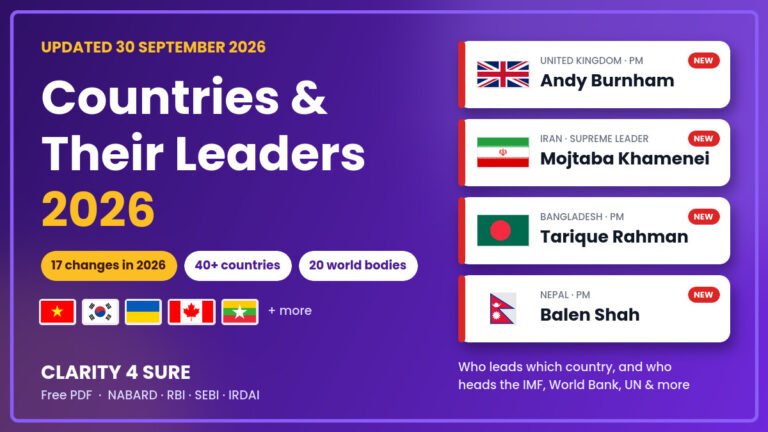 Free sheet · Static GKCountries & Their Leaders 2026Who leads which country in 2026, with all 17 changes marked. Get the article and the PDF free on WhatsApp.Get it free on WhatsApp →
Indian Navy Commissions INS Malvan
The Indian Navy commissioned INS Malvan, the second Mahe-class Anti-Submarine Warfare Shallow Water Craft (ASW-SWC), at Naval Base Karwar. Built by Cochin Shipyard Limited (CSL) with over 80% indigenous content, it is the first naval vessel commissioned at Karwar and strengthens India’s coastal anti-submarine warfare capabilities.
Paninian India Launches Private-Sector Turbofan Engine Programme
Paninian India Private Limited launched the Yantur 4.5 kN Turbofan Engine Programme, India’s first privately developed turbofan engine in its category. The engine is designed for long-range autonomous cruise missiles and future Collaborative Combat Aerial Vehicles (CCAVs), strengthening indigenous aerospace propulsion technology.
Five New Allographa Lichen Species Discovered in Western Ghats
Researchers from the Agharkar Research Institute (ARI) discovered five new Allographa lichen species in the Western Ghats of Kerala. Published in the journal Mycological Progress, the discovery represents the first comprehensive molecular phylogenetic study of the genus from the region and expands India’s documented lichen biodiversity.
Indian Grandmasters Win Top Honours at Menuires Chess Championship
Grandmaster S. Rohith Krishna won the Menuires International Chess Championship 2026 in France, while GM Raja Rithvik secured the silver medal. Both players remained unbeaten with 7 points from 9 rounds, with Rohith Krishna winning on tie-break under FIDE regulations.
Pi Approximation Day Observed on 22 July
Pi Approximation Day is observed annually on 22 July because the fraction 22/7 closely approximates the mathematical constant π (Pi). The day promotes awareness of mathematics, science, and the importance of Pi in geometry and engineering. It was first celebrated in 1995 in Sweden.
World Brain Day 2026 Observed on 22 July
World Brain Day 2026 was observed on 22 July with the theme “Brain Health: Access for All.” Led by the World Federation of Neurology (WFN), the observance raises awareness about brain health and neurological disorders. The date also marks the establishment of the WFN in 1957.
Sikkim Presents ₹19,215-Crore Budget for FY27
Sikkim Chief Minister Prem Singh Tamang presented the ₹19,215-crore Budget for FY2026–27, prioritising healthcare, education, infrastructure, and social welfare. Key announcements include statewide HPV screening, Sikkim’s first Renal Transplant Programme, an ART Centre, and 100 MBBS seats at the Sikkim Government Medical College.
Andhra Pradesh Signs MoU with UAE for Food Processing Cluster
The Andhra Pradesh Economic Development Board (APEDB) signed an MoU with the UAE Food Cluster to establish a food processing cluster for horticultural exports. The partnership will promote value-added processing, attract UAE investments, and establish a ₹100-crore processing unit in Chittoor district to strengthen exports to global markets.
World Bank Warns War Could Cut Global Growth to 1.3% in 2026
The World Bank has warned that prolonged US–Iran hostilities could reduce global economic growth to 1.3% in 2026, down from 2.9% in 2025, while pushing global inflation to around 4.5%. According to the June 2026 Global Economic Prospects (GEP) Report, the worst-case scenario assumes severe energy supply disruptions and financial market volatility lasting six months or more, whereas the baseline forecast projects 2.5% global growth with inflation around 4.0% if disruptions ease.
World Bank Warns War Could Cut Global Growth to 1.3% in 2026
The World Bank has warned that prolonged US–Iran hostilities could reduce global economic growth to 1.3% in 2026, down from 2.9% in 2025, while pushing global inflation to around 4.5%. According to the June 2026 Global Economic Prospects (GEP) Report, the worst-case scenario assumes severe energy supply disruptions and financial market volatility lasting six months or more, whereas the baseline forecast projects 2.5% global growth with inflation around 4.0% if disruptions ease.
CSIR Transfers Four Indigenous Technologies to Industry
The Council of Scientific and Industrial Research (CSIR) organised a Technology Transfer Event at its headquarters in New Delhi on 23 July 2026, where it transferred four indigenous technologies to industry, commercially launched an IoT-enabled Smart Rural Water Monitoring System, and recognised Bharat Electronics Limited (BEL) for royalty generated from licensed defence technology. The event was organised by CSIR-CSIO, Chandigarh, under the leadership of Dr. N. Kalaiselvi, Director General, CSIR.
AYUSH Ministry Inaugurates Prakriti Café
Union AYUSH Minister Prataprao Jadhav inaugurated Prakriti Café at Ayush Bhawan, New Delhi, the first workplace initiative of its kind by the Ministry of AYUSH. The café aims to promote healthy dietary practices based on the principles of Ayush Ahaar, encouraging nutritious and balanced food choices aligned with traditional Indian wellness systems.
Every day of the month in one file. Enter your details once — the download opens right away.
We already have your details, so no form: tap to open.
Download the July 2026 PDFDownload the July 2026 revision sheet PDF