Daily Current Affairs Quiz
24 March, 2026
National Affairs
1. SWAMIH Investment Fund II to Be Launched
Source: HT
Context:
The Government of India is in the process of launching SWAMIH Investment Fund II, a ₹15,000-crore fund aimed at completing stalled housing projects and providing relief to distressed homebuyers.
The announcement was made by Nirmala Sitharaman in Parliament.
About SWAMIH Fund
Full Form
- SWAMIH: Special Window for Affordable and Mid-Income Housing
Key Features of SWAMIH Investment Fund II
1. Fund Size
- Total corpus: ₹15,000 crore
2. Objective
- Complete 1 lakh (100,000) stalled housing units
- Provide relief to:
- Homebuyers with stuck investments
- Projects facing funding constraints
3. Target Segment
- Affordable housing
- Mid-income housing projects
4. Implementation Status
- Fund is currently under process of formal launch
Background
SWAMIH Fund I
- Launched in 2019
- Managed by:
- State Bank of India (SBI-led entity)
Purpose:
- Provide last-mile funding for stalled housing projects
Outcome:
- Helped revive several delayed real estate projects
- Delivered homes to thousands of buyers
2. Stealth Frigate Taragiri (F41)
Context:
The Indian Navy is set to commission the stealth frigate Taragiri (F41) on 03 April 2026 at Visakhapatnam. The warship is a key milestone under indigenous defence manufacturing and aligns with the vision of Aatmanirbhar Bharat.
About Stealth Frigate Taragiri
- Stealth guided-missile frigate under Project 17A
- Designed for multi-dimensional naval warfare:
- Surface combat
- Air defence
- Anti-submarine operations
Built By
- Mazagon Dock Shipbuilders Limited, Mumbai
Indigenous Content
- Over 75% indigenous components
- Involvement of:
- 200+ MSMEs
Significance:
- Boost to domestic defence ecosystem
Key Features
1. Stealth Capabilities
- Reduced radar signature
- Enhanced survivability in combat
2. Advanced Weapon Systems
- Guided missiles
- Anti-air and anti-submarine systems
- Integrated combat management systems
3. Modern Design
- Improved automation
- Network-centric warfare capability
About Project 17A
- Follow-on to Shivalik-class (Project 17) frigates
- Focus on:
- Advanced stealth
- Improved survivability
- Modern combat systems
3. Iran–Pakistan–India (IPI) & TAPI Pipelines
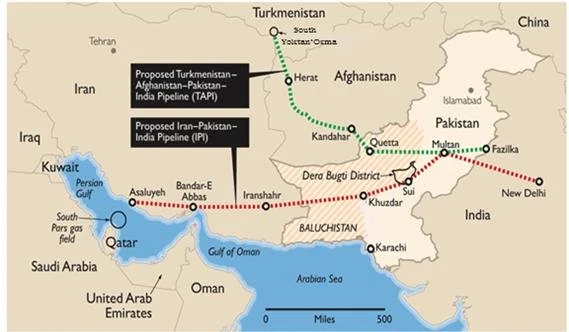
Context:
The ongoing West Asia crisis has disrupted global energy supplies, highlighting India’s dependence on imported hydrocarbons. This has renewed focus on cross-border pipeline projects like the IPI and TAPI pipelines.
Iran–Pakistan–India (IPI) Pipeline
- A proposed 2,775 km natural gas pipeline
- Connects Iran’s South Pars gas field to Pakistan and India
- Also known as the “Peace Pipeline”
Key Features
1. Objective
- Provide cost-effective gas supply
- Reduce reliance on expensive LNG imports
2. Capacity
- 60 mmscmd each for:
- India
- Pakistan
3. Strategic Significance
- Promote:
- Regional cooperation
- Economic interdependence
- Link:
- Energy-rich Persian Gulf
- Energy-deficient South Asia
Current Status
- Dormant / Stalled
Reasons for India’s Exit (2007)
- U.S. sanctions pressure (CAATSA concerns)
- Pricing disagreements
- Security concerns (route via Balochistan)
4. Centre Launches AI Skilling Drive with Google & YouTube
Source: TH
Context:
The Government of India, led by Union Minister Ashwini Vaishnaw, launched key initiatives to boost India’s media, broadcasting, and digital ecosystem, with a focus on strengthening the creative (orange) economy.
Key Initiatives Launched
1. National AI Skilling Initiative
- Implemented in partnership with:
- YouTube
- Indian Institute of Creative Technologies (IICT)
Key Features:
- Target: Train 15,000 youth (free of cost)
- Focus: AI skills for media and creative industries
- Two Phases:
Phase I (March–June 2026):
- Foundational AI training
- Courses include:
- AI Essentials
- Prompting Essentials
- Introduction to Generative AI
- Google Cloud AI learning paths
Phase II (July–December 2026):
- Advanced, project-based learning
- Focus on:
- Storytelling
- YouTube content strategies
- AI tools like Gemini and Vertex AI
2. MyWAVES Platform
- A citizen creator platform hosted on WAVES OTT
Features:
- Enables users to:
- Create
- Upload
- Share content
Objective:
- Promote grassroots content creation
- Showcase India’s cultural diversity
3. TV Broadcasting Reforms
- Introduction of:
- In-built satellite tuners in TV sets
- Advanced Electronic Programme Guide (EPG)
Benefit:
- Direct access to DD Free Dish
- No need for external set-top boxes
What is the “Orange Economy”?
- Refers to industries driven by:
- Creativity
- Culture
- Technology
- Intellectual Property
Examples:
- Media and entertainment
- Digital content creation
- Film, music, OTT platforms
5. Centre to Amend Foreign Contribution (Regulation) Act
Source: TH
Context:
The Union Government is set to introduce amendments to the Foreign Contribution (Regulation) Act, 2010 during the ongoing Parliament session. The proposed changes aim to strengthen regulation, accountability, and oversight of foreign-funded NGOs.
Key Proposed Amendments
1. Appointment of “Designated Authority”
- A new authority will be empowered to:
- Take over
- Manage
- Dispose of assets
Applicable when:
- NGO registration is:
- Suspended
- Cancelled
- Not renewed
2. Expansion of “Key Functionary” Definition
The term will now include:
- Directors
- Partners
- Trustees
- Karta of HUF
- Members of governing bodies or managing committees
- Any person controlling NGO operations
3. Liability of Key Functionaries
- Key individuals will be held legally accountable for FCRA violations.
Implication:
- Enhances personal responsibility and compliance.
4. Prior Approval for Investigation
- Law enforcement agencies and State governments must:
- Seek Central government approval before initiating FCRA-related investigations
Concern:
- May raise issues regarding:
- Federalism
- Investigative autonomy
5. Fixed Timelines for Fund Utilisation
- Introduces time-bound utilisation of foreign funds under prior permission.
Earlier Situation:
- Open-ended time limits
Benefit:
- Ensures efficient and timely use of funds.
6. Reduction in Punishment
- Maximum imprisonment reduced:
- From 5 years → 1 year
Objective:
- Possibly to rationalise penalties and reduce harshness.
Background
About FCRA
- Regulates:
- Acceptance and use of foreign contributions by NGOs
- Ensures:
- Funds are not used for activities detrimental to national interest
Current Scenario
- Around 16,000 NGOs registered
- Annual foreign funding: ~₹22,000 crore
Banking/Finance
1. Credit Guarantee Scheme for Microfinance Institutions-2.0 (CGSMFI-2.0)
Source: Mint
Context:
The Government of India launched the Credit Guarantee Scheme for Microfinance Institutions-2.0 (CGSMFI-2.0) in March 2026 to inject ₹20,000 crore liquidity into the microfinance sector and support financial inclusion.
About CGSMFI-2.0
- A credit guarantee scheme where the government provides default risk cover to banks (Member Lending Institutions – MLIs)
- Covers loans extended to:
- NBFC-MFIs
- Other Microfinance Institutions (MFIs)
Purpose:
- Encourage lending to high-risk microfinance segment
- Reduce credit risk for banks
Implementing Agencies
- Department of Financial Services – Nodal department
- National Credit Guarantee Trustee Company Limited – Provides guarantee cover
Aim of the Scheme
- Strengthen liquidity of MFIs
- Ensure continuous credit flow to small borrowers
- Promote:
- Financial inclusion
- Rural economic stability
Key Features
1. Tiered Guarantee Coverage
- 80% – Small MFIs
- 75% – Medium MFIs
- 70% – Large MFIs
Focus: Prioritises smaller institutions
2. Interest Rate Regulation
- Bank → MFI lending capped at:
- EBLR/MCLR + 2%
- MFI → Borrower lending:
- Must be 1% below average lending rate (last 6 months)
3. Low Guarantee Fee
- 0.50% per annum
- Affordable risk mitigation for lenders
4. Time-bound Scheme
- Valid till 30 June 2026
- Or until ₹20,000 crore guarantee limit is reached
5. Target Beneficiaries
- Focus on small borrowers (as per RBI definition)
- Ensures credit reaches:
- Low-income households
- Underserved rural population
2. Net FDI Negative for Fifth Straight Month
Source: TH
Context:
India’s Net Foreign Direct Investment (FDI) remained negative for the fifth consecutive month in January 2026, as per data released by the Reserve Bank of India. Outflows exceeded inflows by nearly $1.4 billion, indicating pressure on India’s external sector.
Key Data Highlights
Net FDI Position
- Net FDI: –$1.4 billion (January 2026)
- Fifth consecutive month of negative net inflows
- Highest outflow in last three months
FDI Outflows
(a) Outward FDI by Indian Companies
- Increased by 5.4% to $2.1 billion (YoY)
- Major destinations:
- USA
- Singapore
- UK
- UAE
(b) Repatriation & Disinvestment
- Jumped 97.3% to $4.9 billion
- Indicates:
- Foreign companies withdrawing profits
- Disinvestment from Indian operations
Key Reasons for Negative Net FDI
1. Rising Repatriation
- Sharp increase in profit booking and capital withdrawal
2. Decline in Fresh Inflows
- Moderation in global investment appetite
- Uncertainty due to:
- Global economic slowdown
- Geopolitical tensions
3. Increased Outward Investments
- Indian firms expanding overseas operations
Economic Implications
1. External Sector Pressure
- Negative FDI impacts:
- Balance of Payments (BoP)
- Forex reserves
2. Currency Depreciation Risk
- Lower dollar inflows → pressure on Rupee
3. Investment Climate Concerns
- Persistent outflows may signal:
- Reduced investor confidence
- Profit-taking by foreign firms
3. SEBI Approves Conflict of Interest Panel Recommendations
Source: ET
Context:
The Securities and Exchange Board of India (SEBI) has approved key recommendations of a High-Level Committee on Conflict of Interest to strengthen governance, transparency, and ease of doing business in financial markets.
Key Decisions Taken by SEBI
1. Strengthening Conflict of Interest Framework
Inclusion as “Insiders”
- SEBI Chairperson and Whole-Time Members will now be classified as ‘insiders’.
Digital Conflict Monitoring
- Creation of digital systems for:
- Monitoring conflicts of interest
- Ensuring transparency
Institutional Mechanisms
- Establishment of:
- Office of Ethics and Compliance
- Oversight Committee on Ethics
Role:
- Supervise conduct of board members
- Ensure ethical governance
Separate Regulations for Board Members
- Dedicated rules for:
- SEBI board members
- Enhances accountability and independence
2. Simplification of “Fit and Proper Person” Norms
Who are intermediaries?
- Stock exchanges
- Depositories
- Clearing corporations
Revised Criteria
- Disqualification only if:
- Convicted for economic offences
- Violations of securities laws
- Offences involving moral turpitude
3. Major Reform for Foreign Portfolio Investors (FPIs)
Net Settlement System Introduced
- FPIs can now net off transactions:
- Adjust purchase payments against sale proceeds
Earlier System:
- Gross settlement (separate payment and receipt)
Benefits:
- Reduces:
- Transaction costs
- Capital requirements
- Enhances market efficiency
4. Boost to Social Impact Investments
- Minimum investment in Social Impact Funds (AIFs) reduced:
- From ₹2 lakh → ₹1,000
Objective:
- Increase retail participation
- Promote inclusive finance
4. RBI in Talks with 4–5 Countries on Cross-Border CBDC
Context:
The Reserve Bank of India (RBI) is in discussions with 4–5 countries, including Asian and European economies, to develop cross-border transaction systems using Central Bank Digital Currency (CBDC).
What is CBDC?
- A digital form of central bank-issued currency
- Legal tender, backed by the central bank
- Can be used for:
- Retail transactions (public use)
- Wholesale transactions (interbank settlements)
Key Developments
1. Cross-Border CBDC Collaboration
- RBI engaging with:
- Asian economies
- Advanced European economies
Objective:
- Build CBDC transaction rails for:
- Faster
- Cheaper
- More efficient cross-border payments
2. Expected Benefits
(a) Lower Remittance Costs
- Reduces:
- Intermediary charges
- Transaction fees
(b) Faster Transactions
- Eliminates delays caused by:
- Multiple banking layers
- Settlement systems
(c) Reduced Compliance Layers
- Simplifies:
- Verification processes
- Regulatory checks
Agriculture
1. Agri-Photovoltaics (AgriPV)
Source: TH
Context:
India’s push for 300 GW solar capacity by 2030 and net-zero by 2070 is increasing pressure on land resources. With agriculture already occupying over half of India’s land, Agri-Photovoltaics (AgriPV) is emerging as a sustainable solution to balance energy and food security.
The Union Budget 2026–27 increased allocation for PM-KUSUM Scheme to ₹5,000 crore, reinforcing farmer-centric solarisation.
What is Agri-Photovoltaics (AgriPV)?
- Integration of:
- Solar power generation
- Agricultural cultivation on the same land
- Solar panels are:
- Mounted above crops
- Spaced between rows
- Integrated into greenhouses
Types of AgriPV Systems
1. Elevated Systems
- Panels mounted several meters above ground
- Allow full-scale farming below
2. Row-Based Systems
- Panels installed between crop rows
- Minimise shading impact
3. Vertical Systems
- Upright panels capturing sunlight from both sides
4. Greenhouse-Integrated Systems
- Panels on roofs/walls
- Provide controlled growing conditions
Crop Selection Strategy
Key Principle
- Match crops with sunlight availability under panels
Suitable Crops
- Shade-tolerant crops:
- Turmeric, ginger, leafy vegetables, tulsi
- Sunlight-intensive crops (between rows):
- Tomato, onion, potato, chilli
Regional Examples
- Madhya Pradesh: Tomato, garlic, turmeric
- Karnataka & Maharashtra: Ragi, jowar, grapes, banana
Benefits of AgriPV
1. Dual Land Use Efficiency
- Simultaneous:
- Food production
- Energy generation
2. Increased Farmer Income
- Revenue streams:
- Sale of electricity
- Land leasing
- Revenue sharing
3. Environmental Benefits
- Reduced:
- Evapotranspiration (water loss)
- Improved:
- Soil moisture retention
- Protection from:
- Heat
- Hail
- Heavy rainfall
4. Energy & Rural Development
- Powers:
- Cold storage
- Food processing
- Irrigation systems
- Reduces:
- Diesel dependence
Facts To Remember
1. North Korea’s Kim reappointed as President of state affairs: state media
North Korea’s rubber-stamp legislature has re-elected Kim Jong-un as President of state affairs, state media reported on Monday.
2. S. Thyagarajan, doyen of sports journalism, passes away
S. Thyagarajan, 85, veteran sports correspondent, who worked with The Hindu for more than five decades, passed away here on Monday.
3. Outward Remittances Under LRS Decline by 3.2% in Jan 2026
Outward remittances under the Liberalised Remittance Scheme of the Reserve Bank of India declined 3.19% year-on-year (Y-o-Y) to $2.68 billion in January 2026, indicating moderation in overseas spending by Indian residents.
4. Bharat Electricity Summit 2026 Held in New Delhi; Carbon Market Portal Launched
First edition of Bharat Electricity Summit 2026 was held at Yashobhoomi from March 19–22, 2026, inaugurated by Manohar Lal Khattar, organised by Bureau of Energy Efficiency, with theme “Electrifying Growth. Empowering Sustainability. Connecting Globally”, and featured launch of Indian Carbon Market Portal.
5. Government Launches CGSMFI 2.0 to Boost Microfinance Credit Flow
Government of India launched Credit Guarantee Scheme for Microfinance Institutions 2.0 to provide guarantee cover for loans to MFIs, benefiting 36 lakh borrowers, managed by National Credit Guarantee Trustee Company, effective from March 20, 2026.
6. FSI and BISAG-N Sign MoU for Geospatial Tech in Forestry
Forest Survey of India signed MoU with Bhaskaracharya National Institute for Space Applications and Geo-informatics to enhance use of geospatial tech, AI/ML, and remote sensing for forest management and biodiversity conservation.
7. India Sets Up Rare Earth Magnet Pilot Plant at ARCI Hyderabad
Government established Nd-Fe-B magnet pilot plant at International Advanced Research Centre for Powder Metallurgy and New Materials under DST to boost indigenous manufacturing for EVs and renewable energy, reducing import dependence.
8. RRU and SSB Academy Sign MoU for National Security Training
Rashtriya Raksha University signed MoU with Sashastra Seema Bal Academy to enhance security training, academic accreditation, and capacity building for border forces.
9. Indian Navy Participates in Exercise Kakadu 2026 in Australia
Indian Navy deployed INS Nilgiri in Exercise Kakadu 2026 involving 19 nations, enhancing Indo-Pacific maritime cooperation, and won Kakadu Shield Trophy.
10. India and Bhutan Sign MoU for Postal Cooperation
India and Bhutan signed MoU to strengthen postal services, enabling UPU–UPI cross-border remittance between India Post and Bhutan Post.
11. South Indian Bank Appoints Jose Joseph Kattoor as Chairman
South Indian Bank appointed Jose Joseph Kattoor as Non-Executive Part-Time Chairman for three years following RBI approval.
11. City Union Bank Appoints Ravindra Jadeja as Brand Ambassador
City Union Bank appointed Ravindra Jadeja as brand ambassador for two years to enhance outreach.
12. Kotak Mahindra to Divest Stake in Infina Finance
Kotak Mahindra Bank arm KMCC to sell 30.99% stake in Infina Finance for ₹1,293.91 crore, reducing shareholding to 19%.
13. Veteran BJP Leader Datta Meghe Passes Away
Datta Meghe, former MP and senior BJP leader, passed away at age 89 in Maharashtra after decades-long political career.
14. World Day of Theatre for Children and Young People Observed on March 20
Observed globally on March 20 to promote children’s cultural rights, initiated by ASSITEJ International with 2026 theme on child rights in arts.
15. International Day for Elimination of Racial Discrimination – March 21
Observed by United Nations on March 21 marking 61 years of ICERD to combat racial discrimination globally.
16. World Down Syndrome Day 2026 Observed on March 21
Observed globally with theme “Together Against Loneliness” to promote inclusion and rights of persons with Down syndrome.
17. Himachal Pradesh Budget 2026-27 Presented
Sukhvinder Singh Sukhu presented ₹54,928 crore FY27 budget focusing on fiscal discipline, green energy, and social welfare.
18. World Tuberculosis Day: President Murmu Highlights India’s Fight Against Tuberculosis
Today is World Tuberculosis Day. The day is observed on 24th March every year to raise awareness about the devastating health, social and economic consequences of Tuberculosis (TB) and to step up efforts to end the global epidemic.
19. Railways Minister Ashwini Vaishnaw Launches Five Reforms in Railways’ 52 Reforms in 52 Weeks Drive
Union Railways Minister Ashwini Vaishnaw today announced five reforms as part of Indian Railways’ resolve to undertake 52 reforms in 52 weeks this year in New Delhi.
20. India Hosts 12th Steering Committee Meeting of the Global Operational Network
The Director of Enforcement Directorate (ED), Rahul Navin, today said that asset recovery is not an afterthought but the truest measure of enforcement success under the modern anti-corruption framework enshrined in the United Nations Convention against Corruption (UNCAC).