Daily Current Affairs (DCA) 26 May, 2026
Free live session
NABARD Grade A 2026: 45-Day Final Revision Plan + Daily Targets
 🔒 Register to watchLast Sunday’s session · recording
Tomorrow · 7:30 PM IST
Banking/Finance2
Context:
The Reserve Bank of India (RBI), through an order dated 20 May 2026 (communicated on 22 May 2026), has imposed a monetary penalty of ₹10.10 lakh on City Union Bank Limited for non-compliance with directions on Priority Sector Loan accounts and reporting of Self-Help Group (SHG) member-level data to Credit Information Companies (CICs). The penalty, which is split as ₹10 lakh for priority-sector-lending lapses and ₹10,000 for SHG data-reporting failure, has been imposed under Section 47A(1)(c) read with Section 46(4)(i) of the Banking Regulation Act, 1949 and Section 25(1)(iii) read with Section 23(4) of the Credit Information Companies (Regulation) Act, 2005.
Key Highlights
- Regulator: Reserve Bank of India (RBI).
- Order date: 20 May 2026.
- Action source: Statutory Inspection for Supervisory Evaluation (ISE 2025) based on financial position as on 31 March 2025.
Entities and penalties:
| Entity | Penalty | Nature of Lapse |
|---|---|---|
| City Union Bank Limited | ₹10.10 lakh | Priority Sector Loan charges + SHG data reporting failure |
| Newa Investments Private Limited | ₹2.70 lakh | Governance: appointing directors without prior RBI written permission |
| Mintifi Finserve Private Limited (NBFC) | ₹3.10 lakh | KYC: failure to upload customer KYC to Central KYC Records Registry on time |
City Union Bank, split of penalty:
| Component | Amount | Violation |
|---|---|---|
| Priority Sector Loan charges | ₹10,00,000 | Levied loan-related charges on certain agriculture priority sector loans up to ₹25,000, prohibited by RBI directions |
| SHG data reporting | ₹10,000 | Did not report SHG member-level data to Credit Information Companies |
Statutory basis for the action:
- Section 47A(1)(c) read with Section 46(4)(i) of the Banking Regulation Act, 1949.
- Section 25(1)(iii) read with Section 23(4) of the Credit Information Companies (Regulation) Act, 2005.
About the News
What action has the RBI taken against City Union Bank?
Imposed a monetary penalty of ₹10.10 lakh, split into ₹10 lakh for priority-sector-lending lapses (levying loan-related charges on certain agriculture priority sector loans up to ₹25,000) and ₹10,000 for SHG data-reporting failure (not reporting Self-Help Group member-level data to Credit Information Companies).
What about the two NBFCs?
(a) Newa Investments Private Limited: ₹2.70 lakh penalty for appointing directors without prior written RBI permission, in breach of governance directions. (b) Mintifi Finserve Private Limited: ₹3.10 lakh penalty for failure to upload customer KYC records to the Central KYC Records Registry within the prescribed timeline, in breach of KYC directions.
What is the legal basis of the penalties?
The Banking Regulation Act, 1949 (Section 47A(1)(c) read with Section 46(4)(i)) and the Credit Information Companies (Regulation) Act, 2005 (Section 25(1)(iii) read with Section 23(4)). The RBI relied on Statutory Inspection for Supervisory Evaluation (ISE 2025) findings based on the position as on 31 March 2025.
Why did the RBI act on priority-sector-related lapses?
Because under RBI’s Priority Sector Lending (PSL) directions, banks are prohibited from levying processing or service charges on small agricultural loans up to ₹25,000. The intent is to keep small-farmer credit affordable, which is undermined when banks charge fees on these advances.
Background Concepts
What is the Statutory Inspection for Supervisory Evaluation (ISE)?
The RBI’s annual on-site supervisory inspection of banks, NBFCs, and other regulated entities, conducted under the Banking Regulation Act, 1949 and the RBI Act, 1934. Built around a risk-based supervisory framework, ISE assesses financial soundness (capital, asset quality, liquidity), management and governance, regulatory compliance, internal controls, technology risk, and customer-protection practices as on a specific cut-off date (typically 31 March of the relevant financial year). Findings of non-compliance are followed by show-cause notices, personal hearings, and speaking orders, which can lead to monetary penalties, restrictions, or other supervisory actions.
What is Priority Sector Lending (PSL)?
A regulatory framework requiring commercial banks to allocate a specified percentage of their Adjusted Net Bank Credit (ANBC) to priority sectors, including agriculture, MSMEs, education, housing, renewable energy, social infrastructure, weaker sections, and export credit.
What are Credit Information Companies (CICs)?
Regulated entities authorised under the Credit Information Companies (Regulation) Act, 2005 to collect, maintain, and share credit information about borrowers in India. Four CICs operate currently: CIBIL (TransUnion CIBIL), Experian Credit Information Company of India, Equifax Credit Information Services, and CRIF High Mark. Banks, NBFCs, and other regulated lenders are required to report borrower-level credit data (including SHG member-level data, for SHG loans) on a regular basis, enabling credit scoring, underwriting decisions, and a market-wide credit-history infrastructure. Failure to report attracts monetary penalties under the Act, as in the City Union Bank case.
Practice MCQs
Q1. With reference to the RBI’s recent enforcement action on City Union Bank, consider the following statements:
- The RBI has imposed a monetary penalty of ₹10.10 lakh on City Union Bank.
- The penalty includes ₹10 lakh for priority-sector-lending lapses and ₹10,000 for SHG data-reporting failure.
- The action was based on the Statutory Inspection for Supervisory Evaluation (ISE 2025) with reference to the bank’s position as on 31 March 2025.
- The RBI has clarified that the penalty does not affect the validity of any customer transaction or agreement.
How many of the above statements are correct? (a) Only one (b) Only two (c) Only three (d) All four (e) None
Q2. Consider the following statements about the related RBI penalties on NBFCs and other entities:
- Newa Investments Private Limited was penalised for appointing directors without prior written permission of the RBI.
- Mintifi Finserve Private Limited was penalised for failing to upload customer KYC records to the Central KYC Records Registry within the prescribed timeline.
- The penalty on Mintifi Finserve was ₹3.10 lakh.
- The penalties were imposed in exercise of powers under the Banking Regulation Act, 1949 and the Credit Information Companies (Regulation) Act, 2005.
Which of the above are correct? (a) 1, 2 and 3 only (b) 1, 3 and 4 only (c) 2 and 4 only (d) 1 and 4 only (e) All four
Q3. With reference to Priority Sector Lending (PSL) in India, consider the following statements:
- Domestic Commercial Banks must allocate 40 per cent of their Adjusted Net Bank Credit (ANBC) to priority sectors.
- Small Finance Banks have a PSL target of 60 per cent of ANBC.
- Regional Rural Banks have a PSL target of 75 per cent of ANBC.
- RBI directions prohibit banks from levying loan-related charges on small agriculture priority sector loans up to ₹25,000.
Which of the above are correct? (a) 1, 2 and 3 only (b) 1, 3 and 4 only (c) 2 and 4 only (d) 1 and 4 only (e) All four
Q4. Consider the following statements about Credit Information Companies (CICs) in India:
- They are regulated under the Credit Information Companies (Regulation) Act, 2005.
- CIBIL, Experian, Equifax, and CRIF High Mark are the four CICs operating in India.
- Banks and NBFCs are required to report borrower-level credit data, including SHG member-level data for SHG loans.
- Failure to comply with CIC reporting obligations can attract monetary penalties under the Act.
Which of the above are correct? (a) 1, 2 and 3 only (b) 1, 3 and 4 only (c) 2 and 4 only (d) 1 and 4 only (e) All four
Answer Key
- (d), All four statements are correct.
- (e), All four statements are correct.
- (e), All four statements are correct.
- (e), All four statements are correct.
Exam Relevance
| Exam | Relevance |
|---|---|
| UPSC Prelims | GS Paper III on Indian Economy (RBI, Banking, Priority Sector Lending, CICs) |
| UPSC Mains | GS Paper III on Indian Economy, Financial regulation, Consumer protection, Financial inclusion |
| Banking (RBI Gr B, SBI PO, IBPS, NABARD) | Banking, PSL, CICs, KYC, very high importance |
| NABARD Grade A | Core area on PSL, agricultural credit, SHGs, financial inclusion |
Context:
The Reserve Bank of India (RBI) has tightened governance norms for directors of Urban Cooperative Banks (UCBs) through the “Reserve Bank of India (Urban Co-operative Banks, Governance) Amendment Directions, 2026”, which have come into force with immediate effect. The central provisions are clear and consequential: an individual cannot serve as a director continuously for more than 10 years on the board of a UCB, and reappointment can happen only after a compulsory three-year cooling-off period. During the cooling-off period, the director cannot be associated with the UCB in any capacity other than as a member or customer.
Key Highlights
- Regulator: Reserve Bank of India (RBI).
- Directions: Reserve Bank of India (Urban Co-operative Banks, Governance) Amendment Directions, 2026.
Core provisions:
| Provision | Requirement |
|---|---|
| Maximum continuous tenure | 10 years |
| Cooling-off period | 3 years (compulsory) |
| Reappointment | Only after the cooling-off period ends |
| Permitted association during cooling-off | Only as a member or customer of the UCB |
| Prohibited association during cooling-off | Any other capacity, including consultant, advisor, committee member |
Why the amendment was needed:
- RBI observed directors resigning briefly and getting re-elected or co-opted back within a short period.
- This allowed directors to circumvent statutory tenure provisions and effectively continue indefinitely.
- The amendment plugs the loophole by enforcing both a cumulative tenure cap and a meaningful cooling-off period.
Wider UCB regulatory architecture:
- Banking Regulation Act, 1949 as amended in 2020 (extended RBI’s supervisory powers over cooperative banks).
- Banking Regulation (Amendment) Act, 2020 allowed the RBI to:
- Supersede boards of cooperative banks in public interest.
- Appoint administrators.
- Approve appointment of CEOs subject to RBI’s fit-and-proper criteria.
- Supervise management in line with commercial-bank standards.
- N.S. Vishwanathan Expert Committee on UCBs (2021) proposed a four-tier regulatory structure for UCBs based on size and area of operation, with tier-specific capital and governance norms.
- Tiered regulation circular subsequently issued by RBI.
About the News
What is the RBI’s new rule on UCB directors?
A UCB director cannot serve continuously for more than 10 years, and any reappointment is permitted only after a compulsory three-year cooling-off period, during which the individual cannot be associated with the UCB in any capacity other than as a member or customer.
Why has the RBI introduced this rule?
Because some directors were resigning briefly and getting re-elected soon after, circumventing tenure limits and continuing on boards for extended periods. The new rule closes this loophole.
Background Concepts
What are Urban Cooperative Banks (UCBs)?
Cooperative banks organised under the cooperative principles of one-member-one-vote and serving customers, especially in urban and semi-urban areas, primarily through deposit-taking and lending operations. UCBs were brought under dual regulation historically, the Registrar of Cooperative Societies (at the state level, for incorporation, governance, and membership matters) and the RBI (for banking operations, prudential norms, capital adequacy, and management). The Banking Regulation (Amendment) Act, 2020 strengthened RBI’s regulatory powers over UCBs, bringing them closer to the commercial-bank regulatory framework for matters of management, capital, and prudential supervision, while cooperative-society aspects remain under state cooperation laws.
What does the Banking Regulation (Amendment) Act, 2020 do for cooperative banks?
It amended the Banking Regulation Act, 1949, to extend several provisions previously applicable only to commercial banks to cooperative banks, particularly: (a) RBI’s power to supersede boards of cooperative banks in public interest. (b) RBI’s power to appoint administrators. (c) RBI’s prior approval for appointment, removal, and compensation of CEOs and whole-time directors. (d) RBI’s enhanced supervisory and inspection powers over cooperative banks. (e) Stronger prudential and capital norms in line with commercial banks. The amendment was prompted by the PMC Bank crisis and the broader need to protect depositors in cooperative banks.
Practice MCQs
Q1. With reference to the RBI’s recent amendment to UCB governance norms, consider the following statements:
- An individual cannot serve as a director of a UCB continuously for more than 10 years.
- A mandatory cooling-off period of 3 years must elapse before reappointment.
- During the cooling-off period, the former director may serve only as a member or customer of the UCB.
- The amendment has been issued under the Reserve Bank of India (Urban Co-operative Banks, Governance) Amendment Directions, 2026.
How many of the above statements are correct? (a) Only one (b) Only two (c) Only three (d) All four (e) None
Q2. Consider the following statements about Urban Cooperative Banks (UCBs):
- UCBs are organised under cooperative principles and operate primarily in urban and semi-urban areas.
- Historically, UCBs were under the dual regulation of the Registrar of Cooperative Societies (for governance and membership) and the RBI (for banking operations).
- The Banking Regulation (Amendment) Act, 2020 strengthened RBI’s regulatory powers over UCBs.
- UCBs are entirely outside the RBI’s regulatory ambit.
Which of the above are correct? (a) 1, 2 and 3 only (b) 1, 3 and 4 only (c) 2 and 4 only (d) 1 and 4 only (e) All four
Q3. With reference to the Banking Regulation (Amendment) Act, 2020, consider the following statements:
- It empowers the RBI to supersede the boards of cooperative banks in public interest.
- It enables the RBI to approve the appointment and removal of CEOs of cooperative banks.
- It allows the RBI to appoint administrators in distressed cooperative banks.
- It applies to all cooperative banks, including Urban Cooperative Banks and State Cooperative Banks.
Which of the above are correct? (a) 1, 2 and 3 only (b) 1, 3 and 4 only (c) 2 and 4 only (d) 1 and 4 only (e) All four
Q4. With reference to the broader regulatory environment for UCBs, consider the following statements:
- The PMC Bank crisis in 2019 was a major trigger for tighter regulation of cooperative banks.
- The N.S. Vishwanathan Expert Committee on UCBs (2021) proposed a four-tier regulatory structure.
- The RBI has gradually aligned UCB governance norms with commercial-bank standards.
- UCBs are entirely exempt from prudential capital norms.
Which of the above are correct? (a) 1, 2 and 3 only (b) 1, 3 and 4 only (c) 2 and 4 only (d) 1 and 4 only (e) All four
Answer Key
- (d), All four statements are correct.
- (a), Statements 1, 2, 3 are correct. Statement 4 is wrong; UCBs are within the RBI’s regulatory ambit for banking operations, prudential norms, and management. They are not outside RBI regulation.
- (e), All four statements are correct.
- (a), Statements 1, 2, 3 are correct. Statement 4 is wrong; UCBs are NOT exempt from prudential capital norms. The RBI prescribes capital adequacy, asset classification, provisioning, and other prudential requirements for UCBs, with tier-specific calibration following the Vishwanathan Committee recommendations.
Agriculture1
How & Why Farmers Producers Organization are formed? FPO #fpo #upsc #nabardgradea #agriculturenotesTap to play · from the C4S channel
Context:
B+H Solutions GmbH, a German agricultural technology firm, has announced plans to invest €1 million in India in 2026 to expand its metal-based nano-fertilizer business, following its recent Fertilizer Control Order (FCO) registration for the AgroCopper (nano copper) product. Dr Laura Wieler, General Manager and Chief Scientific Officer at B+H Solutions GmbH, told PTI that the FCO nano-registration breakthrough has positioned the company for strong growth in 2026 as market awareness deepens.
Product portfolio in India:
| Indicator | Detail |
|---|---|
| Number of products | Eight currently offered in India |
| Flagship product | AgroBeize: developed exclusively for India, combines silver and copper nanoparticles, also registered as a disinfectant |
| Recently FCO-registered | AgroCopper (nano copper) |
| FCO registration pending | Nano iron |
Product positioning:
- Not a nitrogen replacement like nano-urea.
- Not a phosphorus replacement like nano-DAP.
- Functions as “fertilizer plus”:
- Strengthens the plant’s immune system.
- Reduces disease pressure.
- Acts as a plant protection agent.
- Delivers micronutrient value (copper, iron).
- Also positioned in the disinfectant segment (for AgroBeize).
About the News (Q&A)
What is B+H Solutions investing and why?
€1 million in India in 2026 to scale its metal-based nano-fertilizer business, following the recent FCO registration of AgroCopper (nano copper), which opens up legal commercial sale across India.
How are these products different from nano-urea and nano-DAP?
(a) Nano-urea delivers nitrogen; Nano-DAP delivers nitrogen and phosphorus. (b) B+H Solutions’ products are metal-based, using silver and copper nanoparticles (and, prospectively, iron), and are positioned as “fertilizer plus”: combining micronutrient nutrition with disease pressure reduction, plant immunity strengthening, and plant protection.
What is AgroBeize?
The company’s flagship product, developed exclusively for Indian agriculture, combining silver and copper nanoparticles, also registered as a disinfectant. It is the product that has been trialled at ICAR Bangalore on tomatoes with 24 per cent higher yield than conventional fungicides.
What evidence supports the products?
(a) ICAR-Bangalore trials: 24 per cent yield gain on tomatoes vs conventional fungicides, plus improved quality and reduced blight. (b) Company-claimed yield gain: up to 30 per cent across tomatoes, chillies, black pepper, pomegranates, and flowers. (c) OECD studies: safety confirmation for humans and the environment.
Background Concepts (Q&A)
What are Metal-Based Nano-Fertilizers?
A category of nano-fertilizers in which active inputs are metal-element nanoparticles (typically silver, copper, zinc, iron, manganese) sized below 100 nanometres. They are typically used to deliver micronutrients (where deficiency limits yield), and some metals like silver and copper also exhibit antimicrobial properties, allowing the same product to function as both a fertilizer and a plant-protection agent. This is distinct from nano-urea (nitrogen) and nano-DAP (nitrogen plus phosphorus), which target macronutrient delivery. Metal-based formulations can be deployed via foliar spray, seed treatment, or drip irrigation.
What is the Fertiliser Control Order (FCO), 1985?
A regulatory framework issued under the Essential Commodities Act, 1955, by the Department of Agriculture and Farmers’ Welfare in coordination with the Department of Fertilizers, governing the manufacture, import, distribution, sale, and quality control of fertilizers in India. The FCO prescribes product specifications, packaging, labelling, and quality testing standards. It was amended in 2021 to formally include nano-fertilizers as a recognised category, giving products like nano-urea, nano-DAP, and metal-based nano-fertilizers (such as AgroCopper) legal status as agricultural inputs.
Practice MCQs
Q1. With reference to the recent announcement by Germany’s B+H Solutions GmbH, consider the following statements:
- The company plans to invest €1 million in India in 2026.
- It markets its products in India through its subsidiary Dr Heinisch Agro Solutions India Private Limited.
- The company has recently secured FCO registration for AgroCopper, a nano copper product.
- The company’s flagship Indian product, AgroBeize, combines silver and copper nanoparticles.
How many of the above statements are correct? (a) Only one (b) Only two (c) Only three (d) All four (e) None
Q2. Consider the following statements about Metal-Based Nano-Fertilizers:
- They typically use metal-element nanoparticles such as silver, copper, zinc, or iron, sized below 100 nanometres.
- Metals like silver and copper also exhibit antimicrobial properties, enabling dual fertilizer-cum-plant-protection use.
- Metal-based nano-fertilizers primarily target macronutrient delivery, similar to nano-urea.
- They can be deployed via foliar spray, seed treatment, or drip irrigation.
Which of the above are correct? (a) 1, 2 and 4 only (b) 1, 3 and 4 only (c) 2 and 4 only (d) 1 and 4 only (e) All four
Q3. With reference to the Fertiliser Control Order (FCO), 1985, consider the following statements:
- It is issued under the Essential Commodities Act, 1955.
- It governs the manufacture, import, distribution, sale, and quality control of fertilizers in India.
- It was amended in 2021 to formally include nano-fertilizers as a recognised category.
- FCO registration is administered by the Securities and Exchange Board of India.
Which of the above are correct? (a) 1, 2 and 3 only (b) 1, 3 and 4 only (c) 2 and 4 only (d) 1 and 4 only (e) All four
Q4. With reference to the broader nano-fertilizer landscape in India, consider the following statements:
- India is the first country in the world to have commercialised nano-fertilizers at scale.
- IFFCO launched Nano Urea Liquid in 2021 and Nano-DAP in 2023.
- The Indian Council of Agricultural Research conducts independent field validation of new agri-input technologies.
- Indian farmers have generally been more receptive to nanotechnology adoption than their European counterparts.
Which of the above are correct? (a) 1, 2 and 3 only (b) 1, 3 and 4 only (c) 2 and 4 only (d) 1 and 4 only (e) All four
Answer Key
- (d), All four statements are correct.
- (a), Statements 1, 2, 4 are correct. Statement 3 is wrong; metal-based nano-fertilizers primarily target micronutrient delivery (copper, iron, zinc, manganese, silver), NOT macronutrients. Macronutrient delivery is the role of products like nano-urea (nitrogen) and nano-DAP (nitrogen-phosphorus).
- (a), Statements 1, 2, 3 are correct. Statement 4 is wrong; FCO registration is administered by the Department of Agriculture and Farmers’ Welfare in coordination with the Department of Fertilizers, NOT by SEBI. SEBI regulates securities markets, not agricultural inputs.
- (e), All four statements are correct.
Exam Relevance:
| NABARD Grade A | Very high importance on agriculture, agri-inputs, sustainability |
Every day of the month in one file. Enter your details once — the download opens right away.
We already have your details, so no form: tap to open.
Download the May 2026 PDFDownload the May 2026 revision sheet PDFFacts To Remember15
Rajnath Singh Inaugurates NIBE Defence Complex in Maharashtra
Union Defence Minister Rajnath Singh inaugurated the NIBE Group’s defence manufacturing complex in Shirdi, Maharashtra, with an investment of over Rs.5,000 crore and employment potential of around 4,000 jobs. He also flagged off “Suryastra”, India’s first 300-km indigenous Universal Rocket Launching System, developed under the emergency procurement framework. Additionally, four defence corridors in Pune, Nashik, Ahmednagar (Ahilyanagar), and Nagpur were approved to strengthen indigenous defence production and MSME participation.
DoS Approves Two New Space-tech Facilities in Gujarat and Tamil Nadu
The Department of Space (DoS) approved the establishment of two Common Technical Facilities (CTFs) in Gujarat and Tamil Nadu to boost India’s space manufacturing ecosystem. A Space Manufacturing Park will be set up at Khoraj near Ahmedabad for spacecraft and payload manufacturing, while a Space Vehicles Cluster at Thoothukudi, Tamil Nadu, will support launch vehicle testing and integration. Indian National Space Promotion and Authorisation Centre (IN-SPACe) will oversee procurement, installation, and commissioning of the technical infrastructure.
Ladakh Extends MoU with ONGC for India’s First Geothermal Power Project
Lieutenant Governor Vinod Saxena approved a five-year extension of the MoU with Oil and Natural Gas Corporation (ONGC) for India’s first geothermal energy project in Ladakh. The project aims to establish a 1 MWe pilot geothermal power plant at Puga Valley, located over 14,000 feet above sea level. ONGC Energy Centre will undertake phased drilling and testing activities during FY27 for future large-scale geothermal energy exploitation.
India Post and Flipkart Sign Pact to Strengthen E-commerce Logistics
The Department of Posts (DoP) signed an agreement with Flipkart to enhance India’s e-commerce logistics ecosystem and parcel delivery efficiency. Under the agreement, India Post will provide last-mile delivery services for prepaid and Cash on Delivery (COD) shipments across urban and rural regions. The collaboration will also enable OTP-based delivery authentication, real-time shipment tracking, and improved operational coordination.
Indian Army Launches ‘Q-FORCE’ Logistics Management Application
The Indian Army launched ‘Q-FORCE’, an integrated digital logistics application aimed at improving logistics and sustainment management across operational terrains. The platform enables real-time logistics monitoring, efficient supply-chain coordination, and faster resource allocation for military operations. The Army also introduced ‘Kautilya’, an AI-powered command intelligence platform using dashboards and NLP-based analytics for decision-making support.
Rajnath Singh Visits Vietnam and South Korea to Strengthen Defence Cooperation
Union Defence Minister Rajnath Singh visited Vietnam and South Korea from May 18–21, 2026, to deepen defence and Indo-Pacific cooperation. During the Vietnam visit, India and Vietnam signed agreements on AI and quantum technology collaboration, besides inaugurating AI and language laboratories. In South Korea, India exchanged an MoU on defence cyber security cooperation and facilitated industrial agreements between Larsen & Toubro and Hanwha Co. Ltd.
India and Ethiopia Sign WTO Accession Protocol in Geneva
India and Ethiopia signed a bilateral accession protocol in Geneva to support Ethiopia’s membership process in the World Trade Organization (WTO). The agreement followed Ethiopia’s 7th Working Party meeting and focuses on trade reforms, tariff commitments, and WTO rule alignment. India reiterated support for Least Developed Countries (LDCs) and south-south cooperation under the guidance of Union Minister Piyush Goyal.
 Scheme to knowIndia Conformity Assessment Scheme (i-CAS) Halal: Mandatory Certification for Meat ExportsThe India Conformity Assessment Scheme (i-CAS) Halal is a national certification scheme developed by the Quality…
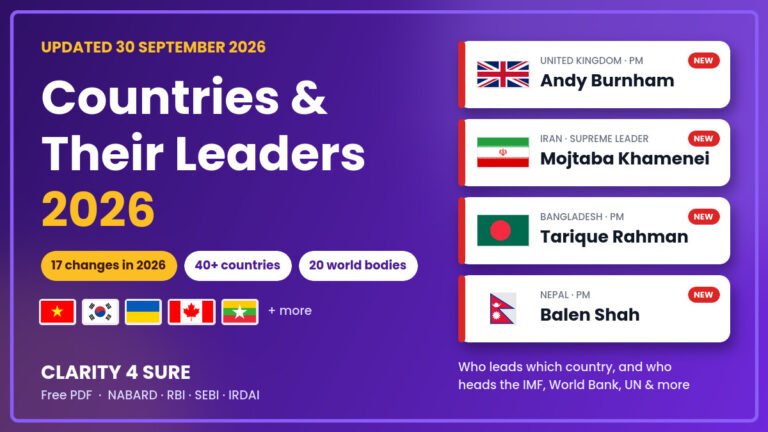 Free sheet · Static GKCountries & Their Leaders 2026Who leads which country in 2026, with all 17 changes marked. Get the article and the PDF free on WhatsApp.Get it free on WhatsApp →
AIIB Launches USD 10 Billion Relief Facility for Conflict-hit Nations
The Asian Infrastructure Investment Bank (AIIB) launched the ‘Energy, Food Security and Economic Resilience Facility (EFSERF)’ with a funding support of USD 10 billion over two years. The initiative aims to help member countries tackle economic disruptions arising from the ongoing Middle East conflict. The facility will provide budgetary support, refinancing aid, liquidity assistance, and funding for essential imports.
Cristian Mungiu’s ‘Fjord’ Wins Palme d’Or at Cannes 2026
At the 79th Cannes Film Festival held in Cannes, France, Romanian director Cristian Mungiu won the Palme d’Or for his film “Fjord”. Russian filmmaker Andrey Zvyagintsev received the Grand Prix for “Minotaur”, while several international artists won awards in acting, screenplay, and directing categories. The festival highlighted themes of war, displacement, and political cinema.
RBI Approves Reappointment of Sandeep Bakhshi as ICICI Bank CEO
The Reserve Bank of India approved the reappointment of Sandeep Bakhshi as Managing Director and CEO of ICICI Bank for another two-year term till October 2028. Since taking charge in 2018, he has overseen major improvements in retail lending, digital banking, and asset quality. The extension remains subject to shareholder and statutory approvals.
Vijay Shankar Retires from Domestic Cricket and IPL
Indian all-rounder Vijay Shankar announced his retirement from domestic cricket and the IPL after a 25-year cricket journey. He represented India in 12 ODIs and 9 T20Is and became the first Indian to take a wicket with the first ball of his World Cup debut during the 2019 ICC Cricket World Cup. Vijay Shankar played for multiple IPL franchises including CSK, SRH, DC, and Gujarat Titans.
International Day to End Obstetric Fistula 2026 Observed on May 23
The International Day to End Obstetric Fistula was observed globally on May 23 to raise awareness about obstetric fistula and promote healthcare support for affected women. The 2026 theme was “Her Health Is a Right: Invest to End Fistula and Childbirth Injuries”. The day was established by the UN General Assembly through Resolution A/RES/67/147 in 2012.
World Turtle Day 2026 Observed on May 23
World Turtle Day was observed worldwide on May 23 to promote conservation of turtles, tortoises, and their habitats. The initiative was launched in 2000 by American Tortoise Rescue (ATR), a US-based non-profit organisation. The observance encourages awareness and collective action for protecting endangered turtle species.
International Day of the Markhor 2026 Observed on May 24
The International Day of the Markhor was observed globally on May 24 to highlight conservation efforts for the markhor, a wild goat species native to Central and South Asia. The day was declared by the UN General Assembly through Resolution A/RES/78/278 in 2024 following a proposal by Pakistan. May 24, 2026 marked the third global observance of the day.
Delhi Government and SBI Sign MoU for e-Procurement Digital Payments
The Delhi e-Governance Society (DeGS) signed an MoU with State Bank of India (SBI) to implement the ‘e-Pay’ digital payment solution on Delhi’s e-procurement portal. The initiative aims to improve transparency, efficiency, and ease of doing business in government procurement processes. The integration will enable real-time Earnest Money Deposit (EMD) verification, digital payments, and MIS support for procurement operations.