Daily Current Affairs (DCA) 28&29 June, 2026
Free live session
NABARD Grade A 2026: what the 2025 cut-offs changed, and the 90-day plan
The 2025 cycle was the toughest on record at every stage. This session reads those numbers properly and turns them into a week-by-week plan for Phase 1.
Today · 7:30 PM IST · 75 minutes · free
In the news2
Context
Union Rural Development Minister Shri Shivraj Singh Chouhan on Sunday, 28 June 2026 launched the “Rural Internal Audit Portal” at the Rashtriya Gramin Vikas Sammelan (RGVS) 2026 held at Pusa Campus, New Delhi — ahead of the Viksit Bharat – Guarantee for Rozgar & Ajeevika Mission (Gramin) [VB-G RAM G] rollout from 1 July 2026. The AI-enabled portal is a first-of-its-kind unified digital platform for end-to-end management of internal audits — covering both risk-based and compliance audits. Conceived by the Office of the Chief Controller of Accounts (CCA), Ministry of Rural Development, the platform was developed in collaboration with the National Informatics Centre (NIC). The portal was piloted in Chandauli district, Uttar Pradesh on 1 April 2025, and all core modules became operational from October 2025. The Office of the Controller General of Accounts (CGA), Ministry of Finance issued Office Memorandum No. I-104/3/2024-ITD-CGA/E-19878/621A dated 9 December 2025 granting in-principle approval for pan-Civil-Ministry rollout across all Pr. CCA / CCA / CA offices — positioning the Rural Internal Audit Portal as a benchmark for internal audit governance across the Government of India.
What is the Rural Internal Audit Portal?
- A first-of-its-kind unified digital platform for end-to-end management of internal audits.
- Covers two audit types:
- Risk-based audits.
- Compliance audits.
- AI-enabled: intelligent audit planning, risk identification, predictive analytics.
- Replaces fragmented, paper-intensive, manual audit practices.
Who built it?
| Entity | Role |
|---|---|
| Office of the Chief Controller of Accounts (CCA), MoRD | Conceptualised the Portal |
| Ministry of Rural Development (MoRD) | Implementing ministry |
| National Informatics Centre (NIC) | Developed + hosts the digital platform |
What are the Portal’s standout features?
| Feature | Detail |
|---|---|
| Map View Module (geospatial) | Visualisation of audit coverage, team deployment, identifies never-audited units for targeted intervention |
| Role-Based Access | Auditors, auditees, approving authorities, programme divisions, States, districts, certified internal auditors |
| Centralised Audit Repository | Digital records, ATRs, observations, compliance responses |
| Real-Time Analytics Dashboards | Audit coverage, pending observations, ATR compliance, financial irregularities |
| AI/ML Integration (progressive) | Risk scoring, pattern recognition, predictive analytics, intelligent audit planning |
| Multilingual Interface | Accessibility across India |
| Paperless | Reduces manual records, accelerates approvals |
What is the technology architecture and security framework?
- Hosted on NIC infrastructure.
- Modern stack: Git-based version control, CI/CD pipelines (Continuous Integration/Continuous Deployment).
- Three environments: Development, User Acceptance Testing (UAT), and Production.
- Security: Role-based access control, centralised monitoring, secure API-based integrations, complete audit logging, periodic security assessments, daily backups, disaster recovery protocols.
- Future-ready: integrates AI, advanced analytics, ML for audit prioritisation + decision support.
What is VB-G RAM G (Viksit Bharat – Guarantee for Rozgar & Ajeevika Mission, Gramin)?
- Statutory basis: VB-G RAM G Act, 2025 (assented by President).
- Replaces: MGNREGA, 2005.
- Effective from: 1 July 2026.
- Implementing Ministry: Ministry of Rural Development (MoRD).
Key Features of VB-G RAM G Act, 2025
| Feature | Detail |
|---|---|
| Guaranteed Workdays | 125 days per rural household per FY (up from MGNREGA’s 100) |
| Eligibility | Adult members of rural households for unskilled manual work |
| No-Work Period | 60 days aggregated during peak sowing/harvest (ensures availability of agri labour) |
| Effective Work Period | 305 days |
| Wage Disbursement | Weekly (within fortnight) |
| Planning Unit | Viksit Gram Panchayat Plans, spatially integrated with PM Gati Shakti |
| National Aggregation | Viksit Bharat National Rural Infrastructure Stack |
What is the Office of the Controller General of Accounts (CGA)?
- Principal Accounting Adviser to GoI.
- Functions under Department of Expenditure, Ministry of Finance.
- Constitutional mandate: derived from Article 150 of the Constitution.
- Current CGA: Shri S.S. Dubey (1989 batch ICAS officer).
- Responsibilities: Establishes/maintains management accounting system; prepares Union Finance Accounts and Appropriation Accounts (Civil); Internal Audit + Exchequer Control; reconciles cash balances with RBI; coordinates Audit Para Monitoring System (APMS).
What is the Office of the Chief Controller of Accounts (CCA)?
- Operates under each central ministry/department.
- Handles payments, accounts, internal audit, financial advice.
- Falls under the Controller General of Accounts (CGA), Department of Expenditure, Ministry of Finance.
- Reports through Principal CCA (Pr. CCA) → CGA.
What is the National Informatics Centre (NIC)?
- Premier IT services organisation of GoI.
- Under Ministry of Electronics and Information Technology (MeitY).
- Established: 1976.
- HQ: CGO Complex, New Delhi.
- Provides e-governance infrastructure (data centres, networking, cloud, software development) to central + state govts.
Practice MCQs
Q1. With reference to the Rural Internal Audit Portal launched on 28 June 2026, consider the following statements:
- The Portal was launched by Union Rural Development Minister Shivraj Singh Chouhan during the Rashtriya Gramin Vikas Sammelan at Pusa Campus, New Delhi.
- The Portal was conceived by the Office of the Chief Controller of Accounts (CCA), Ministry of Rural Development.
- The Portal was developed in collaboration with the National Informatics Centre (NIC).
- The Portal covers only compliance audits and excludes risk-based audits.
How many of the above statements are correct?
(a) Only one (b) Only two (c) Only three (d) All four (e) None
(Statement 4 is wrong; the Portal covers both risk-based AND compliance audits.)
Q2. With reference to the development journey of the Rural Internal Audit Portal, consider the following statements:
- The Portal was piloted in Chandauli district, Uttar Pradesh, on 1 April 2025.
- All core modules of the Portal became operational from October 2025.
- The Office of the Controller General of Accounts (CGA) issued an Office Memorandum on 9 December 2025 granting in-principle approval for rollout across all Pr. CCA/CCA/CA offices of Civil Ministries.
- The Portal was developed entirely by a private-sector consultancy.
How many of the above statements are correct?
(a) Only one (b) Only two (c) Only three (d) All four (e) None
(Statement 4 is wrong; the Portal was developed by the Ministry of Rural Development in collaboration with NIC (Government of India organisation) — NOT a private-sector consultancy.)
Q3. With reference to Viksit Bharat – Guarantee for Rozgar and Ajeevika Mission (Gramin) [VB-G RAM G], consider the following statements:
- VB-G RAM G is statutorily backed by the VB-G RAM G Act, 2025.
- It replaces the Mahatma Gandhi National Rural Employment Guarantee Act (MGNREGA), 2005.
- It guarantees 125 days of wage employment per rural household per financial year, up from 100 days under MGNREGA.
- The Act provides for wage disbursement on a quarterly basis.
How many of the above statements are correct?
(a) Only one (b) Only two (c) Only three (d) All four (e) None
(Statement 4 is wrong; the Act mandates weekly wage disbursement (in any case, not later than a fortnight) — NOT quarterly.)
Q4. With reference to the Office of the Controller General of Accounts (CGA), consider the following statements:
- The CGA is the Principal Accounting Adviser to the Government of India.
- The CGA functions under the Department of Expenditure, Ministry of Finance.
- The CGA’s mandate is derived from Article 150 of the Constitution.
- The CGA is an independent constitutional body like the CAG.
How many of the above statements are correct?
(a) Only one (b) Only two (c) Only three (d) All four (e) None
(Statement 4 is wrong; the CGA is an executive office under the Department of Expenditure — NOT an independent constitutional body. The CAG (Article 148) is the constitutional body, NOT the CGA.)
Answer Key
- (c) — Statement 4 wrong: Covers both risk-based and compliance audits.
- (c) — Statement 4 wrong: Built by MoRD + NIC (govt), not private consultancy.
- (c) — Statement 4 wrong: Wages weekly, not quarterly.
- (c) — Statement 4 wrong: CGA is executive office; CAG is the constitutional body (Article 148).
Exam Relevance
| Exam | Relevance |
|---|---|
| RBI Grade B (Phase I + II) | Critical — ESI on Public Financial Management, CGA, Internal Audit, MGNREGA reform; FM on accounting + audit standards |
| NABARD Grade A | Critical — Direct subject — Rural employment, MGNREGA → VB-G RAM G, rural audit |
| SIDBI / SEBI / IRDAI Grade A | Medium — Govt scheme + PFM awareness |
| Banking (SBI PO, IBPS, RBI Assistant) | High — Government schemes, DBT linkages |
| UPSC Prelims & Mains | Very High — GS-II (Governance, Schemes), GS-III (Rural Economy, PFM), Essay |
| State PCS | High — Rural development, MGNREGA reform |
Context
The Press Information Bureau (PIB) on 28 June 2026 released a comprehensive backgrounder on DIKSHA — Digital Infrastructure for Knowledge Sharing — the Government of India’s national digital platform for school education. Launched on 5 September 2017 (Teachers’ Day) by then Vice-President Shri M. Venkaiah Naidu, DIKSHA is spearheaded by NCERT in collaboration with the Central Institute of Educational Technology (CIET) under the Ministry of Education, and is hosted on NIC infrastructure. It is built on Sunbird, an MIT-licensed open-source technology stack with 100+ micro-services. DIKSHA is a key component of the PM e-Vidya initiative (declared part of Atmanirbhar Bharat in May 2020) and was declared “One Nation, One Digital Platform” for school education. The platform now supports 135 languages (128 Indian + 7 foreign), hosts over 614 Virtual Laboratories, and has been adopted by all States, Union Territories, CBSE, NIOS, and Kendriya Vidyalayas. The platform is explicitly recognised in NEP 2020 clauses 2.60 and 23.60 as the national repository for foundational literacy and numeracy and teacher professional development content.
What is DIKSHA?
- Full Form: Digital Infrastructure for Knowledge Sharing.
- Type: Open-source national digital platform for school education.
- Launched: 5 September 2017 (Teachers’ Day) by VP Shri M. Venkaiah Naidu.
- Spearheaded by: NCERT (National Council of Educational Research and Training).
- Developed by: CIET (Central Institute of Educational Technology) — a constituent unit of NCERT.
- Hosted on: NIC (National Informatics Centre) infrastructure.
- Ministry: Ministry of Education (MoE), Government of India.
What is its status?
- Declared “One Nation, One Digital Platform” for school education in May 2020 under Atmanirbhar Bharat.
- Key component of PM e-Vidya initiative.
- Adopted by: All States, UTs, CBSE, NIOS, Kendriya Vidyalayas.
- Coverage: K-12 (Foundational Literacy and Numeracy → Senior Secondary).
What are the key features?
| Feature | Detail |
|---|---|
| QR-Coded Energised Textbooks | Physical NCERT books → linked to videos, interactives, teacher guides |
| Media-Rich Content | 2D/3D animations, AR experiences, simulations, virtual labs, sign language videos |
| Inclusive Features | DAISY format (Digital Accessible Information System), text-to-speech, Indian Sign Language (ISL) videos for differently-abled learners |
| Practice + Assessment | Unlimited practice questions, adaptive assessments, competency-based question banks |
| Teacher Professional Development | Via NISHTHA + state-specific TPD modules — self-paced, certified training |
| Offline Access | Content downloadable; preloaded on Smart Class boards by States/UTs |
| Virtual Laboratories | 614+ virtual labs for critical thinking, creativity |
| Mobile App | Available on Android + iOS for students, teachers, parents |
| PM e-Vidya DTH-TV Integration | One Class, One Channel (Classes 1-12); QR-linked to DIKSHA |
What is PM e-Vidya?
- A comprehensive initiative of the Ministry of Education for multimodal digital education.
- Declared part of Atmanirbhar Bharat package in May 2020 (COVID response).
- Components:
- DIKSHA (One Nation, One Digital Platform).
- One Class, One Channel — 12 DTH-TV channels for Classes 1-12.
- Radio, Community Radio, Podcasts (Shiksha Vani).
- Special e-content for visually + hearing impaired.
- Top 100 university online courses.
Practice MCQs
Q1. With reference to DIKSHA (Digital Infrastructure for Knowledge Sharing), consider the following statements:
- DIKSHA was launched on 5 September 2017 by the then Vice-President Shri M. Venkaiah Naidu.
- It is spearheaded by NCERT in collaboration with the Central Institute of Educational Technology (CIET).
- It is built on Sunbird, an MIT-licensed open-source technology stack.
- DIKSHA is a proprietary platform developed exclusively by a private MNC.
How many of the above statements are correct?
(a) Only one (b) Only two (c) Only three (d) All four (e) None
(Statement 4 is wrong; DIKSHA is an OPEN-SOURCE platform built on Sunbird (MIT-licensed), developed by NCERT/CIET (Government of India), NOT a proprietary platform from a private MNC.)
Q2. With reference to DIKSHA’s place in the digital education ecosystem, consider the following statements:
- DIKSHA is a key component of the PM e-Vidya initiative under the Ministry of Education.
- DIKSHA was declared “One Nation, One Digital Platform” for school education in May 2020 as part of Atmanirbhar Bharat.
- DIKSHA has been adopted by all States, UTs, CBSE, NIOS, and Kendriya Vidyalayas.
- DIKSHA is administered by the Reserve Bank of India.
How many of the above statements are correct?
(a) Only one (b) Only two (c) Only three (d) All four (e) None
(Statement 4 is wrong; DIKSHA is administered by NCERT/CIET under the Ministry of Education, NOT the RBI.)
Q3. With reference to DIKSHA’s features and accessibility, consider the following statements:
- DIKSHA features QR-coded Energised Textbooks that link physical NCERT books to digital content.
- DIKSHA includes inclusive features like the DAISY format, text-to-speech, and Indian Sign Language videos for differently-abled learners.
- As per the latest PIB release (June 2026), DIKSHA supports 135 languages, including 128 Indian and 7 foreign languages.
- DIKSHA only works with active internet connectivity and does not support offline access.
How many of the above statements are correct?
(a) Only one (b) Only two (c) Only three (d) All four (e) None
(Statement 4 is wrong; DIKSHA supports BOTH online and offline access — content can be downloaded in advance and States/UTs preload it on Smart Class boards.)
Answer Key
- (c) — Statement 4 wrong: DIKSHA is open-source, not proprietary.
- (c) — Statement 4 wrong: Administered by NCERT/CIET, not RBI.
- (c) — Statement 4 wrong: Supports both online and offline.
Exam Relevance
| UPSC Prelims & Mains | Very High — GS-II (Schemes, Education Policy, Governance), Essay on Education/Digital India |
Agriculture3
How & Why Farmers Producers Organization are formed? FPO #fpo #upsc #nabardgradea #agriculturenotesTap to play · from the C4S channel
Context
The Agricultural and Processed Food Products Export Development Authority (APEDA), under the Ministry of Commerce & Industry, facilitated the first commercial export of GI-tagged Rewa Sundarja Mangoes from Madhya Pradesh to the UAE on 26 June 2026. The 1-metric-tonne consignment was exported by M/s Salt Range Foods Pvt. Ltd., sourced from M/s Seondha Farmer Producer Company Limited and farmer Shri Sonu Gupta of Govindgarh, Rewa district, MP. Packing was done at the APEDA-facilitated pack house of Trisagar FPC in Bhadohi, UP, and the consignment was shipped via Varanasi Airport. Farmers received ₹150/kg — a premium of ₹40-50/kg over the local rate of ₹100-110/kg. The Rewa Sundarja variety received its GI tag in 2023.
What is the key announcement?
- Product: GI-tagged Rewa Sundarja Mango (GI tag year 2023).
- Origin: Rewa district, Madhya Pradesh.
- Destination: UAE.
- Facilitator: APEDA.
What is APEDA?
- Full Form: Agricultural and Processed Food Products Export Development Authority.
- Type: Statutory body.
- Established: 13 February 1986 under the APEDA Act, 1985 (Act No. 2 of 1986).
- Ministry: Department of Commerce, Ministry of Commerce & Industry.
- HQ: NCUI Building, August Kranti Marg, Hauz Khas, New Delhi.
- Regional Offices: 15 (Mumbai, Bengaluru, Hyderabad, Kolkata, Guwahati, Ahmedabad, Varanasi, Chandigarh, Bhopal, Chennai, Kochi, Tripura, Srinagar, Jammu, Ladakh).
- Chairman: Shri Abhishek Dev, IAS.
- Replaced: Processed Food Export Promotion Council (PFEPC).
What are APEDA’s key mandates?
- Export promotion of 17 scheduled product categories covering 802 HS codes at 8-digit level (fruits & vegetables, meat & poultry, dairy, cereals, processed food, honey, alcoholic & non-alcoholic beverages, floriculture, herbal & medicinal plants, etc.).
- Basmati Rice included in the Second Schedule of APEDA Act.
- Monitors import of sugar.
- Secretariat for National Programme for Organic Production (NPOP).
- Cashew Kernels, Cashewnut Shell Liquid, Cardanol added in June 2021.
What is the Geographical Indications (GI) Act, 1999?
- Full Title: Geographical Indications of Goods (Registration and Protection) Act, 1999.
- Enacted: 30 December 1999; came into force 15 September 2003.
- Purpose: Legal protection for products with geographical origin-linked qualities.
- Compliance With: WTO TRIPS Agreement (Articles 22-24).
- Validity: 10 years; renewable indefinitely for further 10-year periods.
- Penalty for Infringement: Up to 3 years jail + ₹2 lakh fine.
Who administers GI in India?
- Geographical Indications Registry, Chennai.
- Under the Controller General of Patents, Designs & Trade Marks (CGPDTM).
- CGPDTM operates under the Department for Promotion of Industry and Internal Trade (DPIIT), Ministry of Commerce & Industry.
What is a Farmer Producer Organisation (FPO) / Farmer Producer Company (FPC)?
- Collective entity of primary producers (farmers).
- FPC registered under Part IX-A of the Companies Act, 2013.
- Aim: Scale, market access, bargaining power.
- Central Scheme: “Formation and Promotion of 10,000 FPOs” (launched 29 February 2020, ₹6,865 crore outlay).
- Implementing Agencies: SFAC, NABARD, NCDC.
Practice MCQs
Q1. With reference to APEDA, consider the following statements:
- APEDA is a statutory body established on 13 February 1986 under the APEDA Act, 1985.
- APEDA functions under the Department of Commerce, Ministry of Commerce and Industry.
- APEDA replaced the erstwhile Processed Food Export Promotion Council (PFEPC).
- APEDA also functions as the Secretariat for the National Programme for Organic Production (NPOP).
How many of the above statements are correct?
(a) Only one (b) Only two (c) Only three (d) All four (e) None
(All four statements are correct.)
Q2. With reference to India’s agri-export performance and APEDA targets, consider the following statements:
- APEDA’s scheduled product exports in FY 2024-25 stood at an all-time high of approximately USD 28.59 billion.
- APEDA has set a target of exporting USD 55+ billion of scheduled products by 2030.
- Total India agri exports in FY 2024-25 stood at approximately USD 51.9 billion, with APEDA accounting for about 55%.
- APEDA’s scheduled product exports in FY 2024-25 already crossed USD 100 billion.
How many of the above statements are correct?
(a) Only one (b) Only two (c) Only three (d) All four (e) None
(Statement 4 is wrong; APEDA’s scheduled product exports in FY 2024-25 stood at USD 28.59 billion, NOT USD 100 billion. The $100 billion is the broader agri-export aspirational target.)
Answer Key
- (d) All four — all statements correct.
- (c) — Statement 4 wrong: APEDA exports USD 28.59 billion, not USD 100 billion.
Exam Relevance
| Exam | Relevance |
|---|---|
| NABARD Grade A | Critical — Direct subject — APEDA, FPOs, agri-exports, rural value chains |
Context
A three-day Capacity Building Programme on Geographical Indications (GI) and Post-GI Initiatives for Livelihood began at Hotel Namlau, Namsai, Arunachal Pradesh on Wednesday, 17 June 2026, running through 19 June 2026. The programme is organised by the Bankers Institute of Rural Development (BIRD), Kolkata — one of NABARD’s training institutes (serving the Eastern + North-Eastern Region). Participants include NGOs, Farmer Producer Organisations (FPOs), Organic Farmer Producer Organisations (OFPOs), and other stakeholders from Arunachal Pradesh and Assam. The inaugural session was attended by MLA Namsai Shri Chau Zingnu Namchoom as Chief Guest, District Planning Officer Dr. Keshab Sarmah, NABARD DGM Shri Vivek Anand, BIRD Kolkata Programme Director Dr. Bhawana Pal, and NABARD AGM Shri Kamal Roy. The training focuses on GI registration procedures, post-GI livelihood initiatives, branding strategies, IPR awareness, market development, and case studies — citing Khaw Tai (Khamti Rice), a GI-tagged Arunachal variety, as a key example for scaling up production while maintaining quality.
What is BIRD?
- Full Form: Bankers Institute of Rural Development.
- Promoted by: NABARD (National Bank for Agriculture and Rural Development).
- Three BIRD institutes:
- BIRD Lucknow — premier/apex training institute (est. 1983).
- BIRD Kolkata — focuses on Eastern + North-Eastern Region (est. 1984).
- BIRD Mangaluru — third institute (est. November 1984).
- Mandate: Training, research, consultancy in agriculture + rural development banking.
- Clients: Commercial Banks, RRBs, Cooperative Banks, IAS officers, IES officers, NGOs, FPOs.
What is NABARD’s role in GI promotion?
| Role | Detail |
|---|---|
| GI Registration Facilitation | Helping FPOs/artisans apply for GI tags |
| Post-GI Interventions | Capacity building, branding, packaging, quality standardisation, market linkages, IPR awareness |
| FPO Support | Equity grants, refinance, training |
| Rural Livelihood Promotion | Income enhancement for farmers, artisans, producer groups |
What is Khaw Tai (Khamti Rice)?
- A chewy sticky rice variety from the Namsai region of Arunachal Pradesh.
- Cultivated by the traditional Khampti tribal farmers.
- GI-tagged (granted in 2024 batch of Arunachal GI registrations).
- District Planning Officer noted: GI is only a milestone; commercial success depends on scaling production while maintaining quality.
What is the local example cited — Namsai Fresh?
- Brand of locally produced ghee from Namsai.
- Effective branding + promotion has driven increased market demand.
- Cited as a model for value addition + market linkage.
Practice MCQs
Q1. With reference to the NABARD-BIRD Capacity Building Programme on GI held at Namsai (17-19 June 2026), consider the following statements:
- The three-day programme was organised by BIRD, Kolkata — one of NABARD’s training institutes.
- The programme brought together NGOs, FPOs, and OFPOs from Arunachal Pradesh and Assam.
- The inaugural session was attended by MLA Namsai Shri Chau Zingnu Namchoom as Chief Guest.
- The programme focused exclusively on private sector trade, with no government participation.
How many of the above statements are correct?
(a) Only one (b) Only two (c) Only three (d) All four (e) None
(Statement 4 is wrong; the programme included government officials, FPOs, NGOs, and stakeholders — NOT exclusively private sector.)
Q2. With reference to the Bankers Institute of Rural Development (BIRD), consider the following statements:
- BIRD is promoted by the National Bank for Agriculture and Rural Development (NABARD).
- BIRD Lucknow, established in 1983, is the premier/apex training institute.
- BIRD Kolkata serves the Eastern and North-Eastern Region of India.
- BIRD is administered directly by the Reserve Bank of India.
How many of the above statements are correct?
(a) Only one (b) Only two (c) Only three (d) All four (e) None
(Statement 4 is wrong; BIRD is promoted and administered by NABARD, NOT directly by the RBI. NABARD itself is under the Ministry of Finance, Department of Financial Services.)
Q3. With reference to NABARD’s role in GI promotion mentioned at the Namsai training, consider the following statements:
- NABARD facilitates GI registration and post-GI interventions for FPOs and artisans.
- Post-GI interventions include capacity building, branding, packaging, quality standardisation, market linkages, and IPR awareness.
- The aim is to improve incomes of farmers, artisans, and producer groups by helping them capture greater value from traditional products.
- NABARD does not engage in any IPR or branding-related work.
How many of the above statements are correct?
(a) Only one (b) Only two (c) Only three (d) All four (e) None
(Statement 4 is wrong; NABARD’s post-GI interventions explicitly include IPR awareness and branding.)
Q4. With reference to Khaw Tai (Khamti Rice) cited at the Namsai training, consider the following statements:
- Khaw Tai is a chewy sticky rice variety from the Namsai region of Arunachal Pradesh.
- It is cultivated by the traditional Khampti tribal farmers.
- It is a GI-tagged variety from Arunachal Pradesh.
- GI registration alone guarantees commercial success without any need for production scale-up or quality standardisation.
How many of the above statements are correct?
(a) Only one (b) Only two (c) Only three (d) All four (e) None
(Statement 4 is wrong; the DPO Dr. Keshab Sarmah explicitly emphasised that commercial success depends on scaling up production while maintaining quality — GI registration alone is just a milestone.)
Answer Key
- (c) — Statement 4 wrong: Programme included govt + private + NGOs.
- (c) — Statement 4 wrong: BIRD under NABARD, not RBI directly.
- (c) — Statement 4 wrong: NABARD explicitly does IPR + branding work.
- (c) — Statement 4 wrong: GI alone is only a milestone; scale + quality essential.
Exam Relevance
| NABARD Grade A | Critical — Direct subject — NABARD’s GI work, BIRD, FPOs, post-GI interventions |
Context
The centuries-old “Jasdan Patari” handicraft of Jasdan town and taluka, Rajkot district, Gujarat has been officially granted Geographical Indication (GI) tag registration in June 2026 — adding another distinctive product to Saurashtra’s cultural heritage. The Patari (also called Patara) is a brass-ribbed wooden chest typically made of teak wood with 8+ drawers, traditionally covered with brass and copper (now also white metal), strengthened with thick black metal pieces and embossed with thin white metal decoration. Used historically for storage and as dowry/trousseau carriers, fine examples can be seen in the Hingolgadh Castle and Gondal Palace museum collections. The GI tag recognises Jasdan as a leading craft centre for embellished wooden chests and ornate jewel boxes, strengthening the rural artisan economy and adding to Gujarat’s growing GI basket, which already includes Sankheda Furniture, Kutch Embroidery, Rajkot Patola, Patan Patola, Tangaliya Shawl, Kutch Ajrakh, Gir Kesar Mango, Bhalia Wheat, and others.
What is the Jasdan Patari?
| Aspect | Detail |
|---|---|
| Type | Brass-ribbed wooden chest with embellishments |
| Local Names | Patara / Patari |
| Primary Material | Teak wood |
| Metal Embellishments | Traditionally brass + copper; now also white metal |
| Strengthening | Thick black metal pieces on edges |
| Decoration | Thin white metal pieces embossed on wood |
| Lining | Brass strips + brass stoppers |
| Traditional Use | Storage + dowry/trousseau carriers |
| Museum Collections | Hingolgadh Castle and Gondal Palace |
Where is it produced?
- Jasdan town and surrounding villages in Rajkot district, Gujarat.
- Markets: Main market + Lathi Bazaar of Jasdan.
- Smaller versions of pataras and jewel boxes also sold at Udhyog Bharati and Khadi Plaza, Gondal.
What other crafts does Rajkot district have?
| Craft | Description |
|---|---|
| Rajkot Patola | Single ikat saris (GI-tagged) |
| Meenakari Furniture | Painted lacquered wooden furniture |
| Silver Jewellery + Silverware | Soni Bazaar, Palace Road, Rajkot |
| Block Printing | Jetpur (in district) |
What other GI-tagged products does Gujarat have?
| Category | GI-Tagged Products |
|---|---|
| Handicraft | Sankheda Furniture, Agates of Cambay, Kutch Embroidery, Tangaliya Shawl, Surat Zari Craft, Kachchh Shawls, Patan Patola, Warli Painting, Jamnagari Bandhani, Rajkot Patola, Pethapur Printing Blocks, Pithora, Mata ni Pachhedi, Kutch Rogan Craft, Gharchola Craft, Gujarat Suf Embroidery, Ahmedabad Sodagari Block Print, Surat Sadeli Craft, Bharuch Sujani Weaving, Kutch Ajrakh |
| Agricultural | Gir Kesar Mango, Bhalia Wheat, Kachchhi Kharek |
Practice MCQs
Q1. With reference to the recently GI-tagged Jasdan Patari, consider the following statements:
- Jasdan Patari is a centuries-old handicraft from Jasdan town and taluka in Rajkot district, Gujarat.
- It is a brass-ribbed wooden chest typically made of teak wood, with eight or more drawers.
- It has been traditionally used for storage and as dowry/trousseau carriers.
- Jasdan Patari is a textile handicraft made of silk and zari.
How many of the above statements are correct?
(a) Only one (b) Only two (c) Only three (d) All four (e) None
(Statement 4 is wrong; Jasdan Patari is a wooden chest handicraft (with brass/copper/white metal embellishments), NOT a textile silk/zari handicraft.)
Q2. With reference to Jasdan Patari and the Saurashtra craft tradition, consider the following statements:
- Jasdan is located in Rajkot district of Gujarat, in the Saurashtra region.
- Fine examples of Jasdan Patari can be seen in the museum collections of Hingolgadh Castle and Gondal Palace.
- The patari was traditionally an essential part of a bride’s trousseau in Saurashtra culture.
- Jasdan Patari has its origin in the Vidarbha region of Maharashtra.
How many of the above statements are correct?
(a) Only one (b) Only two (c) Only three (d) All four (e) None
(Statement 4 is wrong; Jasdan Patari originates in the Saurashtra region of Gujarat, NOT Vidarbha (Maharashtra).)
Answer Key
- (c) — Statement 4 wrong: Jasdan Patari is a wooden chest, not silk/zari textile.
- (c) — Statement 4 wrong: Jasdan Patari originates in Saurashtra, not Vidarbha.
Every day of the month in one file. Enter your details once — the download opens right away.
We already have your details, so no form: tap to open.
Download the June 2026 PDFDownload the June 2026 revision sheet PDFFacts To Remember28
Ethan Vaz and Harshavardhan Become India’s 96th and 97th Grandmasters
Ethan Vaz and G. B. Harshavardhan became India’s 96th and 97th Chess Grandmasters. Ethan secured his final GM norm at the Sarajevo GM tournament while remaining unbeaten. Their achievement strengthens India’s rising global chess dominance.
DAE Launches World’s First Nuclear Heat-Based Hydrogen Facility
Department of Atomic Energy inaugurated the world’s first hydrogen production facility using the Copper–Chlorine thermochemical cycle. Located at Indira Gandhi Centre for Atomic Research, it uses nuclear process heat for carbon-free hydrogen production. The facility marks a major clean-energy breakthrough.
Amazon to Invest USD 48 Billion in India by 2030
Amazon announced a USD 48 billion investment in India to expand AI, cloud, e-commerce, and logistics infrastructure. The investment includes AWS data center expansion and new fulfillment centers. It is expected to boost jobs, exports, and AI adoption.
Herbalife and IIT Madras Launch CoE on Plant Cell Fermentation
Herbalife partnered with Indian Institute of Technology Madras to establish India’s first CoE on plant cell fermentation. The center will support R&D in herbal biomass and phytochemicals. It aims to bridge laboratory innovation with industrial applications.
IIT Bombay and SUNY Old Westbury Sign AI Research Collaboration
Indian Institute of Technology Bombay signed an LoI with State University of New York Old Westbury. The partnership will promote joint AI research, faculty exchange, and academic programs. IIT Bombay will also establish its first overseas sub-campus in New York.
MAHE Achieves Top Ranking in THE Sustainability Impact Ratings
Manipal Academy of Higher Education secured the top global rank in SDG-5 (Gender Equality) in THE Sustainability Impact Ratings 2026. The ranking measures universities’ contributions to UN SDGs. MAHE retained its place in the 101–200 global overall band.
RBI Revises Upper Layer Classification for NBFCs
Reserve Bank of India revised the framework for identifying Upper Layer NBFCs. NBFCs with assets above Rs 1 lakh crore will now automatically enter the upper layer. This enhances regulatory oversight for systemically important financial institutions.
ADB Approves USD 42.2 Million Loan for Bamboo Industry
Asian Development Bank approved a USD 42.2 million loan to support bamboo development in Northeast India. The funding will promote cultivation, value-chain development, and women-led enterprises. It aligns with India’s National Bamboo Mission.
Goldman Sachs Raises India’s GDP Forecast to 6.8%
Goldman Sachs raised India’s CY26 GDP growth forecast to 6.8%. The revision reflects improved macroeconomic conditions and lower inflation expectations. It also projects stronger balance-of-payments performance.
Florence Rabier Wins WMO’s Top IMO Prize
Florence Rabier received the 71st IMO Prize from the World Meteorological Organization. She was recognized for major contributions to numerical weather prediction. Her work improved forecasting accuracy through advanced data and AI models.
Jaime de la Espriella Wins Colombia Presidential Election
Jaime Abelardo de la Espriella won Colombia’s presidential runoff election. He defeated Iván Cepeda and will assume office in August 2026. His victory marks a major political shift in Colombia.
Dr. U.P. Rajeev Appointed VSSC Director
U. P. Rajeev was appointed Director of Vikram Sarabhai Space Centre. He succeeds Dr. A. Rajarajan and brings expertise in rocket guidance systems. He will lead India’s launch vehicle programs.
India Tops ISSF Junior World Championship Medal Tally
India topped the medal tally at the ISSF Junior World Championship 2026 with 25 medals. India secured 7 gold, 8 silver, and 10 bronze medals. The performance highlights India’s growing strength in shooting sports.
Veteran Filmmaker K. Bhagyaraj Passes Away at 73
K. Bhagyaraj passed away at the age of 73 in Chennai. He was widely known as actor, writer, and director with a five-decade career. His storytelling earned him the title “Screenplay King.”
 Scheme to knowImportant Schemes for Women Empowerment and Child Development in India: Mission Shakti, Mission Vatsalya, Poshan 2.0, PMMVY, BBBP and FactsSchemes for women and children in India are run mainly by the Ministry of Women and Child Development (MWCD), which…
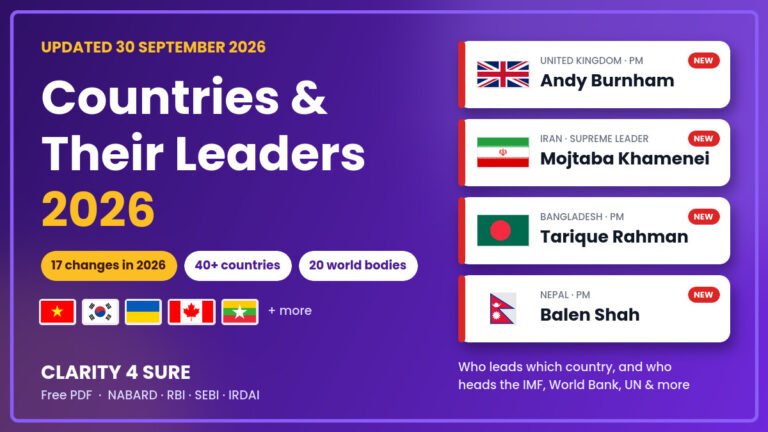 Free sheet · Static GKCountries & Their Leaders 2026Who leads which country in 2026, with all 17 changes marked. Get the article and the PDF free on WhatsApp.Get it free on WhatsApp →
‘The Second Orbit’ Memoir Released in New Delhi
The Second Orbit was released by Amar Preet Singh. The memoir chronicles astronaut Shubhanshu Shukla’s journey to the ISS. It aims to inspire youth toward STEM and space exploration.
VP Releases ‘Sanskritir Ratna Bhandar’ Book
Sanskritir Ratna Bhandar: Bhaowaiyar Itibritto was released by C. P. Radhakrishnan. The book documents the cultural heritage of Bhawaiya folk music. It highlights preservation of India’s regional traditions.
World Refrigeration Day Observed on June 26
World Refrigeration Day highlights the importance of refrigeration and cooling technologies. The 2026 theme is “Cool Intelligence.” It promotes sustainable cooling and energy-efficient innovation.
International Day of Deafblindness Observed on June 27
The day raises awareness about deafblindness and challenges faced by affected individuals. It promotes inclusion, accessibility, and equal rights. The UN officially recognized the observance in 2025.
Sanjay Jaju Appointed Telangana Chief Secretary
Sanjay Jaju was appointed the new Chief Secretary of Telangana. He succeeds K. Ramakrishna Rao and also holds additional administrative responsibilities. His appointment strengthens governance.
Government Launches Revamped Anaemia Mukt Bharat Abhiyaan
Ministry of Health and Family Welfare launched the revamped Anaemia Mukt Bharat Abhiyaan. The programme introduces a new 7x7x7 strategy and T4 approach—Test, Treat, Talk, and Track. It expands into a technology-enabled, people-centric health mission.
Pralhad Joshi to Inaugurate Two Major Solar Power Parks in Madhya Pradesh
Pralhad Joshi will inaugurate two major solar power parks in Madhya Pradesh at Neemuch and Shajapur. These projects aim to boost renewable energy generation and strengthen India’s clean energy transition. The parks will support the country’s solar power capacity expansion.
J.P. Nadda to Launch Samagra Shishu Bal Swasthya Karyakram
Jagat Prakash Nadda will launch the Samagra Shishu Bal Swasthya Karyakram in New Delhi. The initiative focuses on improving child health, nutrition, and early healthcare intervention. It aims to strengthen pediatric healthcare delivery nationwide.
Tiger Reintroduction in Sariska Completes 18 Years
Bhupender Yadav congratulated citizens on 18 years of tiger reintroduction in Sariska Tiger Reserve. The milestone reflects India’s successful wildlife conservation efforts. Sariska remains a key example of tiger restoration.
INS Udaygiri, Kavaratti and Shakti Reach Thailand
Indian Navy ships INS Udaygiri, INS Kavaratti, and INS Shakti reached Sattahip, Thailand. The deployment aims to enhance maritime cooperation in Southeast Asia. It strengthens regional naval partnerships and strategic engagement.
INS Ikshak Reaches Seychelles on Operational Deployment
Indian Navy’s survey vessel INS Ikshak reached Port Victoria in Seychelles. The deployment supports maritime cooperation in the South West Indian Ocean Region. It reinforces India’s regional maritime presence.
Shivraj Singh Chouhan to Chair National Rural Development Conference 2026
Shivraj Singh Chouhan will chair the National Rural Development Conference 2026 in New Delhi. The conference will focus on rural development strategies and policy coordination. It aims to accelerate inclusive rural growth.
Amit Shah Launches Cooperative Taxi Service ‘Bharat Taxi’
Amit Shah launched cooperative ride-hailing service Bharat Taxi in Gujarat. The platform will expand to 500 cities and towns over the next two years. It aims to promote cooperative entrepreneurship in mobility services.
India Launches World’s First Nuclear Heat-Based Hydrogen Facility
Department of Atomic Energy inaugurated the world’s first hydrogen production facility using the Copper–Chlorine thermochemical cycle. Located at Indira Gandhi Centre for Atomic Research, it uses nuclear process heat for carbon-free hydrogen production. The facility marks a major clean-energy breakthrough.