Daily Current Affairs (DCA) 4 June, 2026
Free live session
NABARD Grade A 2026: 45-Day Final Revision Plan + Daily Targets
 🔒 Register to watchLast Sunday’s session · recording
8 of the top 10 in NABARD Grade A 2025, Rank 1 included, and Rank 1 back to back before that in 2021 and 2022: all prepared with C4S. Watch last Sunday's session on the 45-day final revision plan now, then join the next one live on Zoom.
Today · 8:30 PM IST · 75 minutes · free
In the news1
Context:
Forbes, the American business magazine and global media company, has released its latest World’s Top 10 Richest People rankings (as of 1 June 2026). Elon Musk, the CEO of Tesla and SpaceX, has retained the top spot since May 2024, with an estimated net worth of USD 835 billion. Larry Page, co-founder of Alphabet Inc. (Google’s parent), is in second place with USD 309 billion, while his fellow co-founder Sergey Brin is third with USD 285 billion. The list reflects the continued dominance of US-based tech billionaires in global wealth rankings.
Key Facts
Forbes Top 10 Richest People in the World (June 2026):
| Rank | Person | Net Worth (USD billion) | Source / Company |
|---|---|---|---|
| 1 | Elon Musk | 835 | Tesla, SpaceX |
| 2 | Larry Page | 309 | Alphabet (Google) co-founder |
| 3 | Sergey Brin | 285 | Alphabet (Google) co-founder |
| 4 | Jeff Bezos | 277 | Amazon, Blue Origin founder |
| 5 | Larry Ellison | 276 | Oracle co-founder and Chairman |
| 6 | Michael Dell | 260.1 | Dell Technologies |
| 7 | Mark Zuckerberg | 206.1 | Meta Platforms (Facebook, Instagram, WhatsApp) |
| 8 | Jensen Huang | 193.7 | NVIDIA CEO |
| 9 | Bernard Arnault | 149.1 | LVMH (Louis Vuitton, Dior, etc.) |
| 10 | Steve Ballmer | 143.5 | Former CEO, Microsoft |
Indian billionaires like Mukesh Ambani (Reliance Industries) and Gautam Adani (Adani Group) are usually in the global top 20-25, but not in the top 10 as of this snapshot. India also features many other names in the Forbes World’s Billionaires list.
About Forbes and the ranking:
- Forbes: an American business magazine founded in 1917 by B. C. Forbes and Walter Drey; headquartered in Jersey City, New Jersey, USA.
- Forbes is famous for several global lists, including the World’s Billionaires list, Forbes 400 (richest Americans), Global 2000 (largest public companies), Most Powerful People, and Best Countries for Business.
- The wealth estimates are calculated based on public stock holdings, private business valuations, real estate, and other assets, net of debts, on a specified date.
Practice MCQs
Q1. With reference to the Forbes World’s Top 10 Richest People list (June 2026), consider the following statements:
- Elon Musk topped the list with an estimated net worth of about USD 835 billion.
- Larry Page and Sergey Brin, co-founders of Alphabet (Google’s parent), are ranked second and third respectively.
- Jeff Bezos, founder of Amazon and Blue Origin, is ranked fourth with about USD 277 billion.
- Bernard Arnault, Chairman of LVMH, is the only non-American billionaire in the top 10 of this list.
How many of the above statements are correct? (a) Only one (b) Only two (c) Only three (d) All four (e) None
Q2. Consider the following statements about specific billionaires in the Forbes June 2026 list:
- Larry Ellison is associated with the technology company Oracle.
- Jensen Huang is the CEO of NVIDIA, a leading semiconductor company.
- Bernard Arnault heads LVMH, which owns brands like Louis Vuitton, Dior, Tiffany, and Bulgari.
- Steve Ballmer is a former CEO of Apple.
Which of the above are correct? (a) 1, 2 and 3 only (b) 1, 3 and 4 only (c) 2 and 4 only (d) 1 and 4 only (e) All four (Statement 4 is wrong; Steve Ballmer is a former CEO of Microsoft, NOT Apple.)
Q3. With reference to Forbes and its rankings, consider the following statements:
- Forbes is an American business magazine and global media company founded in 1917 by B. C. Forbes and Walter Drey.
- Forbes is headquartered in Jersey City, New Jersey, USA.
- Forbes publishes lists such as the World’s Billionaires, Forbes 400, Forbes Global 2000, Most Powerful People, and Forbes 30 Under 30.
- The Forbes World’s Billionaires list is published once a year, although net worth is also tracked in real time on its website.
Which of the above are correct? (a) 1, 2 and 3 only (b) 1, 3 and 4 only (c) 2 and 4 only (d) 1 and 4 only (e) All four
Q4. Consider the following statements about wealth concentration and inequality:
- Wealth concentration refers to the unequal distribution of accumulated assets, not annual income.
- Income inequality measures the distribution of annual earnings, while wealth concentration measures the distribution of total wealth.
- The Gini coefficient is a commonly used measure of inequality, with values closer to 1 indicating greater inequality.
- SDG 10 of the United Nations Sustainable Development Goals focuses on reducing inequality within and among countries.
How many of the above statements are correct? (a) Only one (b) Only two (c) Only three (d) All four (e) None
Answer Key
- (d), All four statements are correct.
- (a), Statements 1, 2, 3 are correct; Statement 4 is wrong because Steve Ballmer is a former CEO of Microsoft, not Apple.
- (e), All four statements are correct.
- (d), All four statements are correct.
National Affairs3
How & Why Farmers Producers Organization are formed? FPO #fpo #upsc #nabardgradea #agriculturenotesTap to play · from the C4S channel
Context:
India has received the fourth squadron of the Russian-made S-400 long-range air defence missile system from Russia, as part of the USD 5.43-billion contract signed between India and Russia in 2018 for the acquisition of five S-400 regimental systems. The fourth squadron arrived in May 2026, and is expected to be deployed in an operational area shortly. Three S-400 squadrons had already been inducted into service before this; the fourth has now arrived after delays caused by the Russia-Ukraine conflict, which had disrupted defence supply chains between Russia and several global partners.
Key Highlights
- System: S-400 Triumf (NATO reporting name: SA-21 Growler).
- Origin: Russian-made.
- Contract value: USD 5.43 billion.
- Number of squadrons: 5 (under the contract).
Key capabilities of the S-400:
| Feature | Detail |
|---|---|
| Type | Long-range surface-to-air missile (SAM) system |
| Maximum range | About 400 km (longest-range variant) |
| Engagement altitude | From a few metres to 30+ km |
| Targets | Aircraft, drones, cruise missiles, short and intermediate-range ballistic missiles |
| Simultaneous targets | Can track 300+ targets and engage multiple simultaneously |
| Multi-layered missiles | Different missiles for short, medium, long, and very-long range |
| Mobility | Highly mobile, road-based; can deploy and relocate quickly |
Background Concepts
What is the S-400 Triumf, and What Makes It a Top-Tier Air Defence System?
The S-400 Triumf (NATO reporting name: SA-21 Growler) is a Russian-made long-range, mobile, surface-to-air missile (SAM) system developed by Almaz-Antey, designed to protect large air-defence areas against a wide range of aerial threats. It entered service with the Russian Armed Forces in 2007 and has been exported to several countries, including China, Turkey, Belarus, Algeria, Saudi Arabia, and India.
What makes the S-400 a top-tier air defence system:
(a) Multi-target tracking: Can track over 300 targets simultaneously and engage multiple simultaneously.
(b) Multi-layered missile mix: The system fires different types of missiles for different ranges:
- Very long-range missile (up to 400 km), capable of engaging high-altitude, high-value targets like AWACS aircraft and refuelling tankers.
- Long-range missile (up to 250 km).
- Medium-range missile (around 120 km).
- Short-range missile (around 40 km) for close-in defence.
(c) Wide altitude coverage: From a few metres above ground (against cruise missiles) to about 30 km altitude (against ballistic missiles).
(d) High mobility: The system is road-mobile, allowing fast deployment and relocation, which makes it less vulnerable to enemy strikes.
(e) Robust radars and command systems: Each S-400 unit includes multiple radars for early warning, target acquisition, fire control, and a command-and-control vehicle.
(f) Engagement of multiple threat types: Aircraft (including stealth), drones, cruise missiles, and short to intermediate-range ballistic missiles.
Practice MCQs
Q1. With reference to the recent delivery of the fourth S-400 squadron, consider the following statements:
- India has received the fourth S-400 air defence squadron from Russia in May 2026.
- The S-400 deal between India and Russia was signed in 2018 for five regimental systems, worth USD 5.43 billion.
- The fifth and final S-400 squadron under the contract is expected to be delivered in 2027.
- The fourth squadron will be integrated with AI-enabled decision-support capabilities for threat prioritisation.
How many of the above statements are correct? (a) Only one (b) Only two (c) Only three (d) All four (e) None
Q2. Consider the following statements about the S-400 Triumf air defence system:
- The S-400 is a Russian-made, long-range, mobile surface-to-air missile system developed by Almaz-Antey.
- It can engage targets such as aircraft, drones, cruise missiles, and short and intermediate-range ballistic missiles.
- Its longest-range missile can engage targets up to about 400 km away.
- The S-400 cannot track multiple targets at the same time.
Which of the above are correct? (a) 1, 2 and 3 only (b) 1, 3 and 4 only (c) 2 and 4 only (d) 1 and 4 only (e) All four (Statement 4 is wrong; the S-400 can track over 300 targets simultaneously and engage multiple targets at the same time.)
Q3. With reference to India’s air defence architecture, consider the following statements:
- The Akash missile system is an indigenous medium-range surface-to-air missile system developed by DRDO.
- The MR-SAM (Barak-8) is a joint India-Israel medium-range air defence system.
- Project Kusha is an indigenous long-range air defence missile project under development by DRDO.
- Akashteer is an indigenous air-defence command-and-control system designed to integrate multiple air defence assets.
Which of the above are correct? (a) 1, 2 and 3 only (b) 1, 3 and 4 only (c) 2 and 4 only (d) 1 and 4 only (e) All four
Q4. Consider the following statements about the impact of the Russia-Ukraine conflict on Indian defence imports:
- The Russia-Ukraine conflict has affected the delivery timelines of major Russian defence systems including the S-400 to India.
- India faces potential secondary sanction risks under the US CAATSA framework for purchasing major Russian weapons.
- India has used the disruption as one reason to diversify its defence partnerships with France, the United States, and Israel.
- The Russia-Ukraine conflict has fully ended India’s defence relationship with Russia.
Which of the above are correct? (a) 1, 2 and 3 only (b) 1, 3 and 4 only (c) 2 and 4 only (d) 1 and 4 only (e) All four (Statement 4 is wrong; the Russia-Ukraine conflict has not ended India’s defence relationship with Russia; India continues to acquire major Russian systems, including the S-400, and remains a significant defence partner.)
Answer Key
- (d), All four statements are correct.
- (a), Statements 1, 2, 3 are correct; Statement 4 is wrong because S-400 can track and engage multiple targets simultaneously.
- (e), All four statements are correct.
- (a), Statements 1, 2, 3 are correct; Statement 4 is wrong because India’s defence ties with Russia have continued, not ended.
Context:
The Department of Higher Education under the Ministry of Education has officially opened applications for the Prime Minister Research Chair (PMRC) Scheme 2026. The PMRC is a national talent-repatriation initiative that creates a direct pathway for top Indian-origin researchers working in leading foreign universities, private laboratories, and tech industries to take up high-level research positions in premier Indian institutions, especially in 13 strategic technology areas critical to India’s economic and security future.
About Scheme
The scheme will link global Indian talent with the country’s rapidly expanding research, development, innovation and technology ecosystem across 13 thematic areas of national priority, including Advanced Computing, Semiconductors and Cybersecurity.
Key Facts
- Scheme: Prime Minister Research Chair (PMRC) Scheme 2026.
- Ministry: Department of Higher Education, Ministry of Education.
- Budget estimate: about ₹200 crore for multi-year research grants, relocation, fellowships, and lab infrastructure.
- Governance: An Empowered Committee chaired by the Principal Scientific Adviser (PSA) to the Government of India.
13 Prioritised Strategic Thematic Areas:
| Category | Areas |
|---|---|
| Computing and Tech (4) | Advanced Computing (AI, Quantum, Supercomputing), Semiconductors, Next-Generation Communications, Cybersecurity |
| Industrial and Infrastructure (4) | Manufacturing and Industry 4.0, Advanced Materials and Critical Minerals, Space and Defence, Atomic Energy |
| Sustainability and Biology (5) | Energy, Sustainability and Climate Change, Biotechnology, Healthcare and MedTech, Agri and Food Technologies, Blue Economy |
Difference from PMRF (often confused):
| Indicator | PMRC (this scheme) | PMRF (Prime Minister’s Research Fellowship) |
|---|---|---|
| Target | Indian-origin researchers abroad | Indian students pursuing PhDs in India |
| Stage | Mid- to senior-level researchers | Doctoral (PhD) candidates |
| Aim | Talent repatriation | Top domestic doctoral fellowships |
About the News (Q&A)
What is the Prime Minister Research Chair (PMRC) Scheme?
A government scheme to attract top Indian-origin researchers working abroad to take up research positions in top Indian institutions, particularly in 13 strategic technology areas.
Who administers and funds it?
The Department of Higher Education, Ministry of Education, with an Empowered Committee chaired by the Principal Scientific Adviser to the Government of India for evaluation and selection.
Background Concepts (Q&A)
What is the “National Institutional Ranking Framework (NIRF)”, and Why is It Central to the PMRC?
The National Institutional Ranking Framework (NIRF) is the Government of India’s official ranking system for higher education institutions, launched in 2015 by the Ministry of Education (then Ministry of Human Resource Development). The framework ranks institutions across multiple categories, including Overall, Universities, Engineering, Management, Pharmacy, Medical, Law, Architecture, Dental, Research, Agriculture, Innovation, and State Universities.
NIRF rankings are based on five broad parameters:
(a) Teaching, Learning, and Resources, covering faculty-student ratios, infrastructure, and PhD output. (b) Research and Professional Practice, covering publications, citations, intellectual property, and funded research. (c) Graduation Outcomes, including placement, higher studies progression, and exam results. (d) Outreach and Inclusivity, including gender diversity, regional diversity, and outreach to disadvantaged groups. (e) Perception, based on a wide survey of employers, academics, and professionals.
NIRF is central to the PMRC because the host eligibility criteria are tied directly to NIRF ranks. Institutions in the Top 100 of NIRF Overall or Engineering, or Top 50 of NIRF Research, are eligible to host PMRC researchers. This use of NIRF acts as a quality filter, ensuring that incoming global talent is hosted only by institutions with strong academic and research environments, with the infrastructure and culture to support high-end work.
Practice MCQs
Q1. With reference to the Prime Minister Research Chair (PMRC) Scheme 2026, consider the following statements:
- The scheme is administered by the Department of Higher Education under the Ministry of Education.
- It is designed to attract Indian-origin researchers working in leading foreign universities, private laboratories, and tech industries to top Indian institutions.
- The scheme has three tiers: Young Research Fellows, Senior Research Fellows, and Research Chairs.
- The Empowered Committee that selects fellows and proposals is chaired by the Principal Scientific Adviser to the Government of India.
How many of the above statements are correct? (a) Only one (b) Only two (c) Only three (d) All four (e) None
Q2. Consider the following statements about the institutional eligibility under the PMRC scheme:
- Only government Higher Education Institutions ranked in the Top 100 of NIRF Overall or Engineering, or Top 50 of NIRF Research, can host PMRC researchers.
- Selected national research labs under DST, DBT, ICMR, and CSIR are also eligible to host PMRC researchers.
- Seven institutions, including IIT Delhi, IIT Bombay, IIT Madras, IIT Kanpur, IIT Hyderabad, IIT (ISM) Dhanbad, and IISc Bengaluru, have been designated as Lead Hubs.
- The scheme is open to all private universities in India regardless of NIRF ranking.
Which of the above are correct? (a) 1, 2 and 3 only (b) 1, 3 and 4 only (c) 2 and 4 only (d) 1 and 4 only (e) All four (Statement 4 is wrong; the PMRC scheme is restricted to government Higher Education Institutions meeting NIRF criteria, NOT all private universities.)
Q3. With reference to the 13 strategic thematic areas under the PMRC scheme, consider the following statements:
- The Computing and Tech category includes Advanced Computing (AI, Quantum, and Supercomputing), Semiconductors, Next-Generation Communications, and Cybersecurity.
- Space and Defence and Atomic Energy are among the prioritised areas.
- Biotechnology, Healthcare and MedTech, Agri and Food Technologies, and Blue Economy are part of the Sustainability and Biology category.
- The Sports and Recreation sector is one of the 13 prioritised thematic areas under the scheme.
Which of the above are correct? (a) 1, 2 and 3 only (b) 1, 3 and 4 only (c) 2 and 4 only (d) 1 and 4 only (e) All four (Statement 4 is wrong; Sports and Recreation is not one of the 13 prioritised thematic areas.)
Q4. Consider the following statements about the broader research ecosystem in India:
- The Anusandhan National Research Foundation (ANRF) was set up under the ANRF Act, 2023, and is chaired by the Prime Minister.
- The National Institutional Ranking Framework (NIRF) is run by the Ministry of Education and ranks institutions across multiple categories.
- The Principal Scientific Adviser (PSA) is an ex-officio member of the ANRF and chairs the PMRC Empowered Committee.
- The Prime Minister’s Research Fellowship (PMRF) and the Prime Minister Research Chair (PMRC) are the same scheme.
Which of the above are correct? (a) 1, 2 and 3 only (b) 1, 3 and 4 only (c) 2 and 4 only (d) 1 and 4 only (e) All four (Statement 4 is wrong; PMRF and PMRC are different schemes: PMRF supports doctoral students in India, while PMRC targets Indian-origin researchers abroad at mid and senior levels.)
Answer Key
- (d), All four statements are correct.
- (a), Statements 1, 2, 3 are correct; Statement 4 is wrong because the scheme is restricted to government Higher Education Institutions meeting NIRF criteria and select research labs.
- (a), Statements 1, 2, 3 are correct; Statement 4 is wrong because Sports and Recreation is not among the 13 prioritised areas.
- (a), Statements 1, 2, 3 are correct; Statement 4 is wrong because PMRF and PMRC are distinct schemes.
Context:
Union Minister Jyotiraditya M. Scindia and the Chief Minister of Assam have launched Mission Senehjori on 2 June 2026, an Atmanirbhar North East project aimed at transforming Assam’s Muga silk, the only silk in the world that is golden in colour and produced exclusively in Assam, into a globally competitive luxury ecosystem. The mission is anchored by the Ministry of Development of North Eastern Region (MDoNER), in convergence with the Ministry of Textiles and the Government of Assam, and will work along the entire farm-to-foreign-shores value chain.
Key Facts
- Initiative: Mission Senehjori.
- Launched on: 2 June 2026.
- Launched by: Union Minister Jyotiraditya M. Scindia (MDoNER) and the Chief Minister of Assam.
- Anchor ministry: Ministry of Development of North Eastern Region (MDoNER).
- Partner ministry: Ministry of Textiles.
- Implementing State: Government of Assam.
- Programme type: Cluster-based, value-chain-focused textile initiative.
Why Muga silk matters:
| Indicator | Detail |
|---|---|
| Produced exclusively in | Assam (a globally unique product) |
| Colour | Natural golden tint, brightens with age |
| Geographical Indication (GI) tag | Yes (since 2007) |
| Host plants | Som (Persea bombycina) and Soalu (Litsea polyantha) trees |
| Current rearer-weaver income (annual) | About ₹18,000 to ₹21,000 |
Main goals:
(a) Raise annual incomes of Muga rearers and weavers (currently very low).
(b) Capture full premium value of Muga silk from the farm gate to international markets.
(c) Position Muga silk as a traceable, GI-tagged, high-end global commodity.
(d) Preserve Assam’s silk heritage and culture.
Why this matters:
(a) Muga silk is one of Assam’s most unique cultural and economic assets, but rearers and weavers earn very low incomes.
(b) The golden colour and rarity give Muga strong luxury-market potential, especially in Japan, the EU, and the Middle East.
(c) GI authentication and digital traceability can protect Muga from cheaper imitations.
(d) FPOs and Farmer Interest Groups give weavers and rearers collective bargaining power.
(e) Silk tourism can create additional employment and link the textile story to cultural experience.
(f) Fits the Aatmanirbhar North East vision and the broader Viksit Bharat 2047 focus on traditional, place-based industries.
Other Indian silks for context:
| Silk | Where Produced | Type |
|---|---|---|
| Muga | Assam (only place in the world) | Wild silk, golden |
| Eri / Endi | Assam, Meghalaya, Bihar, parts of NE | Wild silk, vegan (non-violent) |
| Tasar | Jharkhand, Chhattisgarh, Odisha, MP | Wild silk |
| Mulberry | Karnataka, AP, TN, WB, J&K | Cultivated silk (largest share) |
About the News (Q&A)
What is Mission Senehjori?
A cluster-based, value-chain-focused textile initiative to transform Assam’s Muga silk into a globally competitive luxury brand, anchored by MDoNER in partnership with the Ministry of Textiles and the Government of Assam.
What is special about Muga silk?
Muga silk is produced exclusively in Assam, has a natural golden colour that brightens with age, holds a Geographical Indication (GI) tag since 2007, and is reared on the leaves of Som and Soalu trees.
Practice MCQs
Q1. With reference to Mission Senehjori, consider the following statements:
- Mission Senehjori was launched in June 2026 to transform Assam’s Muga silk into a global luxury brand.
- It is an Atmanirbhar North East project anchored by the Ministry of Development of North Eastern Region (MDoNER).
- It works in convergence with the Ministry of Textiles and the Government of Assam.
- The mission targets annual Muga silk exports of over 2,000 kg by 2028.
How many of the above statements are correct? (a) Only one (b) Only two (c) Only three (d) All four (e) None
Q2. Consider the following statements about the key targets and components of Mission Senehjori:
- The mission plans to regenerate about 5,000 hectares of Som and Soalu host plants.
- It aims to establish five modernised reeling units and a specialised Muga Spun Mill.
- The mission will create 30 Farmer Producer Organisations and over 1,180 Farmer Interest Groups.
- About 80 per cent of traded Muga silk is targeted to be authenticated under the Geographical Indication (GI) tag.
Which of the above are correct? (a) 1, 2 and 3 only (b) 1, 3 and 4 only (c) 2 and 4 only (d) 1 and 4 only (e) All four
Q3. With reference to Muga silk, consider the following statements:
- Muga silk is produced exclusively in Assam.
- It is produced by the Muga silkworm, Antheraea assamensis, which feeds on Som and Soalu trees.
- Muga silk has a natural golden tint that brightens over time with washing and wear.
- Muga silk is a type of cultivated mulberry silk.
Which of the above are correct? (a) 1, 2 and 3 only (b) 1, 3 and 4 only (c) 2 and 4 only (d) 1 and 4 only (e) All four (Statement 4 is wrong; Muga is a wild, non-mulberry silk, not a cultivated mulberry silk.)
Q4. Consider the following statements about Geographical Indication (GI) tags in India:
- Geographical Indications in India are governed by the Geographical Indications of Goods (Registration and Protection) Act, 1999.
- The GI Registry in India is headquartered in Chennai.
- Muga silk of Assam received a Geographical Indication tag in 2007.
- India’s protection of GIs is broadly aligned with the obligations under the WTO’s TRIPS Agreement.
How many of the above statements are correct? (a) Only one (b) Only two (c) Only three (d) All four (e) None
Answer Key
- (d), All four statements are correct.
- (e), All four statements are correct.
- (a), Statements 1, 2, 3 are correct; Statement 4 is wrong because Muga is a wild, non-mulberry silk.
- (d), All four statements are correct.
Exam Relevance
| Exam | Relevance |
|---|---|
| UPSC Prelims | GS Paper II on Government Schemes; GS Paper III on Indian Economy (Textiles, GI, Exports) |
| UPSC Mains | GS Paper II on Welfare schemes, North East development; GS Paper III on Indian Economy, Textiles, IPR |
| BPSC and State PCS | Schemes, Economy, Current Affairs |
| Banking and NABARD | General Awareness on rural livelihoods and FPOs |
| NABARD Grade A | Very high importance on rural development, FPOs, sericulture |
Every day of the month in one file. Enter your details once — the download opens right away.
We already have your details, so no form: tap to open.
Download the June 2026 PDFDownload the June 2026 revision sheet PDFBanking/Finance1
Context:
The Reserve Bank of India has released its Annual Report 2025-26, a statutory report of its Central Board of Directors covering its working and functions from April 2025 to March 2026. The report shows an Indian economy that grew at 7.6 per cent, with sharp food deflation pulling CPI to 2.1 per cent, alongside a depreciating rupee, FPI outflows, falling Sensex, a widening trade deficit cushioned by services and remittances, and an RBI that cut the policy repo rate by 100 bps to 5.25 per cent while running a larger balance sheet (26.4 per cent of GDP) through the West Asia conflict-driven external stress.
PART ONE: THE ECONOMY
Chapter I: Taking Stock and Looking Forward
The World Economy
Worldwide output expanded 3.4% during 2025, a touch above the 3.3% recorded in 2024. The year was a tug-of-war: steep tariffs, mounting public debts, and murky trade rules dragged on activity, while early stockpiling of imports ahead of tariffs, the reshaping of supply chains, and a wave of AI-driven technology spending propped it up. Once hostilities erupted in West Asia in the final days of February 2026, the IMF trimmed its 2026 global growth call to 3.1%.
Trade told a similar story. The total volume of goods and services traded across borders climbed 5.1% in 2025. Goods led with 4.6% growth as firms loaded up on technology inventory, whereas services cooled to 5.3% once the rush of post-pandemic travel ran its course. For 2026, the IMF anticipates a marked slowdown to 2.8%.
On prices, global inflation drifted down to 4.1% over 2025. With the West Asian flare-up snarling shipping lanes and supply networks, however, the Fund nudged its 2026 inflation projection up to 4.4%.
India’s Economy
India held on to its title as the quickest-expanding major economy. Real GDP rose 7.6% in 2025-26, building on the prior year’s 7.1%, with buoyant household demand and dependable investment doing the heavy lifting. Looking to 2026-27, growth is pencilled in at 6.9%, though the balance of risks tilts downward given the threat of dearer freight and energy from overseas.
Inflation eased dramatically. Headline CPI cooled to 2.1% in 2025-26 from 4.6% a year earlier, almost entirely because food turned cheaper. The forecast for 2026-27 sits at 4.6%, with risks pointing higher.
Chapter II: The Economy in Detail
The Real Economy
On the demand side, consumer spending continued to anchor the economy. It quickened to 7.7% in 2025-26 from 5.8%, lifted by firm appetite in both rural and urban markets. Investment in physical assets such as plants and machinery advanced a healthy 7.1%, and the broader investment-to-GDP ratio held firm at 34.3% in 2024-25.
Savings improved as well. National savings reached 34.2% of disposable income in 2024-25, households’ net financial savings edged up to 7.0%, and the government’s shortfall between earning and spending narrowed to 4.6% of GDP from 5.3%. Closing this gap between what the nation saves and invests has left India leaning less heavily on fickle foreign capital.
Turning to supply, farming lost momentum, slowing to 2.4% from 4.2% as poor weather hit the monsoon (Kharif) harvest. A generous South-West monsoon offered relief, though, pushing reservoir levels to a record 91.4% by October 2025 and giving the winter and summer crops a boost. Come end-March 2026, the government’s grain reserves stood at over four times the legally required cushion.
Industry was a standout, growing 9.5% versus 8.7% the year before, with manufacturing surging 11.5% and factory utilisation climbing to 75.6% by the third quarter. The clean-energy push also hit milestones: renewable capacity passed 250 GW, total non-fossil capacity reached 283 GW — more than half (53.2%) of the power mix — fulfilling the COP26 pledge years ahead of 2030, while EV sales topped 25 lakh units under PM E-DRIVE. Services, contributing 69% of real growth, grew 8.7%, powered by trade, transport, hospitality, and professional finance and IT work.
Prices
A new price-measurement framework arrived in February 2026, when MoSPI rolled out a CPI series rebased to 2024, refreshing the basket using the 2023-24 household spending survey. Food and beverages saw their weight cut from 45.9% to 36.8%, ready meals were folded into restaurants and accommodation, a single housing-and-fuel category was carved out at 17.7%, and transport (8.8%) and information and communication (3.6%) were given their own slots.
Behind the headline numbers, food prices slipped 0.8% from April to December 2025. Tomatoes, onions, and potatoes plunged 31.3% as onion output jumped 26.7% and buffer stocks were released; pulses also fell, down 13%. Cutting the other way, edible oils and fats vaulted 15.0% on the back of global palm-oil biodiesel rules. Fuel inflation crept up to 2.4% over the same stretch after LPG cylinders rose ₹50 in April 2025 and another ₹60 in March 2026. Stripping out food and fuel, core inflation lingered near 4.3% (3.7% in the fourth quarter under the new series), kept warm by personal-care costs — chiefly gold and silver, which spiked as nervous investors sought shelter. Elsewhere, wholesale inflation softened to 0.7% from 2.3% on cheaper energy, and the GDP deflator fell to 0.9% from 2.5%.
Money and Credit
The RBI’s balance sheet equalled 26.4% of GDP. After accounting for the staggered one-percentage-point cut to the Cash Reserve Ratio — which brought the requirement down to 3.0% — reserve money grew 10.8%, while cash in public hands rose 11.4% on welfare payouts and stronger retail spending after tax cuts. Broad money expanded 13.0%, up from 9.4%, aided by a 10.6% rise in time deposits; the currency-to-deposit ratio dipped to 14.9% and the money multiplier firmed to 6.1.
Lending stayed robust. Non-food bank credit grew 15.9%, with non-bank credit up 13.3%. Loans to micro and small firms leapt 33.1% and to medium firms 21.7%; personal loans rose 16.2%, of which housing made up close to half; and bank lending to NBFCs climbed 26.3% once the RBI reset risk weights to normal in April 2025. Because credit outran deposits, the funding gap widened, nudging banks to issue more Certificates of Deposit to plug the hole.
Financial Markets
In the money market, the overnight call rate hugged the repo rate, sitting about 7 basis points beneath it, and collateral-backed trades dominated — triparty repos at 67% and market repos at 30%. Government bond yields dipped early on amid ample liquidity but firmed later, with the 10-year benchmark pushing past 7.04% by late March 2026 as crude prices and borrowing plans rose.
Equities had a rough year: the Sensex shed 7.1% to close at 71,948, as a strong first half gave way to a second-half slide driven by West Asian strains and a reset in tech valuations. Foreign portfolio investors offloaded a net ₹2.7 lakh crore of shares, while domestic institutions snapped up a net ₹8.5 lakh crore. The rupee leaned weaker all year, ending 9.9% lower at ₹94.83 to the dollar, and the trade-weighted NEER and REER measures fell 6.9% and 7.5%.
Government Finances
The Centre tightened its belt, trimming the fiscal deficit to 4.4% of GDP in 2025-26 (revised) on the strength of solid non-tax receipts and disciplined spending, with the bar set fractionally lower at 4.3% for 2026-27. Direct taxes are slated to reach 6.9% of GDP next year — a ten-year high — and central capital outlay is set to grow 11.5% to ₹12.2 lakh crore. States saw revenue growth ease on thinner central grants and softer GST, yet their combined deficit is budgeted at 3.0% of state GDP, with transfers from the Centre rising 12.2%.
The Sixteenth Finance Commission left the states’ slice of central taxes untouched at 41% but reworked the distribution formula, introducing a 10% weight for a state’s contribution to GDP, while paring income-distance to 42.5%, population to 17.5%, and fiscal performance to 10%. It also scrapped post-devolution revenue-deficit grants to stop rewarding weak revenue effort and to nudge states toward collecting more on their own.
The External Sector
The goods trade gap swelled to US$ 333.2 billion, but a 15.3% jump in net services exports and a 10.1% rise in remittances kept the current account deficit at a slim 1.0% of GDP through April–December 2025. Trade alliances shifted notably — China leapfrogged the US as India’s top single trading partner — and India sealed an FTA with the EU and signed deals with the UK (CETA), Oman (CEPA), and New Zealand (FTA). With inflows falling short of the external gap, reserves fell US$ 30.8 billion (excluding valuation), equity FPI flows reversed by US$ 16.5 billion, and gross FDI rose to US$ 94.5 billion (net US$ 7.7 billion). Reserves finished at US$ 691.1 billion in end-March 2026, covering 11 months of imports and 90.3% of external debt.
PART TWO: THE WORKINGS OF THE RESERVE BANK OF INDIA
Chapter III: Monetary Policy
The Monetary Policy Committee lowered the repo rate by a full percentage point to 5.25%, spread across a 0.25-point move in April 2025, a 0.50-point move in June 2025, and a 0.25-point move in December 2025. Its stance turned accommodative in April 2025 before reverting to neutral in June to preserve flexibility against jumpy fuel and commodity costs.
To keep cash flowing, the RBI added durable liquidity through open-market purchases, dollar-rupee swaps, and the one-point CRR cut, releasing roughly ₹2,50 crore into the system. After an internal review it retired its daily 14-day repo and reverse-repo auctions in favour of 7-day and fine-tuning operations, and the Standing Deposit Facility soaked up 84.9% of daily surplus parked with the central bank.
Rate cuts fed through reasonably well: banks shaved 0.60 point off their one-year median MCLR, fresh-loan rates fell 0.95 point and outstanding-loan rates 0.78 point. Loans tied to external benchmarks reached 65.4% of the total by December 2025, and because private banks carried a far larger share (89.2% against public banks’ 50.6%), cuts reached their borrowers faster.
Chapter IV: Credit Delivery and Financial Inclusion
Banks routed 45.0% of adjusted net credit to priority sectors, comfortably above the 40% floor, with Small Finance Banks topping the table at 78.8%. To ease pressure on small firms, the collateral-free lending ceiling for micro and small enterprises was doubled from ₹10 lakh to ₹20 lakh.
The Financial Inclusion Index rose to 67.0 in March 2025 from 64.2 on better usage and quality. The digital-payments drive achieved full digital onboarding in 710 districts (over 80% of the country), and basic savings accounts reached 7,304 lakh, 52% of them held by women. In December 2025 the RBI launched the 2025-30 financial-inclusion strategy, “Panch-Jyoti,” a 47-point plan resting on five pillars: widening access to affordable services for households and small firms; advancing women-led inclusion through gender-sensitive design; tying livelihoods and skills to formal finance; using financial education to instil discipline; and bolstering customer protection and grievance handling.
Chapter V: Financial Markets and Foreign Exchange
The RBI made the Unique Transaction Identifier mandatory for OTC derivative trades, consolidating the rule into a single master direction. It accepted municipal bonds as repo collateral, tied the FX-Retail platform to Bharat Connect, hooked NDS-OM up to global bond networks, and recognised FIMMDA as a self-regulatory organisation. To tame dollar-rupee swings it intervened across onshore and offshore currency-derivative markets and capped dealers’ net open rupee positions at US$ 100 million by April 2026.
On internationalising the rupee, the central bank finalised local-currency arrangements with the UAE, Indonesia, Maldives, and Mauritius, while banks in 35 countries opened Special Rupee Vostro Accounts. Rupee-settled exports touched ₹1,71,916 crore and imports ₹1,59,691 crore. Banks were cleared to lend rupees to counterparties in Nepal, Bhutan, and Sri Lanka, easing reliance on swap lines. Exporters got breathing room too — those serving Bharat Mart in the UAE were given nine months to repatriate earnings, the standard window for regular exports stretched from 9 to 15 months, and the external-borrowing framework was widened with limits keyed to a borrower’s finances.
Chapter VI: Regulation, Supervision and Stability
In a sweeping simplification, the Department of Regulation rolled more than 11,000 scattered circulars into 244 Master Directions spanning 30 categories and 11 types of regulated entities, and floated 64 draft directions for comment. The fintech arm layered programmability onto retail digital-rupee pilots to deliver food subsidies in Gujarat, Puducherry, and Chandigarh; built the Unified Markets Interface using wholesale CBDC to speed settlement, with a pilot to tokenise Certificates of Deposit; scaled up the Unified Lending Interface; and rolled MuleHunter.ai across banks to catch fraudulent mule accounts in near-real time. The RBI also studied the FREE-AI committee’s report on ethical AI, in step with the government’s launch of “Bharat Gen,” a state-backed multilingual, multimodal language model. On the supervisory front, a cyber-range initiative tested banks’ cyber defences, KYC/AML risk reviews covered NBFCs, and a supervisory data-quality index was built for smaller urban cooperative banks.
Chapter VII: Public Debt Management
The RBI raised ₹14.6 lakh crore in gross market borrowing for the Centre during 2025-26, with 2026-27 budgeted at ₹17.2 lakh crore gross and ₹11.7 lakh crore net (3.0% of GDP) — enough net borrowing to fund 69.2% of the central deficit. For states, it ran the securities programme and extended the 50-year interest-free capital-investment loan scheme, lifting the pool by a third to ₹2 lakh crore.
Chapter VIII: Currency Management
Cash in circulation grew 11.4% by value, up sharply from 5.8%, on spending after income-tax cuts, crop-damage compensation, and state cash transfers; the ₹500 note led in both value and count. Old notes were retired through shredding-and-briquetting and high-speed processing systems, printing costs were trimmed via efficiencies at BRBNMPL presses, coin reach was widened with more mobile vans, and the MANI app for visually impaired users was refreshed.
Chapter IX: Payments, Settlements and Technology
UPI volumes surged 30% past 200 billion transactions a year, and the digital-payments index rose 11%, reflecting steady uptake in rural and semi-urban areas. Under Payments Vision 2028 — themed “Shaping India’s Payment Frontier” and running through December 2028 — the RBI plans a full Digital Payments Intelligence Platform to combat cyber fraud, a central switch-on/switch-off tool for payment channels, and stronger consumer safeguards that cap customer liability for electronic fraud and compensate victims of low-value scams.
Chapter X: Communication, International Relations and Research
The central bank struck digital-asset partnerships with Singapore’s MAS and ran joint sessions with the UAE’s central bank to link fast-payment systems and trial cross-border CBDC flows, and it joined BIS Innovation Hub efforts including Project Rialto and the second phase of Project Mandala to smooth cross-border payments. Its statistical backbone, CIMS, was upgraded for micro-data analytics, sharpening forecasting and risk-tracking while lightening banks’ reporting load.
Chapter XI: Governance, Human Resources and Organisation
The RBI unveiled Utkarsh 2029, its 2026-29 strategy centred on earlier risk detection, deeper root-cause analysis, and more consistent supervisory action, and consolidated technical training under the Enterprise Computing and Cybersecurity Training Institute. It also pared back routine reporting for commercial bank boards so they can focus more on strategy and risk.
Chapter XII: The Reserve Bank’s Accounts for 2025-26
The balance sheet grew to 26.4% of GDP as of 31 March 2026, up from 23.7%, propelled by revaluation gains on foreign-currency assets and gold amid exchange-rate moves and rising bullion prices. Gold’s share of net foreign assets accordingly rose to 17.2% from 12.0%, and net income gains enabled a surplus transfer to the Centre to shore up stabilisation reserves.
Key Terms (Simple Explanations)
- GDP (Gross Domestic Product): Total value of all goods and services produced inside a country in a year. The headline measure of an economy’s size.
- CPI (Consumer Price Index): A measure of how prices of a basket of goods and services bought by households change over time. India’s official inflation target is based on CPI.
- WPI (Wholesale Price Index): A measure of how prices change at the wholesale (bulk) level, before goods reach consumers.
- GVA (Gross Value Added): The value an industry adds at each stage of production; GDP at factor cost is built up from GVA across sectors.
- GNDI (Gross National Disposable Income): A country’s total income (including transfers from abroad like remittances) that is available for spending and saving.
- GFCF (Gross Fixed Capital Formation): Investment in long-lived assets like factories, machinery, buildings, and infrastructure. A key sign of how much the economy is investing in its future.
- PFCE (Private Final Consumption Expenditure): Total spending by households on goods and services. It is the biggest component of demand in India.
- Repo Rate: The interest rate at which the RBI lends short-term money to commercial banks. The RBI’s main policy rate.
- CRR (Cash Reserve Ratio): The share of bank deposits that banks must keep as cash with the RBI. Lowering CRR releases more money for banks to lend.
- MPC (Monetary Policy Committee): A six-member committee of the RBI that decides the repo rate and the policy stance. Three members are from the RBI and three are external experts.
- MCLR (Marginal Cost of Funds-based Lending Rate): An internal benchmark used by banks to decide their lending rates, based on their own cost of funds.
- WALR (Weighted Average Lending Rate): The average interest rate that banks actually charge across all their loans, weighted by the size of each loan.
- EBLR (External Benchmark-based Lending Rate): A bank’s lending rate linked to an outside benchmark (usually the repo rate), so that changes in policy rate pass through to customers faster.
- LAF (Liquidity Adjustment Facility): The RBI’s main tool to manage short-term liquidity in the banking system, through repo (lending) and reverse repo (absorbing) operations.
- SDF (Standing Deposit Facility): A facility that lets banks park surplus cash with the RBI without giving collateral, at a rate slightly below the repo rate.
- OMO (Open Market Operations): When the RBI buys or sells government securities in the market to either inject or absorb rupee liquidity.
- VRR / VRRR (Variable Rate Repo / Reverse Repo): Auction-based operations through which the RBI provides or absorbs liquidity at market-determined rates.
- M3 (Broad Money): The widest measure of money supply, including currency with the public, demand deposits, time deposits, and other deposits with the RBI.
- Money Multiplier: The ratio of broad money (M3) to reserve money. It shows how many times the banking system multiplies central bank money.
- ANBC (Adjusted Net Bank Credit): The benchmark amount on which a bank’s Priority Sector Lending obligations are calculated.
- PSL (Priority Sector Lending): A requirement that banks lend a fixed share of their credit to specified priority sectors like agriculture, MSEs, education, housing for the weak, and weaker sections.
- CAD (Current Account Deficit): The gap between what a country pays out to the rest of the world (imports, dividends sent abroad) and what it earns (exports, remittances, services).
- GFD (Gross Fiscal Deficit): The total borrowing requirement of the government in a year, that is, the gap between what it spends and what it earns (excluding borrowings).
- BoP (Balance of Payments): The complete record of all economic transactions between a country and the rest of the world.
- FDI (Foreign Direct Investment): Long-term investment by foreign companies in a country’s businesses, often with management control.
- FPI (Foreign Portfolio Investment): Foreign investment in shares, bonds, and other financial instruments, without management control. More volatile than FDI.
- NEER / REER (Nominal / Real Effective Exchange Rate): NEER is the rupee’s value against a basket of foreign currencies; REER adjusts that for differences in inflation. Falls in these indicate a weaker rupee.
- G-sec (Government Securities): Bonds issued by the Central or State governments to borrow money from the market.
- 10-year yield: The market interest rate on the 10-year G-sec, a key benchmark for long-term borrowing in India.
- CBDC (Central Bank Digital Currency): A digital form of central bank money. India’s CBDC is called the e-rupee, with separate wholesale (CBDC-Wholesale) and retail (CBDC-Retail) versions.
- UPI (Unified Payments Interface): India’s real-time digital payments system that lets users transfer money instantly between bank accounts using a mobile app.
- ULI (Unified Lending Interface): A digital infrastructure built by the RBI to make small-ticket lending faster and friction-free by sharing borrower data with consent.
- SCB (Scheduled Commercial Bank): A bank included in the Second Schedule of the RBI Act, 1934. The main category of formal banks in India.
- SFB (Small Finance Bank): A specialised bank category created by the RBI to extend banking services to small businesses, marginal farmers, and the unbanked.
- NBFC (Non-Banking Financial Company): A financial company that lends and invests but cannot accept demand deposits like a bank.
- FCA (Foreign Currency Assets): The part of India’s reserves held in foreign currencies, mainly in US dollars, euros, yen, and pounds.
- NFA (Net Foreign Assets): A central bank’s total foreign assets minus its foreign liabilities, a key part of its balance sheet.
- HCES (Household Consumption Expenditure Survey): A large-scale national survey of how households spend their money, used to update CPI weights.
- CETA / CEPA / FTA: Different names for trade agreements. FTA is a Free Trade Agreement; CEPA is a Comprehensive Economic Partnership Agreement (broader, includes investment and services); CETA is a Comprehensive Economic and Trade Agreement.
- MoSPI: Ministry of Statistics and Programme Implementation, the central government body that produces India’s official statistics, including the CPI.
- IMF (International Monetary Fund): A 191-member international organisation that monitors the global economy, helps countries with balance of payments problems, and publishes forecasts like the World Economic Outlook.
- FC-XVI: The 16th Finance Commission, a constitutional body that decides how central taxes should be shared between the Centre and the States for a 5-year period.
- Master Directions: Consolidated, single-document regulations issued by the RBI on a specific topic, replacing many earlier scattered circulars.
- SRO (Self-Regulatory Organisation): A non-government organisation recognised by a regulator (like the RBI or SEBI) to set rules and supervise its own industry members.
- LCA (Local Currency Arrangement): A bilateral agreement between two central banks that allows trade between the two countries to be settled in their own currencies, reducing dependence on the US dollar.
- SRVA (Special Rupee Vostro Account): A rupee account opened by a foreign bank in an Indian bank, to settle trade in Indian rupees.
- LLM (Large Language Model): A type of artificial intelligence model trained on large amounts of text. Bharat Gen is India’s own state-backed multilingual, multimodal LLM.
- bps (basis points): A small unit of interest rate measurement. 100 bps = 1 percentage point. So a “100 bps cut” means an interest rate cut of 1 percentage point.
About the News (Q&A)
What is the overall picture from the RBI Annual Report 2025-26?
A fast-growing economy at 7.6 per cent, with sharp food deflation pulling CPI to 2.1 per cent, alongside a depreciating rupee, FPI outflows, falling Sensex, larger trade deficit cushioned by services and remittances, and an RBI that cut both the repo rate and CRR by 100 bps each while running a bigger balance sheet at 26.4 per cent of GDP.
What did the new CPI series change?
The base year moved from 2012 to 2024, with the Food and Beverages weight cut from 45.9 per cent to 36.8 per cent, a new unified Housing-water-electricity-gas-fuels division (17.7 per cent), and Transport and Information and Communication separated as distinct categories.
What are the headline monetary-policy actions?
A cumulative 100 bps repo rate cut to 5.25 per cent (in April, June, and December 2025), a 100 bps CRR cut to 3.0 per cent, and a stance briefly accommodative before returning to neutral.
Background Concepts (Q&A)
What is the “RBI Balance Sheet”, and Why is the 26.4 Per Cent of GDP Figure Significant?
The RBI’s balance sheet captures all its assets and liabilities as the central bank, monetary authority, banker to the government, and manager of foreign exchange reserves. The major assets are foreign currency assets, gold holdings, domestic investments (mainly government securities), and loans and advances to banks and the government. The major liabilities are currency in circulation, deposits from banks (including CRR balances), government deposits, and capital and reserves (including the Contingency Fund and the Currency and Gold Revaluation Account). When the balance sheet expands, it usually reflects larger forex operations, more open market activity, gold accumulation or revaluation gains, and higher currency issuance. The figure of 26.4 per cent of GDP is significant because it shows the balance sheet has grown faster than nominal GDP, signalling active liquidity management, forex intervention, and gold-driven revaluation gains. The Economic Capital Framework, based on the Bimal Jalan Committee (2019), governs how much risk buffer the RBI must hold within this balance sheet, with the Contingent Risk Buffer band of 5.5 to 6.5 per cent of the balance sheet.
What is “Priority Sector Lending (PSL)”, and Why are SFBs Required to Lend a Much Higher Share?
Priority Sector Lending (PSL) is a policy framework under which the RBI mandates that scheduled commercial banks, regional rural banks, small finance banks, and certain other regulated entities must lend a specified share of their Adjusted Net Bank Credit (ANBC) to sectors considered economically essential but credit-deprived. These sectors include agriculture, micro and small enterprises, education, housing for the weaker sections, renewable energy, social infrastructure, and weaker sections more broadly. The general PSL target for domestic commercial banks and foreign banks with 20 or more branches is 40 per cent of ANBC, with sub-targets of 18 per cent for agriculture (within which 10 per cent is for small and marginal farmers), 7.5 per cent for micro enterprises, and 12 per cent for weaker sections. Regional Rural Banks (RRBs) have a higher PSL target of 75 per cent, and Small Finance Banks (SFBs) have a target of 60 per cent of ANBC, reflecting their specialised mandate to serve the unbanked and underserved. Urban Cooperative Banks (UCBs) have a target of 60 per cent, and Foreign Banks with fewer than 20 branches have a target of 40 per cent. SFBs are structurally designed to be community-focused, small-ticket lenders, so a higher PSL target makes sense, and shows in their 78.8 per cent achievement, well above the 60 per cent norm. Banks that fall short must contribute the shortfall to specific funds like the Rural Infrastructure Development Fund (RIDF) with NABARD, the Small Industries Development Fund (SIDBI), or similar arrangements.
Practice MCQs
Q1. With reference to India’s macroeconomic performance in 2025-26 as per the RBI Annual Report, consider the following statements:
- India’s real GDP grew at 7.6 per cent in 2025-26, up from 7.1 per cent in 2024-25.
- Headline CPI inflation moderated sharply to 2.1 per cent in 2025-26 from 4.6 per cent in the previous fiscal year.
- The Current Account Deficit (CAD) was contained at about 1.0 per cent of GDP during April-December 2025.
- India’s real GDP growth for 2026-27 has been projected at 9.5 per cent in the RBI’s report.
How many of the above statements are correct?
(a) Only one (b) Only two (c) Only three (d) All four (e) None
(Statement 4 is wrong; the RBI has projected India’s GDP growth at 6.9 per cent for 2026-27, not 9.5 per cent.)
Q2. Consider the following statements about monetary policy actions of the RBI in 2025-26:
- The MPC cut the policy repo rate cumulatively by 100 basis points to 5.25 per cent during the year.
- The Cash Reserve Ratio (CRR) was cut by 100 bps to 3.0 per cent.
- The MPC’s policy stance was shifted to accommodative in April 2025 but was returned to neutral in June 2025.
- The Standing Deposit Facility (SDF) absorbed about 84.9 per cent of total daily Liquidity Adjustment Facility surplus.
Which of the above are correct?
(a) 1, 2 and 3 only (b) 1, 3 and 4 only (c) 2 and 4 only (d) 1 and 4 only (e) All four
Q3. With reference to the 16th Finance Commission, consider the following statements:
- The vertical devolution share to states has been preserved at 41 per cent.
- The horizontal criteria now include a 10 per cent weight for the States’ contribution to GDP.
- The Income distance weight has been lowered to 42.5 per cent and population to 17.5 per cent.
- The 16th Finance Commission has discontinued post-devolution revenue deficit grants.
Which of the above are correct?
(a) 1, 2 and 3 only (b) 1, 3 and 4 only (c) 2 and 4 only (d) 1 and 4 only (e) All four
Q4. Consider the following statements about Priority Sector Lending (PSL) in India:
- The general PSL target for domestic commercial banks is 40 per cent of Adjusted Net Bank Credit (ANBC).
- Regional Rural Banks (RRBs) have a higher PSL target of 75 per cent of ANBC.
- Small Finance Banks (SFBs) have a PSL target of 60 per cent of ANBC.
- Scheduled Commercial Banks in 2025-26 achieved a PSL ratio of 45.0 per cent of ANBC, exceeding the statutory threshold.
Which of the above are correct?
(a) 1, 2 and 3 only (b) 1, 3 and 4 only (c) 2 and 4 only (d) 1 and 4 only (e) All four
Answer Key
- (c), Statements 1, 2, 3 are correct; Statement 4 is wrong because the RBI has projected 6.9 per cent GDP growth for 2026-27, not 9.5 per cent.
- (e), All four statements are correct.
- (e), All four statements are correct.
- (e), All four statements are correct.
Exam Relevance
For Banking exams (RBI Grade B, SBI PO, IBPS PO and Clerk, NABARD Grade A, SIDBI Grade A), this is absolutely essential, especially RBI Grade B, where the Annual Report is a primary reference for the Economic and Social Issues and Finance and Management papers.
For SEBI Grade A and IRDAI Grade A, the report supports macroeconomic and regulatory awareness.
Facts To Remember9
India Issues Letter of Request to France for Acquisition of 114 Rafale Fighter Jets
The Government of India issued a Letter of Request (LoR) to the Government of France for a government-to-government defence deal worth around Rs.3.25 lakh crore to procure 114 Rafale fighter aircraft for the Indian Air Force (IAF). Under the proposed agreement, nearly 94 Rafale jets are expected to be manufactured in India by Dassault Aviation in partnership with an Indian company. The acquisition is part of India’s Multi-Role Fighter Aircraft (MRFA) programme aimed at addressing the IAF’s declining squadron strength.
Assam Launches ‘Mission Senehjori’ to Promote Muga Silk Ecosystem
Union Minister Jyotiraditya Scindia and Assam Chief Minister Himanta Biswa Sarma launched ‘Mission Senehjori’, a cluster-based initiative to transform Assam’s traditional Muga silk industry into a globally competitive luxury textile ecosystem. The three-year programme (2026–2028), with an investment of around Rs.396–411 crore, aims to create a premium, traceable, and export-oriented Muga silk economy under the unified brand identity ‘Senehjori’.
MoE Launches Prime Minister Research Chair (PMRC) Scheme 2026
The Ministry of Education (MoE) launched the Prime Minister Research Chair (PMRC) Scheme 2026 to attract accomplished Indian-origin researchers, scientists, and technologists from across the world into India’s research ecosystem. The scheme focuses on 13 priority sectors including Artificial Intelligence (AI), semiconductors, quantum computing, biotechnology, healthcare, cybersecurity, climate change, defence, and advanced manufacturing.
 Scheme to knowOne Nation One Subscription (ONOS): Research Access Scheme ExplainedOne Nation One Subscription (ONOS) is a Central Sector scheme under which the Government of India pays for a single…
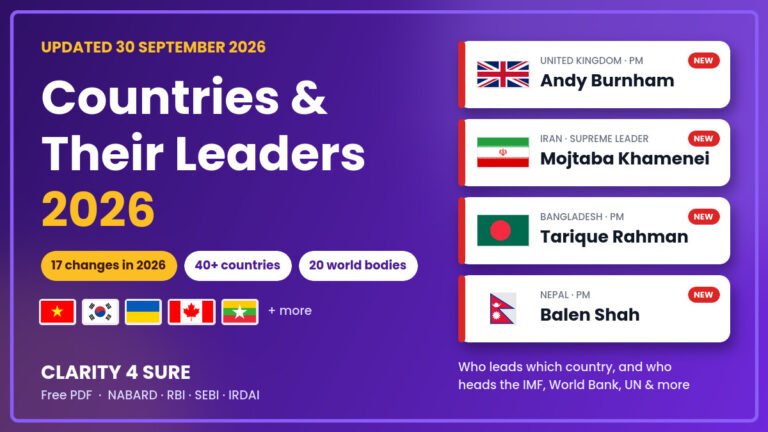 Free sheet · Static GKCountries & Their Leaders 2026Who leads which country in 2026, with all 17 changes marked. Get the article and the PDF free on WhatsApp.Get it free on WhatsApp →
Chandigarh University Establishes India’s First Private ‘IndiaAI Data Lab’
Chandigarh University became India’s first private university to establish an ‘IndiaAI Data Lab’ in partnership with Intel India. The initiative aims to strengthen students’ industry-oriented skills in Artificial Intelligence (AI), Data Science, and emerging technologies through practical training, research projects, hackathons, and Intel certification programmes.
BHASHINI Launches ‘VYOMA Innovation Challenge’ for Multilingual AI Solutions
The Digital India BHASHINI Division under the Ministry of Electronics and Information Technology (MeitY) launched the ‘VYOMA Innovation Challenge’ to promote development of multilingual, voice-first, and open-source Artificial Intelligence (AI) solutions. The initiative encourages AI applications in sectors such as education, healthcare, agriculture, governance, and public services, especially for offline and low-connectivity environments. Winning teams may receive prizes of up to Rs.80 lakh and opportunities for government deployment.
India Issues Letter of Request to France for 114 Rafale Fighter Jets
The Government of India issued a Letter of Request (LoR) to France for the acquisition of 114 Rafale fighter aircraft for the Indian Air Force (IAF) under a proposed government-to-government defence deal worth around Rs.3.25 lakh crore. The deal forms part of India’s Multi-Role Fighter Aircraft (MRFA) programme aimed at addressing the IAF’s declining squadron strength. Around 94 Rafale jets are proposed to be manufactured in India by Dassault Aviation in partnership with an Indian company, while the first Rafale-M jets are expected to arrive by 2028.
Ministry of Education Launches Prime Minister Research Chair (PMRC) Scheme 2026
The Ministry of Education launched the Prime Minister Research Chair (PMRC) Scheme 2026 to attract distinguished Indian-origin researchers, scientists, and technologists from across the world into India’s research ecosystem. The scheme focuses on priority sectors such as Artificial Intelligence, semiconductors, cybersecurity, biotechnology, climate change, quantum computing, healthcare, and defence technologies. Seven premier institutions have been designated as Lead Institutions for implementation of the programme.
Chandigarh University Establishes India’s First Private ‘IndiaAI Data Lab’
Chandigarh University became India’s first private university to establish an ‘IndiaAI Data Lab’ in collaboration with Intel India. The initiative aims to provide students with hands-on experience in Artificial Intelligence, Data Science, and emerging technologies through real-world projects, research, hackathons, and industry-linked programmes. The lab will support AI innovation, faculty development, and industry-academia collaboration to improve employability and technical skills.
BHASHINI Launches ‘VYOMA Innovation Challenge’ for Multilingual AI Solutions
The Digital India BHASHINI Division under the Ministry of Electronics and Information Technology launched the ‘VYOMA Innovation Challenge’ to promote development of multilingual, voice-first, open-source Artificial Intelligence solutions for low-connectivity environments. The challenge is built around the ‘Sunno Sutra’ handheld AI device and focuses on AI applications in education, healthcare, agriculture, governance, and public services. Winning teams can receive prizes of up to Rs.80 lakh and opportunities for deployment with government departments.