Daily Current Affairs (DCA) 8 & 9 August, 2025
Free live session
NABARD Grade A 2026: what the 2025 cut-offs changed, and the 90-day plan
Today · 7:30 PM IST
National Affairs4
Context:
The Chief of Defence Staff (CDS) has declassified and released India’s Joint Doctrines for Cyberspace Operations and Amphibious Operations to enhance interoperability, strengthen national defence strategy, and guide integrated multi-domain warfare. These doctrines outline operational principles, strategic objectives, and coordination mechanisms for the armed forces in two critical domains.
About Cyberspace
- A global domain of interconnected information systems, networks, and data infrastructures (internet, intranets, satellites, control systems).
- Characteristics:
- Borderless Domain – Operates beyond physical boundaries.
- Dual-use Nature – Serves both civilian and military needs.
- Real-time Impact – Actions can have immediate global effects.
- Anonymity Challenges – Attribution of attacks is difficult.
- Constantly Evolving Threats – Adapts with technology.
Components of Cyberspace Operations
- Defensive Cyber Operations: Protects networks from hacking, malware, and breaches.
- Offensive Cyber Operations: Disrupts enemy systems and critical infrastructure.
- Cyber Intelligence & Reconnaissance: Analyses threat data and vulnerabilities.
- Cyber Support Operations: Provides tools for land, air, sea, and space missions.
- Resilience & Recovery Systems: Ensures continuity via backups and redundancies.
About Amphibious Operations
- Coordinated military actions from sea to shore using naval, air, and land forces.
- Uses: Warfare, humanitarian assistance, disaster relief (HADR), force projection.
- Features:
- Tri-service integration.
- Rapid mobilisation from sea to shore.
- Flexible mission profiles (combat to HADR).
- Strategic reach over islands and coasts.
- Maritime–land operational linkage.
Significance of the Doctrines
- National Security: Safeguards critical infrastructure from cyber threats.
- Force Multiplier: Integrates cyber capabilities with conventional warfare.
- Maritime Superiority: Strengthens littoral zone dominance.
- Jointness: Enhances Army–Navy–Air Force coordination.
- Hybrid Warfare Preparedness: Counters combined cyber, sea, and land threats.
Context:
Prime Minister inaugurated Kartavya Bhavan-03, the first of ten planned Common Central Secretariat (CCS) buildings under the Central Vista redevelopment project in New Delhi. This marks a major step towards modernising government infrastructure, enhancing administrative efficiency, and integrating green and digital governance systems.
About Kartavya Bhavan-03
- Type: Common Central Secretariat building.
- Purpose: Consolidates offices of over 50 Union ministries (spread across Delhi) into centralised, modern buildings.
- Objective:
- Improve administrative efficiency.
- Reduce rental and maintenance costs.
- Integrate sustainable infrastructure and digital work systems.
- Location: New Delhi.
BS
Context:
The Opposition party has accused the Election Commission of India (ECI) of large-scale voter list manipulation in Karnataka, Maharashtra, and other states, alleging bias and “vote theft” in favour of the ruling party.
About the Election Commission of India (ECI)
The Election Commission of India (ECI) is an autonomous constitutional authority responsible for conducting and regulating elections to the Lok Sabha, Rajya Sabha, State Legislative Assemblies, and the offices of the President and Vice President in India. It was established on 25 January 1950 (celebrated as National Voters’ Day), with its headquarters in New Delhi.
It does not conduct elections to Panchayats and Municipalities, as these fall under the jurisdiction of the State Election Commissions.
Constitutional Provisions (Part XV: Articles 324–329)
- Article 324 – Superintendence, direction, and control of elections vested in the Election Commission.
- Article 325 – No discrimination in electoral rolls on grounds of religion, race, caste, or sex.
- Article 326 – Elections based on adult suffrage (18 years and above).
- Article 327 – Parliament’s power to legislate on elections.
- Article 328 – State Legislature’s power to legislate on elections.
- Article 329 – Bar on judicial interference in electoral matters.
Structure of ECI
- Initially a single-member body, but became a multi-member body after the Election Commissioner Amendment Act, 1989.
- Presently consists of:
- Chief Election Commissioner (CEC)
- Two Election Commissioners (ECs)
- At the state level, assisted by the Chief Electoral Officer.
Appointment & Tenure
- Appointed by the President of India under the CEC and Other ECs (Appointment, Conditions of Service and Term of Office) Act, 2023.
- Tenure: 6 years or up to 65 years of age, whichever is earlier.
- Salary and service conditions are equivalent to a Supreme Court Judge.
Removal
- CEC: Can only be removed in the same manner as a Supreme Court judge (by Parliament).
- ECs: Can be removed on the recommendation of the CEC.
- All can resign before the expiry of their term.
Limitations
- No constitutional prescription of qualifications (legal, educational, administrative, or judicial).
- No specific term fixed in the Constitution.
- Retiring commissioners are not barred from future government appointments.
UPSC Civil Services Examination Previous Year Questions (PYQs)
Prelims
Q. Consider the following statements: (2017)
- The Election Commission of India is a five-member body.
- The Union Ministry of Home Affairs decides the election schedule for the conduct of both general elections and bye-elections.
- Election Commission resolves the disputes relating to splits/mergers of recognised political parties.
Which of the statements given above is/are correct?
(a) 1 and 2 only
(b) 2 only
(c) 2 and 3 only
(d) 3 only
Ans: (d)
Mains
Q. Discuss the role of the Election Commission of India in the light of the evolution of the Model Code of Conduct. (2022)
Context:
Government approved continuation of ₹300 per LPG cylinder subsidy for PMUY beneficiaries in FY 2025–26.
About PMUY
- Type: Flagship social welfare scheme for deposit-free LPG connections.
- Launch: May 2016, Ballia, Uttar Pradesh.
- Nodal Ministry: Ministry of Petroleum & Natural Gas (MoPNG).
- Goal: Replace hazardous traditional cooking fuels with clean LPG for health, environment, and women empowerment.
Key Features
- Deposit-Free LPG Connection – No initial security deposit.
- Financial Support for Stove Purchase – Ensures ready-to-use connections.
- ₹300 Subsidy per 14.2 kg Cylinder – Proportional for 5 kg cylinders, max 9 refills/year.
- Direct Benefit Transfer (DBT) – Subsidy directly credited to beneficiary bank accounts.
- Swachh Indhan Behtar Jeevan – Clean fuel for women’s health, reduced indoor air pollution, and sustainable cooking.
Objectives
- Universal access to clean cooking fuel.
- Reduce indoor air pollution & related health hazards.
- Empower rural women by reducing drudgery.
- Promote environmental conservation (reduce deforestation & carbon emissions).
Eligibility
- Adult women from BPL households.
- Identified via SECC 2011 data.
- PMUY 2.0: Includes migrant families without address proof.
Banking/Finance6
How & Why Farmers Producers Organization are formed? FPO #fpo #upsc #nabardgradea #agriculturenotesTap to play · from the C4S channel
Context:
On 8 August 2025, the Reserve Bank of India (RBI) granted in-principle approval to AU Small Finance Bank (AU SFB) to transition into a universal bank. AU becomes the first SFB to receive such approval and the first universal bank approval in over 11 years. It currently commands about 40% market share among SFBs.
Eligibility Criteria for SFB to Transition into a Universal Bank
| Criterion | Requirement |
|---|---|
| Scheduled Status | Must have been in the RBI’s Scheduled Banks list for at least 5 years |
| Stock Listing | Shares must be listed on a recognised stock exchange |
| Net Worth | Minimum net worth of ₹1,000 crore |
| Financial Health – Profitability | Net profits in each of the last 2 Financial Years (FYs) |
| Financial Health – Asset Quality | G-NPA ≤ 3% and N-NPA ≤ 1% over the last 2 FYs |
| Promoter Requirements | No addition or change in promoters during the transition period |
| Portfolio Preference | Preference given to SFBs with diversified loan portfolios |
About Small Finance Banks (SFBs)
| Parameter | Details |
|---|---|
| Genesis | Announced in Union Budget 2014–15 |
| Objective | Promote financial inclusion by serving small businesses, marginal farmers, micro industries, and unorganised sector entities |
| Registration | Public limited company under Companies Act, 2013 |
| Licensing | Licensed & governed under Banking Regulation Act, 1949 |
| Capital Requirement | Minimum paid-up voting equity capital of ₹200 crore (except in certain cases) |
| Eligible Promoters | Resident individuals/professionals with ≥10 years experience in banking & finance |
Difference Between Small Finance Banks and Universal Banks
| Parameter | Small Finance Banks (SFBs) | Universal Banks |
|---|---|---|
| Primary Objective | Financial inclusion by providing credit to unserved/underserved segments like small businesses, farmers, low-income households | Provide a wide range of banking services to all segments of the economy |
| Customer Focus | Primarily rural and semi-urban customers, small borrowers | Both retail and corporate clients |
| Product Range | Savings accounts, fixed deposits, small business loans, microfinance | All banking products including corporate loans, international banking, investment banking |
| Priority Sector Lending | 75% of net loans | 40% of net loans |
| Regulatory Capital | Minimum capital requirement: ₹200 crore | Minimum capital requirement: ₹1,000 crore |
| Branch Expansion | At least 25% branches in unbanked rural areas | No such mandatory rural branch requirement |
| Scope of Operations | Restricted geographical and lending scope | Full-scale domestic and international operations |
Context:
IDFC FIRST Bank has launched RemitFIRST2India, a next-generation digital remittance platform enabling Non-Resident Indians (NRIs) to send money to India quickly, securely, and at zero transfer fees. Developed in partnership with SingX, the platform aims to provide a transparent, compliant, and customer-friendly cross-border payment experience.
About RemitFIRST2India
- Purpose: Simplify and speed up NRI remittances to India with competitive forex rates and full transparency.
- Availability:
- For IDFC FIRST Bank NRI customers – direct transfer via Mobile Banking App without extra registration.
- For non-customers – quick, paperless onboarding via a dedicated web portal.
- Current Coverage: Transfers from Singapore and Hong Kong; expansion planned to more countries.
- Partnership: SingX (licensed by Monetary Authority of Singapore) for regulatory compliance and operational efficiency.
About IDFC FIRST Bank
- Type: Private sector universal bank in India.
- Branch Network: 1,016 branches; digital-first approach with highly rated mobile app.
- Core Banking Principles: Ethical banking, customer-friendly products, financial inclusion, ESG focus, and transparent zero-fee services.
Context:
The International Finance Corporation (IFC), a member of the World Bank Group, has committed USD 150 million to HDFC Capital Affordable Real Estate Fund – 3 (H-CARE 3). The investment aims to boost the supply of green-certified affordable housing in India and advance climate-friendly construction practices.
Key Highlights:
- Investment Details: IFC will act as an anchor investor with a USD 150 million commitment to H-CARE 3.
- Fund Objective: Promote affordable, green-certified housing projects in India, supporting low- and middle-income homebuyers.
- Environmental Impact: Encourages sustainable construction and resource efficiency, aligning with India’s climate goals.
- Economic Impact: Supports real estate developers with long-term funding for environmentally responsible affordable housing.
- Partnership: This is IFC’s third investment with HDFC Capital’s H-CARE platform, reinforcing a long-standing collaboration.
About IFC
- A member of the World Bank Group.
- Focuses on private sector development in emerging markets through investments, advisory, and asset management services.
About H-CARE
- Managed by HDFC Capital Advisors Ltd.
- Focuses on financing affordable and mid-income housing projects in India.
Context:
The Food Safety and Standards Authority of India (FSSAI) has partnered with Bank of Baroda to promote digital payment adoption in the food business sector. The initiative aims to improve financial transparency, reduce cash-based transactions, and encourage small food businesses to transition to secure, traceable payment methods.
Key Highlights:
- Partnership Objective: To integrate digital payment solutions for food business operators (FBOs) across India.
- Target Audience: Street vendors, small eateries, and micro food enterprises.
- Services Offered:
- QR code-based payment systems.
- Training and awareness campaigns for digital literacy.
- Access to simplified banking solutions.
- Implementation Plan: Nationwide roll-out through FSSAI’s regional offices and Bank of Baroda’s branch network.
- Expected Benefits: Enhanced financial inclusion, transparency in transactions, and faster payment processing for small vendors.
Context:
DSP Mutual Fund has introduced the DSP Nifty500 Flexicap Quality 30 Index Fund, marking it as India’s first-ever flexi-cap index fund. The fund is designed to offer a low-cost, rules-based investment strategy that adapts dynamically to market conditions.
Flexi-Cap Index Fund
A Flexi-Cap Index Fund is a type of equity mutual fund that invests across large-cap, mid-cap, and small-cap stocks, offering diversification and flexibility. Unlike pure large-cap or small-cap funds, its allocation changes dynamically based on market conditions and index composition.
Key Features:
- Quality-Only Stock Selection: The fund tracks the Nifty500 Flexicap Quality 30 Index, comprising 30 fundamentally strong companies 10 each from large-cap, mid-cap, and small-cap segments, all equally weighted within each category.
- Dynamic Allocation: Fund manager can shift portfolio weightage between large, mid, and small caps depending on valuation and market trends.
- Index-Based: Tracks a specific benchmark index (e.g., Nifty 500, Nifty Flexi Cap Index) passively, ensuring low costs compared to actively managed flexi-cap funds.
- Risk-Return Profile: Balanced risk due to diversification; can capture growth opportunities in smaller companies while maintaining stability from large-cap exposure.
- SEBI Regulation: Categorised under “Flexi Cap Fund” with the mandate to invest at least 65% in equities across all caps.
Context:
Kotak Mahindra Bank has introduced ‘Solitaire’, an exclusive, invitation-only programme designed for affluent customers, offering premium banking privileges and personalised services.
Eligibility
- Salaried individuals: Minimum relationship value of ₹75 lakh.
- Self-employed individuals: Minimum relationship value of ₹1 crore.
Key Benefits
- Pre-approved credit lines: Up to ₹8 crore across home loans, personal loans, and credit cards.
- Solitaire Credit Card perks:
- Zero annual fees
- Unlimited lounge access
- Zero forex markup
- Access to advanced investment tools and top-tier personalised banking services.
About Kotak Mahindra Bank:
- Founded: 2003
- Headquarters: Mumbai, Maharashtra, India
- Managing Director & CEO: Ashok Vaswani
- Tagline: Let’s Make Money Simple
- Merger: ING Vysya Bank merged with Kotak Mahindra Bank in 2015.
 Scheme to knowPradhan Mantri Matsya Sampada Yojana (PMMSY): Objectives, Components and FactsPradhan Mantri Matsya Sampada Yojana (PMMSY) is the flagship fisheries scheme of the Government of India, launched in…
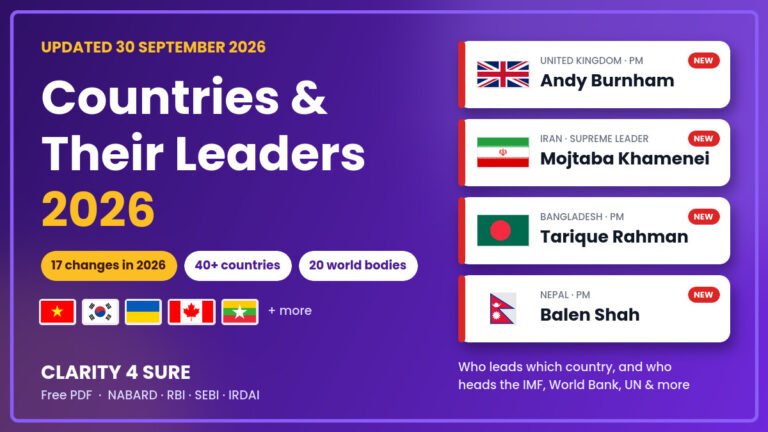 Free sheet · Static GKCountries & Their Leaders 2026Who leads which country in 2026, with all 17 changes marked. Get the article and the PDF free on WhatsApp.Get it free on WhatsApp →
Every day of the month in one file. Enter your details once — the download opens right away.
We already have your details, so no form: tap to open.
Download the August 2025 PDFDownload the August 2025 revision sheet PDFAgriculture1
Context:
India’s agriculture sector, employing ~150 million farmers and contributing 18% to GDP, faces climate change, soil degradation, and pest attack challenges. Traditional farming methods are increasingly inadequate, pushing the need for technology-driven, proactive solutions.
Key Challenges
- Climate Volatility: Irregular monsoons affect ~70% of farmland.
- Delayed Information: Crop stress, pests, and nutrient gaps often detected too late.
- Debt Cycle: Losses push farmers into repeated borrowing.
- Declining Soil Health: Excessive and inefficient input use.
Tech-Based Solutions
Artificial Intelligence (AI) + Satellite Intelligence:
- Soil Analysis: Done in hours instead of weeks.
- Hyperlocal Advisories: Based on soil moisture, weather history, and crop growth models.
- Weather & Pest Prediction: Advance alerts for rainfall, heat waves, and infestations.
- Yield Gains: AI-driven advisories have boosted yields by 15–20%.
- Input Efficiency: Fertiliser use reduced by up to 30% without affecting yield.
Example:
- Telangana chilli crop losses avoided via predictive advisories.
Impact Beyond Farming
- Credit & Insurance:
- AI + satellite data create verifiable farm records.
- Faster loan approvals and claim settlements.
- PM Fasal Bima Yojana: Using AI and space tech for better yield estimation and dispute resolution.
- Risk Management: Early warnings allow proactive, targeted interventions.
Policy & Vision
- Vision 2030 for Agriculture: Focus on sustainability and resilience.
- Need for Scale: Moving from pilot projects to nationwide implementation to make proactive, data-driven farming standard.
Facts To Remember2
ChatGPT 5
OpenAI has officially launched ChatGPT 5, the newest version of its advanced AI chatbot, bringing significant upgrades that are already generating buzz.
India’s 3rd Launch Pad in Sriharikota by 2029
India’s space program is preparing for its next giant leap. The Indian Space Research Organisation (ISRO) has officially begun work on its Third Launch Pad (TLP) at the Satish Dhawan Space Centre in Sriharikota.