
Daily Current Affairs Quiz: 11 July 2026
Free live session
NABARD Grade A 2026: what the 2025 cut-offs changed, and the 90-day plan
The 2025 cycle was the toughest on record at every stage. This session reads those numbers properly and turns them into a week-by-week plan for Phase 1.
Today · 7:30 PM IST · 75 minutes · free
1. The Third India–Australia Annual Summit, attended by PM Modi, was held in which city?
A. Sydney
B. Canberra
C. Melbourne
D. Perth
E. Brisbane
View Answer
Explanation: The Third India–Australia Annual Summit was held in Melbourne, where both nations adopted a Joint Statement to strengthen the Comprehensive Strategic Partnership (established 2020). Key outcomes included a Joint Declaration on Defence and Security Cooperation, an annual Defence Ministers’ Dialogue, a Maritime Security Collaboration Roadmap, and an MoU between the Australian Maritime Border Command and the Indian Coast Guard.
2. Under the India-Australia summit outcomes, Australia will provide tracking support for the Gaganyaan Mission through a tracking station located at:
A. Christmas Island
B. Cocos (Keeling) Islands
C. Norfolk Island
D. Tasmania
E. Darwin
View Answer
Explanation: Australia will support Gaganyaan tracking via a station on the Cocos (Keeling) Islands. Other outcomes: an Administrative Arrangement under the Civil Nuclear Cooperation Agreement enabling long-term Australian uranium exports to India under IAEA safeguards, operationalisation of the Rooftop Solar Academy, and acceleration of CECA negotiations with strengthened critical minerals (lithium, cobalt) partnership.
3. As per the India-Australia summit outcomes, a National Centre of Excellence for Skilling in Mining will be established (with Western Australia) at which location?
A. Ranchi
B. Dhanbad
C. Bhubaneswar
D. Raipur
E. Hyderabad
View Answer
Explanation: India and Western Australia will establish the National Centre of Excellence for Skilling in Mining at Bhubaneswar, Odisha. In education, Flinders University received a Letter of Intent for a Bengaluru campus, Victoria University got approval for a Gurugram campus, and Australia announced US$10 million under the Maitri Grants Programme.
4. “TribeX”, India’s first dedicated digital learning platform for tribal arts, culture and traditional knowledge, has been developed by which Ministry?
A. Ministry of Culture
B. Ministry of Education
C. Ministry of Tribal Affairs
D. Ministry of Skill Development
E. Ministry of Rural Development
View Answer
Explanation: TribeX is a centralized digital learning platform and knowledge repository developed by the Ministry of Tribal Affairs to preserve tribal arts, culture, languages and traditional knowledge, promote skill development, and connect learners with master tribal artisans — with open access to learners and researchers worldwide.
5. In July 2026, which state was declared India’s 6th fully literate State under the ULLAS Initiative?
A. Himachal Pradesh
B. Uttarakhand
C. Goa
D. Sikkim
E. Tripura
View Answer
Explanation: Uttarakhand became India’s 6th fully literate State under ULLAS (Understanding of Lifelong Learning for All in Society), also known as Nav Bharat Saaksharta Karyakram — a Centrally Sponsored Scheme (FY 2022-27) of the Ministry of Education for adult non-literates aged 15+. In 2026, Andaman & Nicobar (UT), Sikkim and Uttarakhand achieved 95%+ literacy under ULLAS.
6. The ULLAS Initiative aims to achieve Foundational Literacy and Numeracy (FLN) for how many adult learners by 2027?
A. 2 crore
B. 3 crore
C. 5 crore
D. 7 crore
E. 10 crore
View Answer
Explanation: ULLAS targets FLN for 5 crore adult learners by 2027 (1 crore learners every year). Learners are assessed via FLNAT (Foundational Literacy and Numeracy Assessment Test), conducted twice a year; successful learners receive a NIOS–DoSEL certificate.
7. The “Manas” epic — whose first Hindi translation was recently released under the India-Kyrgyzstan civilizational initiative — is the national epic of Kyrgyzstan and is recognised by UNESCO as:
A. A World Heritage Site
B. A Memory of the World document
C. An Intangible Cultural Heritage of Humanity
D. A Global Geopark tradition
E. A Biosphere heritage
View Answer
Explanation: The Manas epic — one of the longest epic poems in the world, narrating the deeds of the legendary Kyrgyz warrior Manas — is inscribed on the UNESCO Representative List of the Intangible Cultural Heritage of Humanity. The International Centre for Civilizational Studies “Manas and Mahabharata” was established in Bishkek. Kyrgyzstan: capital Bishkek, currency Kyrgyzstani Som, borders Kazakhstan, China, Tajikistan and Uzbekistan.
8. India signed a landmark defence agreement with Indonesia in Jakarta for the supply of which indigenously developed missile?
A. BrahMos
B. Akash-NG
C. Astra Mk 1
D. Nirbhay
E. Pralay
View Answer
Explanation: India and Indonesia signed an agreement for supply of the Astra Mk 1 — an indigenous Beyond-Visual-Range Air-to-Air Missile (BVRAAM) developed by DRDO and produced by Bharat Dynamics Limited (BDL). It engages enemy aircraft at long distances before visual range, reducing dependence on imported air-to-air missiles.
9. The CE20 cryogenic engine powers the upper stage of LVM3 and uses which propellant combination?
A. UDMH + N2O4
B. Liquid Hydrogen (LH₂) + Liquid Oxygen (LOX)
C. Kerosene + LOX
D. Solid propellant + LOX
E. Methane + LOX
View Answer
Explanation: The CE20, developed by ISRO’s Liquid Propulsion Systems Centre (LPSC) and tested at IPRC Mahendragiri, powers the C25/C32 upper stage of LVM3 using LH₂ + LOX. It replaced the CE-7.5, has powered eight consecutive LVM3 missions (including Chandrayaan-2 and Chandrayaan-3), and is the human-rated cryogenic engine planned for Gaganyaan.
10. Parrot Bornavirus 4 (PaBV-4), identified for the first time in India among captive birds, is the primary cause of which disease?
A. Avian Influenza
B. Newcastle Disease
C. Proventricular Dilatation Disease (PDD)
D. Psittacosis
E. Ranikhet Disease
View Answer
Explanation: PaBV-4 — a single-stranded RNA virus of species Orthobornavirus alphapsittaciforme — is the primary cause of PDD, a serious neurological and digestive disease of psittacine birds (parrots, macaws, parakeets, cockatiels, lovebirds). Symptoms include weight loss, poor digestion, enlarged stomach and neurological disorders; the disease is often fatal.
11. The National CAMPA Governing Body approved four new wildlife conservation projects under a new scheme with an initial corpus of:
A. ₹1,000 crore
B. ₹2,000 crore
C. ₹3,000 crore
D. ₹5,000 crore
E. ₹7,500 crore
View Answer
Explanation: National CAMPA (under MoEFCC, legal basis: CAF Act, 2016) approved four projects under a ₹3,000 crore, 5-year scheme: River Dolphin Conservation, Project Snow Leopard Phase II (with second nationwide population estimation), Indian Rhinoceros Conservation Action Plan, and Wild Water Buffalo Conservation Project.
12. Which of the following is INCORRECT regarding the species covered under the new CAMPA wildlife projects?
A. River Dolphin is India’s National Aquatic Animal
B. Snow Leopard is the state animal of Ladakh
C. The largest Indian Rhinoceros population is in Kaziranga, Assam
D. Wild Water Buffalo is found mainly in Assam and Chhattisgarh
E. River Dolphin is protected under Schedule IV of the Wildlife (Protection) Act
View Answer
Explanation: The River Dolphin (found in the Ganga-Brahmaputra system) is protected under Schedule I — the highest protection — of the Wildlife (Protection) Act, 1972, not Schedule IV. The other statements are correct.
13. The SEA Regenerative Mustard Model Farm Programme (2025-26 rabi season) recorded mustard yield improvements of up to 30% in demonstration farms. In which states does it operate?
A. Punjab, Haryana, UP
B. Rajasthan, Haryana, Madhya Pradesh
C. Gujarat, Rajasthan, Maharashtra
D. UP, Bihar, MP
E. Haryana, Punjab, Rajasthan
View Answer
Explanation: The programme — launched in 2019 by the Solvent Extractors’ Association of India (SEA) with implementation partner Solidaridad Network Asia — covers 3,000 front-line demonstration plots across 14 districts of Rajasthan, MP and Haryana. It aims to raise mustard productivity, improve soil health, and reduce India’s dependence on imported edible oils.
14. On 9 July 2026, the RBI absorbed how much surplus liquidity from the banking system through money market operations?
A. ₹75,000 crore
B. ₹90,000 crore
C. ₹1.10 lakh crore
D. ₹1.50 lakh crore
E. ₹2 lakh crore
View Answer
Explanation: The RBI absorbed ₹1.10 lakh crore of surplus liquidity on 9 July 2026 through money market operations, indicating excess cash availability with banks.
15. SEBI has recently permitted mutual funds to avail which facility to address temporary liquidity mismatches caused by settlement timing differences?
A. Overnight repo borrowing
B. Intraday borrowing
C. Margin trading
D. Short selling
E. External commercial borrowing
View Answer
Explanation: SEBI permitted mutual funds to use intraday borrowing facilities to manage temporary liquidity mismatches from differences in market settlement timings — improving operational efficiency without increasing long-term leverage.
16. Union Minister Ashwini Vaishnaw announced plans to develop which city as a major high-speed rail hub, with proposed bullet train corridors to Pune, Chennai and Bengaluru?
A. Nagpur
B. Hyderabad
C. Visakhapatnam
D. Coimbatore
E. Indore
View Answer
Explanation: Hyderabad will be developed as a major high-speed rail hub, with proposed bullet train corridors connecting it to Pune, Chennai and Bengaluru — strengthening regional connectivity and economic growth.
17. India and New Zealand have upgraded their bilateral relationship to a Strategic Partnership, setting a target to double bilateral trade by 2030 to:
A. ₹20,000 crore
B. ₹25,000 crore
C. ₹35,000 crore
D. ₹50,000 crore
E. ₹70,000 crore
View Answer
Explanation: Following talks between PM Modi and PM Christopher Luxon, India and New Zealand elevated ties to a Strategic Partnership with a target to double bilateral trade to ₹35,000 crore by 2030. The two countries also celebrated 100 years of sporting relations in 2026 — begun with the Indian Army Hockey Team’s tour of 1926.
18. The BRICS Ministerial Declaration 2026, recently adopted, pertains to cooperation in which sector?
A. Agriculture
B. Health
C. Transport
D. Energy
E. Tourism
View Answer
Explanation: BRICS Transport Ministers adopted the BRICS Ministerial Declaration 2026 to strengthen technology and innovation-driven cooperation in the transport sector — focusing on sustainable, carbon-neutral transport across road, rail, aviation and waterways.
19. NITI Aayog recently organised a stakeholder consultation on the implementation of which Act of 2025?
A. DPDP Act
B. SHANTI Act
C. Telecom Act
D. Bharatiya Vayuyan Adhiniyam
E. Jan Vishwas Act
View Answer
Explanation: NITI Aayog held a stakeholder consultation on implementing the SHANTI Act 2025, discussing regulatory frameworks, financing, insurance, manufacturing capabilities, public awareness and operational preparedness.
20. “Operation Amistad” — India’s humanitarian assistance and disaster relief mission that recently concluded — was carried out for which earthquake-hit country?
A. Chile
B. Peru
C. Venezuela
D. Ecuador
E. Colombia
View Answer
Explanation: India successfully concluded Operation Amistad, its HADR mission to earthquake-hit Venezuela; the Venezuelan government thanked India for its timely support during the crisis. (“Amistad” means “friendship” in Spanish.)
21. INS Mahendragiri, the indigenous stealth frigate commissioned by Defence Minister Rajnath Singh, belongs to which class/project?
A. Shivalik-class (Project 17)
B. Nilgiri-class (Project 17A)
C. Visakhapatnam-class (Project 15B)
D. Talwar-class
E. Kamorta-class (Project 28)
View Answer
Explanation: Defence Minister Rajnath Singh commissioned INS Mahendragiri — the 6th of 7 Project 17A (Nilgiri-class) indigenous guided-missile stealth frigates — reaffirming India’s commitment to a self-reliant, future-ready Navy. It joins the Eastern Fleet at Visakhapatnam.
22. World Population Day is observed on which date?
A. 5 July
B. 7 July
C. 11 July
D. 15 July
E. 22 July
View Answer
Explanation: World Population Day was observed on 11 July 2026 to raise awareness about population-related challenges and sustainable development. Union Health Minister J.P. Nadda highlighted voluntary family planning, informed choices and healthy families for inclusive growth.
Every day of the month in one file. Enter your details once — the download opens right away.
We already have your details, so no form: tap to open.
Download the July 2026 current affairs quiz PDFDownload the July 2026 Exam Ready quiz PDFAll July 2026 quizzes in one place: every question of the month with answers, a full PDF and an Exam Ready PDF — July 2026 current affairs quiz
Related on Clarity 4 Sure
 Scheme to knowPM Vidyalaxmi Scheme: Collateral-Free Education Loans, Interest Subvention and FactsPM Vidyalaxmi is a Central Sector scheme, approved by the Union Cabinet on 6 November 2024, under which any student…
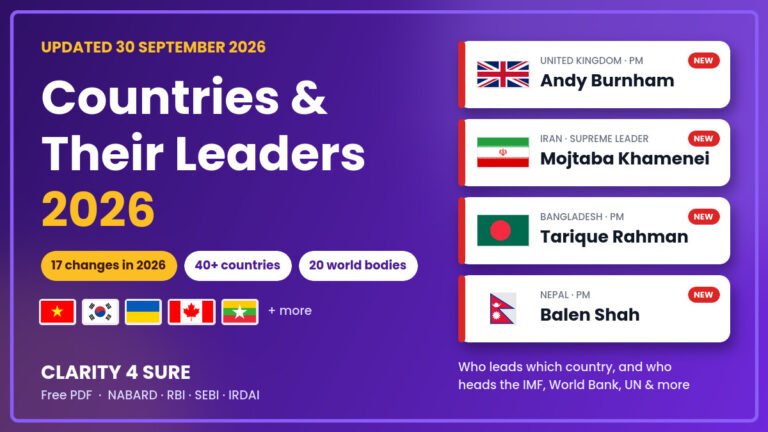 Free sheet · Static GKCountries & Their Leaders 2026Who leads which country in 2026, with all 17 changes marked. Get the article and the PDF free on WhatsApp.Get it free on WhatsApp →