The United States’ National Oceanic and Atmospheric Administration (NOAA) confirmed on 11 June 2026 the formation of a new El Niño in the equatorial Pacific, issuing an El Niño Advisory. NOAA placed the odds at 63 per cent that it will intensify into a very strong or “super” El Niño by the northern winter (November 2026-January 2027). A super El Niño is defined by sea surface temperature (SST) anomalies exceeding 2°C in a specific reference patch of the Pacific. Since 1950, only four major events have crossed this extreme threshold: 1972-73, 1982-83, 1997-98, and 2015-16. The 2026-27 event could potentially become one of the strongest on record, with ECMWF projecting SST anomalies of +3°C by December 2026. The event is likely to weaken India’s southwest monsoon, cause droughts globally, push global temperatures above the 1.5°C threshold, and trigger ecological destruction.
Context
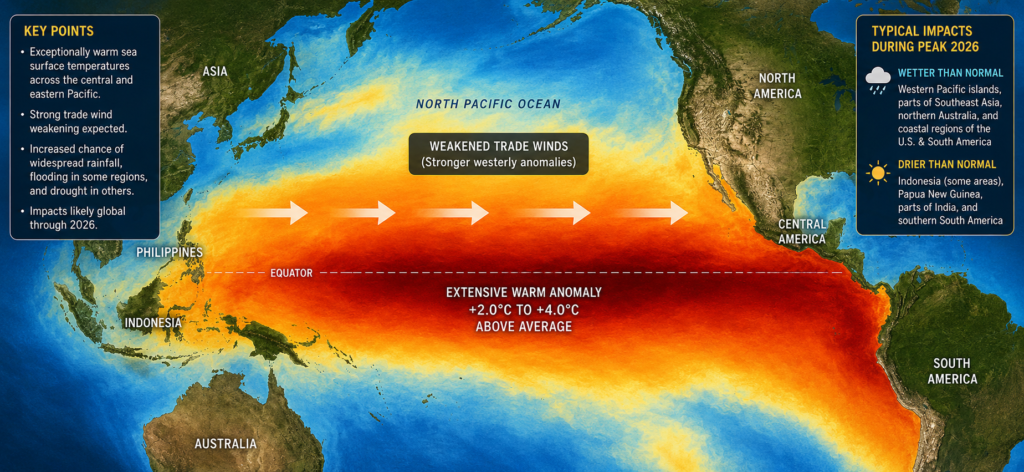
What is El Niño?
- The warm phase of the El Niño-Southern Oscillation (ENSO).
- Periodic, anomalous warming of sea surface temperatures (SSTs) across the central and eastern equatorial Pacific Ocean.
- Occurs every 3-7 years.
- Affects global weather patterns.
A clean PDF of this page with the C4S header — it opens right away, and the link comes to your WhatsApp too.
What Makes a "Super" El Niño?
- SST anomaly exceeding 2°C in the Niño 3.4 reference region.
- ONI (Oceanic Niño Index) or RONI value of +2°C or above.
- Among the top 3-4 events in the reliable satellite record since late 1970s.
How El Niño Forms
Step 1: Slackening of Trade Winds
- Equatorial trade winds that normally blow east to west begin to stall or reverse.
- Normally, these winds push warm surface waters toward Asia.
Step 2: West-to-East Warm Water Drift
- With weakened winds, warm surface water accumulates and moves eastward toward South American coast.
Step 3: The Feedback Loop (Bjerknes Feedback)
- As eastern Pacific heats up, atmospheric pressure zones shift.
- This further slackens trade winds.
- Self-reinforcing cycle pushes temperatures past the 2°C threshold.
Step 4: Climate Change Multiplier
- Long-term climate change acts as an incubator.
- Higher baseline ocean heat makes modern super El Niños more intense than historical ones.
Impact on India
Monsoon Suppression
- El Niño often weakens the Indian monsoon.
- Below-normal rainfall.
- Increased drought risks across many regions.
Erratic Rainfall Distribution
- Delayed monsoon onset.
- Long dry spells.
- Crop growth and agricultural productivity affected.
- Kharif season at risk.
Indian Ocean Dipole (IOD) Variable
- A positive IOD may partly offset El Niño’s effects.
- Current forecasts suggest limited relief from monsoon weakening.
Global Impacts
Severe Ecological Destruction
- Forest fires (especially in Indonesia, Australia, Amazon).
- Coral bleaching (Great Barrier Reef, Indian Ocean reefs).
- Ecosystem degradation across tropical regions.
Extreme Transnational Droughts
- Many countries: Severe droughts, water shortages, crop failures.
- Heightened food security concerns.
- Vulnerable regions: Australia, Indonesia, Brazil, Southern Africa, parts of India.
Breaching Global Temperature Thresholds
- Releases additional ocean heat into the atmosphere.
- Pushes global temperatures to record levels.
- May push above the 1.5°C threshold (Paris Agreement).
- Climate simulations: “Shockingly high” temperatures forecast for November-December 2026.
About ENSO
- El Niño-Southern Oscillation.
- A semi-regular recurring cycle that transfers heat and momentum from the tropical Pacific to the global atmosphere.
- Three phases:
- El Niño: Warm phase.
- La Niña: Cool phase.
- Neutral: Normal phase.
- Cycle frequency: Every 2-7 years.
About NOAA
- National Oceanic and Atmospheric Administration.
- A US scientific agency under the Department of Commerce.
- Founded: 1970.
- Functions:
- Weather forecasting.
- Climate monitoring.
- Ocean and fisheries research.
- Climate change research.
- Headquartered: Silver Spring, Maryland.
Practice MCQs
Q1. With reference to NOAA’s June 2026 El Niño announcement, consider the following statements:
- NOAA confirmed the formation of El Niño on 11 June 2026.
- NOAA placed the odds at 63 per cent that it will intensify into a very strong or super El Niño by winter.
- A super El Niño is defined by sea surface temperature anomalies exceeding 2°C in the Niño 3.4 region.
- NOAA’s El Niño Advisory was downgraded to a Watch.
How many of the above statements are correct?
(a) Only one (b) Only two (c) Only three (d) All four (e) None
(Statement 4 is wrong; NOAA’s El Niño status was upgraded from Watch to Advisory, NOT downgraded.)
Q2. With reference to historical super El Niños, consider the following statements:
- Since 1950, four major super El Niño events have been recorded: 1972-73, 1982-83, 1997-98, and 2015-16.
- The 2015-16 super El Niño is the current record holder for peak SST anomaly.
- Super El Niños have an SST anomaly exceeding 2°C in the reference region.
- There has never been a super El Niño in recorded history.
How many of the above statements are correct?
(a) Only one (b) Only two (c) Only three (d) All four (e) None
(Statement 4 is wrong; four super El Niños have been recorded since 1950.)
Q3. With reference to the mechanism of El Niño formation, consider the following statements:
- Slackening of equatorial trade winds is the trigger.
- Warm surface water drifts from west to east toward the South American coast.
- The Bjerknes feedback loop is a positive feedback that reinforces El Niño.
- Climate change has made modern super El Niños less intense than historical ones.
Which of the above are correct?
(a) 1, 2 and 3 only (b) 1, 3 and 4 only (c) 2 and 4 only (d) 1 and 4 only (e) All four
(Statement 4 is wrong; climate change has made modern super El Niños MORE intense, NOT less.)
Q4. With reference to El Niño’s impact on India, consider the following statements:
- El Niño often weakens the Indian southwest monsoon.
- It can cause below-normal rainfall and increased drought risks.
- A positive Indian Ocean Dipole (IOD) may partly offset El Niño’s effects.
- El Niño typically enhances and strengthens the Indian monsoon.
Which of the above are correct?
(a) 1, 2 and 3 only (b) 1, 3 and 4 only (c) 2 and 4 only (d) 1 and 4 only (e) All four
(Statement 4 is wrong; El Niño typically WEAKENS the Indian monsoon, NOT strengthens it.)
Q5. With reference to El Niño’s global impacts, consider the following statements:
- El Niño suppresses Atlantic hurricane formation due to wind shear.
- It favours super typhoons in the Central and Eastern Pacific.
- It can push global temperatures above the 1.5°C threshold.
- El Niño has no effect on coral reefs.
Which of the above are correct?
(a) 1, 2 and 3 only (b) 1, 3 and 4 only (c) 2 and 4 only (d) 1 and 4 only (e) All four
(Statement 4 is wrong; El Niño causes coral bleaching and damage to reefs.)
Answer Key
- (c), Statements 1, 2, 3 are correct; Statement 4 is wrong because the Advisory was upgraded, not downgraded.
- (c), Statements 1, 2, 3 are correct; Statement 4 is wrong because four super El Niños have been recorded.
- (a), Statements 1, 2, 3 are correct; Statement 4 is wrong because climate change has made modern El Niños more intense.
- (a), Statements 1, 2, 3 are correct; Statement 4 is wrong because El Niño weakens the Indian monsoon.
- (a), Statements 1, 2, 3 are correct; Statement 4 is wrong because El Niño causes coral bleaching.
Exam Relevancemost asked
| Exam | Relevance |
|---|---|
| UPSC Prelims | GS Paper I on Geography (El Niño, ENSO, Monsoon); GS Paper III on Environment, Disaster Management |
| UPSC Mains | GS Paper I on Geography, Climate; GS Paper III on Environment, Agriculture, Food Security |
| BPSC and State PCS | Geography, Environment, Current Affairs |
| Banking and NABARD | Macroeconomic awareness, agriculture |
| RBI Grade B | Inflation, agricultural economy |
| NABARD Grade A | Very high importance, agriculture, monsoon, climate |