The Odisha Chief Minister urged the Centre to nominate Puri’s Shree Jagannath Rath Yatra for inclusion in UNESCO’s Representative List of the Intangible Cultural Heritage of Humanity.
Context:
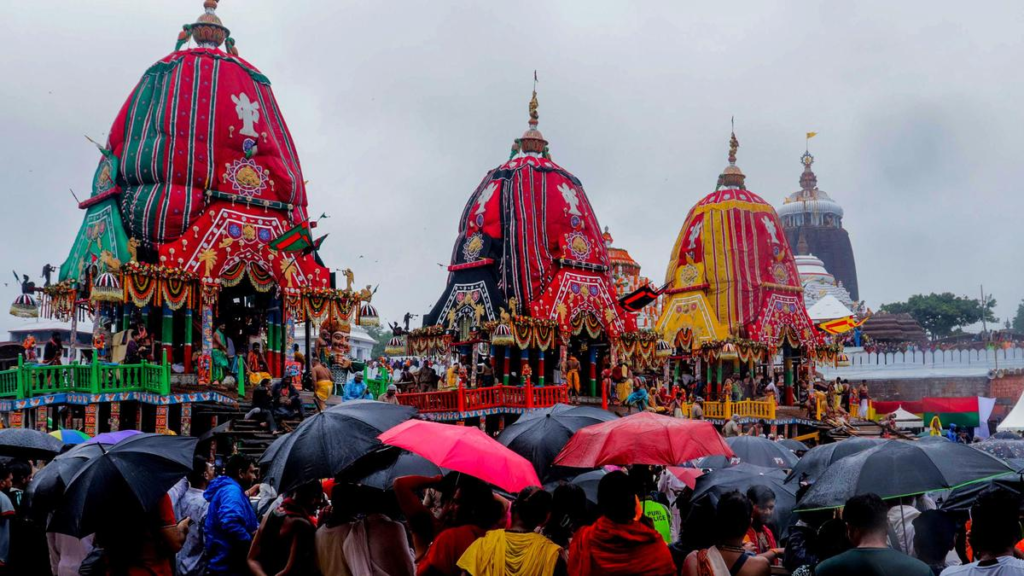
Origin and Antiquity
- Puranic and historical roots: textual descriptions appear in the Brahma Purana, Padma Purana, Skanda Purana and Kapila Samhita.
- European accounts: documented by European travellers since the 13th century, with detailed accounts from the 17th century onward.
- Annual occurrence: during the bright fortnight (Shukla Paksha) of the lunar month of Ashadha (June–July).
Key Features
Annual reconstruction of chariots. Three massive, distinct wooden chariots are newly built every year:
| Chariot | Deity |
|---|---|
| Nandighosha | Lord Jagannath |
| Taladhwaja | Lord Balabhadra |
| Darpadalana | Goddess Subhadra |
- Built from specific timber types — Phassi and Dhausa — traditionally brought from the ex-princely state of Dasapalla along the Mahanadi River.
- Hereditary artisan guilds. Construction follows ancient architectural canons (Shilpa Shastras), executed by hereditary teams of carpenters (Maharanas), blacksmiths, painters and tailors.
- The divine procession. The deities are brought out of the 12th-century Jagannath Temple in the grand Pahandi Bije procession and placed on chariots aligned on the Bada Danda (Grand Avenue), where millions of devotees pull them to the Gundicha Temple.
Exam Relevance
UPSC — Prelims (GS-I, Art and Culture): the three chariots and their deities, the Ashadha timing, Gundicha and Mausi Maa temples, and — most importantly — the distinction between the 2003 ICH Convention and the 1972 World Heritage Convention, with India’s inscribed ICH elements. UPSC has asked directly about ICH elements before. Mains (GS-I): usable on cultural heritage as a resource for diplomacy and livelihoods, and on the argument that intangible heritage safeguarding protects craft communities and skills — the Maharana carpenters, weavers and painters — rather than merely a festival.