Introduction
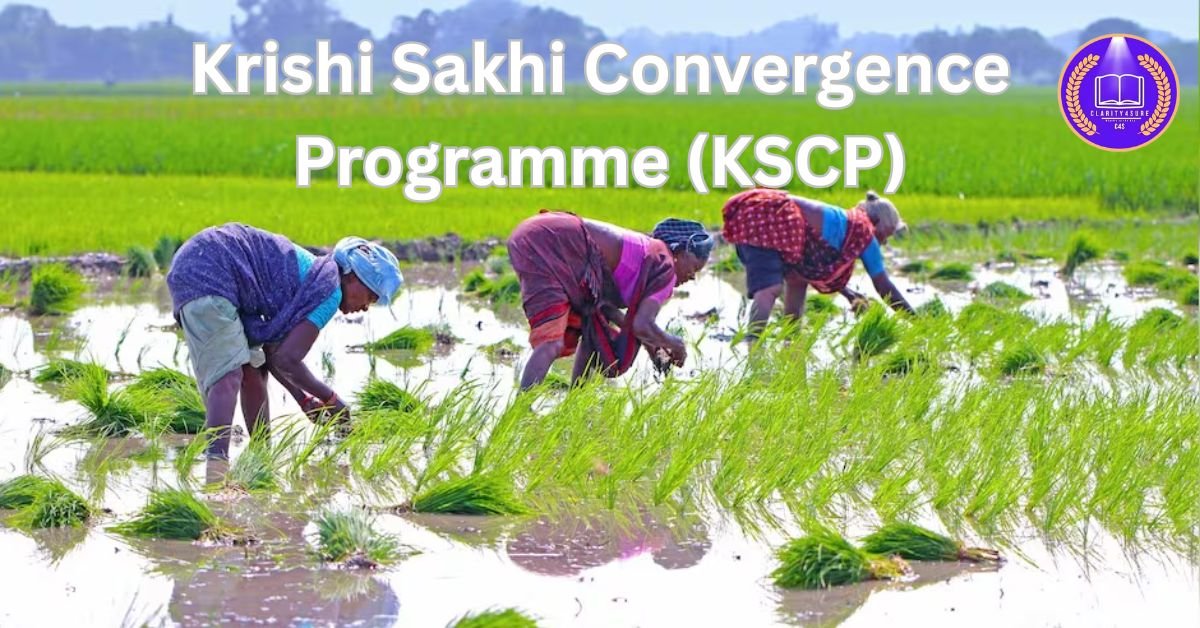
Agriculture plays a crucial role in India’s economy, employing nearly 50% of the population. Women form nearly 75% of the total rural workforce, yet they remain largely invisible in policy frameworks, financial decisions, and agricultural leadership roles. Recognizing this gap, the Government of India launched the Krishi Sakhi Convergence Programme (KSCP)—a groundbreaking initiative aimed at training, certifying, and empowering rural women as agricultural entrepreneurs and community advisors.
This initiative is not just about improving agricultural productivity but also about strengthening rural women’s financial independence, enhancing their decision-making power, and integrating them into the formal agricultural ecosystem.
Background Krishi Sakhi Convergence Programme (KSCP)
India is an agrarian economy, with over 50% of the population engaged in farming. Women contribute significantly to agricultural activities, accounting for nearly 75% of the total rural workforce. Despite their crucial role in food production, they face numerous challenges:
- Limited access to land ownership –
- Most women do not own farmland, even though they work extensively on it.
- Lack of financial independence –
- Women farmers struggle to access credit, loans, and government subsidies.
- Restricted access to modern farming techniques –
- They have fewer opportunities for formal training in sustainable agriculture.
- Social and cultural barriers –
- Women often lack decision-making power in agricultural and financial matters.
Recognizing these challenges, the Government of India launched the Krishi Sakhi Convergence Programme (KSCP) under the Deendayal Antyodaya Yojana – National Rural Livelihood Mission (DAY-NRLM). This initiative trains, certifies, and empowers women farmers as Krishi Sakhis (Women Agricultural Advisors) who help local farmers improve productivity, access financial support, and adopt sustainable practices.
What is Krishi Sakhi Convergence Programme ?
The Krishi Sakhi Convergence Programme (KSCP) is a government-backed initiative that aims to train rural women from Self-Help Groups (SHGs) in modern and sustainable farming techniques. After completing the training, these women, known as Krishi Sakhis, serve as community agricultural advisors, helping fellow farmers improve their farming practices, increase crop yields, and access financial and government support.
- Launched by:
- Ministry of Rural Development (MoRD) in collaboration with the Ministry of Agriculture and Farmers Welfare.
- Under:
- Deendayal Antyodaya Yojana – National Rural Livelihood Mission (DAY-NRLM).
- Target Beneficiaries:
- Women from Self-Help Groups (SHGs) in rural areas.
- Training & Certification:
- Provided by the National Institute of Agricultural Extension Management (MANAGE) and Krishi Vigyan Kendras (KVKs).
- Primary Goal:
- To create a network of trained women farmers who can lead agricultural transformation at the grassroots level.
Key Objectives of KSCP
The Krishi Sakhi Convergence Programme is designed to address the barriers that limit women’s participation in agriculture and create an inclusive farming ecosystem.
- Empowering Rural Women in Agriculture
- Provide structured training and certification to women farmers.
- Enable women to become agricultural entrepreneurs and earn a stable income.
- Promoting Sustainable & Climate-Resilient Farming
- Encourage organic farming, agroforestry, water conservation, and soil health management.
- Reduce reliance on chemical fertilizers and pesticides.
- Enhancing Financial Inclusion for Women Farmers
- Assist women in accessing government schemes, subsidies, and agricultural loans.
- Train them in agribusiness, market linkages, and financial literacy.
- Building a Women-Led Agricultural Support System
- Create a network of Krishi Sakhis who will act as agricultural mentors in rural communities.
- Ensure farmers receive continuous guidance on improved farming methods.
Evolution of Women’s Role in Agriculture & Policy Support
Traditional Era (Before Independence)
- Women were involved in subsistence farming, livestock rearing, and household-based food production.
- However, they had no formal recognition as farmers.
Post-Independence (1950-2000)
- Government policies focused on increasing agricultural productivity, but women’s role was largely overlooked.
- No structured financial or training programs were available specifically for women farmers.
Recognition & Policy Shift (2000-2020)
- Women’s role in agriculture gained official recognition with the rise of Self-Help Groups (SHGs) and women-led farming initiatives.
- Schemes like Mahila Kisan Sashaktikaran Pariyojana (MKSP) under DAY-NRLM helped women farmers access training and financial support.
Launch of KSCP (2023-Present)
- The Krishi Sakhi Convergence Programme was introduced as an advanced initiative to train and certify rural women in agricultural best practices.
- It integrates modern technology, financial literacy, and agripreneurship to empower women and transform rural agriculture.
How Does the Krishi Sakhi Convergence Programme Work?
The KSCP framework is designed in multiple phases to ensure maximum outreach and effectiveness.
- Selection of Krishi Sakhis
- Women from Self-Help Groups (SHGs) are nominated based on their farming experience and leadership potential.
- Preference is given to women already engaged in farming, dairy, poultry, or agribusiness.
- Training & Skill Development
- Krishi Sakhis receive structured training on:
- Crop management and soil health improvement.
- Integrated pest and nutrient management.
- Efficient irrigation techniques and water conservation.
- Agroforestry, organic farming, and climate-resilient agriculture.
- Market linkages, financial planning, and agribusiness strategies.
- Krishi Sakhis receive structured training on:
- Certification & Recognition
- Upon successful training, Krishi Sakhis receive certification from MANAGE.
- This certification allows them to work as recognized agricultural advisors.
- Field Implementation & Farmer Support
- Krishi Sakhis guide fellow farmers in their villages, sharing best practices and problem-solving strategies.
- They help farmers adopt new farming methods and increase productivity.
- Access to Financial Support & Government Schemes
- Krishi Sakhis assist farmers in applying for agriculture loans, insurance, and subsidies.
- They connect farmers to government schemes like PM-KISAN, PM Fasal Bima Yojana, and Kisan Credit Card.
Benefits of the Krishi Sakhi Convergence Programme
The KSCP scheme offers wide-ranging benefits for women farmers, rural communities, and the Indian agricultural sector.
Benefits for Women Farmers
- Skill development & employment opportunities in agriculture.
- Higher income through advisory roles and farming improvements.
- Better access to financial support, government schemes, and subsidies.
- Greater influence in household and community decision-making.
Benefits for the Agriculture Sector
- Increased productivity through the adoption of modern techniques.
- More sustainable and climate-resilient farming practices.
- Reduced dependence on middlemen, leading to better market access.
- Higher crop yields and lower post-harvest losses.
Benefits for the Government
- Increased participation of women in formal agricultural initiatives.
- More efficient implementation of rural development programs.
- Stronger rural economy with women playing a key role in agribusiness.
- Improved food security and poverty reduction in rural areas.
Challenges in Implementing KSCP
Despite its tremendous potential, the Krishi Sakhi Convergence Programme faces several challenges:
- Limited Awareness & Outreach
- Many rural women are unaware of KSCP and its benefits.
- Strong awareness campaigns are needed for better participation.
- Lack of Digital & Financial Literacy
- Many women in remote areas struggle with accessing digital tools & banking services.
- Basic financial & digital training should be included in KSCP.
- Cultural & Social Barriers
- In some regions, women face restrictions on mobility and decision-making power.
- Community-level awareness is needed to encourage families to support women’s participation.
- Infrastructure & Training Gaps
- Limited availability of training centers, expert trainers, and digital access in some areas.
- More funding and infrastructure support are required to scale the initiative.
Future Prospects of KSCP
- With proper implementation and government support, KSCP can:
- Increase rural household incomes by 20-30%.
- Ensure 50,000+ Krishi Sakhis are trained & certified across India.
- Make farming more inclusive, efficient, and profitable for women.
- Strengthen India’s rural economy & boost food security.
Conclusion
The Krishi Sakhi Convergence Programme is a game-changer for women’s empowerment, agricultural sustainability, and rural development. By equipping women with knowledge, financial access, and leadership roles, this initiative is reshaping Indian agriculture and creating a stronger, self-reliant rural economy.