

Daily Current Affairs Quiz
15 January, 2026
National Affairs
1. INSV Kaundinya
Context:
The INSV Kaundinya, a hand-stitched wooden sailing ship, successfully completed a historic voyage from Porbandar (India) to Muscat (Oman) in January 2026, retracing ancient Indian Ocean trade routes. It is named after Kaundinya, the legendary Indian mariner and merchant associated with early maritime trade between India and Southeast Asia.
- Skipper: Vikas Sheoran, Commander, Indian Navy
- Arrival Port: Port Sultan Qaboos
About INSV Kaundinya
- Length: ~20 metres
- Built at: Divar Island, Goa
- Shipbuilder: Hodi Innovations
- Constructed with support from:
- Naval architects
- Archaeologists
- Traditional shipwrights
2. Employment and Social Trends 2026 Report: ILO
Source: TH
Context:
The International Labour Organization (ILO) has projected that the global unemployment rate will remain at a historically low level of 4.9% in 2026, affecting about 186 million people worldwide, according to its Employment and Social Trends 2026 report released in Geneva.
Key Findings of the Report:
1. Low unemployment, but poor job quality
- Despite low unemployment, job quality remains a major concern.
- Around 284 million workers globally still live in extreme poverty, earning less than $3 per day.
- Over 2 billion workers continue to be engaged in informal employment, lacking job security and social protection.
2. Slow decline in working poverty
- Between 2015 and 2025, the share of workers in extreme poverty declined by only 3.1 percentage points, reaching 7.9%.
- This is sharply lower than the 15 percentage point decline achieved in the previous decade.
- The ILO flags this as a sign of weak progress in inclusive growth.
3. Rising informality
- The global informality rate increased by 0.3 percentage points between 2015 and 2025.
- This reverses gains made in the earlier decade, when informality had declined.
Regional and structural concerns
- Low-income countries are witnessing a rise in working poor and informal workers, highlighting uneven recovery.
- Gender gaps remain widespread across labour markets.
- Limited progress has been made, except in areas such as the reduction of contributing family work.
ILO Director-General Gilbert F. Houngbo warned that these trends show “a lack of progress where it is needed most.”
Trade and structural shifts
- The report identifies trade uncertainty as a persistent short-term feature of the global economy.
- These uncertainties are interacting with:
- Structural transformation
- Digitalisation
- Together, they are reshaping global supply chains, production systems, and labour demand, often faster than workers can adapt.
3. Kuki-Zo Council Reiterates Demand for Union Territory
Source: TH
Context:
The Kuki-Zo Council (KZC) has reiterated its demand for a separate Union Territory (UT) for the Kuki-Zo tribes in Manipur, citing continued insecurity and loss of faith in the State administration following the ethnic violence that began in May 2023. The demand was conveyed to Amit Shah, Union Home Minister, through a memorandum submitted after a mass rally in Churachandpur district.
What is the Kuki-Zo Council?
The Kuki-Zo Council (KZC) is an umbrella socio-political organisation representing the Kuki-Zo tribal groups mainly in Manipur, and parts of Mizoram and Assam. It functions as a collective negotiating and coordinating platform for political, administrative, and security-related issues affecting the Kuki-Zo people.
Who are the Kuki-Zo?
- An umbrella ethnolinguistic grouping that includes Kuki, Zo (Zomi), and related tribes
- Predominantly Scheduled Tribes
- In Manipur, they mainly inhabit hill districts such as:
- Churachandpur
- Kangpokpi
- Pherzawl
- Tengnoupal
4. Responsible Nations Index (RNI)
Source: News on Air
Context:
The World Intellectual Foundation (WIF) will launch the Responsible Nations Index (RNI) in collaboration with Jawaharlal Nehru University (JNU), IIM Mumbai, and the Dr Ambedkar International Centre.
About the Responsible Nations Index
The Responsible Nations Index is a global ranking framework that evaluates how responsibly countries:
- Govern their societies
- Protect the environment
- Contribute to global peace and stability
Aim
To shift global benchmarking away from purely economic (GDP) or power-based (military strength) rankings towards a values-based assessment focused on:
- Human dignity
- Sustainability
- International responsibility
Key Features
- Coverage: 154 countries worldwide
- Data: Transparent, globally sourced indicators
- Framework: Built around three core dimensions:
- Internal Responsibility
- Human dignity
- Justice and rule of law
- Welfare and inclusion of citizens
- Environmental Responsibility
- Climate action
- Biodiversity protection
- Sustainable use of natural resources
- External Responsibility
- Peace and non-aggression
- International cooperation
- Contribution to global stability
5. 16th Assembly of the International Renewable Energy Agency (IRENA)
Context:
The 16th Assembly of the International Renewable Energy Agency (IRENA) concluded in Abu Dhabi, urging an accelerated global transition to renewable energy to meet climate and energy security goals.
About IRENA
- World’s only intergovernmental organisation exclusively focused on renewable energy
- Acts as a global hub for:
- Policy advice
- Technology cooperation
- Data and analysis
- Investment support
Founded: 26 January 2009 (Bonn, Germany)
Statute in force: 8 July 2010
Headquarters: Masdar City, Abu Dhabi (UAE)
India: Founding member
Aim of IRENA
To accelerate the global energy transition through sustainable and equitable use of renewables for:
- Climate change mitigation
- Energy access
- Energy security
- Green economic growth
6. BRICS India 2026
Source: TH
Context:
India has officially launched the BRICS India 2026 logo and website ahead of assuming the Chairmanship of BRICS in 2026.
About BRICS India 2026 Logo
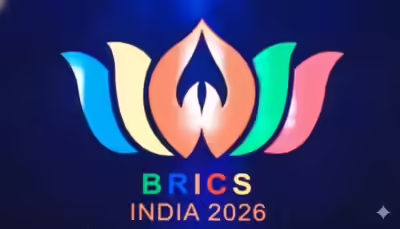
Official visual identity of India’s BRICS Chairship 2026.
Host: India
Chairmanship period: Calendar year 2026
Milestone: 20th anniversary of BRICS (2006–2026)
Logo Theme & Features
- Inspired by Lotus (India’s national flower)
- Symbolises:
- Resilience
- Unity in diversity
- Harmony
- Namaste hands at centre → dialogue & cooperation
- Five petals → Brazil, Russia, India, China, South Africa
- Reflects Vasudhaiva Kutumbakam
7. Jharkhand Megaliths
Source: TOI
Context:
The State of Jharkhand has initiated efforts to secure a UNESCO World Heritage Tag for its vast and unique megalithic landscapes, with the Chief Minister highlighting their significance at international platforms such as Davos and in the UK.
What are Megaliths?

Megaliths are large stone structures erected by prehistoric and early historic communities for multiple purposes, including:
- Burials and ancestor commemoration
- Ritual and ceremonial functions
- Boundary marking
- Astronomical observations (sunrise/sunset tracking)
Common forms include:
- Menhirs (standing stones)
- Dolmens (table-like burial structures)
- Burial slabs
- Cairns
- Stone circles
Region
- Ranchi–Khunti belt (Chokahatu)
- Hazaribagh region
- Chatra–Ramgarh–Gumla–Simdega
- Singhbhum (Ho areas)
Unique Features
- Living megalithic tradition — new stones still erected
- Linked with Munda, Ho, Oraon, Asur communities
- Local terms:
- Sasandiri (dolmens)
- Birdiri (menhirs)
- Some sites aligned with solstice/equinox
8. Shaksgam Valley
Context:
The Shaksgam Valley is in focus after China defended infrastructure activity following India’s protest.
About Shaksgam Valley
Also called the Trans-Karakoram Tract, a high-altitude region claimed by India but administered by China.
Location
- North of Siachen Glacier
- Between Karakoram and Kunlun ranges
- Part of Pakistan-occupied Kashmir, administered by China’s Xinjiang
History & Dispute
- Part of princely Jammu & Kashmir
- 1963 Sino-Pakistan Agreement:
- Pakistan ceded 5,180 sq km to China
- India rejected the agreement as illegal
- Article 6: Boundary temporary pending Kashmir resolution
9. Kashi–Tamil Sangamam
Source: TH
Context:
Prime Minister Narendra Modi celebrated Pongal and highlighted the Kashi–Tamil Sangamam initiative as a powerful symbol of India’s cultural unity amid diversity, reinforcing the spirit of “Ek Bharat, Shreshtha Bharat.”
He articulated these views in a blog titled “Kashi-Tamil Sangamam and a tribute to ‘Ek Bharat, Shreshtha Bharat’” and during Pongal celebrations in New Delhi.
About Kashi–Tamil Sangamam
A cultural, academic, and people-to-people exchange initiative that celebrates the civilisational links between Kashi (Varanasi) and Tamil Nadu.
Key Highlights
- First edition held in 2022
- Translation of Tholkappiyam (ancient Tamil text) into:
- 4 Indian languages
- 6 foreign languages
- Sage Agastya Vehicle Expedition from Tenkasi to Kashi
- Special trains operated by Indian Railways
- Valedictory function of the 2025 edition held in Rameswaram
Banking/Finance
1. RBI Issues Norms for Internal Ombudsman in Banks & NBFCs
Source: ET
Context:
In January 2026, the Reserve Bank of India (RBI) issued fresh guidelines on the appointment and functioning of Internal Ombudsmen (IOs) in banks and Non-Banking Financial Companies (NBFCs) to strengthen customer grievance redressal mechanisms. RBI has issued separate directions to provide category-specific clarity for banks and NBFCs.
Who is an Internal Ombudsman (IO)?
An Internal Ombudsman is an independent senior functionary within a regulated entity who:
- Reviews customer complaints rejected by the bank/NBFC
- Acts as a last internal checkpoint before a complaint can be escalated to RBI’s Integrated Ombudsman Scheme (IOS)
Key Objectives of the New Norms
- Strengthen consumer protection
- Improve fairness and transparency in complaint handling
- Reduce avoidable escalation to RBI
- Ensure institutional accountability in banks and NBFCs
Key Features of RBI Guidelines
1. Mandatory Appointment
- Banks and specified NBFCs must appoint an Internal Ombudsman
- IO must be independent of executive management
2. Independence & Tenure
- IO should not have held any executive role in the same entity in the recent past
- Fixed tenure to ensure functional autonomy
3. Scope of Review
- IO to review all complaints rejected (fully or partly) by internal grievance redressal units
- Decision of IO must be reasoned and documented
4. Binding Nature
- Banks/NBFCs cannot override the decision of the Internal Ombudsman
- If IO upholds rejection, only then can the complaint move to RBI’s IOS
5. Governance & Reporting
- Direct reporting to the MD/CEO or Board-level committee
- Periodic reporting on complaint trends and systemic issues
2. SMBC gets RBI’s in-principle Approval to set up Wholly Owned Subsidiary in India
Source: BS
Context:
Japan’s Sumitomo Mitsui Banking Corporation (SMBC) has received in-principle approval from the Reserve Bank of India (RBI) to establish a wholly owned subsidiary (WOS) in India. The approval allows SMBC to convert its existing branch-based operations into a locally incorporated subsidiary, the RBI said in a statement.
What does the approval mean?
- SMBC will transition from a branch model to a wholly owned subsidiary structure
- The subsidiary will be incorporated under Indian law
- This gives the bank:
- Greater operational flexibility
- Ability to expand its business footprint
- Scope to undertake activities with local capital and governance
Current SMBC presence in India
SMBC currently operates through:
- Branches in New Delhi, Mumbai, Chennai and Bengaluru
- One branch at the GIFT City International Financial Services Centre (IFSC) in Gujarat
These branches will be converted into the WOS once final approvals are granted.
3. Sebi Tightens Scrutiny of NFOs over Portfolio Overlap
Context:
India’s market regulator, the Securities and Exchange Board of India (Sebi), has begun closely scrutinising new fund offers (NFOs) for portfolio overlap with existing schemes, even as its draft proposals on the issue are yet to be notified.
Key proposals in the consultation paper
Cap on portfolio overlap
- Sectoral and thematic schemes:
- Maximum 50% stock overlap with other equity schemes within the same AMC
- Exception: Large-cap schemes
- Objective: Ensure clear differentiation among schemes
Value and contra funds
- Sebi proposes allowing AMCs to offer both value and contra funds
- Condition:
- Portfolio overlap between the two must not exceed 50%
- Monitoring:
- At the time of NFO deployment
- Thereafter semi-annually, using month-end portfolios
Corrective actions if overlap breaches limits
If overlap exceeds permitted levels:
- AMC must rebalance portfolios within 30 business days
- Possible extension of another 30 days with investment committee approval
- If breach persists:
- Investors must be given an exit option without exit load
4. New Fund Offer (NFO)
Context:
India’s market regulator, the Securities and Exchange Board of India (Sebi), has intensified scrutiny of New Fund Offers (NFOs) to check portfolio overlap with existing mutual fund schemes, even though its draft proposals on the issue are yet to be formally notified.
What is an NFO?
A New Fund Offer (NFO) is the initial launch of a mutual fund scheme by an Asset Management Company (AMC), during which investors can subscribe to units at a fixed offer price (usually ₹10 per unit). NFOs are regulated by the Securities and Exchange Board of India (SEBI).
Key Characteristics
- Offer period: Open for subscription for a limited time
- Unit price: Generally fixed at launch (e.g., ₹10)
- Post-NFO: Units are allotted and the scheme becomes open-ended (if applicable)
- Disclosure: Scheme Information Document (SID) and Key Information Memorandum (KIM) must be provided
Types of NFOs
- Open-ended NFOs
- Can be bought/sold anytime after launch
- NAV-based transactions
- Close-ended NFOs
- Fixed maturity period
- Listed on stock exchanges
- By investment style
- Equity (large-cap, mid-cap, thematic/sectoral)
- Debt
- Hybrid
- Passive (index funds, ETFs)
5. RBI Proposes Changes to FX Risk Norms for Banks
Context:
The Reserve Bank of India (RBI) has proposed revisions to the framework governing how banks calculate net foreign exchange (FX) exposure and set aside capital for FX risk, with the aim of aligning domestic norms with global standards and ensuring uniform implementation across regulated entities.
The proposed rules are open for stakeholder feedback and are expected to come into effect from April 1, 2027.
What is changing?
1. Unified net open position (NOP) calculation
- RBI has proposed doing away with separate onshore and offshore NOP calculations
- Banks would compute a single consolidated FX exposure
- This simplifies reporting and improves comparability across institutions
2. Exclusion of ‘structural’ FX positions
Banks may exclude certain long-term, non-trading FX positions from NOP calculations, such as:
- Foreign-currency investments in:
- Overseas subsidiaries
- Branches
- Affiliated but non-consolidated entities
These positions are typically strategic and long-term, not meant for short-term trading gains.
Why RBI is proposing these changes
- To align India’s FX risk framework with global regulatory practices
- To remove inconsistencies in how banks calculate FX exposure
- To ensure more accurate capital allocation against FX risk
- To reduce unnecessary capital strain arising from structural, non-volatile exposures
Facts To Remember
1. Rakesh Aggarwal appointed NIA chief
Counter-terrorism expert Rakesh Aggarwal was on Wednesday appointed the new DG of the National Investigation Agency (NIA).
2. Primary health care gets a boost as govt. launches 81 Ayushman Arogya Mandirs
The Delhi government on Wednesday inaugurated 81 new Ayushman Arogya Mandirs (AAMs) aimed at bringing free treatment closer to residents of the national capital. This takes the number of inaugurated AAMs to 319.
3. Wholesale price inflation rises to an 8-month high of 0.83%
Wholesale price inflation increased for the second month in a row, rising 0.83% in December 2025, driven by an uptick in prices of food, non-food articles, and manufactured items on a month-on-month basis, government data showed on Wednesday.
4. Gujarat CM reviews rescue operations under Karuna Abhiyan-2026 during Uttarayan
The Chief Minister of Gujarat, Bhupendra Patel, reviewed wildlife rescue operations being carried out under Karuna Abhiyan-2026 during the Uttarayan (kite-flying) festival, following a surge in bird injuries caused by sharp kite strings (manja).
5. Kashi-Tamil Sangamam celebrates living unity of India’s many traditions while honouring their unique identities: PM
Prime Minister Narendra Modi has said that Kashi-Tamil Sangamam celebrates the living unity of India’s many traditions while honouring their unique identities.
6. Jammu and Kashmir secures second rank in Export Preparedness Index 2024
Jammu and Kashmir has achieved a significant milestone in its export development journey by securing the second rank among Small States, Northeastern States and Union Territories in the Export Preparedness Index (EPI) 2024, released by NITI Aayog.
7. Department of Financial Services launches composite salary account package for central government employees
The Department of Financial Services today launched a composite salary account package for central government employees in association with Public Sector Banks.
8. Govt launches Paripoorna Mediclaim Ayush Bima offering cashless and modern treatments for CGHS beneficiaries
The Department of Financial Services today launched the Paripoorna Mediclaim Ayush Bima for Central Government Health Scheme (CGHS) beneficiaries.
9. 10th Armed Forces Veterans Day observed nationwide with celebration at Military Station in Nava Raipur
The 10th Armed Forces Veterans Day is being observed across the country today.
10. NHAI testing real-time alerts to reduce cattle-related crashes on highways
The National Highways Authority of India-NHAI has launched a pilot initiative to deliver real-time safety alerts to National Highway users.







