

Why in News?
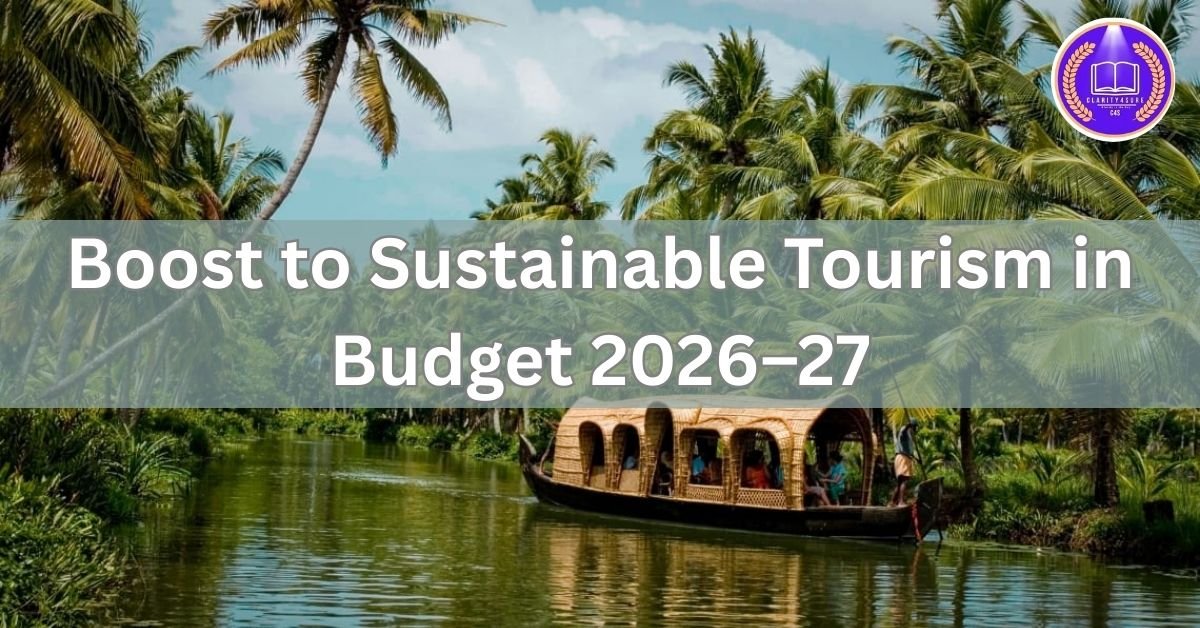
Tourism has emerged as a focal point in the Union Budget 2026-27, with the government unveiling a comprehensive set of measures aimed at positioning the sector as a strategic growth driver for the Indian economy.
- The tourism sector accounts for 5.22% of India’s GDP (total impact) with a direct share of 2.72%, while supporting an impressive 13.34% of total employment, according to the India Tourism Data Compendium 2025 by the Ministry of Tourism.
New Initiatives Announced for Tourism Development in Union Budget 2026-27
- Development of Buddhist Circuits in the Northeast Region:
- A special scheme has been announced to develop Buddhist circuits across Northeast India Arunachal Pradesh, Assam, Sikkim, Manipur, Mizoram and Tripura. The plan includes setting up pilgrimage interpretation centres, improving connectivity, enhancing pilgrim amenities, and strengthening heritage infrastructure.
This initiative builds on the experience of the Swadesh Darshan Scheme (launched in 2014–15), under which 76 projects were sanctioned and 75 have already been completed.
- A special scheme has been announced to develop Buddhist circuits across Northeast India Arunachal Pradesh, Assam, Sikkim, Manipur, Mizoram and Tripura. The plan includes setting up pilgrimage interpretation centres, improving connectivity, enhancing pilgrim amenities, and strengthening heritage infrastructure.
- Eco-Trails and Sustainable Tourism Initiatives:
- The Budget proposes the development of eco-friendly mountain and nature trails in Himachal Pradesh, Uttarakhand, Jammu & Kashmir, Araku Valley in the Eastern Ghats, and Podhigai Malai in the Western Ghats.
It also includes turtle trails at major nesting sites along the coasts of Odisha, Karnataka and Kerala, and bird-watching trails around Pulicat Lake in Andhra Pradesh.
- The Budget proposes the development of eco-friendly mountain and nature trails in Himachal Pradesh, Uttarakhand, Jammu & Kashmir, Araku Valley in the Eastern Ghats, and Podhigai Malai in the Western Ghats.
- Global Big Cat Summit 2026:
- India will host the first-ever Global Big Cat Summit in 2026. Leaders and ministers from 95 big cat range countries will be invited to discuss conservation, habitat protection, scientific cooperation, and sustainable wildlife tourism.
This reflects the Government’s effort to strengthen India’s global leadership in eco-tourism and wildlife conservation. India is home to five of the world’s seven big cat species — tiger, lion, leopard, snow leopard and cheetah.
- India will host the first-ever Global Big Cat Summit in 2026. Leaders and ministers from 95 big cat range countries will be invited to discuss conservation, habitat protection, scientific cooperation, and sustainable wildlife tourism.
- National Institute of Hospitality:
- The National Council for Hotel Management and Catering Technology in Noida, Uttar Pradesh, will be upgraded to a National Institute of Hospitality.
The institute will provide high-quality professional education and act as a bridge between academia, industry and the Government, helping to address skill gaps and better align education with industry needs.
- The National Council for Hotel Management and Catering Technology in Noida, Uttar Pradesh, will be upgraded to a National Institute of Hospitality.
- Tourist Guide Upskilling Programme:
- A pilot programme has been announced to upskill 10,000 tourist guides across 20 iconic destinations.
The training will follow a 12-week hybrid model that combines classroom learning, field training and digital modules.
- A pilot programme has been announced to upskill 10,000 tourist guides across 20 iconic destinations.
- National Destination Digital Knowledge Grid:
- A digital platform will be developed to document cultural, spiritual and heritage sites across India.
It will serve as a knowledge resource for researchers, content creators, historians and tourism stakeholders.
- A digital platform will be developed to document cultural, spiritual and heritage sites across India.
- Experiential Cultural Destinations:
- The Budget proposes to transform 15 archaeological sites into vibrant experiential cultural destinations. These include Lothal, Dholavira, Rakhigarhi, Sarnath, Hastinapur and Leh Palace.
This initiative will complement existing schemes such as Swadesh Darshan 2.0 and PRASHAD.
- The Budget proposes to transform 15 archaeological sites into vibrant experiential cultural destinations. These include Lothal, Dholavira, Rakhigarhi, Sarnath, Hastinapur and Leh Palace.
- Regional Medical Hubs:
- A new scheme has been introduced to support States in establishing five Regional Medical Hubs. The aim is to promote India as a global hub for medical and wellness tourism. These hubs will bring together advanced healthcare services, AYUSH centres and medical value tourism facilitation centres.
- Tourism Development in Purvodaya States:
- The Budget proposes the development of five tourism destinations one each in Bihar, Jharkhand, West Bengal, Odisha and Andhra Pradesh under an integrated framework linked to the East Coast Industrial Corridor, including a node at Durgapur in West Bengal.
Additionally, 4,000 electric buses will be provided to improve connectivity, promote cleaner transport and enhance accessibility in these regions.
- The Budget proposes the development of five tourism destinations one each in Bihar, Jharkhand, West Bengal, Odisha and Andhra Pradesh under an integrated framework linked to the East Coast Industrial Corridor, including a node at Durgapur in West Bengal.
Challenges Associated with Tourism Development in India
- Inadequate Infrastructure:
- Weak transport networks and poor last-mile connectivity continue to be major challenges. In 2025, tourist footfall in Vyas Valley (Uttarakhand) rose from 200 to 30,000 over a decade, but infrastructure did not expand at the same pace. This created capacity pressures and reduced the overall visitor experience.
- Environmental Degradation:
- Overcrowding in environmentally sensitive areas is leading to pollution, waste buildup and loss of biodiversity.
Tourist arrivals in Goa increased from 68.9 lakh domestic visitors in 2017 to nearly 1.1 crore by 2025, resulting in traffic congestion, garbage accumulation, beach erosion and demands for limits based on carrying capacity.
The 2025 Char Dham Yatra drew more than four million pilgrims, further increasing environmental stress in hill regions.
- Overcrowding in environmentally sensitive areas is leading to pollution, waste buildup and loss of biodiversity.
- Safety and Security Concerns:
- Ongoing safety concerns, especially for women and solo travellers, continue to discourage tourism. Travel advisories from the United States and the United Kingdom have been issued, and incidents involving foreign tourists have reinforced negative perceptions. As a result, many travellers prefer Southeast Asian destinations.
- Hygiene and Service Quality:
- Uneven sanitation standards affect visitor satisfaction. Many international tourists restrict their stay to luxury hotels, which limits the economic benefits reaching local communities.
- Visa and Regulatory Complexities:
- Although the e-visa system has expanded, delays in processing still occur. Funding for overseas tourism promotion was reduced from Rs 33 crore to Rs 3.07 crore in Budget 2025–26, making it harder for India to compete with visa-on-arrival destinations such as Thailand and Vietnam.
- Global Competitiveness Gap:
- India received only 10 million foreign tourists in 2024, compared to Thailand’s 35 million, Malaysia’s 25 million and Vietnam’s 17 million. In 2023, Indians spent about USD 33 billion on overseas travel, often choosing foreign destinations for better value, services and transparency.
Steps Needed to Promote Tourism Development in India
- Enhance Infrastructure and Connectivity:
- Increase investment in transport infrastructure such as high-speed rail, multimodal corridors and regional airports under the UDAN scheme.
The aim is to spread tourism more evenly across the country instead of concentrating it only in major metropolitan cities.
- Increase investment in transport infrastructure such as high-speed rail, multimodal corridors and regional airports under the UDAN scheme.
- Revamped “Incredible India 2.0” Campaign:
- Shift from general promotional campaigns to data-driven and highly targeted global marketing. Focus on specific groups such as millennials, luxury travellers and adventure seekers.
At the domestic level, expand the Dekho Apna Desh initiative to encourage people to explore lesser-known destinations within India.
- Shift from general promotional campaigns to data-driven and highly targeted global marketing. Focus on specific groups such as millennials, luxury travellers and adventure seekers.
- Establish “Tourism-Ready” Certification for Destinations:
- Introduce a mandatory accreditation system for tourist destinations based on standards of cleanliness, safety, accessibility and sustainability.
This would create healthy competition among states and encourage them to improve overall tourism standards.
- Introduce a mandatory accreditation system for tourist destinations based on standards of cleanliness, safety, accessibility and sustainability.
- Integrate Tourism with Rural Development:
- Promote agri-tourism and rural tourism by connecting working farms and rural communities with urban and international visitors. This will offer authentic cultural experiences while generating additional income for farmers.
Ensure local communities benefit through programmes such as Paryatan Mitra and Paryatan Didi, so that rural, tribal and underserved regions receive fair economic gains.
- Promote agri-tourism and rural tourism by connecting working farms and rural communities with urban and international visitors. This will offer authentic cultural experiences while generating additional income for farmers.
- Incentivize Green Certification for the Hospitality Industry:
- Launch a national programme to encourage hotels, resorts and homestays to adopt sustainable practices such as water conservation, waste management and use of renewable energy.
Provide marketing support to properties certified under “Green Key” to attract environmentally conscious travellers.
- Launch a national programme to encourage hotels, resorts and homestays to adopt sustainable practices such as water conservation, waste management and use of renewable energy.
Conclusion
The Union Budget 2026–27 lays out an ambitious and forward-looking plan to strengthen India’s tourism sector. With focused initiatives such as the development of Buddhist circuits in the Northeast, promotion of eco-trails, hosting of the Global Big Cat Summit, and upgrading hospitality education and infrastructure, the government is clearly aiming to position tourism as a key pillar of economic growth. These measures reflect a shift toward sustainable, experience-based and globally competitive tourism. However, the real impact of this vision will depend on how effectively India addresses long-standing challenges such as weak infrastructure, environmental pressure in fragile regions, safety concerns and gaps in global competitiveness. Ensuring better connectivity, responsible tourism practices and meaningful participation of local communities will be crucial in turning tourism into a strong, inclusive and sustainable engine of economic development.







