Daily Current Affairs Quiz
18&19 June, 2026
Reports
1. QS World University Rankings 2027
Source: ET
Context
In June 2026, London (UK)-based global higher education analytics firm Quacquarelli Symonds (QS) released the QS World University Rankings 2027 on 18 June 2026. The Indian Institute of Technology (IIT) Delhi ranked 118th globally with an overall score of 65.7, improving 5 places from 123rd and emerging as India’s highest-ranked institution for the second consecutive year. This is the highest global position ever achieved by an Indian institution in QS World University Rankings. MIT (Massachusetts Institute of Technology) retained 1st place globally with a score of 100, while Imperial College London (UK) and Stanford University (USA) were jointly ranked 2nd with scores of 99.2.
The Rankings
- Released by: Quacquarelli Symonds (QS), London-based.
- Date of release: 18 June 2026.
- Edition: 23rd edition.
- Coverage: More than 1,500 universities across 106 countries and territories.
- Indian universities ranked: 52.
Top 3 Global Universities
| Rank | University | Country | Score |
|---|---|---|---|
| 1 | Massachusetts Institute of Technology (MIT) | USA | 100 |
| 2 (joint) | Imperial College London | UK | 99.2 |
| 2 (joint) | Stanford University | USA | 99.2 |
Top 5 Indian Institutions
| Rank | Institution | Location | Score |
|---|---|---|---|
| 118 | IIT Delhi | Delhi | 65.7 |
| 134 | IIT Bombay | Maharashtra | – |
| 170 | IIT Madras | Tamil Nadu | – |
| 205 | IIT Kharagpur | West Bengal | – |
| 221 | IISc Bangalore | Karnataka | – |
IIT Delhi’s Performance Improvement
- Overall rank: Improved 5 places from 123rd to 118th.
- Employer Reputation: Improved 11 positions to 39th globally.
- Employment Outcomes: Jump of 60 positions.
- Citations per Faculty: Improved by 26 positions.
QS Rankings Methodology
QS evaluates universities based on 9 indicators in the 2027 edition:
| Indicator | Weight (Approximate) |
|---|---|
| Academic Reputation | 30% |
| Employer Reputation | 15% |
| Citations per Faculty | 20% |
| Faculty-Student Ratio | 10% |
| International Faculty Ratio | 5% |
| International Student Ratio | 5% |
| International Research Network | 5% |
| Employment Outcomes | 5% |
| Sustainability | 5% |
India’s Growth in QS Rankings
| Edition | Indian Universities Ranked | India’s Top Rank |
|---|---|---|
| 2014 | 11 | IIT Delhi at 235 |
| 2023 | 41 | IIT Delhi at 174 |
| 2026 | 54 | IIT Delhi at 123 |
| 2027 | 52 | IIT Delhi at 118 |
About QS (Quacquarelli Symonds)
- Founded: 1990 by Nunzio Quacquarelli.
- Headquartered: London, United Kingdom.
- Type: Higher education analytics firm.
- First QS World University Rankings: 2004 (with Times Higher Education, separated in 2010).
- Other rankings: QS Asia, QS Latin America, QS Subject Rankings, QS BRICS, QS Stars.
Practice MCQs
Q1. With reference to the QS World University Rankings 2027, consider the following statements:
- IIT Delhi ranked 118th globally, improving from 123rd in the previous edition.
- MIT retained 1st place globally with a perfect score of 100.
- Imperial College London and Stanford University were jointly ranked 2nd with scores of 99.2.
- The rankings were released by Times Higher Education.
How many of the above statements are correct?
(a) Only one (b) Only two (c) Only three (d) All four (e) None
(Statement 4 is wrong; the rankings were released by Quacquarelli Symonds (QS), NOT Times Higher Education.)
Q2. With reference to the top Indian institutions in QS World University Rankings 2027, consider the following statements:
- IIT Delhi ranked 118th and was India’s highest-ranked institution.
- IIT Bombay ranked 134th globally.
- IIT Madras ranked 170th globally.
- IIT Kharagpur ranked higher than IISc Bangalore.
How many of the above statements are correct?
(a) Only one (b) Only two (c) Only three (d) All four (e) None
(IIT Kharagpur at 205 ranks higher than IISc Bangalore at 221.)
Q3. With reference to India’s coverage in QS World University Rankings 2027, consider the following statements:
- 52 Indian universities were ranked in QS World University Rankings 2027.
- India is now the 4th most represented country after USA, UK, and Mainland China.
- India had only 11 universities ranked in 2014.
- No Indian institution has entered the global Top 100 yet.
How many of the above statements are correct?
(a) Only one (b) Only two (c) Only three (d) All four (e) None
Q4. With reference to QS Quacquarelli Symonds, consider the following statements:
- QS is a London-based global higher education analytics firm.
- The QS World University Rankings was first published in 2004 in partnership with Times Higher Education.
- QS separated from Times Higher Education in 2010.
- QS also publishes QS Asia, QS Subject, and QS BRICS rankings.
How many of the above statements are correct?
(a) Only one (b) Only two (c) Only three (d) All four (e) None
Q5. With reference to QS methodology in the 2027 edition, consider the following statements:
- Academic Reputation has the highest weightage at about 30 per cent.
- Citations per Faculty has a weightage of about 20 per cent.
- Sustainability is one of the indicators added in recent editions.
- International Faculty Ratio has the highest weightage.
Which of the above are correct?
(a) 1, 2 and 3 only (b) 1, 3 and 4 only (c) 2 and 4 only (d) 1 and 4 only (e) All four
(Statement 4 is wrong; Academic Reputation has the highest weight, NOT International Faculty Ratio.)
Answer Key
- (c), Statements 1, 2, 3 are correct; Statement 4 is wrong because QS released the rankings.
- (d), All four statements are correct.
- (d), All four statements are correct.
- (d), All four statements are correct.
- (a), Statements 1, 2, 3 are correct; Statement 4 is wrong because Academic Reputation has the highest weight.
2. Global Startup Ecosystem Report (GSER) 2026
Context
In June 2026, Startup Genome, in partnership with the Global Entrepreneurship Network (GEN), released the Global Startup Ecosystem Report (GSER) 2026 at the VivaTech conference in Paris on 17 June 2026. Bengaluru, Karnataka ranked 15th among the top 40 global startup ecosystems (slipping one spot from 14th in 2025, largely a technical adjustment). It also emerged as the second-best AI-native cluster in Asia, after Beijing, China. Silicon Valley (USA), New York City (USA), and London (UK) retained their top three positions. The GSER 2026 is the 14th edition of the report, based on analysis of over 5.5 million startups across 350+ global startup ecosystems, with policy insights from 200+ organizations across 80+ countries. Bengaluru’s ecosystem is valued at about USD 153 billion, with USD 46 billion in startup exits between 2021 and 2025, 304 exits, 30 active unicorns, and an R&D score of 9/10 (ahead of Silicon Valley).
The Report
- Title: Global Startup Ecosystem Report (GSER) 2026.
- Edition: 14th edition.
- Released by: Startup Genome in partnership with the Global Entrepreneurship Network (GEN).
- Launch venue: VivaTech, Paris.
- Launch date: 17 June 2026.
- Coverage:
- 5.5 million startups.
- 350+ global startup ecosystems.
- 200+ organizations across 80+ countries.
Top 5 Global Ecosystems (Verified)
| Rank | Ecosystem | Country | Change |
|---|---|---|---|
| 1 | Silicon Valley | USA | Unchanged |
| 2 | New York City | USA | Unchanged |
| 3 | London | UK | Unchanged |
| 4 | Boston | USA | – |
| 5 | Los Angeles | USA | – |
Bengaluru’s Ranking and Performance
- Global rank: 15th (slipped one spot from 14th in 2025).
- Reason for slip: Toronto-Waterloo and Paris jointly took 13th place; no ecosystem at 14th; pushing Bengaluru to 15th (a technical adjustment).
- Asia rank by value: 3rd (after Beijing and Shanghai).
- AI-Native Cluster Asia rank: 2nd-best (after Beijing).
- Continued presence in global leaders.
Bengaluru’s Performance Across 6 GSER Factors
| Factor | Score (Out of 10) | Notes |
|---|---|---|
| Performance | 9/10 | Ahead of Silicon Valley |
| Funding | 8/10 | Top 15 by capital raised |
| Market Reach | 5/10 | Local 4/10, Global 7/10 |
| Talent and Experience | 4/10 | Cost efficiency 10/10, but quality 1/10 |
| AI-Native Cluster | 8/10 | 2nd in Asia after Beijing |
| R&D | 9/10 | Ahead of Silicon Valley |
GSER 2026 Six Success Factors (Methodology)
- Performance: Startup performance and outputs.
- Funding: Venture capital availability.
- Market Reach: Local and global market access.
- Talent and Experience: Quality and quantity of talent.
- AI-Native Cluster Strength: AI startup density.
- R&D: Research and Development capacity.
About Startup Genome
- Founded: 2011.
- Headquartered: San Francisco, California, USA.
- Type: Innovation policy advisory and research firm.
- CEO: JF Gauthier.
- Mission: To accelerate startup ecosystems through data-driven insights.
About Global Entrepreneurship Network (GEN)
- Founded: 2008.
- Headquartered: Washington, D.C., USA.
- Type: Non-profit advocacy and research organization.
- Reaches: 180+ countries.
- Functions:
- Promotes entrepreneurship globally.
- Hosts Global Entrepreneurship Week.
- Connects policymakers, founders, investors.
Practice MCQs
Q1. With reference to the Global Startup Ecosystem Report (GSER) 2026, consider the following statements:
- GSER 2026 was released on 17 June 2026 at VivaTech in Paris.
- It is the 14th edition of the Global Startup Ecosystem Report.
- It is published by Startup Genome in partnership with the Global Entrepreneurship Network.
- The report was released in New Delhi by the Government of India.
How many of the above statements are correct?
(a) Only one (b) Only two (c) Only three (d) All four (e) None
(Statement 4 is wrong; the report was released at VivaTech in Paris, NOT in New Delhi.)
Q2. With reference to Bengaluru’s ranking in GSER 2026, consider the following statements:
- Bengaluru ranked 15th globally, slipping from 14th in 2025.
- Bengaluru is Asia’s second-best AI-native cluster after Beijing.
- Bengaluru’s ecosystem value is about USD 153 billion.
- Bengaluru ranked 1st globally.
How many of the above statements are correct?
(a) Only one (b) Only two (c) Only three (d) All four (e) None
(Statement 4 is wrong; Bengaluru ranked 15th, NOT 1st.)
Q3. With reference to the top three global startup ecosystems (GSER 2026), consider the following statements:
- Silicon Valley retained the 1st position.
- New York City retained the 2nd position.
- London retained the 3rd position.
- Bengaluru is among the global top 3.
How many of the above statements are correct?
(a) Only one (b) Only two (c) Only three (d) All four (e) None
(Statement 4 is wrong; Bengaluru is at 15th, NOT in top 3.)
Q4. With reference to Bengaluru’s performance metrics (GSER 2026), consider the following statements:
- Bengaluru’s R&D score is 9/10, ahead of Silicon Valley.
- Its ecosystem value grew 190 per cent since 2021 vs global average of 149 per cent.
- It has 30 active unicorns and USD 39 billion in VC funding (2021-2025).
- Bengaluru’s talent quality scored 10/10, the highest globally.
How many of the above statements are correct?
(a) Only one (b) Only two (c) Only three (d) All four (e) None
(Statement 4 is wrong; talent quality scored only 1/10, NOT 10/10. The 10/10 was for cost efficiency and STEM graduate numbers.)
Q5. With reference to the GSER methodology, consider the following statements:
- GSER 2026 evaluates ecosystems on 6 success factors: performance, funding, market reach, talent, AI-native cluster, and R&D.
- The report covers 5.5 million startups across 350+ ecosystems.
- Policy insights from 200+ organizations across 80+ countries are included.
- Each factor is scored on a scale of 1 to 10.
How many of the above statements are correct?
(a) Only one (b) Only two (c) Only three (d) All four (e) None
Answer Key
- (c), Statements 1, 2, 3 are correct; Statement 4 is wrong because the report was released in Paris.
- (c), Statements 1, 2, 3 are correct; Statement 4 is wrong because Bengaluru ranked 15th.
- (c), Statements 1, 2, 3 are correct; Statement 4 is wrong because Bengaluru is at 15th.
- (c), Statements 1, 2, 3 are correct; Statement 4 is wrong because talent quality scored 1/10.
- (d), All four statements are correct.
3. UNICEF’s Children’s Climate Risk Report 2026
Context
The UNICEF Children’s Climate Risk Report (CCRR) 2026 was released on 16 June 2026. It reveals that nearly 392 million children in India (about 92 per cent of all children) are exposed to extreme heat, while 89 million face recurrent heatwaves. India’s hazard exposure score stands at 9.21 out of 10 (among the highest globally), with only Pakistan (9.44) and Bangladesh (9.38) higher in South Asia. India received the maximum score of 10/10 for extreme heat exposure, 9.94 for air pollution, and 8.84 for drought. Globally, 1.1 billion children are exposed to at least three overlapping climate hazards, and more than 4 million children face up to six overlapping threats. The report draws on UNICEF’s Global Child Hazard Database and is the first global assessment since the 2021 “Climate Crisis is a Child Rights Crisis” report.
The Report
- Title: Children’s Climate Risk Report (CCRR) 2026.
- Released by: UNICEF (United Nations Children’s Fund).
- Release date: 16 June 2026.
- Publication body: UNICEF Innocenti, Florence, Italy.
- Released by: UNICEF Executive Director Catherine Russell.
- Source: UNICEF Global Child Hazard Database.
- Builds on: 2021 report “Climate Crisis is a Child Rights Crisis”.
What is the CCRR 2026?
- A global assessment that evaluates children’s exposure and vulnerability to climate and environmental hazards.
- Measures overlapping climate risks affecting children’s:
- Health.
- Education.
- Nutrition.
- Survival.
Climate Hazards Studied (Verified)
Eight Primary Hazards
- Coastal floods.
- Droughts.
- Extreme heat.
- Fires.
- Heatwaves.
- Riverine floods.
- Sand and dust storms.
- Tropical storms.
Two Climate-Sensitive Hazards
- Air pollution.
- Vector-borne diseases (malaria).
Seven Vulnerability Dimensions
- Water, sanitation and hygiene (WASH).
- Nutrition.
- Protection.
- Health.
- Education.
- Poverty.
- Child survival.
Key Findings on India
Massive Exposure to Extreme Heat
- 392 million children (about 92 per cent) in India exposed to extreme heat.
- 89 million children face recurrent heatwave events.
India’s Hazard Exposure Score
- Overall hazard exposure: 9.21/10 (among highest globally).
- South Asia comparison:
- Pakistan: 9.44/10 (highest).
- Bangladesh: 9.38/10 (second highest).
- India: 9.21/10 (third highest).
Specific Hazard Scores for India
| Hazard | India’s Score |
|---|---|
| Extreme heat | 10/10 (maximum) |
| Air pollution | 9.94/10 |
| Drought | 8.84/10 |
Global Findings
- 1.5 billion children globally exposed to heatwaves.
- 1.2 billion children exposed to extreme heat conditions.
- 1.8 billion children exposed to droughts.
- 662 million children in areas exposed to tropical storms.
- 337 million children in areas affected by riverine flooding.
- 33 million children exposed to coastal floods.
- 1.1 billion children face 3+ overlapping climate hazards.
- More than 4 million children face 6 overlapping climate threats.
- 2.3 billion children live in areas with unhealthy air quality.
- 1 billion children exposed to malaria.
Most Affected Countries
- India, Bangladesh, Pakistan, Nigeria: Among the most affected due to large child populations and high exposure.
Comparison with 2021 UNICEF Report
| Feature | 2021 Report | 2026 Report |
|---|---|---|
| Title | “Climate Crisis is a Child Rights Crisis” | “Children’s Climate Risk Report” |
| Scope | 8 climate hazards | 8 climate hazards + 2 climate-sensitive (air pollution, malaria) |
| Approach | Country-level CCRI | Sub-national, granular data via Global Child Hazard Database |
| Vulnerability dimensions | 6 dimensions | 7 dimensions |
| India’s CCRI rank (2021) | 26th out of 163 countries (high risk) | Detailed in new framework |
About UNICEF
- Full name: United Nations Children’s Fund (originally United Nations International Children’s Emergency Fund).
- Founded: 1946 (in response to post-WWII child welfare crisis).
- Headquartered: New York City, USA.
- Research arm: UNICEF Innocenti in Florence, Italy.
- Executive Director: Catherine Russell (since February 2022).
- Funding: Voluntary contributions from governments, businesses, foundations, and individuals.
Practice MCQs
Q1. With reference to UNICEF’s Children’s Climate Risk Report 2026, consider the following statements:
- The report was released on 16 June 2026 by UNICEF Executive Director Catherine Russell.
- It assesses children’s exposure to 8 primary climate hazards and 2 climate-sensitive hazards.
- India’s overall hazard exposure score is 9.21 out of 10.
- The report was released by the United Nations Environment Programme (UNEP).
How many of the above statements are correct?
(a) Only one
(b) Only two
(c) Only three
(d) All four
(e) None
(Statement 4 is wrong; the report was released by UNICEF, NOT UNEP.)
Q2. With reference to India’s climate hazard exposure (CCRR 2026), consider the following statements:
- About 392 million children in India (92 per cent) are exposed to extreme heat conditions.
- India received the maximum score of 10/10 for extreme heat exposure.
- India’s air pollution exposure score is 9.94/10.
- Pakistan (9.44) and Bangladesh (9.38) have higher overall hazard scores than India in South Asia.
How many of the above statements are correct?
(a) Only one
(b) Only two
(c) Only three
(d) All four
(e) None
Q3. With reference to the global findings of CCRR 2026, consider the following statements:
- 1.1 billion children globally are exposed to at least three overlapping climate hazards.
- More than 4 million children could face as many as six overlapping climate threats.
- About 1.8 billion children are exposed to droughts globally.
- Air pollution affects less than 100 million children globally.
Which of the above are correct?
(a) 1, 2 and 3 only
(b) 1, 3 and 4 only
(c) 2 and 4 only
(d) 1 and 4 only
(e) All four
(Statement 4 is wrong; 2.3 billion children live in areas with unhealthy air quality, NOT less than 100 million.)
Q4. With reference to India’s Heat Action Plans (HAPs) as assessed by CCRR 2026, consider the following statements:
- India has expanded HAPs across multiple states and cities.
- Most HAPs lack provisions for schools and Anganwadis.
- They lack night-time heat management measures.
- They lack child vulnerability mapping and age-specific adaptation measures.
How many of the above statements are correct?
(a) Only one
(b) Only two
(c) Only three
(d) All four
(e) None
Q5. With reference to UNICEF, consider the following statements:
- UNICEF was founded in 1946 in response to post-WWII child welfare crisis.
- UNICEF Innocenti is its research arm based in Florence, Italy.
- UNICEF stands for the United Nations Children’s Fund.
- UNICEF is funded entirely by mandatory contributions from member states.
Which of the above are correct?
(a) 1, 2 and 3 only
(b) 1, 3 and 4 only
(c) 2 and 4 only
(d) 1 and 4 only
(e) All four
(Statement 4 is wrong; UNICEF is funded by VOLUNTARY contributions, NOT mandatory ones.)
Answer Key
- (c), Statements 1, 2, 3 are correct; Statement 4 is wrong because the report was released by UNICEF, not UNEP.
- (d), All four statements are correct.
- (a), Statements 1, 2, 3 are correct; Statement 4 is wrong because air pollution affects 2.3 billion children.
- (d), All four statements are correct.
- (a), Statements 1, 2, 3 are correct; Statement 4 is wrong because UNICEF funding is voluntary.
National Affairs
1. Super El Niño 2026-27
Source: Down to Earth
Context
The United States’ National Oceanic and Atmospheric Administration (NOAA) confirmed on 11 June 2026 the formation of a new El Niño in the equatorial Pacific, issuing an El Niño Advisory. NOAA placed the odds at 63 per cent that it will intensify into a very strong or “super” El Niño by the northern winter (November 2026-January 2027). A super El Niño is defined by sea surface temperature (SST) anomalies exceeding 2°C in a specific reference patch of the Pacific. Since 1950, only four major events have crossed this extreme threshold: 1972-73, 1982-83, 1997-98, and 2015-16. The 2026-27 event could potentially become one of the strongest on record, with ECMWF projecting SST anomalies of +3°C by December 2026. The event is likely to weaken India’s southwest monsoon, cause droughts globally, push global temperatures above the 1.5°C threshold, and trigger ecological destruction.
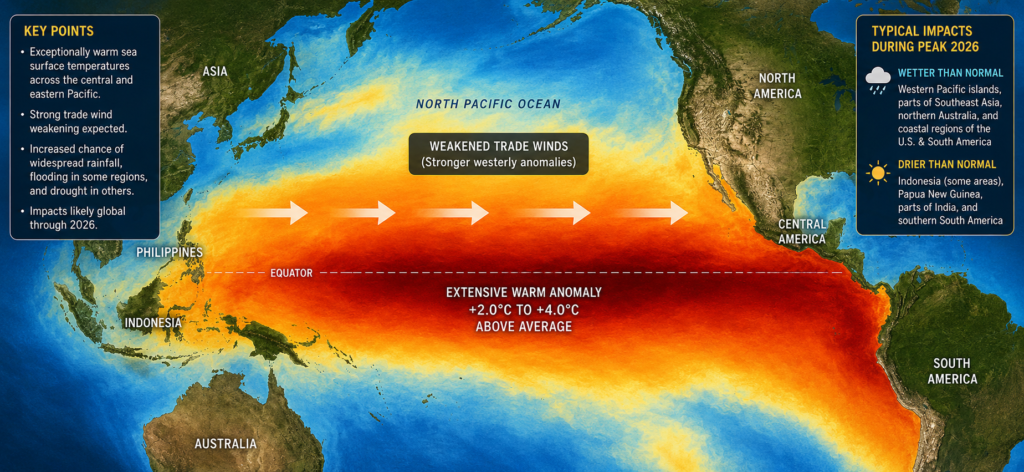
What is El Niño?
- The warm phase of the El Niño-Southern Oscillation (ENSO).
- Periodic, anomalous warming of sea surface temperatures (SSTs) across the central and eastern equatorial Pacific Ocean.
- Occurs every 3-7 years.
- Affects global weather patterns.
What Makes a “Super” El Niño?
- SST anomaly exceeding 2°C in the Niño 3.4 reference region.
- ONI (Oceanic Niño Index) or RONI value of +2°C or above.
- Among the top 3-4 events in the reliable satellite record since late 1970s.
How El Niño Forms
Step 1: Slackening of Trade Winds
- Equatorial trade winds that normally blow east to west begin to stall or reverse.
- Normally, these winds push warm surface waters toward Asia.
Step 2: West-to-East Warm Water Drift
- With weakened winds, warm surface water accumulates and moves eastward toward South American coast.
Step 3: The Feedback Loop (Bjerknes Feedback)
- As eastern Pacific heats up, atmospheric pressure zones shift.
- This further slackens trade winds.
- Self-reinforcing cycle pushes temperatures past the 2°C threshold.
Step 4: Climate Change Multiplier
- Long-term climate change acts as an incubator.
- Higher baseline ocean heat makes modern super El Niños more intense than historical ones.
Impact on India
Monsoon Suppression
- El Niño often weakens the Indian monsoon.
- Below-normal rainfall.
- Increased drought risks across many regions.
Erratic Rainfall Distribution
- Delayed monsoon onset.
- Long dry spells.
- Crop growth and agricultural productivity affected.
- Kharif season at risk.
Indian Ocean Dipole (IOD) Variable
- A positive IOD may partly offset El Niño’s effects.
- Current forecasts suggest limited relief from monsoon weakening.
Global Impacts
Severe Ecological Destruction
- Forest fires (especially in Indonesia, Australia, Amazon).
- Coral bleaching (Great Barrier Reef, Indian Ocean reefs).
- Ecosystem degradation across tropical regions.
Extreme Transnational Droughts
- Many countries: Severe droughts, water shortages, crop failures.
- Heightened food security concerns.
- Vulnerable regions: Australia, Indonesia, Brazil, Southern Africa, parts of India.
Breaching Global Temperature Thresholds
- Releases additional ocean heat into the atmosphere.
- Pushes global temperatures to record levels.
- May push above the 1.5°C threshold (Paris Agreement).
- Climate simulations: “Shockingly high” temperatures forecast for November-December 2026.
About ENSO
- El Niño-Southern Oscillation.
- A semi-regular recurring cycle that transfers heat and momentum from the tropical Pacific to the global atmosphere.
- Three phases:
- El Niño: Warm phase.
- La Niña: Cool phase.
- Neutral: Normal phase.
- Cycle frequency: Every 2-7 years.
About NOAA
- National Oceanic and Atmospheric Administration.
- A US scientific agency under the Department of Commerce.
- Founded: 1970.
- Functions:
- Weather forecasting.
- Climate monitoring.
- Ocean and fisheries research.
- Climate change research.
- Headquartered: Silver Spring, Maryland.
Practice MCQs
Q1. With reference to NOAA’s June 2026 El Niño announcement, consider the following statements:
- NOAA confirmed the formation of El Niño on 11 June 2026.
- NOAA placed the odds at 63 per cent that it will intensify into a very strong or super El Niño by winter.
- A super El Niño is defined by sea surface temperature anomalies exceeding 2°C in the Niño 3.4 region.
- NOAA’s El Niño Advisory was downgraded to a Watch.
How many of the above statements are correct?
(a) Only one (b) Only two (c) Only three (d) All four (e) None
(Statement 4 is wrong; NOAA’s El Niño status was upgraded from Watch to Advisory, NOT downgraded.)
Q2. With reference to historical super El Niños, consider the following statements:
- Since 1950, four major super El Niño events have been recorded: 1972-73, 1982-83, 1997-98, and 2015-16.
- The 2015-16 super El Niño is the current record holder for peak SST anomaly.
- Super El Niños have an SST anomaly exceeding 2°C in the reference region.
- There has never been a super El Niño in recorded history.
How many of the above statements are correct?
(a) Only one (b) Only two (c) Only three (d) All four (e) None
(Statement 4 is wrong; four super El Niños have been recorded since 1950.)
Q3. With reference to the mechanism of El Niño formation, consider the following statements:
- Slackening of equatorial trade winds is the trigger.
- Warm surface water drifts from west to east toward the South American coast.
- The Bjerknes feedback loop is a positive feedback that reinforces El Niño.
- Climate change has made modern super El Niños less intense than historical ones.
Which of the above are correct?
(a) 1, 2 and 3 only (b) 1, 3 and 4 only (c) 2 and 4 only (d) 1 and 4 only (e) All four
(Statement 4 is wrong; climate change has made modern super El Niños MORE intense, NOT less.)
Q4. With reference to El Niño’s impact on India, consider the following statements:
- El Niño often weakens the Indian southwest monsoon.
- It can cause below-normal rainfall and increased drought risks.
- A positive Indian Ocean Dipole (IOD) may partly offset El Niño’s effects.
- El Niño typically enhances and strengthens the Indian monsoon.
Which of the above are correct?
(a) 1, 2 and 3 only (b) 1, 3 and 4 only (c) 2 and 4 only (d) 1 and 4 only (e) All four
(Statement 4 is wrong; El Niño typically WEAKENS the Indian monsoon, NOT strengthens it.)
Q5. With reference to El Niño’s global impacts, consider the following statements:
- El Niño suppresses Atlantic hurricane formation due to wind shear.
- It favours super typhoons in the Central and Eastern Pacific.
- It can push global temperatures above the 1.5°C threshold.
- El Niño has no effect on coral reefs.
Which of the above are correct?
(a) 1, 2 and 3 only (b) 1, 3 and 4 only (c) 2 and 4 only (d) 1 and 4 only (e) All four
(Statement 4 is wrong; El Niño causes coral bleaching and damage to reefs.)
Answer Key
- (c), Statements 1, 2, 3 are correct; Statement 4 is wrong because the Advisory was upgraded, not downgraded.
- (c), Statements 1, 2, 3 are correct; Statement 4 is wrong because four super El Niños have been recorded.
- (a), Statements 1, 2, 3 are correct; Statement 4 is wrong because climate change has made modern El Niños more intense.
- (a), Statements 1, 2, 3 are correct; Statement 4 is wrong because El Niño weakens the Indian monsoon.
- (a), Statements 1, 2, 3 are correct; Statement 4 is wrong because El Niño causes coral bleaching.
Exam Relevance
| Exam | Relevance |
|---|---|
| UPSC Prelims | GS Paper I on Geography (El Niño, ENSO, Monsoon); GS Paper III on Environment, Disaster Management |
| UPSC Mains | GS Paper I on Geography, Climate; GS Paper III on Environment, Agriculture, Food Security |
| BPSC and State PCS | Geography, Environment, Current Affairs |
| Banking and NABARD | Macroeconomic awareness, agriculture |
| RBI Grade B | Inflation, agricultural economy |
| NABARD Grade A | Very high importance, agriculture, monsoon, climate |
2. The Joint Crediting Mechanism (JCM)
Source: News on Air
Context
The Government of India and the Government of Japan officially adopted the ‘Rules of Implementation’ for the Joint Crediting Mechanism (JCM) on 8 June 2026, under Article 6.2 of the Paris Agreement of the United Nations Framework Convention on Climate Change (UNFCCC). This operational milestone activates a bilateral carbon market framework that builds on the Memorandum of Cooperation (MoC) signed in 2025. India became the 31st partner in Japan’s JCM network, which now covers 32 countries. The first Joint Committee meeting was held on 22 September 2025, leading to the final adoption of the rules. The mechanism allows Japanese entities to invest in emission-reduction projects in India using advanced green technologies, with the resulting carbon credits shared between both countries to count toward their Nationally Determined Contributions (NDCs).
What is JCM?
- The Joint Crediting Mechanism (JCM) is a bilateral carbon crediting initiative launched by Japan in 2013.
- Promotes greenhouse gas (GHG) emission reduction projects in partner countries.
- Facilitates the deployment of advanced low-carbon technologies, infrastructure, and investment.
- Carbon credits generated are shared between Japan and the partner country.
Legal Mandate
- Governed by Article 6.2 of the Paris Agreement (2015).
- Article 6.2 allows cooperative approaches between countries through transfer of Internationally Transferred Mitigation Outcomes (ITMOs).
- UNFCCC framework applies.
Aim
- Accelerate adoption of high-performance, low-carbon technologies across partner countries.
- Leverage private and public capital to reduce GHG emissions.
- Drive sustainable development.
- Help cooperating nations achieve their NDCs.
Japan’s JCM Network
- Established: 2013.
- Partner countries: Now 32, including India (31st), Indonesia, Vietnam, Ethiopia, Mongolia, Kenya, Bangladesh, Cambodia, Costa Rica, Laos, Maldives, Mexico, Chile, Saudi Arabia, and others.
Article 6 of the Paris Agreement
- Article 6.2: Cooperative approaches for ITMOs (Internationally Transferred Mitigation Outcomes).
- Article 6.4: Sustainable Development Mechanism (centralized carbon market under UN).
- Article 6.8: Non-market approaches.
Sectors of Cooperation Under JCM
- Renewable energy (solar, wind, biomass).
- Energy efficiency (industrial processes, building HVAC).
- Transport (EVs, fuel cells).
- Waste management (waste-to-energy).
- Forestry and REDD+.
- Carbon Capture, Utilization and Storage (CCUS).
Practice MCQs
Q1. With reference to the Joint Crediting Mechanism (JCM) adopted between India and Japan, consider the following statements:
- India and Japan adopted the Rules of Implementation for JCM on 8 June 2026.
- JCM is governed under Article 6.2 of the Paris Agreement of the UNFCCC.
- India became the 31st partner in Japan’s JCM network.
- JCM was launched by Japan in 2013.
How many of the above statements are correct?
(a) Only one
(b) Only two
(c) Only three
(d) All four
(e) None
Q2. With reference to Article 6 of the Paris Agreement, consider the following statements:
- Article 6.2 allows cooperative approaches through transfer of ITMOs.
- Article 6.4 establishes a Sustainable Development Mechanism under UN supervision.
- Article 6.8 covers non-market approaches.
- Article 6.2 applies only to developed countries.
Which of the above are correct?
(a) 1, 2 and 3 only
(b) 1, 3 and 4 only
(c) 2 and 4 only
(d) 1 and 4 only
(e) All four
(Statement 4 is wrong; Article 6.2 applies to all Paris Agreement parties, including developing countries.)
Q3. With reference to JCM’s operational mechanism, consider the following statements:
- Japanese entities invest in emission-reduction projects in India using advanced green technologies.
- The carbon credits generated are allocated between Japan and India to count toward their NDC targets.
- A Joint Committee with representatives from both governments oversees the system.
- JCM does not require independent third-party validation and verification.
Which of the above are correct?
(a) 1, 2 and 3 only
(b) 1, 3 and 4 only
(c) 2 and 4 only
(d) 1 and 4 only
(e) All four
(Statement 4 is wrong; JCM requires independent third-party validation and verification.)
Q4. With reference to JCM’s funding channels, consider the following statements:
- JCM Model Projects are funded by the Ministry of the Environment of Japan (MOEJ).
- The Japan Fund for the Joint Crediting Mechanism (JFJCM) is managed by the Asian Development Bank (ADB).
- Demonstration projects are managed by the New Energy and Industrial Technology Development Organization (NEDO).
- JCM is funded solely by the Indian government.
How many of the above statements are correct?
(a) Only one
(b) Only two
(c) Only three
(d) All four
(e) None
(Statement 4 is wrong; JCM is funded primarily by Japan through multiple channels, NOT solely by India.)
Q5. With reference to India’s climate commitments under the Paris Agreement, consider the following statements:
- India aims to reduce emissions intensity of GDP by 45 per cent by 2030 (from 2005 levels).
- India targets 50 per cent of cumulative installed electric power capacity from non-fossil fuel sources by 2030.
- India has committed to achieve net-zero emissions by 2070.
- India has committed to net-zero emissions by 2050.
How many of the above statements are correct?
(a) Only one
(b) Only two
(c) Only three
(d) All four
(e) None
(Statement 4 is wrong; India’s net-zero target is 2070, NOT 2050.)
Answer Key
- (d), All four statements are correct.
- (a), Statements 1, 2, 3 are correct; Statement 4 is wrong because Article 6.2 applies to all parties.
- (a), Statements 1, 2, 3 are correct; Statement 4 is wrong because third-party validation is required.
- (c), Statements 1, 2, 3 are correct; Statement 4 is wrong because JCM is funded by Japan primarily.
- (c), Statements 1, 2, 3 are correct; Statement 4 is wrong because India’s net-zero target is 2070.
3. Kashmir Saffron: GI-Tagged Premium Spice Surges Amid West Asia Crisis
Source: New Indian Express (NIE)
Context
The ongoing crisis in West Asia (Iran conflict) and a sharp 140-ton decline in Iran’s saffron production have triggered a massive global demand surge for premium Kashmiri saffron. Iran is the world’s largest saffron producer (over 300 tonnes annually on 30,000 hectares), while Kashmir ranks second in supply. Kashmir saffron, historically called “bahukam” in ancient Sanskrit literature and “Red Gold”, received its Geographical Indication (GI) tag on 1 May 2020. It is grown across about 3,715 hectares in Pulwama, Budgam, Srinagar, and Kishtwar districts, with Pampore as the main hub. It is the only saffron in the world grown at an altitude of 1,600-1,800 metres. Lab profiles reveal higher concentrations of crocin (18-22 per cent), safranal (0.8-1.2 per cent), and picrocrocin (8-12 per cent) compared to foreign varieties.
What is Kashmir Saffron?
- A highly aromatic and costly spice derived from the dried stigmas of Crocus sativus flower.
- Historical names: “Bahukam” (ancient Sanskrit), “Red Gold”.
- Holds GI tag since 1 May 2020 under GI No. 635, Certificate No. 366.
- A symbol of Jammu and Kashmir’s agricultural heritage.
Why is Kashmir Saffron Unique?
The World’s Highest Altitude Saffron
- Only saffron variety grown at an altitude of 1,600-1,800 metres.
- Microclimate enhances internal oil concentration and potency.
Distinct Physical Appearance
- Longer and thicker stigmas.
- Natural deep crimson-maroon-purple hue.
- Darkest natural saffron coloring in the world.
Superior Bio-Chemical Properties
| Component | Kashmir Saffron | Function |
|---|---|---|
| Crocin | 18-22 per cent | Carotenoid pigment, gives golden-yellow color, antioxidant properties |
| Safranal | 0.8-1.2 per cent | Organic compound responsible for warm, honey-like, earth-toned aroma |
| Picrocrocin | 8-12 per cent | Provides characteristic bitter flavor |
Three Traditional Grades (Verified)
- Mongra Saffron:
- A++ premium grade.
- Strictly hand-detached crimson tips.
- Zero yellow style attachments.
- Lachha Saffron:
- Stigmas separated from the flower and dried immediately.
- No further complex processing.
- Packed loosely in air-tight containers.
- Guchhi Saffron:
- Similar to Lachha, but threads are arranged and tied into bound bundles.
About Geographical Indication (GI) Tag
- What it is: A registered intellectual property that identifies goods originating from a specific geographical region, possessing qualities, reputation, or characteristics attributable to that origin.
- Governing law: Geographical Indications of Goods (Registration and Protection) Act, 1999.
- Implementing authority: Office of the Controller General of Patents, Designs and Trade Marks (Geographical Indications Registry, Chennai).
- Validity: 10 years (renewable).
Notable GI-tagged products of J&K
- Kashmir Saffron (2020).
- Pashmina Wool.
- Kashmir Walnut Wood Carving.
- Kashmir Hand-Knotted Carpets.
- Kani Shawls.
- Khatamband.
- Basmati Rice (UT-wide).
Why is GI Tag Significant for Kashmir Saffron?
- Prevents adulteration by other varieties.
- Better international price realization.
- Protects authenticity in global markets.
- Enables legal action against misuse.
- Boosts farmer income.
- Cultural and heritage protection.
Practice MCQs
Q1. With reference to Kashmir saffron, consider the following statements:
- Kashmir saffron received its GI tag in May 2020.
- It is the only saffron variety in the world grown at an altitude of 1,600-1,800 metres above mean sea level.
- Pampore in Pulwama district is the main hub of Kashmir saffron cultivation.
- Kashmir is the world’s largest producer of saffron.
How many of the above statements are correct?
(a) Only one
(b) Only two
(c) Only three
(d) All four
(e) None
(Statement 4 is wrong; Iran is the world’s largest saffron producer, NOT Kashmir.)
Q2. With reference to the cultivation of Kashmir saffron, consider the following statements:
- It is grown across about 3,715 hectares in Jammu and Kashmir.
- The crop grows exclusively in Karewa soils (alluvial lake-bed deposits).
- It is cultivated in Pulwama, Budgam, Srinagar, and Kishtwar districts.
- The scientific name of the saffron crocus is Crocus sativus.
How many of the above statements are correct?
(a) Only one
(b) Only two
(c) Only three
(d) All four
(e) None
Q3. With reference to the chemical composition of Kashmir saffron, consider the following statements:
- Crocin (18-22 per cent) gives saffron its golden-yellow color and antioxidant properties.
- Safranal (0.8-1.2 per cent) produces the warm, honey-like aroma.
- Picrocrocin (8-12 per cent) provides the characteristic bitter flavor.
- Kashmir saffron has lower concentrations of these compounds than Iranian saffron.
Which of the above are correct?
(a) 1, 2 and 3 only
(b) 1, 3 and 4 only
(c) 2 and 4 only
(d) 1 and 4 only
(e) All four
(Statement 4 is wrong; Kashmir saffron has HIGHER concentrations of these compounds than Iranian saffron.)
Q4. With reference to the grades of Kashmir saffron, consider the following statements:
- Mongra is the premium A++ grade with only hand-detached crimson tips.
- Lachha consists of stigmas dried immediately without further processing.
- Guchhi has threads tied together in bundles.
- All three grades have identical chemical composition.
Which of the above are correct?
(a) 1, 2 and 3 only
(b) 1, 3 and 4 only
(c) 2 and 4 only
(d) 1 and 4 only
(e) All four
(Statement 4 is partially wrong; the grades differ in processing and purity, not just chemical composition.)
Q5. With reference to the Geographical Indication (GI) Tag system in India, consider the following statements:
- GI Tags are governed by the Geographical Indications of Goods (Registration and Protection) Act, 1999.
- The GI Registry is based in Chennai.
- GI Tag validity is 10 years, renewable.
- Kashmir Saffron’s GI registration date is 1 May 2020.
How many of the above statements are correct?
(a) Only one
(b) Only two
(c) Only three
(d) All four
(e) None
Answer Key
- (c), Statements 1, 2, 3 are correct; Statement 4 is wrong because Iran is the largest producer.
- (d), All four statements are correct.
- (a), Statements 1, 2, 3 are correct; Statement 4 is wrong because Kashmir has higher concentrations.
- (a), Statements 1, 2, 3 are correct; Statement 4 is wrong because grades differ.
- (d), All four statements are correct.
4. The Kishau Multi-Purpose Dam
Source: News on Air
Context
Union Home Minister Amit Shah chaired a crucial meeting in New Delhi on 16-17 June 2026, where a historic consensus was reached among six stakeholder states (Himachal Pradesh, Uttarakhand, Haryana, Delhi, Uttar Pradesh, and Rajasthan) to implement the long-pending Kishau Multi-Purpose Dam Project, breaking an eight-year deadlock. The six states agreed to sign a Memorandum of Understanding (MoU) for the hydroelectric and water storage project on the Tons River (a tributary of the Yamuna). The 236-metre concrete gravity dam (estimated cost: ₹11,500-15,000 crore) will create a reservoir of 1,324 MCM, generate 660 MW of hydropower (1,379 MU annually), and irrigate 97,076 hectares. Under the new agreement, the Central Government will fund 90 per cent of the water component as a central assistance grant, while the six states will share 10 per cent. A unique water swap allows Himachal Pradesh’s water share to be supplied to Delhi and Rajasthan in lieu of sharing HP’s power component cost (about ₹2,000 crore). The project was initially approved by the Ministry of Environment and Forests (MoEF) in 2018, and the MoU will now be placed before the Union Cabinet for approval.
Stakeholder States
- Himachal Pradesh.
- Uttarakhand.
- Haryana.
- Delhi.
- Uttar Pradesh.
- Rajasthan.
Location
- River: Tons River (a primary tributary of the Yamuna).
- Site: About 39 km north of Dakpathar, upstream of Ichari Dam.
- Border: Straddles Himachal Pradesh and Uttarakhand.
- Specifically: Between Dehradun (Uttarakhand) and Sirmour (Himachal Pradesh).
- Coordinates: about 30.75°N, 77.70°E.
Aim
- Build extensive water resource management network.
- Secure downstream drinking water.
- Expand agricultural irrigation across northern India.
- Generate peak-load hydroelectric power.
- Increase minimum ecological flow of the Yamuna River for environmental recovery.
- Rejuvenate Yamuna River.
The 90:10 Agreement
- Centre: 90 per cent of water component cost as central assistance grant.
- Six states: Share remaining 10 per cent.
About the Yamuna River
- Origin: Yamunotri Glacier, Uttarkashi district, Uttarakhand at an elevation of 6,387 m.
- Length: About 1,376 km.
- Major tributaries: Tons, Giri, Chambal, Sind, Betwa, Ken, Hindon.
- Joins Ganga: At Triveni Sangam, Prayagraj (Uttar Pradesh).
- Drainage basin: about 366,223 sq km.
- States: Uttarakhand, Himachal Pradesh, Haryana, Delhi, Uttar Pradesh.
Practice MCQs
Q1. With reference to the Kishau Multi-Purpose Dam Project, consider the following statements:
- The dam is being constructed on the Tons River, a tributary of the Yamuna.
- It straddles the border between Himachal Pradesh and Uttarakhand.
- The dam is 236 metres high with an estimated cost of ₹11,500 crore.
- The Kishau dam is located on the Ganga River in Uttar Pradesh.
How many of the above statements are correct?
(a) Only one
(b) Only two
(c) Only three
(d) All four
(e) None
(Statement 4 is wrong; the Kishau dam is on the Tons River, NOT the Ganga.)
Q2. With reference to the funding framework agreed in June 2026, consider the following statements:
- The Central Government will bear 90 per cent of the cost of the water component.
- The remaining 10 per cent will be shared by the six stakeholder states.
- Himachal Pradesh’s water share will be supplied to Delhi and Rajasthan in lieu of HP’s power component cost (about ₹2,000 crore).
- The Centre will bear 100 per cent of both water and power components.
How many of the above statements are correct?
(a) Only one
(b) Only two
(c) Only three
(d) All four
(e) None
(Statement 4 is wrong; the Centre bears 90 per cent of water component, NOT 100 per cent of both components.)
Q3. With reference to the six stakeholder states of the Kishau project, consider the following statements:
- The six states are Himachal Pradesh, Uttarakhand, Haryana, Delhi, Uttar Pradesh, and Rajasthan.
- The meeting was chaired by Union Home Minister Amit Shah in June 2026.
- The Ministry of Environment and Forests had initially approved the project in 2018.
- The eight-year deadlock was over inter-state water and cost-sharing issues.
How many of the above statements are correct?
(a) Only one
(b) Only two
(c) Only three
(d) All four
(e) None
Q4. With reference to the project’s technical features, consider the following statements:
- The reservoir will have a live storage capacity of 1,324 MCM.
- The hydropower plant will be rated at 660 MW with 1,379 MU annual generation.
- The dam will support irrigation of 97,076 hectares.
- The dam will not have any hydropower component.
Which of the above are correct?
(a) 1, 2 and 3 only
(b) 1, 3 and 4 only
(c) 2 and 4 only
(d) 1 and 4 only
(e) All four
(Statement 4 is wrong; the dam will have a 660 MW hydropower plant.)
Q5. With reference to the broader Yamuna basin storage projects, consider the following statements:
- The Lakhwar project is on the Yamuna River in Uttarakhand.
- The Renukaji project is on the Giri River, a tributary of the Yamuna, in Himachal Pradesh.
- The Kishau project is on the Tons River, a tributary of the Yamuna.
- All three projects are part of the Upper Yamuna basin storage initiative.
How many of the above statements are correct?
(a) Only one
(b) Only two
(c) Only three
(d) All four
(e) None
Answer Key
- (c), Statements 1, 2, 3 are correct; Statement 4 is wrong because the Kishau dam is on the Tons River, not the Ganga.
- (c), Statements 1, 2, 3 are correct; Statement 4 is wrong because the Centre bears only 90 per cent of water component.
- (d), All four statements are correct.
- (a), Statements 1, 2, 3 are correct; Statement 4 is wrong because the dam includes a 660 MW hydropower plant.
- (d), All four statements are correct.
Banking/Finance
1. NPCI Unveils Drunix
Source: Business Standard
Context
The National Payments Corporation of India (NPCI) has rolled out Drunix, an open-source, enterprise-grade blockchain platform designed to help organisations build and scale tokenisation platforms, digital asset ecosystems, and multi-organisation networks. Drunix has been developed as an enhanced fork of Hyperledger Fabric and is intended to address the growing demand for scalable and secure distributed ledger solutions. It is engineered for enterprise and public infrastructure adoption and enables blockchain deployment at scale without compromising privacy, governance, or interoperability. Drunix marks NPCI’s second major open-source contribution in the blockchain and tokenization space, following Falcon, which focused on production-grade blockchain network management and orchestration. NPCI’s Chief Technology Officer Vishal Kanvaty said the platform aims to accelerate blockchain readiness with foundational technologies for experimentation, interoperability, and real-world adoption.
Purpose of Drunix
To help organisations build and scale:
- Tokenisation platforms.
- Digital asset ecosystems.
- Multi-organisation networks.
- Public infrastructure adoption.
Key Features
- High-performance distributed ledger platform.
- Enhanced throughput, scalability, and operational efficiency.
- Compatibility with existing Hyperledger Fabric ecosystems.
- Privacy, governance, and interoperability preserved.
- Enterprise-grade architecture.
NPCI’s Open-Source Blockchain and AI Initiatives
| Initiative | Purpose |
|---|---|
| Falcon | Production-grade blockchain network management and orchestration (NPCI’s 1st blockchain open-source contribution) |
| Drunix | Core blockchain runtime and transaction processing layer (NPCI’s 2nd open-source contribution in blockchain) |
| FiMi | NPCI’s open-source initiative |
| Vigil-AI | NPCI’s AI-based initiative |
What is Blockchain Technology?
- A distributed ledger technology (DLT) where data is stored in blocks that are chained cryptographically.
- Key features:
- Decentralisation: No single point of control.
- Immutability: Once recorded, data cannot be altered.
- Transparency: All participants can verify transactions.
- Consensus mechanisms: For validating transactions (PoW, PoS, PBFT, etc.).
- Applications:
- Cryptocurrencies: Bitcoin, Ethereum.
- Smart contracts.
- Supply chain tracking.
- Digital identity.
- Tokenisation of assets.
- Cross-border payments.
What is Hyperledger Fabric?
- An open-source enterprise-grade blockchain platform.
- Hosted by: Linux Foundation.
- Released: 2016.
- Key features:
- Permissioned blockchain.
- Modular architecture.
- Privacy through channels and private data collections.
- Smart contracts (chaincode) in Go, Node.js, Java.
- Widely used by: Enterprises, banks, governments.
What is Tokenisation?
- The process of converting rights to an asset into a digital token on a blockchain.
- Examples:
- Real estate tokenisation: Fractional ownership of property.
- Asset-backed tokens: Gold, silver-backed tokens.
- Equity tokens: Digital representation of company shares.
- Stablecoins: Tokens pegged to fiat currencies.
- NFT (Non-Fungible Tokens): Unique digital assets.
- Benefits: Fractional ownership, faster settlement, lower costs, increased liquidity.
About NPCI
- National Payments Corporation of India.
- A non-profit company under the Ministry of Finance.
- Founded: 2008.
- Promoted by: RBI and Indian Banks’ Association (IBA).
- Headquartered: Mumbai.
- Functions:
- Operates UPI, RuPay, IMPS, BHIM, AEPS, BBPS, NETC (FASTag).
- Sets standards for retail payment systems.
- NPCI International Payments Limited (NIPL): For global UPI expansion.
Practice MCQs
Q1. With reference to NPCI’s Drunix, consider the following statements:
- Drunix is an open-source, enterprise-grade blockchain platform released by NPCI in June 2026.
- It is built as an enhanced fork of Hyperledger Fabric.
- Drunix is NPCI’s second major open-source contribution in the blockchain space, following Falcon.
- Drunix is a closed-source proprietary platform.
How many of the above statements are correct?
(a) Only one (b) Only two (c) Only three (d) All four (e) None
(Statement 4 is wrong; Drunix is open-source, NOT closed-source.)
Q2. With reference to Hyperledger Fabric, consider the following statements:
- Hyperledger Fabric is an open-source enterprise-grade blockchain platform.
- It is hosted by the Linux Foundation.
- Hyperledger Fabric is a permissioned blockchain.
- Drunix maintains compatibility with existing Hyperledger Fabric ecosystems.
How many of the above statements are correct?
(a) Only one (b) Only two (c) Only three (d) All four (e) None
Q3. With reference to NPCI, consider the following statements:
- NPCI is a non-profit company promoted by the RBI and the Indian Banks’ Association (IBA).
- NPCI was founded in 2008 and is headquartered in Mumbai.
- NPCI operates UPI, RuPay, IMPS, BHIM, AEPS, BBPS, and NETC (FASTag).
- NPCI is a foreign company headquartered in Singapore.
Which of the above are correct?
(a) 1, 2 and 3 only (b) 1, 3 and 4 only (c) 2 and 4 only (d) 1 and 4 only (e) All four
(Statement 4 is wrong; NPCI is an Indian non-profit company headquartered in Mumbai.)
Q4. With reference to blockchain technology, consider the following statements:
- Blockchain is a distributed ledger technology (DLT) where data is stored in cryptographically linked blocks.
- Key features include decentralisation, immutability, and transparency.
- Tokenisation is the process of converting rights to an asset into a digital token on a blockchain.
- Public blockchains are restricted to authorised users only.
Which of the above are correct?
(a) 1, 2 and 3 only (b) 1, 3 and 4 only (c) 2 and 4 only (d) 1 and 4 only (e) All four
(Statement 4 is wrong; PRIVATE/PERMISSIONED blockchains are restricted to authorised users; public blockchains are open to all.)
Q5. With reference to India’s CBDC (e-Rupee), consider the following statements:
- The e-Rupee is India’s Central Bank Digital Currency, launched by the RBI.
- The wholesale e-Rupee pilot was launched in November 2022.
- The retail e-Rupee pilot was launched in December 2022.
- CBDC is built on blockchain technology.
How many of the above statements are correct?
(a) Only one (b) Only two (c) Only three (d) All four (e) None
Answer Key
- (c), Statements 1, 2, 3 are correct; Statement 4 is wrong because Drunix is open-source.
- (d), All four statements are correct.
- (a), Statements 1, 2, 3 are correct; Statement 4 is wrong because NPCI is Indian, headquartered in Mumbai.
- (a), Statements 1, 2, 3 are correct; Statement 4 is wrong because private blockchains are restricted, not public.
- (d), All four statements are correct.
2. RBI Temporarily Withdraws Interest Rate Ceilings on FCNR(B) and NRE Deposits to Attract NRI Funds
Source: ET
Context
The Reserve Bank of India (RBI) on 17 June 2026 temporarily withdrew the interest rate ceiling on fresh Foreign Currency Non-Resident (Bank) [FCNR(B)] deposits with maturities of 3 years and above up to 5 years, until 30 September 2026. Separately, the RBI also temporarily removed restrictions on interest rates for fresh Non-Resident External (NRE) deposits of 3 years and above, including deposits renewed on maturity, until 30 September 2026. The amendment was issued under Section 35A of the Banking Regulation Act, 1949, modifying the Commercial Banks Interest Rate on Deposits Directions, 2025. This move builds on the earlier FCNR(B) swap facility (announced 8 June 2026) under which the RBI bears the full hedging cost for banks. Following these moves, banks like AU Small Finance Bank (7.10 per cent), Karur Vysya Bank (7 per cent), CSB Bank (6.95 per cent), and Yes Bank (6.6 per cent) have raised FCNR(B) rates. SBI Research estimates USD 40-45 billion inflows via the FCNR(B) route alone, with combined inflows of USD 55-65 billion likely in FY27.
On NRE Deposits
- Restrictions removed on interest rates for fresh NRE deposits of 3 years and above.
- Banks no longer bound by the requirement that rates must not exceed those on comparable domestic rupee term deposits.
- Same validity: Until 30 September 2026.
Important Exception
- Transfers from NRO accounts to NRE accounts will NOT qualify for the exemption.
Legal Basis
- Section 35A of Banking Regulation Act, 1949.
- Modifies: Commercial Banks Interest Rate on Deposits Directions, 2025.
Prior Ceilings (Before Relaxation)
| Maturity | Previous Ceiling |
|---|---|
| 3-5 years | Overnight ARR/swap rate + 350 bps |
| 1 year to less than 3 years | Overnight ARR/swap rate + 250 bps (still applicable) |
FCNR(B) Swap Facility
- Window for fresh FCNR(B) deposits with 3-5 year maturity.
- Deposits must be opened: Between 8 June and 30 September 2026.
- Banks can access RBI swap until: 16 October 2026.
- 1-year lock-in from deposit opening date.
- Exempt from CRR and SLR maintenance for these deposits.
- RBI absorbs the full hedging cost (about 3-3.5 per cent annually).
- Swaps cannot be cancelled once executed with RBI.
What is FCNR(B)?
- Foreign Currency Non-Resident (Bank) deposit.
- A term deposit account for Non-Resident Indians (NRIs) and Persons of Indian Origin (PIOs).
- Held in foreign currency: USD, GBP, EUR, JPY, CAD, AUD, etc.
- Tenure: 1 to 5 years.
- Key features:
- No exchange rate risk for depositor (currency same throughout tenure).
- Interest is tax-free in India.
- Funds and interest are fully repatriable.
What is NRE Deposit?
- Non-Resident External (NRE) Account.
- A rupee-denominated account for NRIs and PIOs.
- Funds sourced from foreign income.
- Key features:
- Interest is tax-free in India.
- Funds and interest are fully repatriable.
- Exchange rate risk for depositor (since denominated in INR).
- Can be: Savings, Current, or Term Deposit.
What is NRO Deposit?
- Non-Resident Ordinary (NRO) Account.
- A rupee-denominated account for NRIs.
- Funds sourced from Indian income (rent, dividends, etc.).
- Interest is taxable in India.
- Repatriation restricted: USD 1 million per year limit.
FCNR(B) vs NRE vs NRO
| Feature | FCNR(B) | NRE | NRO |
|---|---|---|---|
| Currency | Foreign (USD, GBP, etc.) | Rupee | Rupee |
| Source of funds | Foreign earnings | Foreign earnings | Indian income |
| Interest taxable | No (tax-free) | No (tax-free) | Yes |
| Repatriation | Fully repatriable | Fully repatriable | Restricted (USD 1 mn/yr) |
| Exchange rate risk | No | Yes | N/A (domestic income) |
What is the FCNR(B) Swap Facility?
- Announced: 8 June 2026 (some sources cite 5 June).
- Mechanism: RBI takes on the hedging cost (3-3.5 per cent annually) for banks on eligible FCNR(B) deposits.
- Effect: Banks can offer higher rates (5.5-7.1 per cent) on USD FCNR(B) deposits.
- Benefits to banks: No CRR/SLR maintenance; lower hedging cost.
What is the OFCB Swap Facility?
- Overseas Foreign Currency Borrowing.
- Fixed rate of 1.5 per cent per annum for:
- PSUs raising ECBs.
- Banks’ overseas borrowings.
- This is different from the FCNR(B) Swap Facility (where RBI bears the full hedging cost, not at 1.5 per cent).
About Alternative Reference Rates (ARRs)
- The replacement for LIBOR (London Interbank Offered Rate), which was phased out by 30 June 2023.
- Key ARRs:
- SOFR (Secured Overnight Financing Rate): For USD (replaced USD LIBOR on 30 June 2023).
- SONIA (Sterling Overnight Index Average): For GBP (LIBOR ceased 31 December 2021).
- TONA (Tokyo Overnight Average Rate): For JPY.
- €STR (Euro Short-Term Rate): For EUR.
- SARON (Swiss Average Rate Overnight): For CHF.
Practice MCQs
Q1. With reference to the RBI’s 17 June 2026 move on FCNR(B) and NRE deposits, consider the following statements:
- The interest rate ceiling on FCNR(B) deposits with 3-5 year maturity has been temporarily withdrawn till 30 September 2026.
- Restrictions on interest rates for NRE deposits of 3 years and above have also been removed till 30 September 2026.
- The amendment was issued under Section 35A of the Banking Regulation Act, 1949.
- Transfers from NRO accounts to NRE accounts will also qualify for the exemption.
How many of the above statements are correct?
(a) Only one (b) Only two (c) Only three (d) All four (e) None
(Statement 4 is wrong; NRO-to-NRE transfers will NOT qualify for the exemption.)
Q2. With reference to the FCNR(B) Swap Facility announced on 8 June 2026, consider the following statements:
- The RBI bears the full hedging cost (3-3.5 per cent annually) for banks on eligible FCNR(B) deposits.
- Banks can access the RBI swap facility until 16 October 2026.
- Deposits mobilised under this scheme are exempt from CRR and SLR maintenance.
- The FCNR(B) Swap Facility uses a fixed rate of 1.5 per cent per annum charged to banks.
How many of the above statements are correct?
(a) Only one (b) Only two (c) Only three (d) All four (e) None
(Statement 4 is wrong; the 1.5 per cent fixed rate is for the OFCB Swap Facility for PSUs and banks’ overseas borrowings, NOT the FCNR(B) Swap Facility. Under FCNR(B), RBI bears the full hedging cost.)
Q3. With reference to India’s NRI deposits position (June 2025 data), consider the following statements:
- Total outstanding NRI deposits were USD 168.32 billion in June 2025.
- NRE deposits outstanding were USD 102.75 billion.
- FCNR(B) deposits outstanding were USD 33.58 billion.
- India had no outstanding NRI deposits as of June 2025.
How many of the above statements are correct?
(a) Only one (b) Only two (c) Only three (d) All four (e) None
(Statement 4 is wrong; India had USD 168.32 billion in outstanding NRI deposits.)
Q4. With reference to FCNR(B), NRE, and NRO deposits, consider the following statements:
- FCNR(B) deposits are held in foreign currency without exchange rate risk for the depositor.
- NRE deposits are rupee-denominated with tax-free interest and full repatriation.
- NRO deposits are rupee-denominated for NRIs’ Indian income, with taxable interest and restricted repatriation (USD 1 million per year).
- All three deposit types have unrestricted repatriation.
Which of the above are correct?
(a) 1, 2 and 3 only (b) 1, 3 and 4 only (c) 2 and 4 only (d) 1 and 4 only (e) All four
(Statement 4 is wrong; NRO repatriation is restricted to USD 1 million per year.)
Q5. With reference to SBI Research estimates and forex reserves, consider the following statements:
- SBI Research expects USD 40-45 billion inflows via the FCNR(B) route alone.
- Combined inflows from all RBI measures could be USD 55-65 billion in FY27.
- India’s forex reserves were USD 681.61 billion at the end of the week ending 5 June 2026.
- India has never had forex reserves above USD 700 billion.
Which of the above are correct?
(a) 1, 2 and 3 only (b) 1, 3 and 4 only (c) 2 and 4 only (d) 1 and 4 only (e) All four
(Statement 4 is wrong; India’s highest-ever forex reserves were USD 728.49 billion; reserves recovered above USD 700 billion in June 2026.)
Answer Key
- (c), Statements 1, 2, 3 are correct; Statement 4 is wrong because NRO-to-NRE transfers don’t qualify.
- (c), Statements 1, 2, 3 are correct; Statement 4 is wrong because the 1.5 per cent is for OFCB, not FCNR(B) swap facility.
- (c), Statements 1, 2, 3 are correct; Statement 4 is wrong because India had USD 168.32 billion NRI deposits.
- (a), Statements 1, 2, 3 are correct; Statement 4 is wrong because NRO repatriation is restricted.
- (a), Statements 1, 2, 3 are correct; Statement 4 is wrong because India’s reserves have crossed USD 700 billion.
3. RBI Master Directions on Authorisation to Operate a Payment System (PSO)
Source: BS
Context:
In June 2026, the Reserve Bank of India (RBI) issued the Master Directions on Authorisation to Operate a Payment System to consolidate the existing guidelines for entities seeking to operate payment systems under the Payment and Settlement Systems (PSS) Act, 2007. The directions, which come into effect immediately, provide a unified framework covering eligibility criteria, authorisation, perpetual validity of licences, voluntary surrender, and cooling-off requirements for Payment System Operators (PSOs).
What is a Payment System Operator (PSO)?
- An entity authorised by the RBI to operate a payment system.
- A payment system enables clearing, payment, or settlement of funds between participants.
- No entity, other than RBI, can operate a payment system without prior RBI authorisation (Section 4, PSS Act 2007).
Why was the Framework Consolidated?
- Multiple existing guidelines had been issued over time.
- Need for unified clarity for fintech and payment industry.
- Aligns with global standards (BIS Principles, FATF).
- Brings regulatory certainty to fintech ecosystem.
- Strengthens systemic risk management.
- Enhances customer protection.
Key Features of the Master Directions
1. Perpetual Validity of Licences
- Authorisation to new PSOs: Perpetually valid.
- Existing operators: May receive perpetual validity on renewal, provided:
- Regulatory requirements are met.
- No supervisory concern.
- Non-compliant existing operators: Get one-year renewals until deficiencies addressed.
- Significance: Removes burden of periodic re-authorisation; provides stability.
2. On-Tap Availability
- Authorisation to operate payment systems will continue to be available on an on-tap basis.
- No fixed window: Applications can be submitted at any time.
- Process: Through the RBI’s portal.
- Useful for: Innovative and niche PSOs, fintech entrants.
3. FATF Safeguards
- Investment restrictions retained for non-compliant FATF jurisdictions.
- New investors from FATF non-compliant jurisdictions:
- Cannot acquire significant influence in PSOs.
- Aggregate voting rights capped below 20 per cent.
- Purpose: AML/CFT compliance.
4. “Fit and Proper” Criteria
Applicants must meet criteria relating to:
- Integrity.
- Financial soundness.
- Governance standards.
5. Capital and Net-Worth Requirements
- Applicants must comply with capital and net-worth requirements prescribed for specific payment systems.
- Varies by PSO type:
- PPI issuers: about ₹100 crore minimum net worth.
- Card networks: Higher requirements.
- Specialised PSOs: Tailored requirements.
6. Voluntary Surrender Process
Entities seeking to discontinue operations must:
- Settle outstanding liabilities to:
- Customers.
- Merchants.
- Agents.
- Banks.
- Obtain auditor-certified confirmation.
- Notify RBI.
- Submit wind-up plan.
7. Cooling-Off Period
A 1-year cooling-off period may be imposed on entities whose authorisation has been:
| Category | Cooling-Off Period |
|---|---|
| Revoked by RBI | 1 year |
| Not renewed | 1 year |
| Voluntarily surrendered | 1 year |
| Application rejected | 1 year |
During the cooling-off, such entities cannot apply for permission to operate any payment system.
Three-Tier PSO Classification
| Tier | PSO Type | Examples |
|---|---|---|
| Tier 1 | Systemic Authorised Payment Systems (large national) | NPCI (RTGS, NEFT, UPI), Card networks, ATM networks |
| Tier 2 | Specialised PSOs (specific functions) | PPI issuers, Cross-border money transfer operators, BBPS, TReDS |
| Tier 3 | Niche/innovation PSOs | Account aggregators, payment intermediaries, FinTechs |
About Payment and Settlement Systems (PSS) Act, 2007
- Enacted: 2007.
- Effective: 2008.
- Purpose: Provide regulation and supervision of payment systems in India.
- Key provisions:
- Section 4: RBI authorisation required for operating payment systems.
- Section 7: Issuance of authorisation.
- Section 8: Revocation of authorisation.
- Section 17: Power to call for returns and documents.
- Section 18: Power to issue directions.
- Designated authority: Board for Regulation and Supervision of Payment and Settlement Systems (BPSS) under RBI.
Major PSOs in India (Examples)
| PSO | Function |
|---|---|
| NPCI (National Payments Corporation of India) | Operates RTGS, NEFT, UPI, IMPS, Bharat BillPay (BBPS), FASTag, RuPay |
| CCIL (Clearing Corporation of India Ltd) | Settles money market, government securities, forex transactions |
| Card networks: Visa, Mastercard, RuPay, American Express | Operate card payment networks |
| PPI issuers: PhonePe, Paytm, Mobikwik | Prepaid Payment Instruments |
| Cross-border money transfer operators: Wise, Remitly | International remittances |
| TReDS platforms: Receivables Exchange of India Ltd | MSME receivables discounting |
Key Terms
- Payment System Operator (PSO): An entity authorised by RBI under Section 4 of PSS Act, 2007 to operate a payment system that enables clearing, payment, or settlement of funds between participants.
- Master Directions: A consolidated set of regulatory guidelines issued by RBI that brings together multiple individual circulars on a topic into a single, comprehensive document.
- Payment and Settlement Systems (PSS) Act, 2007: The primary legislation governing payment systems in India, providing RBI with regulatory and supervisory powers.
- Perpetual Validity: A licence that does not expire unless revoked or surrendered, removing the need for periodic re-authorisation.
- On-Tap: An application window that is continuously open throughout the year, not restricted to specific periods.
- Cooling-Off Period: A specified time during which an entity is prevented from applying for a new authorisation after its previous one was revoked, surrendered, or rejected.
- FATF (Financial Action Task Force): An intergovernmental body that sets global standards for Anti-Money Laundering (AML) and Counter-Terror Financing (CFT).
- FATF Non-Compliant Jurisdictions: Countries that do not adequately comply with FATF’s 40 Recommendations, placed on FATF’s “grey” or “black” lists.
- “Fit and Proper” Criteria: Standards that applicants must meet on integrity, financial soundness, and governance to be authorised.
- Voluntary Surrender: A process by which a PSO can discontinue operations by settling outstanding liabilities and notifying RBI.
- Voting Rights Cap: A regulatory limit on how much voting control an investor can have, used to prevent undue influence.
- AML/CFT: Anti-Money Laundering / Counter-Terror Financing, global regulatory standards to prevent financial crimes.
- NPCI: National Payments Corporation of India, an umbrella organisation that operates several major payment systems (UPI, RTGS, NEFT, IMPS, RuPay).
- PPI (Prepaid Payment Instrument): A payment instrument like digital wallets that store value for future use.
- BPSS: Board for Regulation and Supervision of Payment and Settlement Systems, the designated authority under RBI for PSS oversight.
Practice MCQs
Q1. With reference to the RBI’s Master Directions on Authorisation to Operate a Payment System (June 2026), consider the following statements:
- The Master Directions consolidate existing guidelines on authorisation of Payment System Operators (PSOs).
- They provide a unified framework covering eligibility criteria, authorisation, perpetual validity, voluntary surrender, and cooling-off requirements.
- The directions are issued under Section 4 of the Payment and Settlement Systems (PSS) Act, 2007.
- Authorisation granted to new PSOs is valid for only 5 years.
How many of the above statements are correct?
(a) Only one
(b) Only two
(c) Only three
(d) All four
(e) None
(Statement 4 is wrong; new PSOs receive PERPETUAL validity, NOT 5-year validity.)
Q2. With reference to the validity provisions of the Master Directions, consider the following statements:
- New PSOs receive perpetual validity of authorisation.
- Existing operators may receive perpetual validity on renewal if regulatory requirements are met and there is no supervisory concern.
- Non-compliant existing operators receive one-year renewals until deficiencies are addressed.
- Authorisation cannot be revoked once granted.
How many of the above statements are correct?
(a) Only one
(b) Only two
(c) Only three
(d) All four
(e) None
(Statement 4 is wrong; RBI retains revocation powers under Section 8 of PSS Act 2007.)
Q3. With reference to FATF safeguards in the Master Directions, consider the following statements:
- Investment restrictions are retained for jurisdictions identified as non-compliant by the Financial Action Task Force (FATF).
- New investors from such non-compliant jurisdictions cannot acquire significant influence in PSOs.
- Aggregate voting rights for such investors are capped below 20 per cent.
- FATF is a body that sets standards for Anti-Money Laundering (AML) and Counter-Terror Financing (CFT).
How many of the above statements are correct?
(a) Only one
(b) Only two
(c) Only three
(d) All four
(e) None
Q4. With reference to the application process and cooling-off period, consider the following statements:
- Authorisation is available on an on-tap basis through the RBI’s portal.
- Applicants must meet “fit and proper” criteria relating to integrity, financial soundness, and governance.
- The RBI may impose a 1-year cooling-off period on entities whose authorisation has been revoked, not renewed, voluntarily surrendered, or whose application has been rejected.
- The cooling-off period is only 30 days.
How many of the above statements are correct?
(a) Only one
(b) Only two
(c) Only three
(d) All four
(e) None
(Statement 4 is wrong; the cooling-off period is 1 year, NOT 30 days.)
Q5. With reference to the voluntary surrender process, consider the following statements:
- Entities seeking to discontinue operations must settle outstanding liabilities to customers, merchants, agents, and banks.
- They must obtain auditor-certified confirmation of settlement before surrendering their licences.
- The Payment and Settlement Systems (PSS) Act, 2007 is the legal basis for PSO regulation.
- NPCI is one of the major PSOs operating in India, running UPI, RTGS, NEFT, and IMPS.
How many of the above statements are correct?
(a) Only one
(b) Only two
(c) Only three
(d) All four
(e) None
Q6. With reference to the three-tier classification of PSOs, consider the following statements:
- Tier 1 includes systemic authorised payment systems like NPCI’s RTGS, NEFT, UPI.
- Tier 2 includes specialised PSOs like PPI issuers, BBPS, TReDS, and cross-border money transfer operators.
- Tier 3 includes niche/innovation PSOs like account aggregators and payment intermediaries.
- All PSOs require the same minimum net worth, regardless of tier.
How many of the above statements are correct?
(a) Only one
(b) Only two
(c) Only three
(d) All four
(e) None
(Statement 4 is wrong; minimum net worth varies by PSO type (e.g., ₹100 crore for PPI issuers, higher for card networks).)
Answer Key
- (c), Statements 1, 2, 3 are correct; Statement 4 is wrong because new PSOs receive perpetual validity.
- (c), Statements 1, 2, 3 are correct; Statement 4 is wrong because RBI retains revocation powers.
- (d), All four statements are correct.
- (c), Statements 1, 2, 3 are correct; Statement 4 is wrong because the cooling-off period is 1 year.
- (d), All four statements are correct.
- (c), Statements 1, 2, 3 are correct; Statement 4 is wrong because net worth requirements vary by PSO type.
4. RBI Reelathon 2026
Context
In June 2026, the Reserve Bank of India (RBI) launched ‘RBI Reelathon 2026’, a state-wide cyber financial fraud awareness campaign across approximately 150 colleges in Kerala. The initiative promotes financial literacy, cyber hygiene, safe digital banking, smart borrowing, and vigilance against emerging online financial threats through student engagement and a reel-making competition. It was inaugurated on 16 June 2026 at the RBI Office, Thiruvananthapuram, Kerala, by Kerala Director General of Police (DGP) Ravada Chandrasekhar. The campaign is implemented through a three-phase programme: awareness sessions, reel-making competitions, and a grand finale. The top three winners will receive cash prizes of ₹75,000, ₹50,000, and ₹25,000.
The Three Phases
Phase 1: Awareness Sessions
- Financial literacy education.
- Safe digital practices.
- Smart borrowing practices.
- Conducted in about 150 colleges.
Phase 2: Reel-Making Competition
- Students create short videos on:
- Illegal loan applications.
- Mule accounts.
- Cyber financial frauds.
- Cyber hygiene.
- Multiple rounds of evaluation.
Phase 3: Grand Finale
- Held later in 2026.
- Best entries showcased on official social media platforms.
- Disseminated through: RBI, Kerala Police, banks, colleges, partner institutions.
Rewards (Verified)
| Rank | Prize Amount |
|---|---|
| 1st | ₹75,000 |
| 2nd | ₹50,000 |
| 3rd | ₹25,000 |
Types of Cyber Financial Frauds Addressed
- Investment Scams: Fraudulent investment schemes promising high returns.
- Digital Arrest Scams: Impersonating law enforcement to extort money.
- Illegal Loan Applications: Predatory lending through fake apps.
- Fake Job Offers: Phishing for personal/financial details.
- Phishing Attacks: Deceptive emails/messages stealing credentials.
- Mule Account Networks: Bank accounts used to transfer/conceal illicit proceeds.
Practice MCQs
Q1. With reference to RBI Reelathon 2026, consider the following statements:
- The campaign was launched in Kerala on 16 June 2026.
- It targets approximately 150 colleges across Kerala.
- The top three winners will receive cash prizes of ₹75,000, ₹50,000, and ₹25,000.
- The campaign was launched by the SEBI.
How many of the above statements are correct?
(a) Only one (b) Only two (c) Only three (d) All four (e) None
(Statement 4 is wrong; the campaign was launched by RBI, NOT SEBI.)
Q2. With reference to the cyber financial frauds addressed by Reelathon, consider the following statements:
- Investment scams, digital arrest scams, and illegal loan applications are key targets.
- Mule accounts are used by cybercriminals to transfer or conceal illicit proceeds.
- The “Golden Hour” is the earliest possible time to report cyber fraud for fund recovery.
- Cyber hygiene includes practices like strong passwords and two-factor authentication.
How many of the above statements are correct?
(a) Only one (b) Only two (c) Only three (d) All four (e) None
Q3. With reference to the three-phase implementation of Reelathon, consider the following statements:
- Phase 1 involves awareness programmes on smart borrowing and safe digital banking.
- Phase 2 involves reel-making competitions on cyber fraud themes.
- The grand finale is scheduled later in 2026.
- The campaign was inaugurated by the Kerala Chief Minister.
How many of the above statements are correct?
(a) Only one (b) Only two (c) Only three (d) All four (e) None
(Statement 4 is wrong; the campaign was inaugurated by Kerala DGP Ravada Chandrasekhar, NOT the Chief Minister.)
Q4. With reference to cyber fraud prevention infrastructure in India, consider the following statements:
- The National Cybercrime Reporting Portal is at cybercrime.gov.in.
- The cyber fraud helpline number is 1930.
- The Indian Cyber Crime Coordination Centre (I4C) operates under the Ministry of Home Affairs.
- CERT-In stands for Computer Emergency Response Team – India.
How many of the above statements are correct?
(a) Only one (b) Only two (c) Only three (d) All four (e) None
Answer Key
- (c), Statements 1, 2, 3 are correct; Statement 4 is wrong because RBI (not SEBI) launched the campaign.
- (d), All four statements are correct.
- (c), Statements 1, 2, 3 are correct; Statement 4 is wrong because Kerala DGP (not CM) inaugurated.
- (d), All four statements are correct.
Agriculture
1. Watershed Development Component of Pradhan Mantri Krishi Sinchayee Yojana (WDC-PMKSY 2.0)
Source: Press Information Bureau (PIB)
Context
The World Day to Combat Desertification and Drought (WDCDD) was celebrated on 17 June 2026 across 813 project areas under the Watershed Development Component of Pradhan Mantri Krishi Sinchayee Yojana (WDC-PMKSY 2.0) throughout the country. The Watershed Management Division of the Department of Land Resources, Ministry of Rural Development, is implementing WDC-PMKSY 2.0 (approved on 15 December 2021 for the period 2021-2026) to promote soil and water conservation, restore degraded lands, and enhance resilience of rainfed agriculture. Activities included Bhoomi Poojan of 1,444 new watershed development works, Lokarpan (inauguration) of 8,341 completed assets, plantation of 51,299 saplings under “Ek Ped Maa Ke Naam”, and a public pledge on the theme “For a Developed India, Let Us Build a Drought-Free India.
About WDC-PMKSY 2.0
- Approved on: 15 December 2021.
- Project period: 2021-2026 (5 years).
- Implementing ministry: Ministry of Rural Development.
- Implementing department: Department of Land Resources.
- Predecessor schemes:
- Integrated Watershed Management Programme (IWMP): Launched 2009-10.
- Merged with PMKSY as WDC-PMKSY: 2015-16.
Unit Cost Revisions Under WDC-PMKSY 2.0
| Area Type | Old Unit Cost | New Unit Cost |
|---|---|---|
| Plain areas | ₹12,000/ha | ₹22,000/ha |
| Difficult/LWE areas | ₹15,000/ha | ₹28,000/ha |
Key Features of WDC-PMKSY 2.0
- Saturation-based approach: Treats entire watersheds comprehensively.
- Springshed Rejuvenation: New component on NITI Aayog’s recommendation.
- Livelihood focus: 15 per cent of project cost for landless/assetless households.
- GIS and Remote Sensing: For better planning of projects.
- Convergence: With other Central and State schemes.
- Activities: Check dams, percolation tanks, farm ponds, contour bunding, gully plugs, springshed rejuvenation, plantations.
About “Ek Ped Maa Ke Naam” Campaign
- Launched: 5 June 2024 by PM Narendra Modi on World Environment Day.
- Meaning: “One Tree in the Name of Mother”.
- Aim: Plant trees in honour of mothers and environment.
- Target: 140 crore trees by March 2027.
- Coverage: All states and UTs.
- Convergence: With MGNREGA, CAMPA, Green India Mission.
About Desertification in India
- India’s land degradation: 97.85 million hectares = 29.77 per cent of total geographical area (TGA).
- Source: Desertification and Land Degradation Atlas of India, 2021 by Space Applications Centre (SAC), ISRO.
- Major drivers:
- Vegetation degradation (about 28 per cent).
- Water erosion (10.98 per cent).
- Wind erosion (5.55 per cent).
- Salinity.
- Worst-affected states: Rajasthan, Maharashtra, Gujarat, Karnataka, Andhra Pradesh, Telangana.
India’s International Commitments
UNCCD (1994)
- United Nations Convention to Combat Desertification.
- Adopted: 1994.
- Effective: December 1996.
- Sole legally binding international agreement linking environment and development to sustainable land management.
- India ratified: December 1996.
LDN Target (Land Degradation Neutrality)
- India committed to restoring 26 million hectares of degraded land by 2030 (announced at UNCCD COP14, September 2019, New Delhi).
Bonn Challenge
- India aims to restore 21 million hectares of degraded land by 2030.
About PMKSY (Pradhan Mantri Krishi Sinchayee Yojana)
- Launched: 2015.
- Tagline: “Har Khet Ko Pani” (Water for Every Field).
- Aim: Expanding cultivable area under irrigation, improving water use efficiency, and adopting sustainable water conservation practices.
- Components:
- Accelerated Irrigation Benefit Programme (AIBP) by Ministry of Jal Shakti.
- Har Khet Ko Pani (HKKP) by Ministry of Jal Shakti.
- Watershed Development Component (WDC) by Ministry of Rural Development.
- Per Drop More Crop by Ministry of Agriculture.
About UNCCD
- Full name: United Nations Convention to Combat Desertification.
- Adopted: 17 June 1994 (Paris).
- Effective: 26 December 1996.
- Headquartered: Bonn, Germany.
- Secretariat: UNCCD Secretariat.
- Executive Secretary: Ibrahim Thiaw (since 2019).
- Parties: 197 countries + EU.
- One of the 3 Rio Conventions (along with UNFCCC and CBD).
SDGs Linked to This Day
- SDG 1: No Poverty.
- SDG 2: Zero Hunger.
- SDG 5: Gender Equality.
- SDG 6: Clean Water and Sanitation.
- SDG 8: Decent Work.
- SDG 13: Climate Action.
- SDG 15: Life on Land (with target 15.3 on Land Degradation Neutrality by 2030).
Other Indian Initiatives Related to Land Restoration
- Green India Mission (GIM): Under National Action Plan on Climate Change (NAPCC).
- National Afforestation Programme (NAP): Forest restoration.
- National Mission on Sustainable Agriculture.
- Compensatory Afforestation Fund Management and Planning Authority (CAMPA).
- National Watershed Development Project for Rainfed Areas (NWDPRA).
Practice MCQs
Q1. With reference to the World Day to Combat Desertification and Drought 2026, consider the following statements:
- The day was observed on 17 June 2026 across 813 WDC-PMKSY 2.0 project areas in India.
- It is observed annually as per UN General Assembly Resolution A/RES/49/115 of 1994.
- The 2026 day is themed “Rangelands: Recognize. Respect. Restore.” reflecting the UN International Year of Rangelands and Pastoralists.
- The day is led by the Secretariat of the UNFCCC.
How many of the above statements are correct?
(a) Only one (b) Only two (c) Only three (d) All four (e) None
(Statement 4 is wrong; the day is led by the Secretariat of UNCCD, NOT UNFCCC.)
Q2. With reference to WDC-PMKSY 2.0, consider the following statements:
- It was approved on 15 December 2021 for the period 2021-2026.
- The physical target is 49.50 lakh hectares with a central financial outlay of ₹8,134 crore.
- The Integrated Watershed Management Programme (IWMP) was launched in 2009-10 and merged with PMKSY in 2015-16.
- It is implemented by the Ministry of Agriculture.
How many of the above statements are correct?
(a) Only one (b) Only two (c) Only three (d) All four (e) None
(Statement 4 is wrong; WDC-PMKSY 2.0 is implemented by the Ministry of Rural Development, NOT Agriculture.)
Q3. With reference to land degradation in India, consider the following statements:
- Approximately 97.85 million hectares (29.77 per cent of total geographical area) of India’s land is degraded.
- The data comes from the Desertification and Land Degradation Atlas of India, 2021 by ISRO’s Space Applications Centre.
- Rajasthan, Maharashtra, Gujarat, and Karnataka are among the most affected states.
- Vegetation degradation is a minor driver of land degradation in India.
How many of the above statements are correct?
(a) Only one (b) Only two (c) Only three (d) All four (e) None
(Statement 4 is wrong; vegetation degradation is a major driver (about 28 per cent), NOT minor.)
Q4. With reference to UNCCD and India’s commitments, consider the following statements:
- UNCCD was adopted in 1994 and is headquartered in Bonn, Germany.
- India has committed to restore 26 million hectares of degraded land by 2030.
- The commitment was announced at UNCCD COP14 in New Delhi in September 2019.
- UNCCD has only 50 country parties.
Which of the above are correct?
(a) 1, 2 and 3 only (b) 1, 3 and 4 only (c) 2 and 4 only (d) 1 and 4 only (e) All four
(Statement 4 is wrong; UNCCD has 197 country parties + EU, NOT 50.)
Q5. With reference to PMKSY (Pradhan Mantri Krishi Sinchayee Yojana), consider the following statements:
- PMKSY was launched in 2015 with the tagline “Har Khet Ko Pani”.
- Its components include Accelerated Irrigation Benefit Programme (AIBP), Har Khet Ko Pani, Watershed Development, and Per Drop More Crop.
- The Watershed Development Component is implemented by the Ministry of Rural Development.
- PMKSY is implemented exclusively by the Ministry of Agriculture.
How many of the above statements are correct?
(a) Only one (b) Only two (c) Only three (d) All four (e) None
(Statement 4 is wrong; PMKSY is implemented by multiple ministries (Jal Shakti, Rural Development, Agriculture), NOT exclusively by Agriculture.)
Answer Key
- (c), Statements 1, 2, 3 are correct; Statement 4 is wrong because UNCCD (not UNFCCC) leads the day.
- (c), Statements 1, 2, 3 are correct; Statement 4 is wrong because Ministry of Rural Development implements WDC-PMKSY 2.0.
- (c), Statements 1, 2, 3 are correct; Statement 4 is wrong because vegetation degradation is a major driver.
- (a), Statements 1, 2, 3 are correct; Statement 4 is wrong because UNCCD has 197 country parties + EU.
- (c), Statements 1, 2, 3 are correct; Statement 4 is wrong because PMKSY is implemented by multiple ministries.
Exam Relevance
| NABARD Grade A | Very high importance, watershed development, rural credit |
2. Pradhan Mantri Krishi Sinchayee Yojana (PMKSY)
Source: PIB
Context:
The Pradhan Mantri Krishi Sinchayee Yojana (PMKSY) is India’s flagship umbrella scheme for irrigation development, launched on 1 July 2015. It aims to enhance access to water for farming, expand cultivable area under assured irrigation, improve water use efficiency, and promote sustainable water conservation practices. PMKSY is a Centrally Sponsored Scheme (Core Scheme) with Centre-State sharing of 75:25 for general states and 90:10 for North-Eastern and Hilly states. The scheme is implemented by three ministries: Ministry of Jal Shakti, Ministry of Rural Development, and Ministry of Agriculture. The initial 2015-2020 outlay was ₹50,000 crore; the continuation for 2021-2026 has an outlay of about ₹93,068 crore. The scheme follows the motto “Har Khet Ko Paani” (Water for Every Field) and “Per Drop More Crop”. To date, 53 projects have been completed under PMKSY-AIBP, generating an additional irrigation potential of 25.14 lakh hectares.
The Scheme
- Full name: Pradhan Mantri Krishi Sinchayee Yojana (PMKSY).
- Launched: 1 July 2015.
- Type: Centrally Sponsored Scheme (Core Scheme).
- Initial outlay (2015-2020): ₹50,000 crore (5 years).
- Mottos: “Har Khet Ko Paani” + “Per Drop More Crop”.
Funding Pattern
| Region | Centre | State |
|---|---|---|
| General states | 75% | 25% |
| North-Eastern + Hilly states | 90% | 10% |
Implementing Ministries
| Component | Ministry |
|---|---|
| AIBP, HKKP | Ministry of Jal Shakti |
| Watershed Development (WDC) | Ministry of Rural Development (Department of Land Resources) |
| Per Drop More Crop (PDMC) | Ministry of Agriculture (Department of Agriculture & Farmers Welfare) |
Objectives
- Convergence of investments in irrigation at the field level (District/Sub-district Irrigation Plans).
- Enhance physical access of water on farm (Har Khet Ko Paani).
- Integration of water source, distribution, and efficient use.
- Improve on-farm water use efficiency to reduce wastage.
- Adoption of precision irrigation and water-saving technologies (More Crop Per Drop).
- Enhance recharge of aquifers.
- Integrated development of rainfed areas through watershed approach.
- Promote extension activities on water harvesting, management, crop alignment.
- Explore reuse of treated municipal wastewater for peri-urban agriculture.
Components of PMKSY
1. Accelerated Irrigation Benefit Programme (AIBP)
- Launched: 1996.
- Subsumed under PMKSY: 2015.
- Aim: Accelerate implementation of major and medium irrigation projects that exceed state resource capabilities.
- Achievement: 53 projects completed under PMKSY-AIBP, generating 25.14 lakh hectares additional irrigation potential.
- Implementing ministry: Ministry of Jal Shakti.
2. Har Khet Ko Pani (HKKP)
- Aim: Create new water sources through Minor Irrigation; repair, restoration, and renovation of water bodies.
- Sub-components:
- Command Area Development & Water Management (CAD&WM): Pari passu with AIBP from 2016. 85 ongoing projects target 30.23 lakh hectares (2021-2026).
- Surface Minor Irrigation (SMI): New surface minor irrigation works.
- Repair, Renovation and Restoration (RRR) of Water Bodies: Traditional water bodies.
- Ground Water (GW) Development: Approval only till 2021-22; thereafter only ongoing works.
- Implementing ministry: Ministry of Jal Shakti.
3. Watershed Development (WDC)
- Aim: Effective management of runoff water, soil and moisture conservation activities such as:
- Ridge area treatment.
- Drainage line treatment.
- Rain water harvesting.
- In-situ moisture conservation.
- Other allied activities on watershed basis.
- Implementing ministry: Ministry of Rural Development (Department of Land Resources).
- Current avatar: WDC-PMKSY 2.0 (2021-2026) with ₹8,134 crore outlay and 49.50 lakh hectares target.
4. Per Drop More Crop (PDMC)
- Aim: Promote micro-irrigation (drip and sprinkler systems).
- Components:
- Subsidies for micro-irrigation systems.
- Capacity building.
- Implementing ministry: Ministry of Agriculture.
- Note: From 2022-23, PDMC was transferred to the Rashtriya Krishi Vikas Yojana (RKVY) as RKVY-Cafeteria.
Amalgamation of Earlier Schemes
PMKSY was formed by merging the following earlier schemes:
| Predecessor Scheme | Original Ministry |
|---|---|
| Accelerated Irrigation Benefit Programme (AIBP) | Ministry of Water Resources, River Development & Ganga Rejuvenation (now Ministry of Jal Shakti) |
| Integrated Watershed Management Programme (IWMP) | Department of Land Resources, Ministry of Rural Development |
| On-Farm Water Management (OFWM) | Department of Agriculture and Cooperation |
About Accelerated Irrigation Benefit Programme (AIBP)
- Launched: 1996 by Ministry of Water Resources.
- Aim: Provide Central Loan Assistance (CLA) for major and medium irrigation projects beyond state resources.
- Today: Subsumed under PMKSY as PMKSY-AIBP.
- Focus on: Projects in tribal areas, drought-prone areas, and irrigation projects benefiting SC/ST farmers.
Practice MCQs
Q1. With reference to Pradhan Mantri Krishi Sinchayee Yojana (PMKSY), consider the following statements:
- PMKSY was launched on 1 July 2015 as a Centrally Sponsored Scheme.
- The Centre-State funding ratio is 75:25 for general states and 90:10 for North-Eastern and Hilly states.
- The scheme follows the motto “Har Khet Ko Paani” along with “Per Drop More Crop”.
- PMKSY is implemented solely by the Ministry of Agriculture.
How many of the above statements are correct?
(a) Only one (b) Only two (c) Only three (d) All four (e) None
(Statement 4 is wrong; PMKSY is implemented by three ministries: Jal Shakti, Rural Development, and Agriculture.)
Q2. With reference to the components of PMKSY, consider the following statements:
- Accelerated Irrigation Benefit Programme (AIBP) and Har Khet Ko Pani (HKKP) are implemented by the Ministry of Jal Shakti.
- Watershed Development Component (WDC) is implemented by the Ministry of Rural Development.
- Per Drop More Crop (PDMC) was implemented by the Ministry of Agriculture (now under RKVY since 2022-23).
- PMKSY has only one component (AIBP).
How many of the above statements are correct?
(a) Only one (b) Only two (c) Only three (d) All four (e) None
(Statement 4 is wrong; PMKSY has four major components: AIBP, HKKP, WDC, PDMC.)
Q3. With reference to PMKSY-AIBP achievements and Har Khet Ko Pani sub-components, consider the following statements:
- To date, 53 projects have been completed under PMKSY-AIBP, generating 25.14 lakh hectares additional irrigation potential.
- HKKP has four sub-components: CAD&WM, SMI, RRR of Water Bodies, and Ground Water Development.
- Ground Water Development was approved only till 2021-22; thereafter only for ongoing works.
- AIBP was launched in 1996.
How many of the above statements are correct?
(a) Only one (b) Only two (c) Only three (d) All four (e) None
Q4. With reference to the formulation of PMKSY, consider the following statements:
- PMKSY was formed by amalgamating Accelerated Irrigation Benefit Programme (AIBP), Integrated Watershed Management Programme (IWMP), and On-Farm Water Management (OFWM).
- IWMP was originally under the Department of Land Resources, Ministry of Rural Development.
- OFWM was under the Department of Agriculture and Cooperation.
- PMKSY does not have any decentralized planning mechanism.
Which of the above are correct?
(a) 1, 2 and 3 only (b) 1, 3 and 4 only (c) 2 and 4 only (d) 1 and 4 only (e) All four
(Statement 4 is wrong; PMKSY uses decentralized planning through State Irrigation Plan and District Irrigation Plan.)
Q5. With reference to PMKSY’s Geo-Tagging initiative, consider the following statements:
- The Ministry of Jal Shakti launched a mobile application for Geo-Tagging of PMKSY project components in 2020.
- Geo-Tagging helps in transparent monitoring and tracking of assets.
- Geo-Tagging is used for components like check dams, percolation tanks, farm ponds.
- Geo-Tagging is mandatory only for AIBP projects, not for Watershed Development or HKKP.
How many of the above statements are correct?
(a) Only one (b) Only two (c) Only three (d) All four (e) None
(Statement 4 is wrong; Geo-Tagging covers all PMKSY components, NOT only AIBP.)
Answer Key
- (c), Statements 1, 2, 3 are correct; Statement 4 is wrong because three ministries implement PMKSY.
- (c), Statements 1, 2, 3 are correct; Statement 4 is wrong because PMKSY has four major components.
- (d), All four statements are correct.
- (a), Statements 1, 2, 3 are correct; Statement 4 is wrong because PMKSY uses decentralized planning.
- (c), Statements 1, 2, 3 are correct; Statement 4 is wrong because Geo-Tagging covers all components.
Exam Relevance
| NABARD Grade A | Very high importance, irrigation, watershed, agriculture |
Facts To Remember
1. The National Statistical Commission (NSC) Gets New Chairperson and Members
The Appointments Committee of the Cabinet approved the appointment of Dr. Saibal Chattopadhyay as Chairperson of the National Statistical Commission. Three domain experts were also appointed as part-time members to strengthen India’s statistical governance and data quality.
2. Bank of Baroda Launches ‘bob Golden Goal Deposit Scheme’
Bank of Baroda launched the bob Golden Goal Deposit Scheme, a special 555-day retail term deposit for deposits below ₹3 crore. The scheme offers interest rates up to 7.40% per annum, providing stable returns in a changing interest-rate environment.
3. Green Hydrogen Certification Portal Launched
Union Minister Pralhad Joshi launched the Green Hydrogen Certification Portal of India (GHCI). Developed by the Ministry of New and Renewable Energy, the portal enables certification, verification, and regulatory compliance for green hydrogen production in India.
4. NCRPB Approves Development of Four ‘Namo Cities’
The National Capital Region Planning Board approved plans to develop four greenfield Namo Cities across Delhi-NCR. These cities aim to promote balanced regional growth and modern urban infrastructure under the Regional Plan 2041.
5. Jeh Aerospace and Solestra Group Sign Manufacturing Agreement
Jeh Aerospace and Solestra Group signed a multi-year agreement to establish a Global Manufacturing Centre in Hyderabad. The facility will produce high-precision aerospace components for aircraft and aero-engine systems.
6. PM Narendra Modi Visits France
Prime Minister Narendra Modi undertook a six-day visit to France, focusing on innovation, strategic cooperation, and technology partnerships. Key outcomes included the India-France Innovation Roadmap 2030 and expansion of UPI in France.
7. Essar Group and IRH Sign USD 500 Million Energy Agreement
Essar Group and International Resources Holding signed a USD 500 million crude oil sourcing agreement to strengthen procurement, supply-chain efficiency, and global energy trading.
8. Hitesh Rameshchandra Joshi Appointed CMD of GIC Re
The Department of Financial Services appointed Hitesh Rameshchandra Joshi as CMD of General Insurance Corporation of India. He brings over three decades of experience in insurance and reinsurance.
9. Robert A.F. Thurman Passes Away at 84
Robert A. F. Thurman, renowned scholar of Tibetan Buddhism and Padma Shri awardee, passed away at 84 in New York City. He was widely known for promoting Buddhist studies globally.
10. World Crocodile Day 2026 Observed
World Crocodile Day was observed on 17 June 2026 with the theme “Legacy in Every Scale.” The day highlights crocodile conservation and protection of aquatic ecosystems.
11. International Day for Countering Hate Speech Observed
The United Nations observed the International Day for Countering Hate Speech on 18 June 2026 with the theme “Hate Speech and Artificial Intelligence.”
12. Sustainable Gastronomy Day 2026 Observed
Sustainable Gastronomy Day was observed on 18 June 2026 to promote sustainable food systems, biodiversity conservation, and responsible consumption.
13. Ladakh Approves SHAN Conservation Society
Ladakh approved the Snow Leopard and High-Altitude Nature (SHAN) Conservation Society to protect snow leopards and fragile mountain ecosystems.
14. Gujarat Signs ₹1 Lakh Crore Funding Pact with HUDCO
The Government of Gujarat signed an MoU with HUDCO for long-term financing of major infrastructure projects including metro expansion and Dholera smart city development.
15. Six States Sign MoU for Kishau Multipurpose Dam Project
Six northern states signed an MoU for the Kishau Multipurpose Dam Project on the Tons River. The project aims to improve water storage, hydropower generation, and Yamuna rejuvenation.
16. CSIR Transfers Technologies and Releases BNDs
Council of Scientific and Industrial Research transferred 7 indigenous technologies, released 10 Bharatiya Nirdeshak Dravya reference materials, and handed over 5 quantum components for advanced research applications.
17. MoRTH Signs First Vehicle Replacement Scheme MoU
The Ministry of Road Transport and Highways signed its first MoU under the vehicle replacement scheme with Ashok Leyland and Switch Mobility to reduce vehicular pollution in Delhi-NCR.
18. ISRO and DAE Develop Heating System for Lunar Landers
Indian Space Research Organisation and the Department of Atomic Energy are developing an artificial heating system to extend lunar lander life from 14 Earth days to nearly 200 days.
19. MoD Approves ₹500 Crore Military Drone Hub at IIT Kanpur
The Ministry of Defence approved a ₹500 crore National Military Drone Technology Hub at Indian Institute of Technology Kanpur to boost indigenous drone capabilities.
20. Uzbekistan Becomes 10th Member of NDB
Uzbekistan became the 10th member of the New Development Bank (NDB), becoming the first Central Asian nation to join the institution.
21. Smriti Mandhana Named in TIME 100 Sports List
Smriti Mandhana became the only Indian featured in TIME 100 Most Influential People in Sports 2026.
22. Tripura’s Sarinda Receives GI Tag
Tripura’s traditional musical instrument Sarinda received a Geographical Indication (GI) tag, recognizing its cultural and artistic significance.
23. CCI Approves Major Investment Deals
The Competition Commission of India approved multiple investment deals involving TVS-PGIM, Temasek-Romsons, and Kedaara Capital-Axis Finance.
24. Indian Navy Decommissions Sea King Mk42B Fleet
The Indian Navy decommissioned the Sea King Mk42B helicopters after 36 years of service in anti-submarine warfare and search-and-rescue missions.
25. Drogo Aerospace Delivers 41 JK 250e Drones to Indian Army
Drogo Aerospace delivered the first batch of 41 JK 250e drones to the Indian Army under a ₹72 crore contract.
26. Lt Gen Vijay Oberoi Passes Away
Vijay Oberoi passed away at 84. He was known for leading major post-Kargil military reforms.
27. International Day of Family Remittances 2026 Observed
The International Day of Family Remittances was observed on 16 June 2026 with the theme “Remittances for Rural Resilience, Entrepreneurship and Employment.”
28. World Day to Combat Desertification and Drought Observed
The World Day to Combat Desertification and Drought was observed on 17 June 2026 with the theme “Rangelands: Recognize. Respect. Restore.”