

Source: The Hindu
Context
Seychelles, an archipelagic sovereign island republic in the western Indian Ocean, hosted PM Modi on his 27-29 June 2026 State Visit as Guest of Honour at its Golden Jubilee National Day celebrations (50 years of Independence on 29 June 1976). Recognized as one of the world’s smallest nations by land area but with a massive maritime footprint, Seychelles is celebrated for pristine white beaches, diverse coral systems, and pioneering ecological preservation. The country comprises two distinct island groups: the Granitic Inner Islands (Mahé Group) — the world’s only mid-ocean islands formed of ancient continental granite — and the Coralline Outer Islands — flat coral atolls. Mahé is the largest and most populous island, hosting the capital Victoria. The highest peak is Morne Seychellois (905 m / 2,969 ft) on Mahé. Two iconic biological features make Seychelles a global ecological treasure: the Coco de Mer palm (endemic to just two islands; bears world’s heaviest wild fruit) and the Aldabra Atoll (UNESCO World Heritage Site; sanctuary for ~100,000 wild giant tortoises). President: Dr. Patrick Herminie (6th President, since 2025).
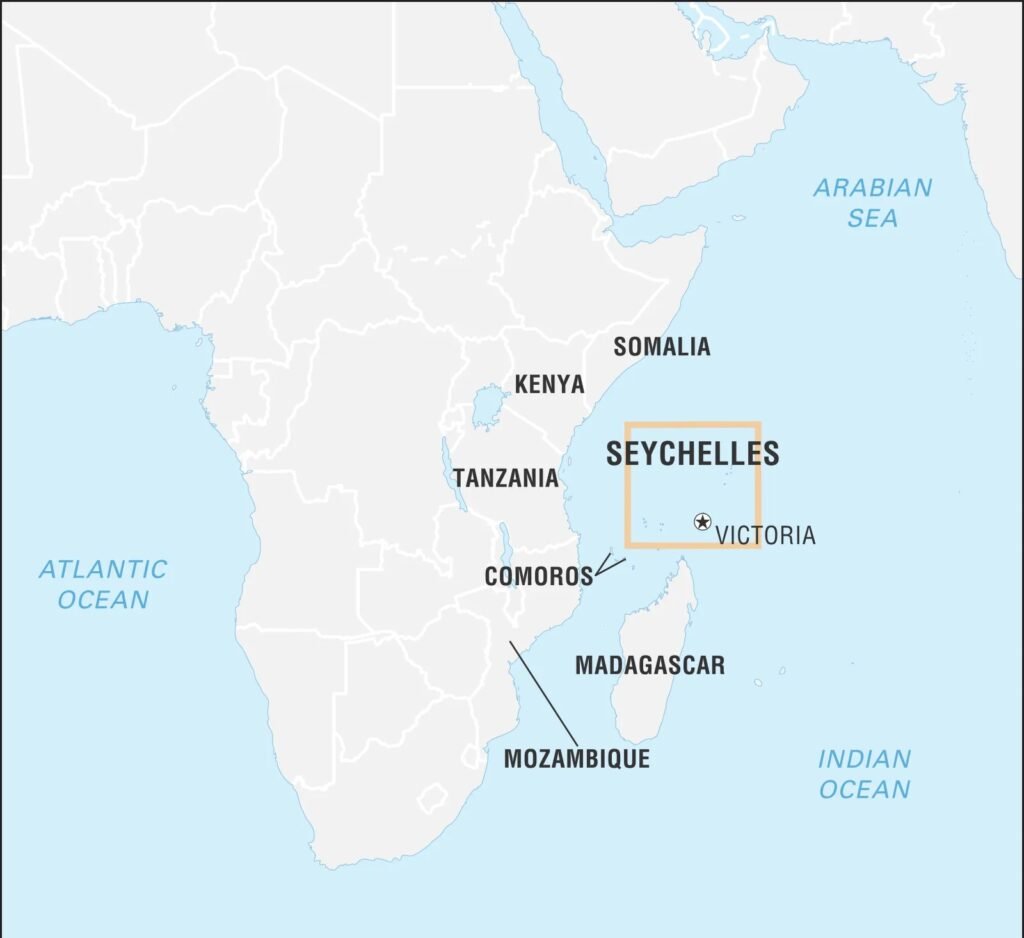
Where is Seychelles?
| Aspect | Detail |
|---|---|
| Region | Western Indian Ocean |
| Coordinates | 4°S to 11°S latitude; 46°E to 56°E longitude |
| Capital | Victoria, on Mahé (largest, most populous island) |
| Total Islands | 115 (a multi-island archipelago) |
| Independence | 29 June 1976 (from UK) |
| Government | Sovereign, multi-party Republic with a single legislative house (National Assembly) |
What are the key biological treasures?
| Feature | Detail |
|---|---|
| Coco de Mer Palm | Endemic to only 2 islands (Praslin + Curieuse); bears world’s largest and heaviest wild fruit (~30 kg); state-protected against poaching; cultural/national symbol |
| Aldabra Atoll | UNESCO World Heritage Site (1982); 2nd-largest coral atoll in the world; sanctuary for ~100,000 wild Aldabra giant tortoises |
Why is Seychelles strategically important to India?
| Aspect | Detail |
|---|---|
| MAHASAGAR Partner | Key partner in India’s Global Maritime Vision (2025) |
| Colombo Security Conclave | Full member from June 2026 (earlier observer) |
| Strategic Location | Western Indian Ocean — between Africa, India, Madagascar |
| Blue Economy Pioneer | World leader in Blue Bonds + Blue Economy frameworks |
| Diplomatic Relations | 50 years in 2026 |
| Defence Cooperation | India-built fast patrol vessels, Dornier aircraft, joint maritime training |
About the President of Seychelles
- Dr. Patrick Herminie — 6th President of Seychelles.
- Took office 2025.
- Met PM Modi during his February 2026 State Visit to India and June 2026 in Seychelles.
Practice MCQs
Q1. With reference to Seychelles, consider the following statements:
- Seychelles is a sovereign multi-party island republic located in the western Indian Ocean.
- Its capital, Victoria, is located on the largest island, Mahé.
- Seychelles gained independence on 29 June 1976.
- Seychelles is a single-island nation with no archipelagic features.
How many of the above statements are correct?
(a) Only one (b) Only two (c) Only three (d) All four (e) None
(Statement 4 is wrong; Seychelles is an ARCHIPELAGO of 115 islands, NOT a single-island nation.)
Q2. With reference to the two distinct island groups of Seychelles, consider the following statements:
- The Granitic Inner Islands, also known as the Mahé Group, consist of more than 40 central islands.
- These granitic islands are the world’s only mid-ocean islands formed of ancient continental granite.
- The Coralline Outer Islands consist of more than 70 low-lying coral atolls and are mostly uninhabited.
- Both island groups have similar geological origins and topography.
How many of the above statements are correct?
(a) Only one (b) Only two (c) Only three (d) All four (e) None
(Statement 4 is wrong; the two island groups have DIFFERENT geological origins — granitic continental rock vs coralline reef material — and very different topographies.)
Answer Key
- (c) — Statement 4 wrong: Seychelles is a 115-island archipelago.
- (c) — Statement 4 wrong: Different geological origins.













