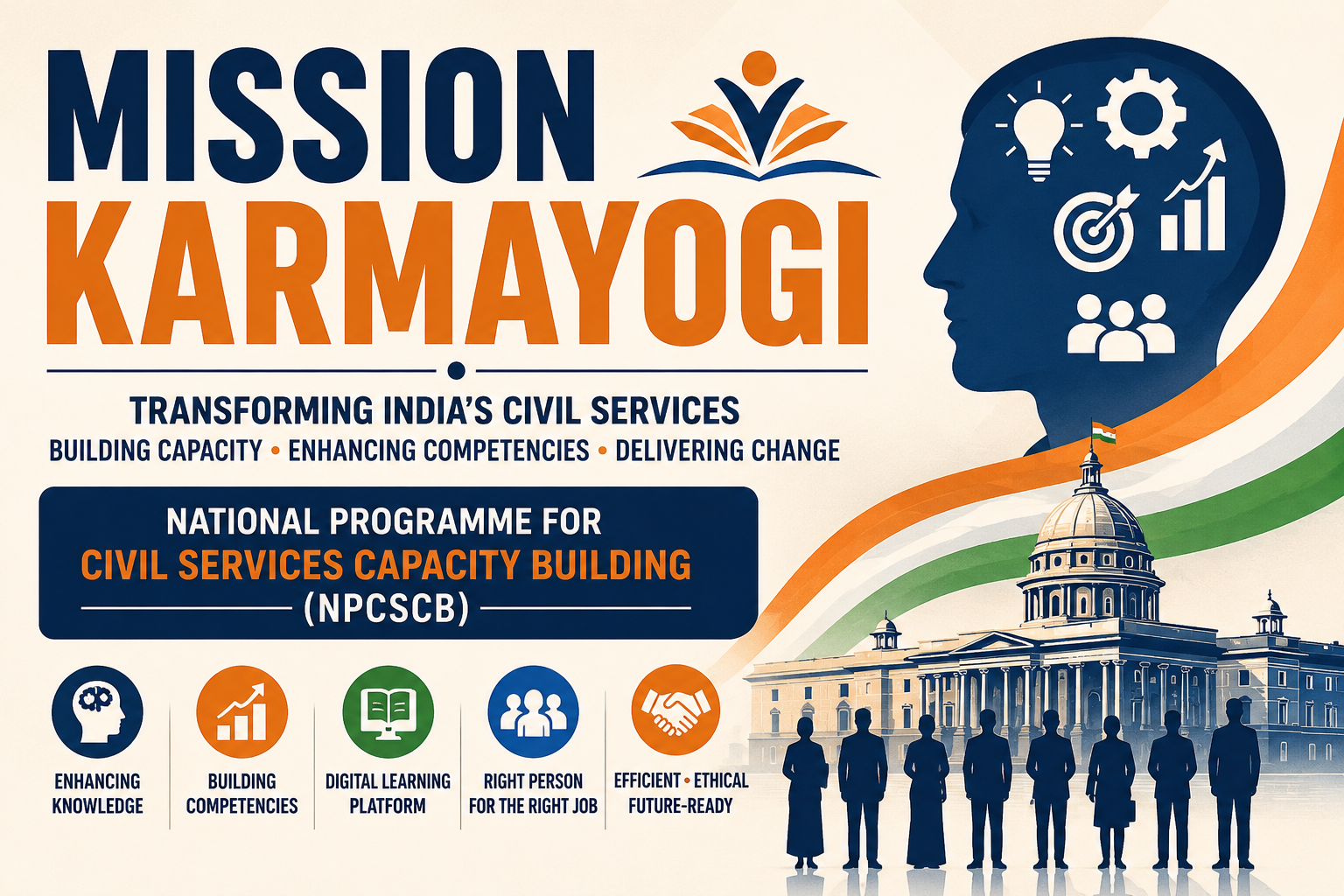
Recently, the Union Government has introduced Mission Karmayogi, a major reform aimed at improving the functioning and capacity of India’s civil services. Officially known as the National Programme for Civil Services Capacity Building (NPCSCB), the mission focuses on bringing institutional and process-level changes in the bureaucracy. Mission Karmayogi aims to make civil servants better equipped to handle the changing needs of the country. It seeks to develop officers who are creative, innovative, proactive, professional, transparent, technology-friendly and capable of finding effective solutions to public problems.
The mission also combines India’s traditional values and administrative culture with global best practices. This means civil servants will learn from both Indian experiences and successful institutions and practices from around the world.
Need of The Mission
- Developing specialised knowledge: Bureaucrats need more than just administrative skills. They should also have expertise in specific areas so that they can handle complex policy and governance issues effectively.
- Right person for the right job: The recruitment and placement process should be more structured so that officers are assigned roles according to their skills, knowledge and areas of competence.
- Continuous learning: Capacity building should not stop after recruitment. It should start from the beginning of a civil servant’s career and continue throughout their service through regular training and skill development.
- Keeping pace with a growing economy: As India’s economy grows, its governance challenges will become more complex. Therefore, the government needs to continuously upgrade the skills and capabilities of civil servants to meet these new challenges.
- A timely reform: Reforming the bureaucracy has become essential for improving the quality of governance. Mission Karmayogi is an important step towards creating a more efficient, skilled, responsive and future-ready civil service in India.
Other Reforms
- Reducing IAS dominance: The government has reduced the traditional dominance of the Indian Administrative Service (IAS) in appointments to the important post of Joint Secretary (JS). Earlier, these positions were largely occupied by IAS officers.
- Opportunities for other services: Now, officers from other services such as the Indian Revenue Service (IRS), Indian Accounts and Audit Service (IA&AS), and Indian Economic Service (IES) are also being considered for Joint Secretary-level positions. This promotes greater diversity and specialisation in the bureaucracy.
- More representation from other cadres: As a result, around one out of every two Joint Secretary-level officers is now from a service other than the IAS.
- Lateral entry: The government has also promoted lateral entry, under which experienced professionals from the private sector and other specialised fields can be brought directly into senior government positions. This helps the government access specialised knowledge, professional experience and new ideas that may not always be available within the traditional civil services.
How will it work?
- Digital training through iGOT-Karmayogi: Civil servants will receive training through the iGOT-Karmayogi online platform. The courses will combine Indian values and administrative traditions with successful practices from around the world.
- Comprehensive capacity building: The platform will support Mission Karmayogi by improving the skills and capabilities of civil servants at three levels — individual, institutional and administrative processes.
- Continuous assessment: Officers will be encouraged to take relevant courses throughout their careers, and their learning and performance in these courses will be tracked.
- Digital record of skills: An online record will maintain information about the courses an officer has completed, their performance, skills and areas of expertise.
- Better selection for future roles: When a suitable vacancy arises, the appointing authority can check an officer’s training and expertise and choose the person whose skills best match the requirements of the job. This supports the principle of “the right person for the right job.”
iGOT- Karmayogi platform
- What is iGOT? iGOT stands for Integrated Government Online Training. It is a digital platform created to help government employees improve their skills, knowledge and professional capabilities.
- iGOT-Karmayogi: It is a continuous online learning platform under Mission Karmayogi. Government officers, from Assistant Secretary to Secretary level, can take courses related to their specific fields and responsibilities.
- Access to global courses: Officers will be able to access courses and learning resources from leading international universities and institutions, helping them learn from global best practices.
- A world-class learning platform: iGOT-Karmayogi aims to become a one-stop digital marketplace for high-quality learning content, where reliable and carefully selected e-learning materials are made available to civil servants.
- Beyond training: The platform is not limited to skill development. In the future, it may also connect training and competency records with important service-related decisions such as confirmation after probation, deployment, work assignments and filling of vacancies.
- In simple terms: iGOT-Karmayogi will help the government know what an officer is good at, what training they have received and where their skills can be used most effectively.
Benefits of the Mission
- From Rule-Based to Role-Based: Mission Karmayogi aims to move from a system where officers are assigned work mainly according to fixed rules and cadres to a role-based system. Officers will be given responsibilities based on their skills, experience and competencies, ensuring the right person is placed in the right role.
- Focus on Domain and Other Skills: The programme will not focus only on technical or subject knowledge. It will also develop functional skills required for a particular job and behavioural skills such as leadership, communication, teamwork and decision-making.
- Continuous Learning: Civil servants will have opportunities to keep improving their skills throughout their careers through both compulsory and self-chosen training programmes.
- Common Training Standards: Mission Karmayogi will bring greater uniformity in training standards across the country. This will help government officials develop a common understanding of India’s development priorities and national goals.
- Building a Future-Ready Civil Service: The mission aims to create a modern and future-ready bureaucracy with the right attitude, knowledge and skills to support the vision of a New India.
- Learning at the Workplace: Training will not be limited to classrooms or online courses. Officers will also learn through real-life work experiences and practical situations at their workplaces, complementing formal training.
- Learning from the Best: The government will collaborate with leading universities, government training institutions, startups, experts and other organisations to provide high-quality learning content and bring the best practices into civil service training.
Challenges
- Resistance to Change: Economist John Maynard Keynes highlighted that the biggest challenge is often not accepting new ideas, but letting go of old ways of thinking. Similarly, government officials may sometimes resist reforms because changes can disturb the existing system and established practices.
- Need for Specialisation: The bureaucracy should recognise that general administrative knowledge alone is no longer enough. Officers also need specialised knowledge and expertise in specific fields.
- Growing Technical Nature of Governance: Modern governance is becoming increasingly technical and specialised. Therefore, officials responsible for a particular sector should ideally have the relevant knowledge, skills and practical experience to make informed decisions.
- Change in Mindset: Bureaucrats need to develop a positive attitude towards change. Reforms should be seen as an opportunity to improve governance rather than as a threat to their existing position or authority.
- Proper Monitoring of Online Training: Online courses should not become a mere formality or an excuse for officers to take extended breaks from work. The government must ensure that officers actively participate in the courses, complete the required learning and are properly assessed.
- Overall: The success of Mission Karmayogi will depend not only on introducing new technology and training programmes but also on bringing a genuine change in the mindset and working culture of the bureaucracy.
Conclusion
- A Welcome Reform, but Not the Complete Solution: Mission Karmayogi is an important and positive step towards improving the bureaucracy. However, bureaucratic inefficiency is only one part of the problem.
- Political Interference: Another major issue is political interference in the functioning of civil servants, particularly through frequent transfers and postings. Such interference can affect an officer’s independence and ability to work effectively.
- Example of Ashok Khemka: Ashok Khemka, an IAS officer from Haryana, is often cited as an example of the problem of frequent transfers. He has faced numerous transfers during his career, highlighting the challenges that civil servants can face while working within the administrative system.
- Reform Will Take Time: Transforming India’s bureaucracy will not happen overnight. It requires changes in work culture, political-administrative relations, training and accountability.
- A Step in the Right Direction: Despite these challenges, Mission Karmayogi is a significant step towards creating a more skilled, professional, responsive and efficient civil service.