

Why in News?
The Sub-Mission on Agricultural Mechanization (SMAM) is helping small farmers, women and other disadvantaged farmers get access to modern farm machines and technologies. It gives special attention to areas where such facilities are limited, including the North-Eastern States. So far, ₹9,404.47 crore has been spent to provide 21.61 lakh farm machines. In addition, ₹52.5 crore has been used for 40,928 drone demonstrations covering 40,918 hectares, helping farmers understand and use modern precision farming techniques.
What is the Sub-Mission on Agricultural Mechanization?
- About: SMAM was started in 2014–15 as a Centrally Sponsored Scheme to make modern farm machinery available to farmers across India.
- Main Objective: Its basic idea is “reach the unreached”—meaning it focuses on helping small and marginal farmers, women, SCs, STs, FPOs, SHGs and rural entrepreneurs access agricultural machinery.
- Custom Hiring Centres: Farmers who cannot afford to buy expensive machines can rent farm equipment at affordable rates through Custom Hiring Centres.
- Modern Machinery: The scheme supports farmers with modern and high-tech agricultural machines and promotes machinery hubs where such equipment can be made available.
- Focus on Less-Mechanised Areas: Special attention is given to areas where farm machinery is not easily available. Renting machines is especially useful for farmers with small landholdings, who may not find it economical to purchase expensive equipment.
- Financial Support: From 2014–15 to 2025–26, the government provided ₹9,404.47 crore in central assistance. This helped distribute 21.61 lakh machines and establish 27,554 Custom Hiring Centres, 646 Hi-tech Hubs and 25,608 Farm Machinery Banks.
- Growing Coverage: The number of farmers receiving support to own farm machinery increased from 2.07 lakh in 2020–21 to 2.32 lakh in 2024–25, showing that the scheme is reaching more farmers.
- Funding Pattern: The Centre and States generally share the cost in a 60:40 ratio. For North-Eastern and Himalayan States, the ratio is 90:10, while Union Territories get 100% central funding.
- Training and Awareness: The government conducts demonstrations, training programmes and awareness campaigns so that farmers can learn how to properly use modern agricultural machines.
- Testing and Certification: Agricultural machines are also tested and certified to ensure that they are safe, efficient, reliable and suitable for farmers.
SMAM helps farmers access modern machines without having to bear the full cost of buying them, while also providing training, rental facilities and better-quality equipment.
Rashtriya Krishi Vikas Yojana
- About: RKVY was launched in 2007 as a major government scheme to encourage States to invest more in agriculture and related activities.
- State Flexibility: States have the freedom to plan and implement agricultural projects based on their own local needs and priorities.
- Coverage: The scheme supports areas such as crop production, agricultural infrastructure, farm mechanization and value addition to agricultural products.
- RKVY-RAFTAR: In 2017–18, RKVY was revamped as RKVY-RAFTAR (Remunerative Approaches for Agriculture and Allied Sector Rejuvenation). The revamped scheme placed greater focus on improving infrastructure before and after harvesting, helping farmers reduce losses and get better value for their produce.
RKVY gives States the freedom and financial support to develop agriculture according to their local needs, while RKVY-RAFTAR places more emphasis on improving the entire agricultural value chain.
What are the Strategic Pillars of SMAM for Enhancing Farm Productivity?
- Training, Testing and Demonstration: Farmers are trained and shown how to use modern agricultural machines and technologies. The scheme also supports better processing, storage, value addition and management of crop waste after harvesting.
- Financial Help for Buying Farm Machinery: Farmers can get subsidies through Direct Benefit Transfer (DBT) to purchase agricultural machines. Generally, the government provides 40% of the machinery cost, while SC/ST farmers, small and marginal farmers and farmers in North-Eastern States can get up to 50% assistance. Small and marginal farmers can also receive ₹2,000 per hectare for mechanized services, including drone services, through Custom Hiring Centres, SHGs and FPOs.
- Farm Machinery Banks and Custom Hiring: Instead of buying expensive machines, farmers can rent them at affordable rates. SHGs, FPOs and local institutions can receive 80–90% financial assistance to set up Farm Machinery Banks. Custom Hiring Centres can get 40% assistance for eligible projects up to ₹250 lakh, while Farm Machinery Banks can receive 80% assistance for projects up to ₹30 lakh.
- Hi-Tech Equipment Hubs: The scheme supports centres equipped with advanced, high-capacity and crop-specific machines. These hubs make expensive and modern equipment more easily available to farmers and improve farm efficiency.
- Special Support for North-Eastern States: The North-Eastern Region receives higher financial support to promote mechanization. Assistance can go up to 100% for small machinery and 95% for Farm Machinery Banks, helping farmers in the region access modern equipment more easily.
SMAM helps farmers buy, rent and use modern farm machinery at lower costs, while providing training and special financial support to small farmers, disadvantaged groups and farmers in the North-Eastern Region.
What is the Role of Farm Mechanization and Drone Technology under SMAM?
Farm Mechanization and Drone Farming — In Simple Words
- What is Farm Mechanization?
Farm mechanization means using machines, equipment and modern technology for different farming activities such as preparing the land, sowing seeds, irrigation, spraying crops, harvesting and post-harvest work. - Benefits:
It reduces farmers’ dependence on manual labour and animal power, helps complete farm work faster and on time, lowers production costs and improves farm productivity and efficiency. - Use of Drones in Farming:
SMAM is promoting drones for agricultural activities. Under the scheme, ₹52.50 crore was given to ICAR to encourage drone use through practical field demonstrations. - Kisan Drone Demonstrations:
From 2023–24 to 2025–26, ICAR, State Agricultural Universities and Krishi Vigyan Kendras conducted 40,928 drone demonstrations covering 40,918 hectares. Farmers were shown how drones can be used for the proper application of fertilizers, nutrients and crop-protection chemicals. - Financial Support for Drones:
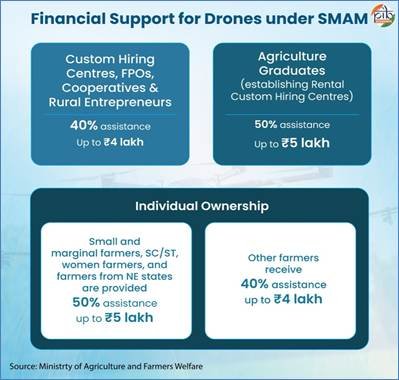
ICAR institutes, KVKs and State Agricultural Universities can get 100% financial assistance of up to ₹10 lakh per drone for purchasing drones and conducting demonstrations. FPOs can receive up to 75% grant, while agencies providing drone services can get ₹6,000 per hectare as support. - Support for Women Farmers:
SMAM reserves 30% of its funds for women farmers to help them access agricultural machinery and take a greater role in modern, mechanized farming.
Farm mechanization makes farming easier, faster and more productive, while drones are helping farmers use fertilizers and crop-protection inputs more efficiently and precisely.
Conclusion
SMAM has played an important role in making modern farm machinery and technology more accessible to farmers, especially small and marginal farmers, women, SCs, STs and other disadvantaged groups. By providing subsidies, rental facilities, training and demonstrations, the scheme has helped farmers use machines and technologies that may otherwise be too expensive or difficult to access.
However, simply providing machines is not enough to achieve long-term benefits. Farmers need affordable access to machinery, proper training and regular technical support so that they can use the equipment effectively. The scheme also needs to be implemented according to the different needs and farming conditions of each region, as the requirements of farmers in the North-Eastern States may be different from those in other parts of the country.
At the same time, greater focus should be placed on sustainable and climate-smart technologies that can save water, reduce input use, manage crop residues and lower the environmental impact of farming. Better access to drones, precision farming tools and efficient machinery can further improve productivity while reducing costs and wastage.
SMAM has taken farm mechanization closer to farmers who need it the most, but its real success will depend on making machines affordable, providing proper training, adapting the scheme to local conditions and promoting technologies that are both productive and environmentally sustainable.
Frequently Asked Questions
1. What is the Sub-Mission on Agricultural Mechanization (SMAM)?
SMAM is a Centrally Sponsored Scheme launched in 2014–15 to help farmers get access to modern farm machinery and agricultural technology. It also supports facilities such as Custom Hiring Centres, Farm Machinery Banks and modern equipment hubs, so that farmers can use machines without necessarily having to buy them.
2. Which scheme is SMAM a part of?
SMAM is implemented as a component of the Rashtriya Krishi Vikas Yojana (RKVY). It works to promote mechanization and improve the use of modern technology in agriculture.
3. Why are Custom Hiring Centres important?
Many small and marginal farmers cannot afford to purchase costly agricultural machines. Custom Hiring Centres allow them to rent machines at affordable rates and use them whenever required. This reduces the financial burden of buying and maintaining expensive equipment.
4. How does SMAM support drone-based farming?
SMAM encourages the use of drones in agriculture by providing financial assistance for drone procurement, training and field demonstrations. This helps farmers and agricultural organisations understand how drones can be used for activities such as spraying fertilizers, nutrients and crop-protection chemicals.
5. Why is SMAM important for inclusive agriculture?
SMAM aims to ensure that the benefits of farm mechanization reach farmers who may otherwise have limited access to modern technology. It gives special attention to small and marginal farmers, women, SC/ST communities, FPOs, SHGs and farmers in underserved regions.
In short: SMAM makes modern farming technology more affordable, accessible and inclusive, particularly for farmers who cannot easily afford expensive machinery on their own.







