

Why in News?
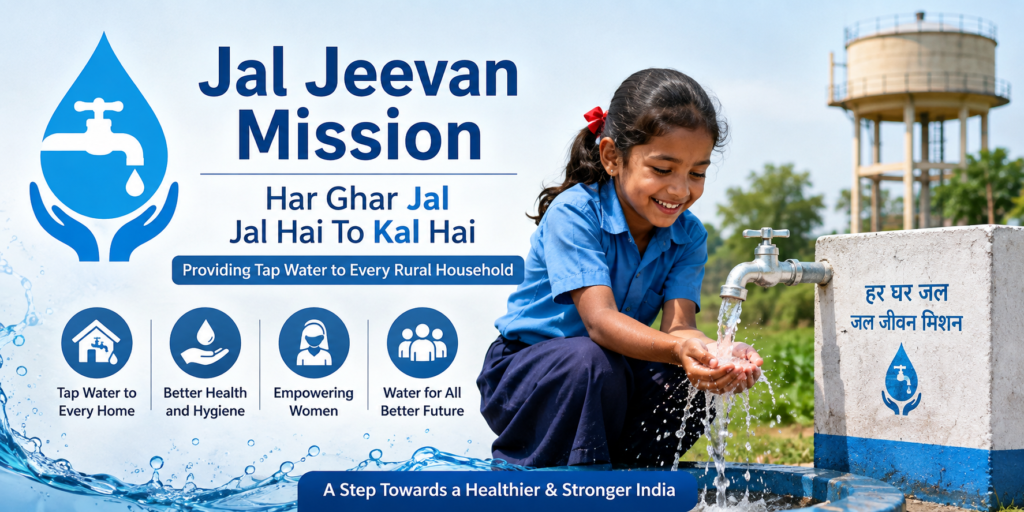
On 15th August 2026, the 7th anniversary of the Jal Jeevan Mission (JJM) was observed, showcasing its impact on 15 crore households with tap water access.
What is the Jal Jeevan Mission?
Jal Jeevan Mission (JJM) — In Simple Words
- Jal Jeevan Mission (JJM) was launched on 15 August 2019 by the Ministry of Jal Shakti.
- Its main aim is to provide tap water connections to every rural household. The original target was 2024, which has now been extended to 2028.
- It aims to provide 55 litres of water per person per day.
- It is a Centrally Sponsored Scheme, meaning both the Centre and State governments share the cost.
Objectives — TAP
- T – Tap Water for Every Rural Household: Provide Functional Household Tap Connections (FHTCs) to all rural homes.
- A – Areas Needing Special Attention: Give priority to water-quality affected, drought-prone and desert areas, as well as Sansad Adarsh Gram Yojana (SAGY) villages.
- P – Public Places: Provide tap water in schools, Anganwadi centres, Gram Panchayats and other community buildings.
Key Features — WATER
- W – Women & Weaker Sections: Ensure 50% representation of women in Village Water and Sanitation Committees (VWSCs) and Pani Samitis.
- A – Awareness & Community Participation: Promote a Jan Andolan for water conservation and encourage people to contribute through activities such as shramdaan.
- T – Technology: Use digital dashboards, JJM-IMIS and IoT-based sensors to monitor water supply and quality.
- E – Education & Training: Train at least 5 people in every village, preferably women, to test water quality.
- R – Rural & Community Focus: The mission focuses on providing water directly to households, rather than only supplying villages or habitations. It promotes a decentralized, demand-driven and community-managed water supply system.
What are the Key Challenges Affecting the Functioning of the JJM?
- G – Gaps in Data: Poor or unreliable data makes it difficult to identify and solve rural water supply problems. More than 12,000 rural habitations have water contamination due to iron, nitrate, salinity and heavy metals.
- A – Absence of Quality Infrastructure: In many States and UTs, roads and other public infrastructure are not properly restored after laying water pipelines, as pointed out by a Parliamentary Committee.
- P – Poor Maintenance Planning: By mid-2025, only 20 states had proper policies for repair and maintenance of water supply systems.
- S – Sluggish Execution: Many important projects and corrective measures are being implemented slowly, which is delaying the overall progress of the mission.
What Key Actions Can Enhance the Functioning of the JJM?
- R – Revise Infrastructure Quality: Make contractors responsible for the quality of work. Their payments should be linked to properly verified work, and better planning should be followed to ensure durable water infrastructure.
- E – Ensure Reliable Data: Make the data more trustworthy through third-party audits, geotagging and public dashboards. This will help track the actual progress of JJM.
- P – Performance-based Funding: States that are performing well should get funding based on their progress, while special task forces should help states that are lagging behind.
- A – Awareness & Water Testing: Ensure that people receive safe and clean piped water. Gram Panchayats should regularly test water quality, along with awareness campaigns on safe drinking water.
- I – Integrate Financial Reforms: Improve financial incentives under SBM-G and connect JJM with rainwater harvesting and Atal Bhujal Yojana to promote better water conservation.
- R – Repair & Maintenance: Every state should have a proper repair and maintenance policy with regular reviews. This will help keep water supply systems working smoothly for the long term.
Did You Know?
- Drinking water is mainly the responsibility of State Governments. They have the power to plan, approve and implement schemes for supplying drinking water.
- Tap water coverage has increased significantly: In 2019, only 3.23 crore rural households (17%) had tap water. By 2025, this increased to more than 15 crore households (around 80%).







