

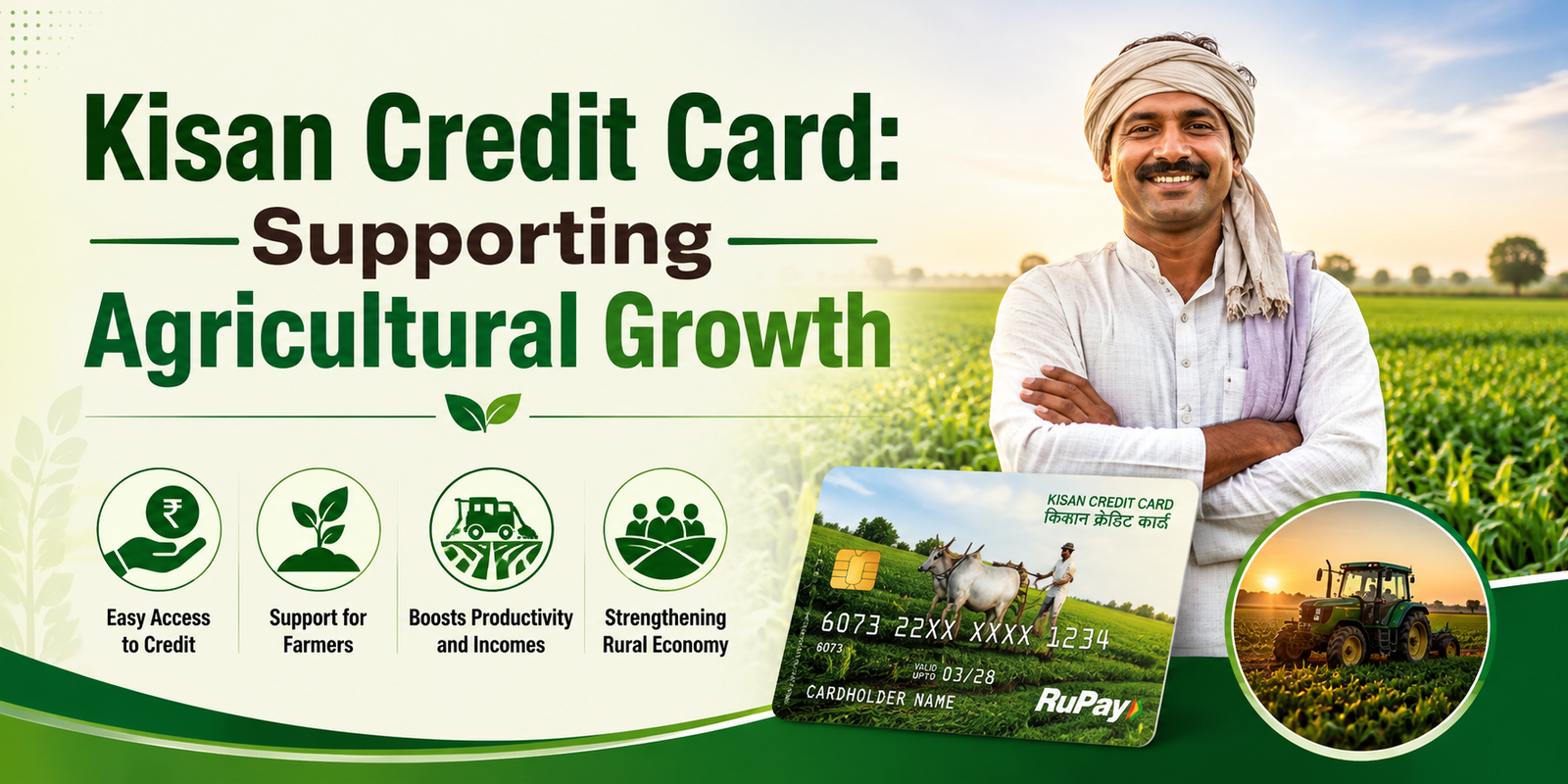
- The Kisan Credit Card (KCC) provides timely, affordable, and collateral-free credit to farmers, including small, marginal, tenant farmers and SHGs/JLGs.
- Under the Modified Interest Subvention Scheme (MISS), the loan limit has been enhanced to Rs. 5 lakh, with collateral-free credit raised to Rs. 2 lakh per borrower.
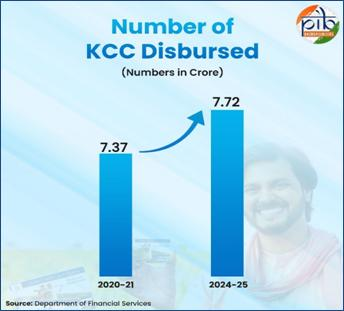
- Over 7.72 crore KCCs are active nationwide, with outstanding loans of about Rs. 10.2 lakh crore.
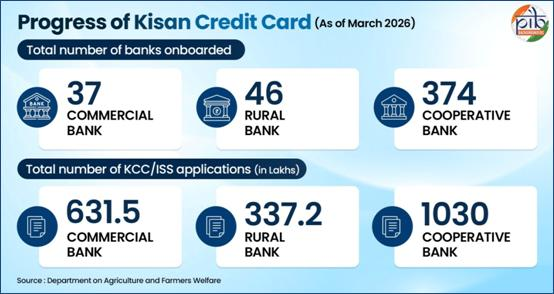
- The KCC platform has onboarded 457 banks and received more than 1,998.7 lakh applications across commercial, regional, rural, and cooperative banks
Introduction
Agriculture and allied activities are very important to India’s economy. Around 46.1% of the population depends on farming and related activities for their livelihood. Therefore, providing farmers with financial security and easy access to affordable loans is a major priority for the government.
To support farmers, the government has introduced several measures to improve agricultural finance, especially by strengthening and modernising the Kisan Credit Card (KCC) scheme.
The Revised Kisan Credit Card Scheme (2020) aims to provide farmers with adequate and timely credit for various needs, such as:
- Growing crops and meeting short-term farming expenses
- Post-harvest activities and storage
- Marketing and selling farm produce
- Household consumption needs
- Working capital for maintaining farms
- Investment in allied activities like dairy, fisheries and animal husbandry
- Non-farm activities that support rural livelihoods
KCC helps farmers get easy and timely credit for farming, household needs, and allied activities, reducing their dependence on informal lenders.
Evolution of Kisan Credit Card and its Features
The Kisan Credit Card (KCC) Scheme was started in 1998 to make it easier and faster for farmers to get loans for farming. It provides credit for crop production, working capital, allied activities, and post-harvest and marketing expenses. This gives farmers financial support for different stages of their agricultural activities and helps improve their income.
To make KCC loans more affordable, the Government introduced the Modified Interest Subvention Scheme (MISS) as a Central Sector Scheme in 2006–07. It provides farmers access to credit at affordable interest rates through KCC. The scheme also helps farmers recover from natural calamities and encourages them to repay their loans on time, reducing their financial burden. Over time, KCC was expanded to include allied and non-farm activities, and the Revised KCC Scheme (2020) introduced a single-window system for meeting farmers’ credit needs.
Under the revised KCC, farmers can get a RuPay-enabled card that allows flexible withdrawals and digital payments, while also reducing paperwork through one-time documentation. The scheme covers cultivation, post-harvest needs, allied activities and non-farm activities. It is provided through commercial banks, Regional Rural Banks (RRBs) and cooperative banks, ensuring that farmers across the country can easily access credit.
Eligible Beneficiaries of the Kisan Credit Card
The Kisan Credit Card (KCC) Scheme covers different types of farmers so that everyone can get access to institutional credit. It includes individual farmers and joint borrowers who own and cultivate land, as well as tenant farmers, oral lessees and sharecroppers.
The scheme also covers Self Help Groups (SHGs) and Joint Liability Groups (JLGs), including groups formed by tenant farmers and sharecroppers. This helps ensure that farmers from different backgrounds, including those who do not own land, can also access affordable institutional credit.
Onboarding of Farmers through the KCC Application
To make it easier for farmers to apply for a Kisan Credit Card (KCC) and access institutional credit, the Government has introduced several simple measures. A one-page KCC application form is available, with basic details of farmers already filled in using their PM-KISAN records. Farmers mainly need to provide their land records and details of the crops they grow.
The application form is made easily available through newspaper advertisements and can also be downloaded from the websites of Scheduled Commercial Banks (SCBs), the Department of Agriculture and Farmers Welfare, and the PM-KISAN portal.
Common Service Centres (CSCs) also help farmers fill out the KCC application and send it digitally to the concerned bank branch. This makes the application process easier and helps more farmers get access to institutional credit.
Kisan Rin Portal (KRP) – Digital Transformation of KCC
The Kisan Rin Portal (KRP) was launched by the Government in September 2023 to make the implementation and monitoring of the Kisan Credit Card (KCC) Scheme easier and more transparent. It works as a single digital platform that brings together farmer details, loan disbursement information, interest subvention claims and the overall performance of the scheme.
For farmers, the portal makes it easier to access low-cost institutional credit and also expands credit support to allied activities such as dairy, poultry, fisheries and beekeeping. By connecting banks and cooperative institutions digitally, it also helps in faster and smoother loan processing.
For banks and lending agencies, the portal makes the submission and processing of Interest Subvention (IS) and Prompt Repayment Incentive (PRI) claims easier and more automated. This reduces delays, improves the verification and settlement of claims, and brings greater transparency and accountability to the credit process.
Enhancing Farmers’ Access to Affordable Credit under MISS and KCC
In 2025–26, the Government of India increased the lending limits under the Kisan Credit Card (KCC) to provide farmers with greater access to credit. The crop loan limit under the Modified Interest Subvention Scheme (MISS) was increased from ₹3 lakh to ₹5 lakh. Similarly, the credit limit for fisheries and other allied activities was increased from ₹2 lakh to ₹5 lakh.
The collateral-free loan limit was also increased from ₹1.6 lakh to ₹2 lakh per borrower, effective from 1 January 2025. This means farmers can get loans up to ₹2 lakh without providing collateral, subject to applicable lending conditions.
Under the interest support scheme, short-term agricultural loans up to ₹3 lakh are available at 7% interest. Farmers who repay their loans on time get an additional 3% interest subvention, which brings their effective interest rate down to 4%.
Credit Limit and Loan provisions under KCC
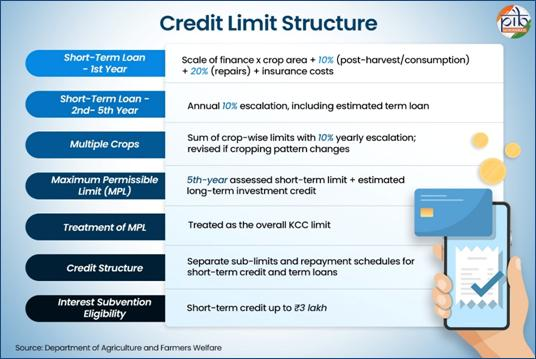
Under the Kisan Credit Card (KCC), the type and amount of credit offered to farmers depends on their landholding, investment capacity and financial needs. Non-marginal farmers are generally given term loans linked to specific assets for long-term investments in agriculture and allied activities.
On the other hand, marginal farmers are provided with flexible, need-based credit through a single composite KCC limit. This can cover their short-term farming expenses, household consumption needs and small investment requirements, making the credit more suitable for their overall livelihood needs.
Provisions for all farmers other than marginal farmers
Provisions for Marginal Farmers
A flexible KCC credit limit of ₹10,000 to ₹50,000 may be provided to farmers based on factors such as their landholding size and cropping pattern. This composite KCC limit is generally fixed for five years. If a farmer needs more credit because of changes in the crops grown or an increase in the cost of cultivation, the limit can be revised according to the prescribed norms.
The credit limit can be used to meet post-harvest and warehouse-related expenses, regular farming and household consumption needs, and small short-term investments. These investments may include buying farm equipment or starting an allied activity. The required amount is assessed by the bank branch manager based on the farmer’s needs, rather than simply on the value of the land.
Scale and Financial Outreach of the KCC
The Kisan Credit Card (KCC) Scheme has a wide reach across the country. More than 7.72 crore KCCs are currently active, with an outstanding credit amount of around ₹10.2 lakh crore. This shows how important KCC has become in providing farmers with timely and affordable institutional credit for agriculture and allied activities.
A total of 457 banks are connected to the KCC platform, including 37 commercial banks, 46 Regional Rural Banks (RRBs), and 374 cooperative banks. Together, these banks have processed around 1,998.7 lakh KCC applications. Of these, 631.5 lakh applications were processed through commercial banks, 337.2 lakh through RRBs, and 1,030 lakh through cooperative banks. The large share of cooperative banks highlights their important role in providing agricultural credit at the grassroots level.
The KCC scheme has also been expanded to cover allied activities. In 2018–19, the Government extended KCC facilities to fishers and fish farmers to meet their working capital needs and provide timely credit for fisheries and aquaculture. This helped bring more people involved in allied activities into the formal credit system.
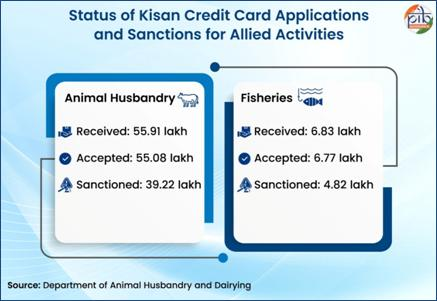
The scheme has also shown strong performance in the animal husbandry and fisheries sectors. In animal husbandry, around 55.9 lakh applications were received, out of which 55.08 lakh were accepted and 39.22 lakh were sanctioned. In fisheries, 6.83 lakh applications were received, of which 6.77 lakh were accepted and 4.82 lakh were sanctioned. Overall, these figures show that KCC is increasingly helping farmers, fishers and people involved in allied activities get formal and affordable credit.
Advancing Affordable Credit and Farm Productivity
The Kisan Credit Card (KCC) Scheme helps farmers get working capital on time, allowing them to buy quality seeds, fertilizers, equipment and other farm inputs when needed. This supports better productivity, higher farm incomes and greater financial stability. The scheme provides affordable institutional credit at a concessional effective interest rate of 4% for eligible short-term agricultural loans, making borrowing easier for small and marginal farmers. It also offers flexible revolving credit, generally valid for up to 5 years, so farmers can withdraw money as and when they need it for agricultural activities.
KCC also provides support during natural calamities. In eligible cases, interest may be waived or supported for up to one year, and this relief can be extended in cases of severe disasters. The scheme also allows farmers to get collateral-free loans up to ₹2 lakh, reducing the difficulty of accessing formal bank credit. The scheme is especially important for small and marginal farmers, who account for around 76% of agricultural credit accounts. By giving them easier access to timely credit, KCC helps farmers invest in better seeds, fertilizers, machinery and other farm inputs, which can improve yields, increase income and make farming more resilient.
Government Initiatives to Enhance Accessibility of the KCC
The Government has taken several steps to make the Kisan Credit Card (KCC) Scheme easier to access and more useful for farmers. These measures focus on increasing awareness, reaching more eligible farmers and making the credit system more efficient. To increase awareness about KCC, the Central and State Governments, along with RBI, NABARD and banks, conduct Information, Education and Communication (IEC) campaigns and various farmer outreach programmes. These initiatives help farmers understand the benefits of KCC and how they can apply for it.
Under the Atmanirbhar Bharat Abhiyan, the Government has also launched a nationwide KCC Saturation Drive to ensure that all eligible farmers get covered. Special attention is given to farmers involved in animal husbandry, dairy and fisheries, with weekly camps at the district level to make the application process easier.
The RuPay KCC has further made it convenient for farmers to access short-term agricultural credit and make digital payments. It reduces dependence on cash and informal moneylenders while helping eligible farmers receive the benefits of interest subvention. These measures have improved financial inclusion, increased farmers’ access to formal credit and made the KCC system more convenient, secure and transparent.
Conclusion
Access to affordable and timely credit is very important for farmers and the rural economy. The Kisan Credit Card (KCC) Scheme helps meet this need by providing farmers with a simple and flexible source of credit for cultivation, allied activities and post-harvest expenses. Over time, the scheme has evolved from providing credit for individual transactions to offering a more comprehensive credit facility that matches farmers’ production cycles and income needs.
Recent changes, such as higher credit limits, wider coverage of allied activities and digital integration through the Kisan Rin Portal, have made the scheme more accessible and transparent. These reforms have helped in faster loan processing, better monitoring and smoother settlement of claims, making the overall credit delivery system more efficient.
With farmers facing increasing climate-related risks, rising costs and market uncertainties, KCC plays an important role in helping them manage financial difficulties. It promotes access to formal institutional credit, improves farmers’ financial resilience and supports sustainable agricultural growth. Strengthening the KCC scheme further will therefore be important for inclusive rural development and long-term stability in the agricultural sector.







