Why in News?
As India celebrates its 80th Independence Day, the Government is focusing on improving the lives of rural and tribal communities. Various initiatives are helping people access basic services, better livelihoods, skills, infrastructure, education and financial support, with the broader aim of promoting inclusive development and empowering communities.
How is India Moving from Welfare Delivery towards Decentralised and Inclusive Development?
Strengthening Local Governments and Rural Development
- More funds for Panchayats: Direct financial support to Panchayats has increased from ₹2.36 lakh crore under the 15th Finance Commission (2021–26) to ₹4.35 lakh crore under the 16th Finance Commission (2026–31). This gives local governments more resources to plan and implement development works.
- Higher Rural Development Budget: The Union Government’s allocation for rural development has increased from ₹87,765 crore in 2016–17 to ₹2.73 lakh crore in 2026–27, showing greater focus on rural infrastructure and welfare.
- Higher Tribal Affairs Budget: The budget for tribal welfare has also increased significantly, from ₹4,826 crore in 2016–17 to ₹15,421.97 crore in 2026–27, supporting development in tribal areas.
Providing Basic Needs and Improving Quality of Life
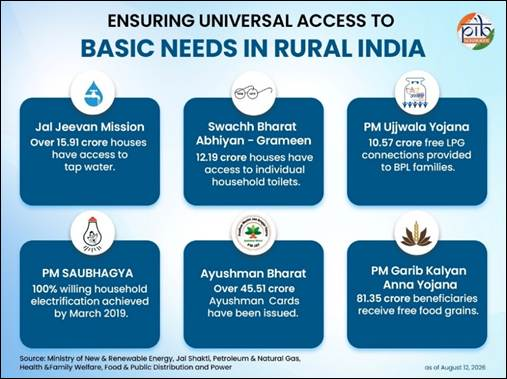
- Jal Jeevan Mission: Access to tap water in rural households has expanded significantly. The number of households with tap-water connections increased from 3.23 crore in August 2019 to more than 15.91 crore by August 2026.
- Har Ghar Jal: By 12 August 2026, around 2.89 lakh villages had reported that all households had access to tap water, improving access to safe drinking water in rural areas.
- Swachh Bharat Mission–Gramin: More than 12.19 crore household toilets had been constructed by August 2026. India was declared Open Defecation Free in 2019, while the expansion of GOBARdhan biogas plants is also helping improve sanitation and promote the use of waste for energy.
- Pradhan Mantri Ujjwala Yojana: More than 10.57 crore LPG connections have been provided to women from poor households. Overall, LPG connections in the country increased from 14.52 crore in 2014 to 33.39 crore in 2026, giving more families access to cleaner cooking fuel.
- Electricity for All: Under SAUBHAGYA, 100% electrification of willing households was achieved across India by March 2019. Later, 100% village electrification was achieved under the Deendayal Upadhyaya Gram Jyoti Yojana by 2025.
Better Healthcare and Food Security
- Ayushman Bharat: More than 45.51 crore Ayushman Cards had been issued by August 2026, helping more people access healthcare services.
- Digital Health: Around 96.43 crore ABHA accounts had been created, allowing people to maintain and access their digital health records more easily.
- Primary Healthcare: More than 1.86 lakh Ayushman Arogya Mandirs were operational, bringing basic and comprehensive healthcare services closer to communities.
- Food Security: The Pradhan Mantri Garib Kalyan Anna Yojana is providing free foodgrains to more than 81.35 crore people.
- Digital PDS: Nearly 99.8% of Fair Price Shops have been automated, making the distribution of foodgrains more transparent. Ration cards have also been fully digitised across all States and Union Territories.
- One Nation One Ration Card: The scheme has recorded more than 221 crore portability transactions, allowing beneficiaries to collect their foodgrains from ration shops even when they move to another location.
Education and Empowerment
- Improving Schools: Under Samagra Shiksha, around 4,073 schools were upgraded, nearly 1.49 lakh ICT and digital initiatives were introduced, and around 25,000 schools were covered under skill education between 2018–19 and 2025–26.
- Better Facilities for Girls: Around 97.3% of schools now have functional sanitation facilities for girls, helping create a safer and more supportive learning environment.
- Lower Female Dropout: The female dropout rate at the primary level declined from 4.6% in 2013–14 to 0.1% in 2025–26. At the secondary level, it declined from 14.5% to 8% during the same period.
- EWS Reservation: The 103rd Constitutional Amendment Act, 2019 introduced up to 10% reservation for Economically Weaker Sections (EWS) in education and government employment, outside the existing SC, ST and OBC reservation categories.
- Higher School Enrolment: In 2025–26, the Gross Enrolment Ratio was 89.4% at the primary level and 81.5% at the secondary level. At the higher-secondary level, it increased from 46.4% in 2014–15 to 61.7% in 2025–26.
- Beti Bachao Beti Padhao: The Gross Enrolment Ratio of girls at the secondary level increased from 75.5% in 2014–15 to 83.4% in 2025–26, showing improvement in girls’ participation in education.
- Kasturba Gandhi Balika Vidyalayas (KGBVs): The number of sanctioned KGBVs increased from 3,609 in 2014–15 to 5,639 in 2024–25, with 5,133 schools operational. Enrolment also increased from 3.52 lakh girls to 7.11 lakh.
- Digital Learning: SWAYAM, India’s online learning platform, had crossed 6.5 crore enrolments by August 2026, giving students and learners wider access to online courses and educational resources.
These initiatives show a shift from simply providing welfare benefits to building stronger communities and local institutions. Better funding for Panchayats, improved access to water, sanitation, electricity, healthcare, food, education and digital services, along with greater focus on women, tribal communities and vulnerable groups, is helping promote inclusive and sustainable rural development.
Building the Backbone: Infrastructure and Connectivity
- Pradhan Mantri Awaas Yojana–Gramin (PMAY-G): Under PMAY-G, more than 3.91 crore houses had been approved and 3.13 crore houses completed by 12 August 2026. This has helped more rural families get access to safe and permanent (pucca) houses.
- Pradhan Mantri Gram Sadak Yojana (PMGSY): By June 2026, around 99.6% of eligible rural habitations had been connected through all-weather roads, making it easier for people to access markets, schools, hospitals and other services.
- More Rural Roads: Around 3.86 lakh km of roads were completed between May 2000 and May 2014. In comparison, about 4.13 lakh km were completed between May 2014 and August 2026.
- More Bridges: Bridge construction has also increased significantly, with 10,404 bridges completed between May 2014 and August 2026, compared with 484 during May 2000–May 2014.
Digitalisation of Gram Panchayats
- BharatNet: Around 2.19 lakh Gram Panchayats had been connected through BharatNet by May 2026, expanding access to high-speed internet and digital services in rural areas.
- eGramSwaraj: More than ₹3.16 lakh crore in online transactions had been processed through the eGramSwaraj platform by 10 June 2026. This helps Panchayats manage funds digitally and makes financial transactions more transparent and accountable.
- SabhaSaar: More than 1.28 lakh Gram Panchayats were using the SabhaSaar AI tool by June 2026. The tool helps prepare summaries and records of Gram Panchayat meetings, reducing paperwork and making local governance more efficient.
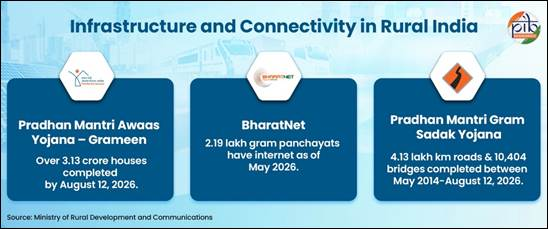
Together, these initiatives are helping rural India become better connected, better housed and more digitally empowered. Improved roads and bridges support economic opportunities, while digital platforms are making Panchayat-level governance faster, more transparent and more efficient.
Pathways to Prosperity: Livelihoods, Skills and Financial Security
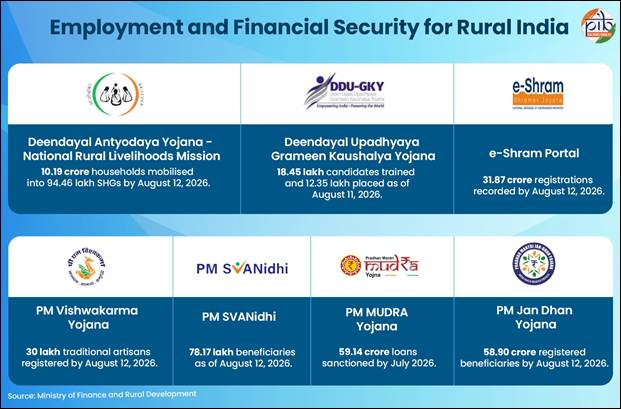
- DAY-NRLM: Under the Deendayal Antyodaya Yojana–National Rural Livelihoods Mission (DAY-NRLM), around 10.19 crore rural households had joined 94.46 lakh Self-Help Groups (SHGs) by August 2026. The programme has helped rural families, especially women, come together, start livelihood activities and improve their incomes.
- Lakhpati Didi Initiative: By 29 July 2026, around 3.46 crore women had become Lakhpati Didis, meaning they were earning an annual household income of at least ₹1 lakh. This reflects the growing role of SHGs in improving women’s economic independence.
- Community Resource Persons: More than 9 lakh Community Resource Persons (CRPs) are working at the grassroots level in areas such as agriculture, banking, insurance and nutrition. They help rural people understand and access government schemes and services.
- The network includes over 50,548 Bank Sakhis, 1.91 lakh Krishi Sakhis, 2,012 Matsya Sakhis and 1.70 lakh Pashu Sakhis, providing specialised support in banking, farming, fisheries and animal husbandry.
- SHE-Mart: Announced in the Union Budget 2026–27, the Self-Help Entrepreneur Mart (SHE-Mart) aims to benefit around 1 crore women by creating community-owned retail outlets where SHG members can sell and promote their products.
Skill Development and Employment
- Deen Dayal Upadhyaya Grameen Kaushalya Yojana (DDU-GKY): The number of rural candidates receiving skill training increased from 43,038 in 2014–15 to 18.45 lakh by August 2026. The number of candidates who secured jobs also increased from 21,446 to 12.35 lakh, strengthening employment opportunities for rural youth.
- Pradhan Mantri Kaushal Vikas Yojana (PMKVY): More than 1.64 crore young people had received skill training under PMKVY since its launch up to June 2026, helping youth develop skills needed for employment and entrepreneurship.
- Rural Employment Guarantee: Under the earlier MGNREGA framework, employment generated increased from 1,660 crore person-days during 2006–07 to 2013–14 to 3,036.7 crore person-days during 2014–15 to 2024–25. Women’s participation also increased from 48% to 58.19%. From 1 July 2026, MGNREGA was replaced by the Viksit Bharat–Guarantee for Rozgar and Ajeevika Mission (Gramin) Act, 2025, which provides a legal guarantee of 125 days of wage employment to each rural household.
Supporting Workers and Small Entrepreneurs
- e-Shram Portal: Registrations on the e-Shram portal increased from 14.40 crore in December 2021 to 31.87 crore by August 2026. The portal creates a national database of unorganised workers and helps connect them with relevant welfare and social-security schemes.
- PM Vishwakarma: More than 30 lakh traditional artisans had registered under PM Vishwakarma by August 2026. Around 24.32 lakh artisans received skill training, while 17.70 lakh received toolkits, helping them improve their traditional skills and businesses.
- PM SVANidhi: The number of beneficiaries under PM SVANidhi increased from 26.37 lakh in November 2021 to 78.17 lakh by August 2026. Loans worth around ₹18,971 crore had been provided, with women making up 46% of beneficiaries, supporting street vendors and small businesses.
- PM MUDRA Yojana: Loans sanctioned under PM MUDRA increased from 3.49 crore in 2016 to more than 59.14 crore by July 2026. The scheme has expanded access to formal credit for small businesses, micro-enterprises and aspiring entrepreneurs.
Expanding Financial Inclusion
- Pradhan Mantri Jan Dhan Yojana: The number of beneficiaries increased from 17.9 crore in August 2015 to 58.90 crore by August 2026. The scheme has brought millions of people into the formal banking system, making it easier for them to save money, receive government benefits and access financial services.
Expanding Social Security
- National Pension System (NPS): The number of beneficiaries increased from 1.05 crore in 2016–17 to 2.17 crore in 2025–26, expanding access to long-term retirement savings.
- Atal Pension Yojana (APY): APY beneficiaries increased from 48.80 lakh in 2016–17 to 9.29 crore by June 2026, helping more people, particularly those in the unorganised sector, plan for their retirement.
- Pradhan Mantri Jeevan Jyoti Bima Yojana (PMJJBY): Around 27.90 crore people were covered under this affordable life-insurance scheme by July 2026.
- Pradhan Mantri Suraksha Bima Yojana (PMSBY): Around 58.78 crore people had accident-insurance coverage under PMSBY as of 1 July 2026, providing financial protection against accidental death or disability.
- Pradhan Mantri Shram Yogi Maandhan: More than 54 lakh unorganised-sector workers had registered under this pension scheme by July 2026, helping provide them with financial security in old age.
These initiatives show a shift from simply providing welfare support to creating sustainable livelihoods and economic opportunities. Through Self-Help Groups, skill training, employment, affordable credit, entrepreneurship and social-security schemes, rural communities—especially women, workers, artisans and small entrepreneurs—are getting greater opportunities to become financially independent and economically secure.
Accelerating Tribal Development through Integrated Interventions
- PM-JANMAN: The Pradhan Mantri Janjati Adivasi Nyaya Maha Abhiyan (PM-JANMAN) focuses on improving the lives of Particularly Vulnerable Tribal Groups (PVTGs). By 5 August 2026, around 540 Van Dhan Vikas Kendras (VDVKs) had been approved, benefiting about 46,042 PVTG members.
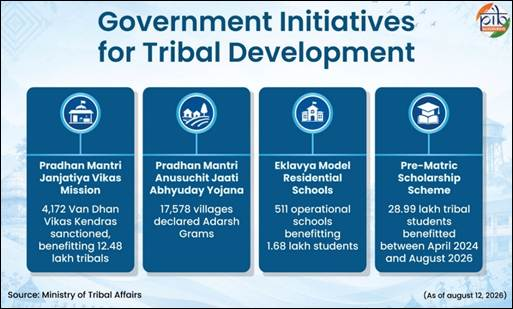
- Pradhan Mantri Janjatiya Vikas Mission (PM-JVM): By August 2026, around 4,172 Van Dhan Vikas Kendras had been approved, benefiting nearly 12.48 lakh tribal people. These centres help tribal communities improve their livelihoods by adding value to forest and other local products.
- PM-JUGA: The Pradhan Mantri Janjatiya Unnat Gram Abhiyan brings together 17 Ministries to address basic development gaps in tribal-majority villages and PVTG areas. It focuses on improving housing, drinking water, electricity, education and other essential services.
- Housing and Water: Over the past 12 years, around 7.60 lakh houses have been completed for tribal families, while 28,303 tribal villages have gained access to drinking water.
- Electricity and Anganwadi Services: Around 59,812 tribal households and public institutions have been electrified, and 657 Anganwadi Centres have been made operational.
- Education: Around 692 hostels have been sanctioned for tribal students, providing better access to residential education.
Supporting Scheduled Castes
- PM-AJAY: The Pradhan Mantri Anusuchit Jaati Abhyuday Yojana supports the development of Scheduled Caste communities. By August 2026, more than 4.16 lakh SC houses had been constructed, over 4.17 lakh SC households had received health protection, and more than 3.57 lakh households had individual toilets.
- Adarsh Gram: Around 17,578 villages had been declared Adarsh Grams by August 2026, with the aim of improving basic infrastructure and living conditions in villages with significant SC populations.
Better Education for Tribal and Disadvantaged Students
- Eklavya Model Residential Schools (EMRS): The number of operational EMRSs increased from 129 in 2014–15 to 511 by August 2026. These schools provide quality residential education to tribal children. Around 1.68 lakh students were enrolled in EMRSs.
- PM-YASASVI: During 2024–25, around 20.61 lakh students received pre-matric scholarships and 24.53 lakh students received post-matric scholarships, helping students from disadvantaged communities continue their education.
- Scholarships for ST Students: Between April 2024 and August 2026, more than 28.99 lakh tribal students benefited from the Pre-Matric Scholarship Scheme.
- National Fellowship for ST Students: In 2025–26, the fellowship supported 2,961 tribal research scholars, with women accounting for 56% of the beneficiaries.
- SHREYAS: Under the Top-Class Education for SC Students programme, 8,571 students studied at leading institutions such as IITs, IIMs, NITs and AIIMS during 2025–26.
Protecting Sanitation and Vulnerable Workers
- NAMASTE: The National Action for Mechanised Sanitation Ecosystem (NAMASTE) aims to improve the safety and dignity of sanitation workers. By July 2026, around 89,915 sewer and septic-tank workers and more than 2.81 lakh waste pickers had been identified and validated.
Supporting De-Notified Tribes
- SEED: The Scheme for Economic Empowerment of De-Notified Tribes (SEED) focuses on improving the education, health and economic well-being of De-Notified Tribes.
- Education: In 2025–26, around ₹26.75 crore was provided to support the education of 4,485 students from De-Notified Tribe communities.
- Health: During the same period, around 73,569 Ayushman Bharat cards were issued to DNT families, helping them access healthcare coverage.
These initiatives aim to ensure that tribal communities, Scheduled Castes and other vulnerable groups are not left behind in development. By combining housing, drinking water, electricity, education, scholarships, healthcare, livelihood support and social security, the government is working towards more inclusive development, equal opportunities and greater dignity for disadvantaged communities.
Conclusion
India’s approach to rural and tribal development is gradually moving beyond simply providing welfare benefits. The focus is now on empowering people, improving their dignity and creating better opportunities through stronger local participation.
Better access to clean water, sanitation, housing, electricity, food, education, healthcare, roads, digital services, employment and social security is improving the quality of life in rural areas. At the same time, special efforts for women, tribal communities, Scheduled Castes, De-Notified Tribes and unorganised workers are helping more vulnerable groups become part of the country’s development process. Overall, the aim is to build more inclusive, self-reliant and empowered rural communities.
Frequently Asked Questions (FAQs)
1. What is the recent progress under the Jal Jeevan Mission?
The Jal Jeevan Mission has significantly increased access to tap water in rural households. Coverage rose from 3.23 crore households in August 2019 to more than 15.91 crore by 12 August 2026.
2. What is DAY-NRLM?
DAY-NRLM is a rural livelihood programme that brings rural families, especially women, into Self-Help Groups (SHGs). It helps them develop livelihoods, increase their income and become financially independent.
3. What is PM-JANMAN?
PM-JANMAN is a special programme aimed at improving the living conditions of Particularly Vulnerable Tribal Groups (PVTGs) by providing better access to basic services, housing, livelihoods and other development opportunities.
4. What is PM-JUGA?
PM-JUGA is a comprehensive tribal development programme that brings together 17 Ministries to address major gaps in housing, water, electricity, education and other basic services in tribal-majority villages and PVTG areas.
5. What is NAMASTE?
NAMASTE stands for National Action for Mechanised Sanitation Ecosystem. It focuses on improving the safety, working conditions and dignity of sewer and septic-tank workers and waste pickers, while promoting safer and mechanised sanitation practices.
6. What is SEED?
SEED stands for Scheme for Economic Empowerment of De-Notified Tribes. It aims to improve the lives of De-Notified Tribe (DNT) communities, particularly by supporting their education, healthcare, livelihoods and economic opportunities.