
Why in News?
The Union Cabinet has approved the Pradhan Mantri Surya Sarovar Yojana (PM-SSY) to promote solar energy, increase the use of renewable power, and help make India more energy secure.
What are the Key Facts About the Pradhan Mantri Surya Sarovar Yojana (PM-SSY)?
- What is PM-SSY?
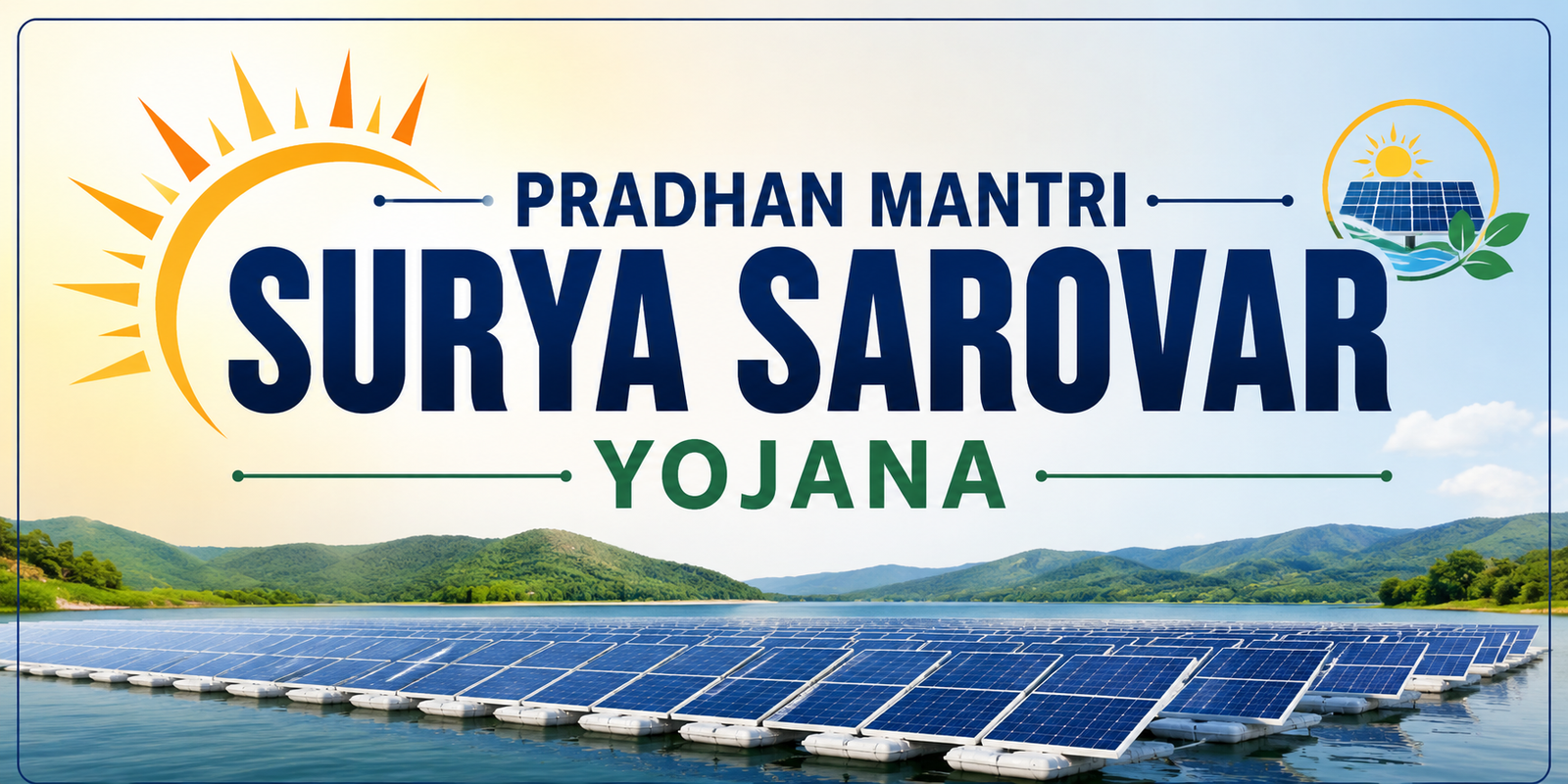
PM-SSY is a Central Government scheme that promotes the use of floating solar panels on reservoirs, lakes and other water bodies. These panels are placed on floating platforms, allowing India to produce more solar energy without requiring large areas of land. - Budget and Target:
The government has allocated ₹5,070 crore to develop 5,000 MW of floating solar power between 2026–27 and 2030–31. - India’s Solar Potential:
According to the National Institute of Solar Energy (NISE), India has the potential to generate around 102.18 GW of floating solar power from its reservoirs and inland water bodies. At present, only about 700 MW of floating solar capacity has been installed. - Energy Storage:
The solar projects will also have energy storage systems, mainly batteries, that can store electricity for at least two hours. Across the entire scheme, the storage capacity will be around 10,000 MWh. This will help provide a more stable power supply and manage electricity demand when solar generation is low.
PM-SSY aims to make better use of India’s water bodies for solar power, reduce the need for land, and ensure a more reliable supply of clean energy.
Financial Support
- Government Financial Help:
The government will give developers ₹1 crore for every MW of eligible floating solar power project after the project is successfully completed and starts operating. - Support for Initial Studies:
Developers can also get up to ₹50 lakh per project to cover important studies, such as checking the depth and condition of the water body and assessing possible environmental impacts.
Why is PM-SSY Important?
- More Solar Power: India’s floating solar capacity could increase from about 700 MW to 5,700 MW.
- Less Pollution: The scheme could help reduce around 10 million tonnes of CO₂ emissions every year.
- More Jobs: It is expected to create around 16,000–17,000 jobs in different areas related to these projects.
- 🇮🇳 Support for Make in India: It will encourage Indian companies to manufacture solar panels, floating structures, batteries and other equipment within the country.
- Reliable Electricity: The 2-hour battery storage systems will store extra solar power and provide electricity when demand is high or solar generation is low.
The scheme will provide financial support for floating solar projects, create jobs, reduce pollution, strengthen domestic manufacturing and make India’s power supply more reliable.
Floating Solar Photovoltaic (FSPV)
- What is Floating Solar?
Floating Solar Photovoltaic (FSPV) means installing solar panels on water bodies such as reservoirs, lakes, dams and industrial ponds instead of using land. - Saves Land:
It helps produce renewable energy without taking away land used for farming, housing or other purposes. This makes it useful for setting up large solar projects. - Land-Friendly Technology:
Unlike traditional solar power plants that require large areas of land, floating solar uses available water surfaces, so there is less competition for valuable land. - Higher Cost:
Floating solar projects can cost around 25% more than land-based solar plants because they need special floating platforms, anchoring systems and waterproof electrical equipment. - India’s Major Project:
The Omkareshwar Floating Solar Park in Madhya Pradesh, located on the Narmada River, is currently one of India’s largest operational floating solar projects, with a capacity of 278 MW and plans to expand it to 600 MW. - Global Growth:
Floating solar is growing rapidly around the world. Global capacity reached around 9.6 GW in 2024, with Asia accounting for nearly 90% of the total installations.
Floating solar allows us to generate clean electricity from water surfaces, save valuable land and reduce pressure on agricultural and residential areas, although it costs more to build than traditional solar plants.
Status of Solar Energy in India
- Rapid Growth:
India’s solar power capacity has increased dramatically, from just 3 GW in 2014 to around 129 GW in 2025. This growth is helping India move towards its goal of achieving 500 GW of non-fossil fuel energy capacity by 2030. - Leading States:
Rajasthan, Gujarat, Maharashtra and Tamil Nadu are among the major solar power-producing states. Their strong sunlight and supportive government policies have helped the growth of solar energy. - Better Power Transmission:
Projects such as the Green Energy Corridor are improving the electricity transmission network so that renewable power can be efficiently supplied from solar and wind-producing areas to places where it is needed. - Rooftop and Farmers’ Solar Power:
The PM Surya Ghar Yojana has helped install around 24 lakh rooftop solar systems up to December 2025. At the same time, PM-KUSUM is encouraging farmers to use solar-powered pumps and generate clean energy. - Battery Storage:
The government has introduced a ₹5,400 crore support scheme to promote 30 GWh of Battery Energy Storage Systems (BESS). These batteries can store renewable electricity and provide power when solar or wind generation is low. - Boost to Indian Manufacturing:
India now has around 100 GW of solar PV module manufacturing capacity under the Approved List of Models and Manufacturers (ALMM). This supports Atmanirbhar Bharat by reducing dependence on imported solar equipment. - International Solar Alliance (ISA):
The ISA is an India-led international initiative, headquartered in Gurugram, that brings together countries with abundant sunlight. Its main aim is to encourage investment, cooperation and wider use of solar energy.
India is rapidly expanding solar power through large solar projects, rooftop systems, agricultural solar pumps, battery storage and domestic manufacturing, helping the country move towards a cleaner and more energy-secure future.
Frequently Asked Questions (FAQs)
1. What is the Pradhan Mantri Surya Sarovar Yojana (PM-SSY)?
PM-SSY is a Central Government scheme with a budget of ₹5,070 crore. It aims to develop 5,000 MW of floating solar power projects across India. These projects will also have energy storage systems to store electricity.
2. What are the benefits of Floating Solar Photovoltaic (FSPV) projects?
Floating solar projects use reservoirs, lakes and other water bodies instead of valuable land. They can help save land, reduce water evaporation, improve solar panel performance and increase the production of clean energy.
3. Why are Energy Storage Systems (ESS) required under PM-SSY?
The scheme requires each project to have at least two hours of energy storage. This stored electricity can be used when sunlight is unavailable or when electricity demand is high. It also helps make the power grid more stable and reliable.
4. How will PM-SSY help India’s climate and energy goals?
The scheme will add 5,000 MW of floating solar capacity and is expected to reduce around 10 million tonnes of CO₂ emissions every year. It will also encourage Indian manufacturing and support India’s goal of achieving 500 GW of non-fossil fuel energy capacity by 2030.
5. Why is the NISE assessment important?
The National Institute of Solar Energy (NISE) estimates that India has the potential to generate around 102.18 GW of floating solar power. This assessment shows that India has a large opportunity to expand floating solar energy and provides a basis for schemes like PM-SSY.