What is the IndiaAI Mission?
The IndiaAI Mission is a major government initiative aimed at making India a strong global player in Artificial Intelligence (AI). It is based on the vision of “Making AI in India and Making AI Work for India.” In simple terms, the mission focuses not only on developing AI within the country but also on using AI to solve India’s social and economic problems and improve people’s lives.
The mission is implemented by IndiaAI, an independent business division under the Ministry of Electronics and Information Technology (MeitY). It aims to create a complete AI ecosystem in India by supporting innovation, startups, research, access to quality data, computing infrastructure, and responsible use of AI for the public good.
Objectives
The main aim of the IndiaAI Mission is to develop India’s own AI capabilities and reduce excessive dependence on foreign AI platforms and technologies. It also seeks to make AI affordable and accessible to a wider section of society, including businesses, researchers, startups, students, and government institutions. By promoting the use of AI in areas such as healthcare, agriculture, education, governance, and industry, the mission aims to use AI as a tool for India’s social and economic development.
Key Components
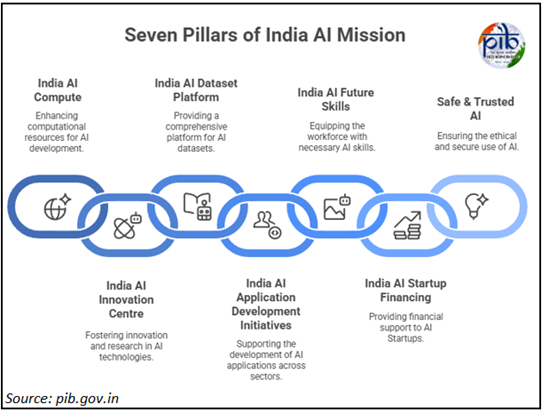
The mission focuses on expanding India’s high-performance computing capacity, including access to around 38,000 GPUs, which are essential for training and running advanced AI models. It also supports the development of Indian foundation and language models, such as BharatGen, that can better understand India’s diverse languages and local needs. The AIKosh platform is intended to provide access to datasets and other resources needed for AI development. In addition, the mission provides support to AI startups and researchers and encourages the development of AI applications designed specifically for Indian conditions and problems.
AI Growth and Adoption in India
India’s technology and AI sector is growing rapidly, creating a large number of jobs and business opportunities. The technology and AI industry is expected to generate revenues of more than USD 280 billion and provide employment to over 6 million people. India has also emerged as a major global AI player, ranking 3rd globally in AI competitiveness according to Stanford University’s 2025 Global AI Vibrancy Tool.
India has a strong base for AI innovation, with more than 1,800 Global Capability Centres (GCCs), including over 500 centres focused on AI. The country also has around 1.8 lakh startups, showing the growing importance of technology and innovation in the Indian economy. AI adoption among startups is particularly high, with nearly 89% of startups launched recently using AI in their products or services.
AI is also increasingly being used by established businesses. India scores 2.45 out of 4 on the NASSCOM AI Adoption Index, and around 87% of enterprises are actively using AI solutions. AI adoption is particularly strong in sectors such as industrial and automotive, retail, banking and financial services (BFSI), and healthcare. Together, these sectors account for around 60% of the value generated through AI, while about 26% of companies have reached an advanced stage of AI adoption at scale.
What are Major Government Initiatives Related to Artificial Intelligence in India?
BharatGen AI
BharatGen AI is an Indian government-supported AI initiative focused on developing a multilingual and multimodal AI model. It is designed to work with different types of information, such as text, speech, and images, across 22 Indian languages. This can help build AI tools that are more useful for India’s diverse population.
Sarvam AI
Sarvam AI is an indigenous AI initiative aimed at developing AI technologies suited to Indian languages and local needs. It focuses on building a more secure and self-reliant AI ecosystem that can be used for areas such as public services and digital governance, reducing dependence on foreign AI platforms.
Centres of Excellence for AI
The government is setting up AI Centres of Excellence to promote research, innovation, and practical applications of AI. These centres focus on areas such as healthcare, agriculture, education, and sustainable cities. Their purpose is to develop AI solutions that can be expanded and used to address real-world problems.
Bhashini
Bhashini is an AI-based language platform designed to reduce language barriers in digital services. It provides translation, speech recognition, and other language-related services in 20+ Indian languages. This makes it easier for people who do not speak English or Hindi to access government and other digital services.
AI Competency Framework
The AI Competency Framework is a capacity-building initiative that helps government officials develop basic and practical AI skills. It aims to ensure that officials understand how AI can be used in policymaking, administration, and public service delivery, while also being aware of its risks and limitations.
India AI Impact Summit 2026
India hosted the India AI Impact Summit 2026 in February 2026, providing a platform to showcase India’s AI capabilities and promote international cooperation and innovation. Several initiatives were associated with the summit:
- AI Pitch Fest (UDAAN): Provides startups with an opportunity to present their AI-based ideas and innovations, with special attention to women-led startups and innovators with disabilities.
- Global Innovation Challenges: Encourages young people, women, and other innovators to develop AI-based solutions for real-world public-sector problems.
- Research Symposium: Brings together AI researchers from India, the Global South, and other parts of the world to share research, exchange ideas, and build international collaborations.
- AI Expo: Provides a platform for companies and organisations to showcase AI technologies, with an emphasis on ethical, responsible, and socially beneficial use of AI.
Frequently Asked Questions (FAQs)
1. Why are GPUs important under the mission?
GPUs (Graphics Processing Units) are powerful computers that help in processing large amounts of data quickly. They are especially important for training and running AI models, which require a huge amount of computing power. Under the IndiaAI Mission, India has onboarded around 38,000 GPUs to provide researchers, startups, and organisations with affordable access to the computing power needed to develop AI technologies.
2. How does the mission support AI startups?
The IndiaAI Startup Financing initiative provides support to AI-based startups through funding, mentorship, and opportunities to expand into international markets. It aims to help Indian startups develop innovative AI products, grow their businesses, and compete at the global level.
3. How does the IndiaAI Mission promote skilling?
Through the IndiaAI Future Skills programme, the government supports students and young researchers who want to build careers in AI. Fellowships are provided to undergraduate, postgraduate, and PhD students, while AI laboratories are also being developed in Tier-2 and Tier-3 cities. This helps spread AI education and opportunities beyond major metropolitan cities.
4. What is Bhashini?
Bhashini is an AI-powered language platform designed to make digital services accessible to people speaking different Indian languages. It provides services such as translation, speech recognition, and language conversion in multiple Indian languages. Its main purpose is to reduce language barriers and ensure that people can access digital and government services even if they are not comfortable using English.