Overview
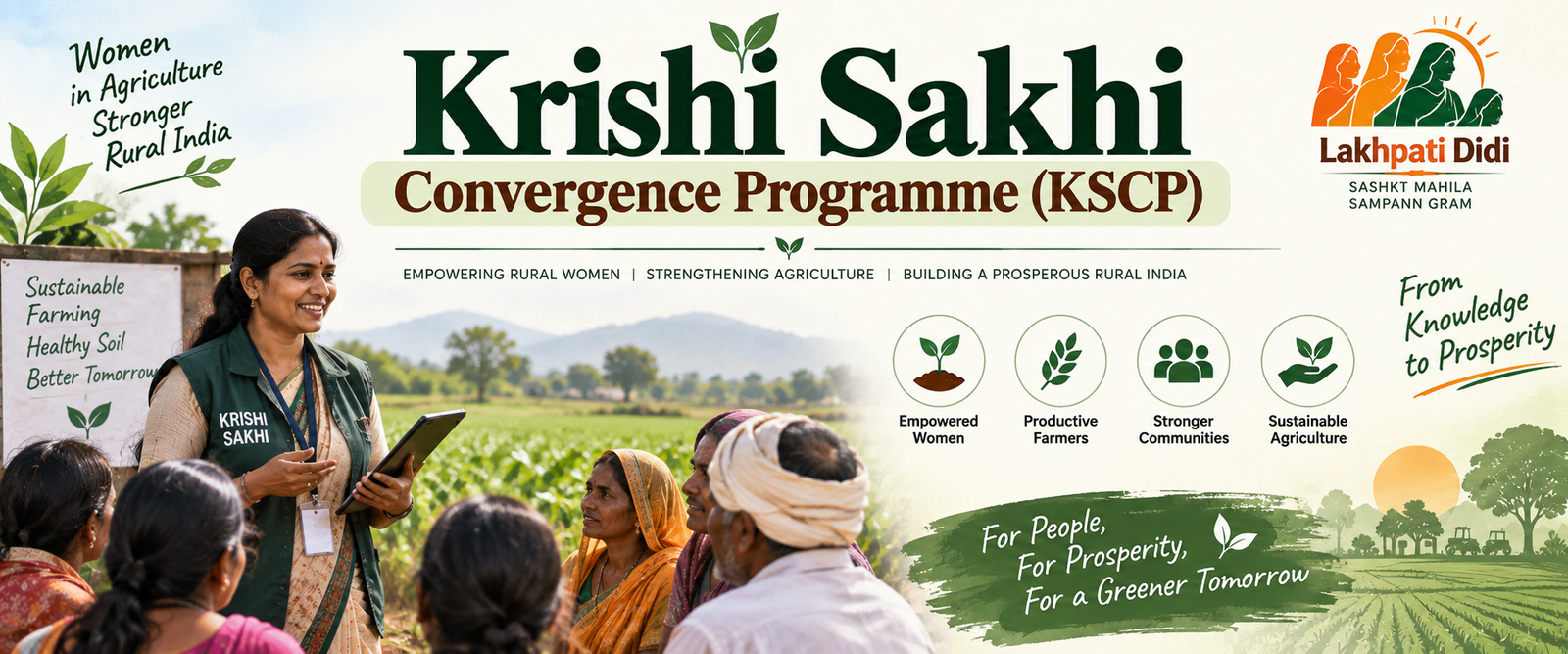
The Krishi Sakhi Convergence Programme is a government initiative that trains and empowers rural women to become “Krishi Sakhis” or community-level agricultural workers. These women help farmers with practical knowledge about better farming methods, soil health, natural and eco-friendly agriculture, and government agricultural schemes.
The programme also creates employment and income opportunities for rural women by giving them the skills to provide agricultural services in their own communities. It is linked with the Lakhpati Didi initiative, which aims to help women in Self-Help Groups increase their income and become financially stronger. In this way, the programme benefits both farmers and rural women by improving agricultural practices while promoting women’s economic empowerment.
Introduction
Agriculture is the main source of livelihood for a large section of rural India, while rural women play an important but often less-recognised role in agricultural activities. However, many women have limited access to formal training, agricultural extension services, and income-generating opportunities. The Krishi Sakhi Convergence Programme (KSCP) seeks to address this gap by training rural women to become knowledgeable community-level agricultural workers known as Krishi Sakhis.
The programme is closely linked with the government’s Lakhpati Didi initiative, which aims to help women associated with Self-Help Groups increase their annual household income. Under KSCP, rural women receive training in different aspects of agriculture and allied activities and are prepared to work as para-extension workers. In this way, the programme combines women’s empowerment with agricultural development and helps bring agricultural knowledge and government support closer to farmers at the village level.
Purpose of the Programme
The main purpose of the Krishi Sakhi Convergence Programme is to empower rural women by providing them with agricultural knowledge, technical skills, and opportunities to earn an income. Instead of being only beneficiaries of government programmes, women are trained to become active service providers and agricultural resource persons within their communities.
Krishi Sakhis act as a link between farmers, government departments, agricultural experts, and various government schemes. Since they belong to the local community, they can communicate with farmers more easily and understand their local agricultural conditions and needs. This makes agricultural extension services more accessible, particularly in villages where farmers may have limited access to agricultural officers or experts.
Background and Link with Lakhpati Didi
The programme is being implemented as part of the broader Lakhpati Didi initiative, which aims to create 3 crore Lakhpati Didis by helping women from Self-Help Groups develop sustainable sources of income. The idea is to enable women to move beyond traditional livelihood activities and take up skilled occupations that can provide them with better and more regular earnings.
Krishi Sakhi is one such opportunity under this larger initiative. By providing women with professional training in agriculture, the programme allows them to use their knowledge to provide services to farmers while also creating an additional source of income for themselves.
Training of Krishi Sakhis
Under KSCP, selected rural women are provided with training and certification so that they can work as para-extension workers. The training covers different stages of farming as well as basic allied agricultural activities. The objective is to ensure that Krishi Sakhis have sufficient practical knowledge to guide farmers in adopting more productive, sustainable, and environmentally friendly agricultural practices.
Major Areas of Training
1. Agro-ecological Practices:
Krishi Sakhis are trained in farming practices that work in harmony with the local environment. Their training covers different stages of cultivation, beginning with land preparation and continuing through sowing, crop management, and harvesting. They help farmers understand methods that can improve productivity while maintaining soil and environmental health.
2. Farmer Field Schools:
They are also trained to help organise Farmer Field Schools, where farmers can learn through practical demonstrations and field-based activities. This allows farmers to understand new agricultural techniques by seeing how they work in real farming conditions.
3. Seed Banks:
Krishi Sakhis receive knowledge about the establishment and management of seed banks. Local seed banks can help farmers maintain access to good-quality seeds and preserve locally suitable and traditional varieties.
4. Soil Health and Water Conservation:
Another important part of their training is soil health management and soil and moisture conservation. They learn about maintaining soil fertility, conserving moisture, and adopting practices that can improve the long-term productivity of agricultural land.
5. Integrated Farming Systems:
Krishi Sakhis are introduced to integrated farming systems, where activities such as crop cultivation, livestock, horticulture, and other farm activities are combined. Such systems can help farmers make better use of available resources and create multiple sources of income.
6. Livestock Management:
Basic training is also provided in livestock management. This helps Krishi Sakhis guide farmers on basic practices related to the care and management of livestock, which is an important source of income for many rural households.
7. Bio-inputs and Organic Practices:
Krishi Sakhis are trained in the preparation and use of bio-inputs, which can reduce dependence on chemical agricultural inputs. They may also support the establishment and management of bio-input shops, making such inputs more easily available to local farmers.
8. Communication Skills:
Technical knowledge alone is not sufficient for an extension worker. Therefore, Krishi Sakhis are also given training in basic communication skills so that they can explain agricultural practices clearly, interact with farmers effectively, and create awareness about government schemes and available services.
Employment and Role of Krishi Sakhis
After completing their training, Krishi Sakhis are required to take an assessment or test to obtain certification as para-extension workers. Once certified, they can provide agricultural extension support at the community level.
Their role is not limited to giving farming advice. They can also help farmers understand and access various government agricultural schemes and services. In this way, Krishi Sakhis act as a bridge between government programmes and rural farming communities.
The programme therefore creates a dual benefit. Farmers receive agricultural knowledge and assistance closer to their homes, while rural women gain skills, recognition, and opportunities to earn an income. It also helps reduce the gap in agricultural extension services, particularly in rural and remote areas.
Conclusion
The Krishi Sakhi Convergence Programme is an important example of how women’s empowerment and agricultural development can be brought together. By training rural women as para-extension workers, the programme not only creates livelihood opportunities for women but also improves farmers’ access to technical knowledge, government schemes, and sustainable agricultural practices.
Its success can contribute to the broader goal of creating economically independent rural women under the Lakhpati Didi initiative, while also strengthening agriculture at the grassroots level. In the long run, Krishi Sakhis can become important community-level agricultural resource persons, helping farmers adopt better practices, improve productivity, manage natural resources more sustainably, and build more resilient rural livelihoods.