
The horticulture sector is an important part of Indian agriculture and plays a major role in the rural economy. It includes the cultivation of fruits, vegetables, flowers, spices, coconut, cashew and other high-value crops. Horticulture not only improves food and nutrition security but also creates employment opportunities in rural areas, encourages farmers to diversify their crops and helps increase their income.
“Promoting High-Value Crops to Increase Farmers’ Income”
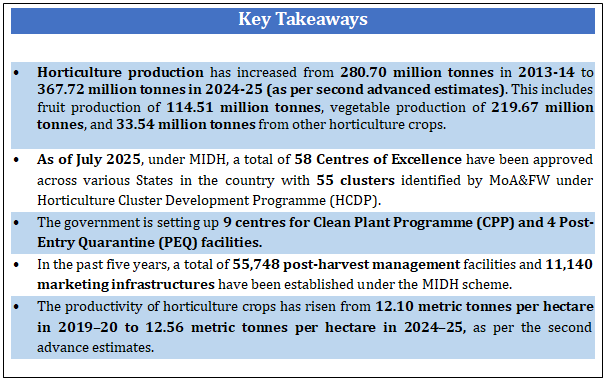
Horticulture Sector in India

India is the second-largest producer of fruits and vegetables in the world. It also has a strong position in the production of spices, coconut and cashew nuts. Recognising the importance of horticulture in increasing farmers’ earnings, the Government set up an Inter-Ministerial Committee in 2016 to examine ways to double farmers’ income. The committee highlighted diversification towards high-value agriculture, including horticulture, as an important way to achieve this goal.
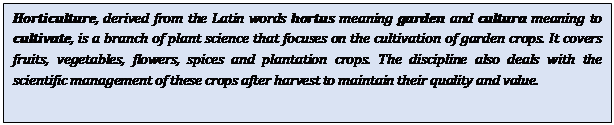
Over the years, the horticulture sector has shown significant growth. According to the second advance estimates for 2024–25 (as of August 2025), total horticulture production increased from 280.70 million tonnes in 2013–14 to 367.72 million tonnes. This included:
- Fruits: 114.51 million tonnes
- Vegetables: 219.67 million tonnes
- Other horticultural crops: 33.54 million tonnes
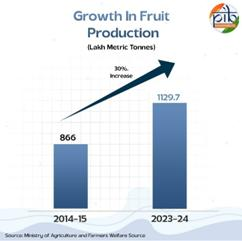
The growth can also be seen over the longer period. Between 2014–15 and 2023–24, fruit production increased from 866 lakh metric tonnes to 1129.7 lakh metric tonnes, an increase of around 30%. Vegetable production also rose from 1694.7 lakh metric tonnes to 2072 lakh metric tonnes, registering a growth of about 22%.
Productivity has improved as well. Fruit productivity increased from 14.17 to 15.80 tonnes per hectare, while vegetable productivity increased from 17.76 to 18.40 tonnes per hectare.
Overall, the growth of horticulture shows that moving beyond traditional crops and adopting high-value crops can help farmers earn better incomes while also supporting employment, nutrition and sustainable agricultural development.
Success Story 1: Coconut-Based Mixed Farming
Shri K. T. Francis, a retired teacher from Kozhikode, Kerala, has successfully turned his three-acre farm into a model of mixed farming. He grows around 200 coconut trees along with spices, tuber crops and tropical fruits. His farm earns around ₹14–15 lakh every year, mainly through coconut production and nursery sales.
His hard work and scientific approach to farming have earned him state and national-level recognition. His story shows that even a small farm can become profitable and sustainable when farmers combine different crops, use scientific farming methods and make good use of available resources.
Success Story 2: From Traditional Crops to Floriculture
Shri Prabhat Das, a 40-year-old farmer from Kulhati village in Assam’s Kamrup district, changed his farming approach by moving from traditional crops to floriculture (flower farming).
A graduate in Arts, he started growing Gladiolus, Tube Rose, Tissue Gerbera and Red Gerbera on 12 bighas of his own land between 2014 and 2016. The change brought better income, and he began earning around ₹1.5–2 lakh annually by selling flowers in wholesale and retail markets in the greater Guwahati area.
Earlier, his income from traditional crops was relatively low. Flower cultivation gave him better returns and greater confidence. Encouraged by the results, he plans to increase the area under flower cultivation in the coming season. His journey shows how crop diversification and choosing high-value crops can improve farmers’ income.
Schemes and Initiatives
The horticulture sector in India has grown significantly with the support of various government schemes and programmes. These initiatives aim to address major problems faced by farmers, such as poor-quality planting material, low productivity, lack of modern technology, storage problems and limited market access. The overall focus is on improving the quality and production of horticultural crops, reducing post-harvest losses and helping farmers get better prices and higher incomes.
Mission for Integrated Development of Horticulture (MIDH)
The Government has been implementing the Mission for Integrated Development of Horticulture (MIDH) since 2014–15. It is a Centrally Sponsored Scheme that promotes the overall development of horticulture across States and Union Territories.
The scheme covers different stages of horticulture, from planting and production to storage, processing and marketing. The government regularly reviews the scheme through impact assessments and monitoring. Organisations such as NITI Aayog have also conducted studies to assess its impact. Based on these reviews and feedback from the field, the scheme has been updated and new components have been added to deal with emerging challenges.
Major Initiatives under MIDH
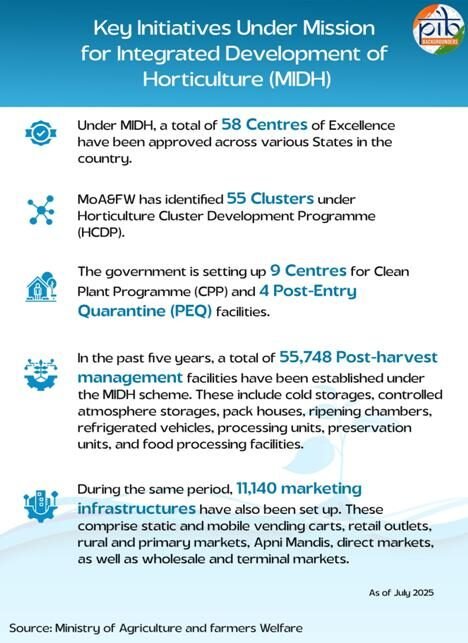
1. Centres of Excellence in Horticulture
These centres act as training and demonstration centres where farmers can learn about modern technologies, improved farming methods and better crop management practices.
2. Horticulture Cluster Development Programme
This programme focuses on developing areas where particular horticultural crops are grown in large quantities. It supports the entire process, from production to storage, transportation, branding and marketing. The aim is to make Indian horticultural products more competitive in both Indian and international markets.
3. Clean Plant Programme
The programme aims to provide farmers with healthy, high-quality and disease-free planting material. This can improve crop quality and productivity and help Indian horticulture compete better in global markets.
4. Post-Entry Quarantine Facilities
These facilities help ensure that imported or newly introduced planting material is genuine, healthy and free from harmful diseases and pests. This helps protect crops and improve orchard productivity.
Financial and Technical Support
Under MIDH, States and Union Territories receive financial and technical support for various horticulture-related activities.
Important Areas of Support
- Nurseries and tissue culture: Establishment of nurseries and tissue culture units to provide farmers with good-quality seeds and planting material.
- New orchards and gardens: Support for developing new areas for fruits, vegetables and flowers, as well as bringing old and unproductive orchards back into production.
- Protected cultivation: Promotion of polyhouses, greenhouses and other protected structures. These allow farmers to grow high-value crops and even produce certain vegetables and flowers during the off-season.
- Organic farming: Encouragement of organic cultivation and certification to promote more sustainable farming practices and improve the quality of agricultural produce.
- Water management: Support for water harvesting structures, irrigation facilities and watershed development to improve water availability and conservation.
- Beekeeping: Promotion of beekeeping because bees help in pollination, which can improve the yield and quality of many horticultural crops.
- Farm mechanisation: Encouragement of modern machines and equipment to save labour, reduce costs and improve farming efficiency.
- Post-harvest management: Development of facilities such as pack houses, cold storages, pre-cooling units, refrigerated transport, ripening chambers and processing units. These facilities help keep fruits and vegetables fresh for longer, reduce wastage and make it easier for farmers to transport their produce to markets.
MIDH aims to strengthen the entire horticulture value chain—from planting the crop to selling the final produce. By providing farmers with better planting material, modern technology, irrigation support, storage facilities, transportation and market linkages, the scheme seeks to increase productivity, reduce post-harvest losses and improve farmers’ income.
National Horticulture Mission (NHM)
The National Horticulture Mission (NHM) was launched in 2005–06 as a Centrally Sponsored Scheme to promote the overall development of horticulture in the country. It follows a cluster-based approach, where farmers, government agencies, researchers and other stakeholders work together to develop horticulture in a coordinated manner.
Main Focus of NHM
- Quality planting material: Promotes nurseries and tissue culture units to provide farmers with healthy and good-quality planting material.
- Higher production: Encourages expansion of cultivation and the improvement of old and unproductive orchards.
- Modern technology: Helps farmers adopt new and improved technologies for better production and quality.
- Training and skill development: Provides farmers and other stakeholders with training to improve their knowledge and farming skills.
- Post-harvest facilities: Supports better storage, handling, processing and marketing of horticultural produce.
- Region-specific planning: Encourages States to plan horticulture activities according to their local climate, soil and available resources.
Horticulture Mission for North East & Himalayan States (HMNEH)
The Horticulture Mission for North East and Himalayan States (HMNEH) was started in 2001–02 to promote horticulture in the North-Eastern and Himalayan regions. It was initially known as the Technology Mission for Integrated Development of Horticulture in the North Eastern States.
During the Tenth Five-Year Plan, the programme was expanded to include Himachal Pradesh, Jammu & Kashmir and Uttarakhand.
The mission covers the entire horticulture value chain, starting from the supply of planting material and cultivation to post-harvest management, processing and marketing. It also creates both backward linkages, such as inputs and technology, and forward linkages, such as processing and markets.
Since 2014–15, HMNEH has been merged with the Mission for Integrated Development of Horticulture (MIDH).
National Horticulture Board (NHB)
The National Horticulture Board (NHB) was established by the Government of India in 1984. It is an autonomous organisation under the administrative control of the Ministry of Agriculture and Farmers Welfare.
The NHB works to modernise and strengthen commercial horticulture. Its major areas of work include:
- Developing high-tech horticulture production clusters.
- Creating cold storage and post-harvest infrastructure.
- Ensuring the availability of quality planting material.
- Promoting modern technologies for commercial and high-value horticulture.
In simple terms, the NHB helps farmers and the horticulture sector improve production, technology, storage and marketing.
Coconut Development Board (CDB)
The Coconut Development Board (CDB) is a statutory body established under the Coconut Development Board Act, 1979. It became operational in January 1981.
Under MIDH, the Board works to strengthen the coconut sector by:
- Producing and distributing quality coconut planting material.
- Promoting coconut cultivation in new and non-traditional areas.
- Improving productivity in major coconut-growing States.
- Supporting post-harvest processing and marketing.
- Encouraging the development of new coconut-based products.
- Making better use of coconut by-products and waste materials.
- Promoting value addition to increase the economic value of coconut products.
- Providing information, training and capacity-building support to people involved in the coconut sector.
Central Institute for Horticulture (CIH)
The Central Institute for Horticulture (CIH) was established at Medziphema, Nagaland, in 2006–07. Its main purpose is to provide technical guidance, training and capacity-building support to farmers and field-level officials in the North-Eastern region.
The institute now functions as a sub-scheme under MIDH.
However, an important point is that CIH does not directly implement government horticulture schemes. Instead, it mainly provides technical knowledge, training and support to improve horticultural practices.
Research and Quality Improvement
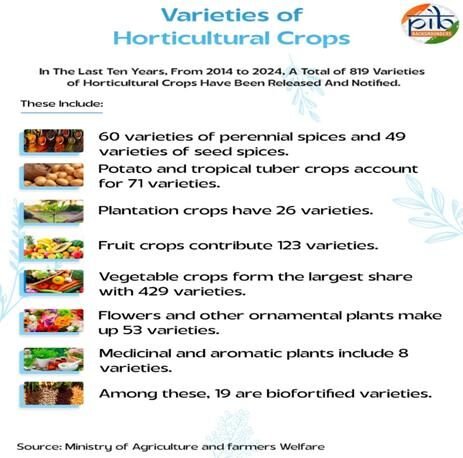
Research plays an important role in improving horticulture. The National Agricultural Research System (NARS), including ICAR institutes and Central and State Agricultural Universities (CAUs/SAUs), works on developing better horticultural varieties and improved farming technologies.
These institutions help farmers by developing crops that can offer higher productivity, better quality, improved resistance to pests and diseases, and better suitability to different climatic conditions.
Together, these institutions and programmes form an important support system for Indian horticulture. NHM and MIDH promote overall horticultural development, HMNEH focuses on the North-Eastern and Himalayan regions, NHB supports commercial horticulture and infrastructure, CDB focuses on coconut development, while CIH provides technical support and training. Along with ICAR and agricultural universities, they help improve crop quality, productivity, technology, storage, processing and market access, ultimately supporting better incomes for horticulture farmers.
Conclusion
The horticulture sector is an important part of India’s agricultural and rural economy. It not only contributes to food and nutritional security but also creates employment, encourages crop diversification and provides farmers with opportunities to earn higher incomes. The wide range of horticultural crops, including fruits, vegetables, spices, flowers, coconut and other plantation crops, highlights the strength and diversity of this sector.
Government initiatives, improved farming technologies, better-quality planting material, scientific research and modern post-harvest management and storage facilities are helping farmers improve both production and productivity. At the same time, better processing, branding and market linkages are creating new opportunities for value addition and exports.
Going forward, greater use of modern technology, efficient water management, climate-resilient practices, cold-chain infrastructure and stronger market connections can further strengthen horticulture. With continued government support and active participation from farmers, the sector can play an even bigger role in increasing rural incomes, creating employment, reducing post-harvest losses, promoting exports and strengthening India’s overall economy.