Context:
On September 2025, RBI issued a revised Master Direction for PAs. Major fintechs like PhonePe, Paytm, and Cred have stopped offering rent payment via credit cards as a result.
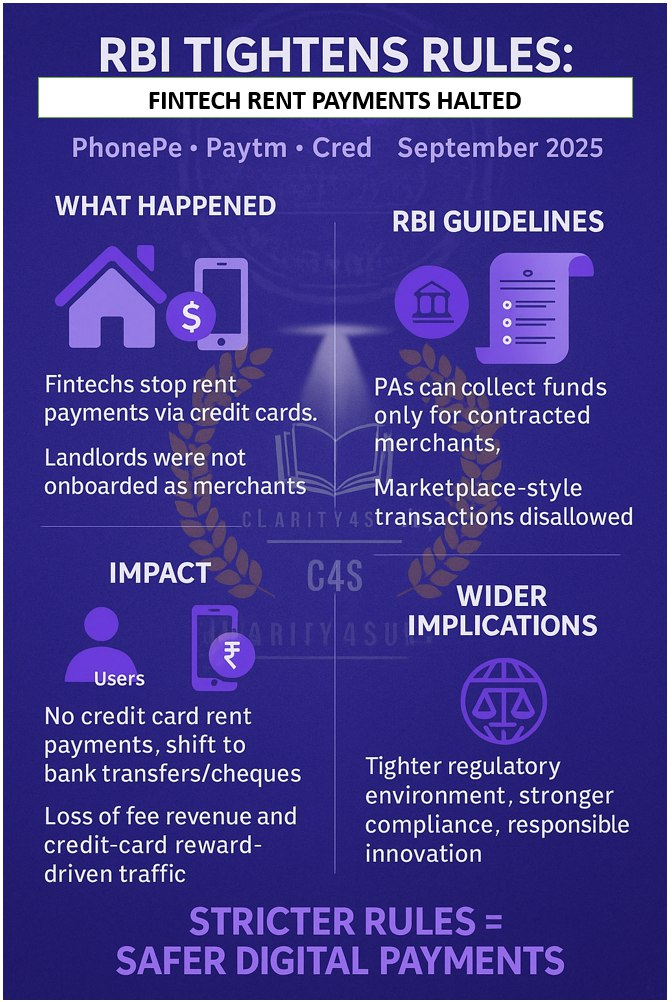
What Changed?
- Merchant-only aggregation
- A PA can aggregate funds only for merchants with whom it has a direct contractual relationship.
- Rent payments to landlords not registered as merchants with full KYC are now disallowed.
- Ban on Marketplace-style PA Business
- PAs cannot act as a marketplace themselves.
- Their role is limited to providing payment facilitation for onboarded merchants.
- Merchant Due Diligence
- PAs, not acquiring banks, are now directly responsible for verifying merchant KYC.
- Funds must be settled only into the onboarded merchant’s bank account.
Why RBI Did This?
- Prevent misuse of credit cards: Rent payments were functioning like disguised peer-to-peer (P2P) transfers.
- Curb fraud and money laundering: Fake “rent” payments were sometimes used for cash flow management or illicit transfers.
- Strengthen accountability: Ensures traceability of funds and merchant legitimacy.
- Regulatory simplification: Moves from multiple licenses and micro-rules → one unified PA licence, principle-based framework.
Impact
On Fintechs
- Loss of a high-volume, fast-growing use case (rent payments via cards).
- Reduced fee income and lower credit card transaction volumes.
- Need to re-onboard landlords as merchants → high cost, less attractive for casual landlords.
On Users
- No more earning credit card reward points / cashback on rent.
- Limited ability to convert rent into EMIs via fintech apps.
- Must switch back to bank transfers, UPI, cheques, or BBPS for rent payments.
Exam Relevance
- Payment Aggregator (PA): Entity that facilitates digital payments between merchants and customers without requiring merchants to set up their own payment infrastructure.
- Marketplace ban: PAs cannot run e-commerce-like setups; they only process payments for contracted merchants.
- KYC mandate: Full merchant verification required, strengthening AML (Anti-Money Laundering) safeguards.