Launched on 6 June 2022, the Jan Samarth Portal has completed four years of promoting digital financial inclusion and easier access to credit in India. It serves as a single-window platform that connects individuals and businesses with various government-backed loan schemes through a simple and technology-driven process. The portal caters to key sectors such as agriculture, business, housing, renewable energy, and livelihoods, helping a wide range of beneficiaries across the country. Available in multiple languages, Jan Samarth has developed into a comprehensive digital platform that makes credit more accessible, transparent, and efficient. By reducing procedural complexities and improving access to institutional finance, it supports farmers, entrepreneurs, self-employed individuals, and livelihood seekers in achieving their economic goals.
Introduction
The Journey of Jan Samarth Portal
NABARD 2021-2024 Cutoff Analysis | What we can Learn? #nabard_grade_a_exam #nabard_cutoffTap to play · from the C4S channel
Across India, many people dream of starting a business, expanding their work, or building a better future. Whether it’s a first-time entrepreneur, a woman starting her own enterprise, or a young professional stepping into the agri-business sector, one thing they all need is timely financial support. Although several government loan schemes were already available, finding the right scheme and completing the application process often meant dealing with multiple websites and complicated procedures.
To make this easier, the Government of India launched the Jan Samarth Portal on 6 June 2022. It is India’s first unified digital platform that brings together various government credit-linked schemes in one place and directly connects eligible applicants with lenders. The portal was created to make applying for government-backed loans simple, transparent, and hassle-free. Its main goal is to help more people benefit from these schemes while ensuring faster and smoother loan processing.
As Jan Samarth completes four years of its journey, it has emerged as an important step towards improving financial inclusion. By making access to credit easier and more transparent, the portal continues to empower entrepreneurs, students, farmers, and businesses across the country to turn their aspirations into reality.
A clean PDF of this page with the C4S header — it opens right away, and the link comes to your WhatsApp too.
End-to-End Digital Lending
Recording outNABARD Grade A 2026: 45-Day Final Revision Plan + Daily TargetsWatch the recording →One Platform, Available in Multiple Languages
The Jan Samarth Portal has been designed to make government loan schemes easy to access for everyone. To ensure that people from different parts of India can use it comfortably, the portal is available in eight languages—English, Hindi, Gujarati, Telugu, Tamil, Marathi, Bengali, and Kannada.
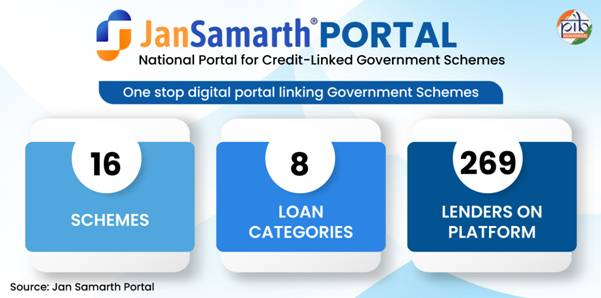
Instead of visiting multiple websites or dealing with complicated paperwork, applicants can explore and apply for various government-backed loan schemes through a single, easy-to-use platform. The portal brings together 16 Central Government credit-linked schemes under one roof, making the entire application process faster, simpler, and more transparent.
Whether someone needs financial support for agriculture, renewable energy, entrepreneurship, education, housing, or other sectors, Jan Samarth helps eligible applicants find the right scheme and connect with lenders. By offering services in multiple languages and simplifying the loan application process, the portal is helping make formal credit more accessible, especially for people in rural and underserved areas across India.
| S. No. | Loan Category | Schemes Covered |
|---|---|---|
| 1 | Credit Guarantee Coverage | Emergency Credit Line Guarantee Scheme 5.0 (ECLGS 5.0) |
| 2 | e-NWR (Electronic Negotiable Warehouse Receipts) Financing | e-Kisan Upaj Nidhi (EKUN) |
| 3 | Home Loan | Home Loan for Economically Weaker Section (EWS), Lower Income Group (LIG), and Middle-Income Group (MIG) – Urban Areas (HL-U) |
| 4 | Agri Loan – Kisan Credit Card | • Kisan Credit Card (KCC) • Kisan Credit Card – Fisheries (KCCFIM) |
| 5 | Renewable Energy | Roof Top Solar Installation Financing (SOLAR) |
| 6 | Agri Infrastructure Loan | • Agri Clinics and Agri Business Centers Scheme (ACABC) • Agriculture Infrastructure Fund (AIF) |
| 7 | Business Activity Loan | • Prime Minister’s Employment Generation Programme (PMEGP) • Weaver Mudra Scheme (WMS) • Pradhan Mantri Mudra Yojana (PMMY) • Pradhan Mantri Street Vendor’s AtmaNirbhar Nidhi (PM SVANidhi) • National Action for Mechanized Sanitation Ecosystem (NAMASTE) • Loan for Startups (START) • Credit Card for Micro Enterprises (CCME) |
| 8 | Livelihood Loan | Deendayal Antyodaya Yojana – National Rural Livelihoods Mission (DAY-NRLM) |
The portal has also onboarded 269 Member Lending Institutions to choose from, which include:
- 12 Public Sector Banks
- 20 Private Sector Banks
- 19 Non-Banking Financial Company (NBFCs)
- 28 Regional Rural Banks
- 7 Small Finance Banks
- 180 District Central Cooperative Banks (DCCBs)
- 2 Scheduled State Co-operative Banks
- 1 All-India Financial Institution
Jan Samarth: Scale and Impact
Over the past four years, the Jan Samarth Portal has made it easier for millions of people across India to access government-backed loans. Beyond simplifying the loan application process, the portal has helped aspiring entrepreneurs, farmers, students, and small business owners turn their ideas into reality by connecting them with formal sources of credit.
The numbers highlight the portal’s growing impact. As of 1 June 2026, nearly 54.10 lakh loan applications, worth around ₹3 lakh crore (₹3,00,951 crore), had been processed through the platform. Out of these, banks had digitally approved about 49.55 lakh applications, sanctioning loans worth ₹2.76 lakh crore (₹2,76,493.78 crore).
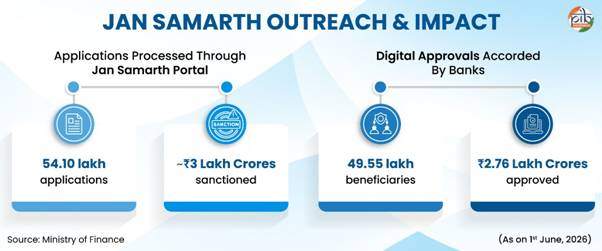
These achievements show how digital platforms like Jan Samarth are making government credit schemes more accessible, faster, and transparent. By reducing paperwork and bringing multiple schemes onto a single platform, the portal is helping more people access formal finance and supporting the country’s journey towards greater financial inclusion.
Building an Inclusive Credit Ecosystem
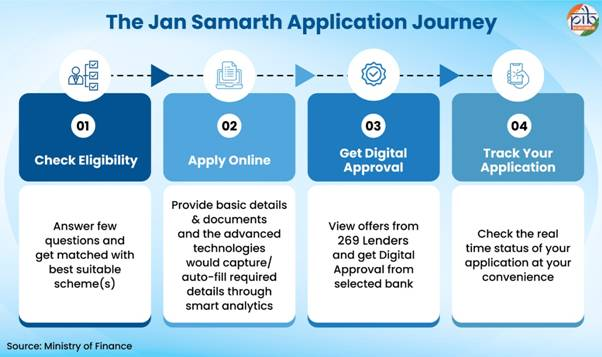
The Jan Samarth Portal has been developed as a single-window digital platform that brings together multiple government credit-linked schemes in one place. Instead of visiting different websites or going through lengthy procedures, people can easily check their eligibility, apply for loans, and track their applications through a simple online process.
The portal supports a wide range of beneficiaries, including entrepreneurs, farmers, small business owners, students, and people looking to build sustainable livelihoods. By reducing paperwork, simplifying the application process, and connecting applicants directly with lenders, Jan Samarth makes institutional credit more accessible to people across the country.
Another key strength of the portal is its end-to-end digital integration, which ensures that every stage of the loan process—from checking eligibility and submitting applications to loan approval and monitoring—is managed through a single platform. This not only improves efficiency but also makes the process more transparent and user-friendly.
Overall, the Jan Samarth Portal reflects the Government’s commitment to digital financial inclusion, faster and more efficient credit delivery, and empowering individuals and businesses by making government-backed financial support easier to access.