
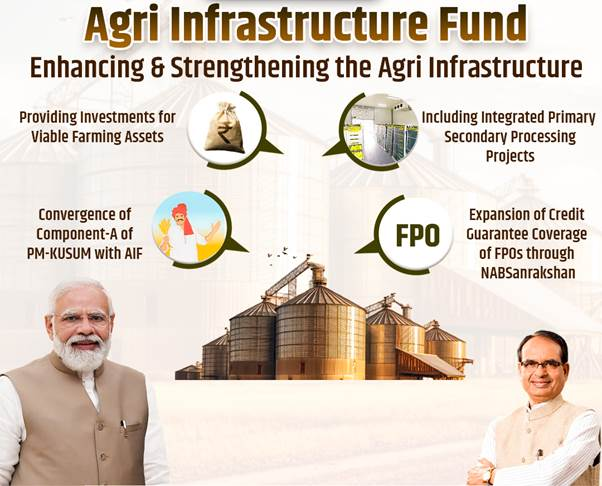
The Agriculture Infrastructure Fund (AIF) is a major initiative launched by the Government of India to drive investment in agriculture and rural infrastructure. Introduced in July 2020, the scheme aims to mobilize medium to long-term debt financing facilities for investment in viable projects across post-harvest management and community farming assets.
Introduction
By strengthening agricultural infrastructure, the AIF supports farmers, agri-entrepreneurs, and cooperatives in enhancing their productivity, reducing wastage, and improving farmers’ income in line with the goals of Doubling Farmers’ Income.
Key Highlights at a Glance
NABARD 2021-2024 Cutoff Analysis | What we can Learn? #nabard_grade_a_exam #nabard_cutoffTap to play · from the C4S channel
| Feature | Details |
|---|---|
| Scheme Name | Agriculture Infrastructure Fund (AIF) |
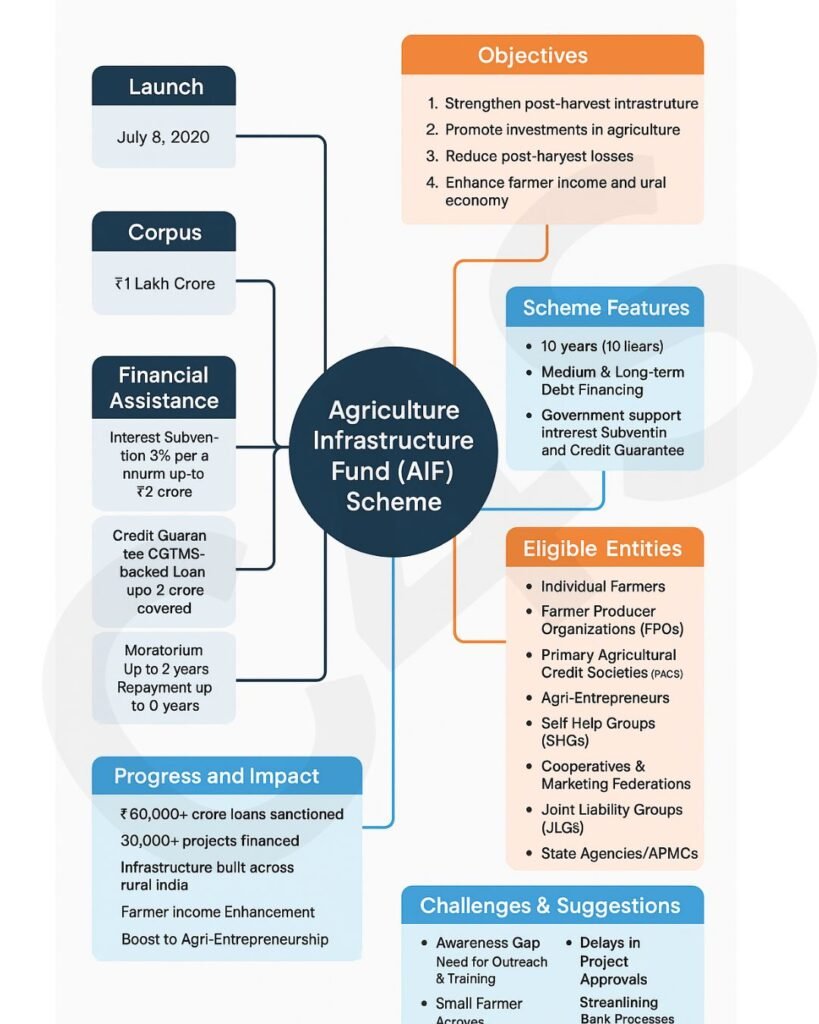
| Launch Date | July 8, 2020 |
| Ministry | Ministry of Agriculture and Farmers’ Welfare |
| Scheme Type | Central Sector Scheme |
| Total Corpus | ₹1 lakh crore |
| Duration | 2020-21 to 2032-33 (10 years) |
| Beneficiaries | Farmers, FPOs, SHGs, PACS, Cooperatives, Startups, APMCs |
| Financial Support | 3% Interest Subvention, Credit Guarantee, Repayment Moratorium |
| Purpose | Building post-harvest management infrastructure and community farming assets |
ARD notes, the monthly current affairs PDF and a descriptive English sample — all free, on WhatsApp.
Get it on WhatsApp — one tap or just leave your numberObjectives of the Agriculture Infrastructure Fund
- To improve agricultural infrastructure across the country, particularly in rural areas.
- To boost supply chain facilities such as warehousing, cold storage, and logistics.
- To reduce post-harvest losses and increase value realization for farmers.
- To enable farmers to access better markets and fair prices.
- To support private investments in agriculture-related infrastructure projects.
Key Features of the AIF Scheme
| Feature | Details |
|---|---|
| Launch Date | 8th July 2020 |
| Tenure of Scheme | FY 2020-21 to FY 2032-33 |
| Corpus Size | ₹1 Lakh Crore |
| Type of Financing | Medium to long-term debt financing |
| Eligible Projects | Post-harvest management infrastructure and community farming assets |
| Interest Subvention | 3% per annum up to a limit of ₹2 crore |
| Credit Guarantee | Coverage under Credit Guarantee Fund Trust for Micro and Small Enterprises (CGTMSE) or through government fund |
| Moratorium Period | Up to 2 years |
Eligible Beneficiaries
The AIF Scheme covers a wide range of stakeholders:
- Individual farmers
- Farmer Producer Organizations (FPOs)
- Primary Agricultural Credit Societies (PACS)
- Agri-entrepreneurs
- Startups
- Central/State agency sponsored Public-Private Partnership (PPP) projects
- Self Help Groups (SHGs)
- Cooperatives and Marketing Cooperatives
- Joint Liability Groups (JLGs)
- State Agencies/APMCs (Agricultural Produce Market Committees)
Types of Infrastructure Supported under AIF
The scheme promotes the creation and modernization of infrastructure such as:
- Warehouses
- Cold chains
- Sorting and grading units
- Primary processing centers
- Collection centers
- Ripening chambers
- Silos
- Packaging units
- Farm mechanization centers
- Supply chain services including e-marketing platforms
Financial Assistance under AIF
- Loan Amount:
- Loans under the AIF have no minimum limit; however, the interest subvention benefit is available for loans up to ₹2 crore.
- Interest Subvention:
- 3% per annum for a maximum period of 7 years.
- Credit Guarantee:
- Loans up to ₹2 crore are eligible for credit guarantee coverage.
- Moratorium Period:
- Up to 2 years depending on the type of project and revenue generation capacity.
Application Process
Here is the step-by-step process to apply for financial assistance under AIF:
- Prepare a Project Report:
- Clearly outline the project, cost, expected outcomes, and infrastructure to be created.
- Apply via AIF Portal:
- Applicants must submit their proposals online through the AIF official portal.
- Loan Processing:
- Banks and lending institutions will process the loan applications based on project viability.
- Approval and Disbursement:
- After approval, loans are disbursed along with interest subvention benefits.
- Monitoring and Reporting:
- Regular project monitoring and reporting are mandatory as per scheme guidelines.
Progress and Achievements (As of Early 2025)
- Over ₹60,000 crore worth of loans sanctioned.
- More than 30,000 projects across India have benefited.
- Significant growth in storage capacity and cold chain development.
- Positive push towards modernization and mechanization in farming practices.
Benefits of Agriculture Infrastructure Fund
- Strengthens rural economy through asset creation.
- Reduces post-harvest losses and improves price realization.
- Encourages private sector participation and entrepreneurship in agriculture.
- Improves food security through better storage and supply chain facilities.
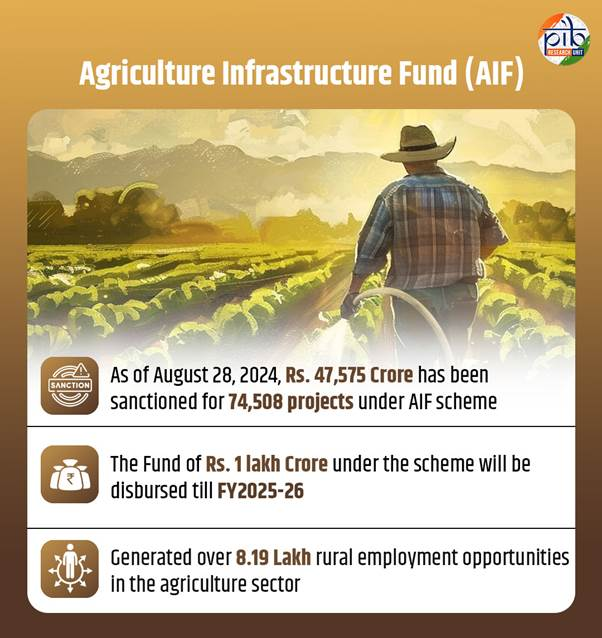
- Generates rural employment opportunities.
- Boosts exports by facilitating global market standards in produce handling.
Challenges and Way Forward
| Challenges | Suggested Solutions |
|---|---|
| Limited awareness among farmers | Stronger awareness campaigns at grassroots level |
| Delays in project approvals | Simplification and digitization of approval processes |
| Land and operational issues | Facilitating easy land leasing and farmer agreements |
| Financing constraints | Wider banking participation and financial literacy programs |
Going forward, stronger synergy between government agencies, financial institutions, and the private sector will be crucial to realize the full potential of the AIF scheme.
- Enhanced Awareness Campaigns:
- Special drives, field demonstrations, and localized campaigns are needed.
- Simplified Application Procedures:
- More user-friendly portal and hand-holding support at district levels.
- Involvement of Technology:
- Using satellite imagery, mobile apps, and AI to monitor projects.
- Special Focus on Smallholders:
- Tailored schemes to enable small farmers and FPOs to access funds.
Conclusion
The Agriculture Infrastructure Fund (AIF) is a visionary step toward building a self-reliant and sustainable agricultural ecosystem in India. By promoting investment, innovation, and rural employment, AIF is poised to be a game-changer in reshaping the agricultural landscape and enhancing farmers’ income.
Farmers, cooperatives, and agri-entrepreneurs must leverage the AIF to unlock opportunities and contribute toward Atmanirbhar Bharat (Self-Reliant India).
FAQs on Agriculture Infrastructure Fund
Q1. What is the maximum loan amount eligible for interest subvention under AIF?
→ Up to ₹2 crore per project.
Q2. Who can apply for the AIF Scheme?
→ Farmers, FPOs, PACS, cooperatives, SHGs, startups, and agri-entrepreneurs.
Q3. How long will the AIF Scheme be operational?
→ It will be operational till FY 2032-33.