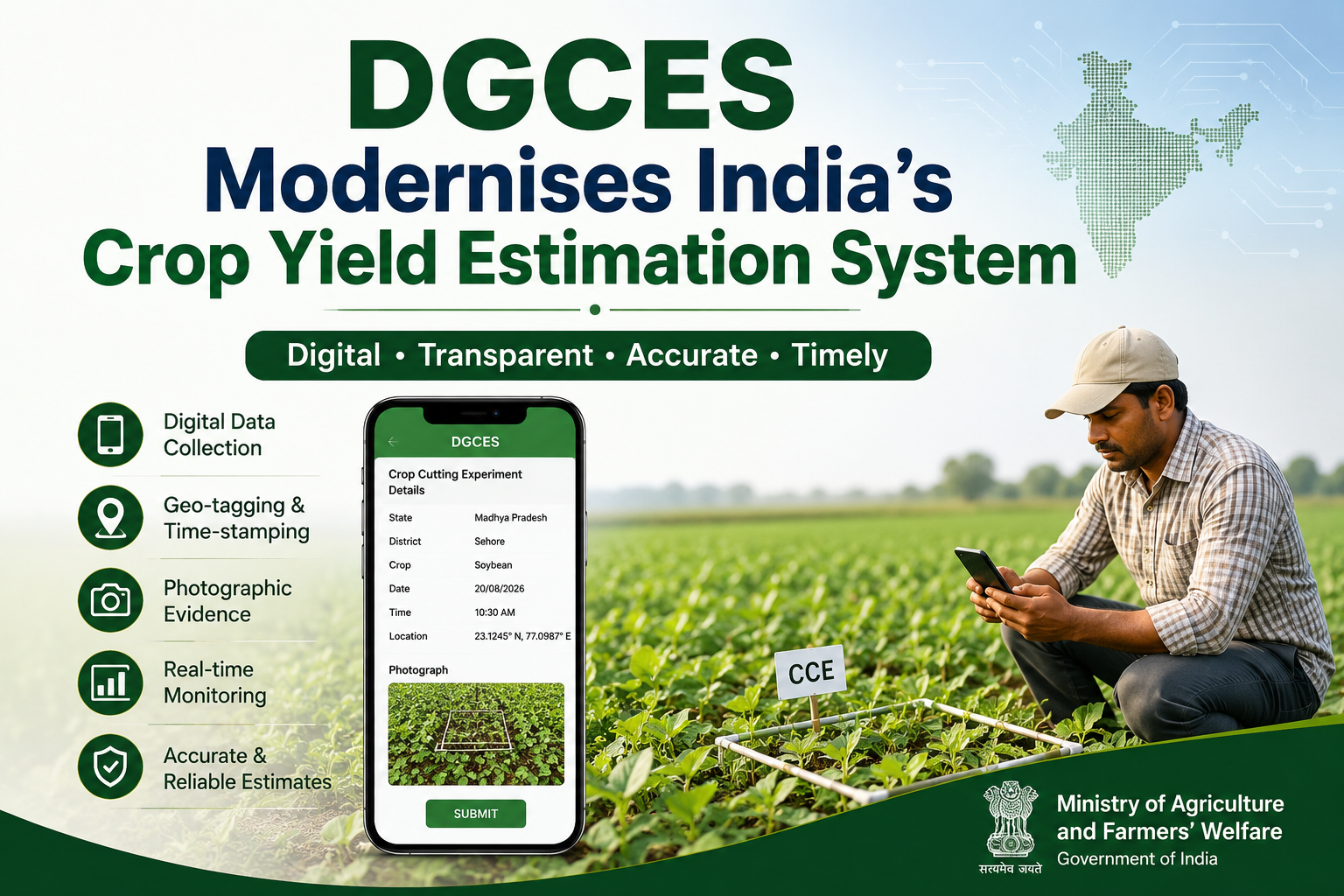
The Digital General Crop Estimation Survey (DGCES), run by the Ministry of Agriculture and Farmers’ Welfare, has now been expanded to 23 states and Union Territories as of August 2026. The survey was first tested during the Kharif season of 2023–24 in 10 states. It uses digital technology to make crop data collection faster, more accurate, transparent, and reliable. The initiative is aimed at solving long-standing problems in estimating crop yields and improving the quality of India’s agricultural statistics.
Background
For many years, crop data in India was collected manually through paper-based Crop Cutting Experiments (CCEs). This often resulted in delays, differences in data quality, and limited transparency in estimating crop yields.
The National Sample Survey Office (NSSO) and the Ministry of Agriculture and Farmers’ Welfare have stressed the need to modernise this system so that agricultural data becomes more accurate, timely, and reliable.
The Digital India initiative, launched in 2015, created a strong foundation for using technology in government services. This approach was later extended to agriculture through initiatives such as the Digital Agriculture Mission.
The government’s goal of doubling farmers’ income also highlighted the need for reliable and timely agricultural data. Better data helps the government design policies and enables farmers and markets to make more informed decisions.
DGCES follows a trend already seen in countries such as the United States and Brazil, where technologies like mobile applications and remote sensing are increasingly used to collect and analyse agricultural data.
Overall, DGCES is part of India’s larger move toward technology-driven and evidence-based decision-making in agriculture. It also complements digital initiatives such as the Soil Health Card and PM-KISAN.
What is the Digital General Crop Estimation Survey (DGCES)?
DGCES is a digital system that aims to modernise crop yield estimation in India. Instead of relying on traditional paperwork, it uses a mobile application to record crop data digitally.
The initiative is being implemented by the Ministry of Agriculture and Farmers’ Welfare, with technical support from the National Informatics Centre (NIC) and the Mahalanobis National Crop Forecast Centre (MNCFC).
During Crop Cutting Experiments (CCEs), the system records the location, date and time, and photographs of the field. This makes the process more transparent and helps ensure that the data is genuine and accurate.
Data collected through the mobile app can be uploaded in real time to a central web-based dashboard. Officials can then monitor the work, check the data, and analyse the results more quickly.
DGCES also creates a standard method for collecting and verifying crop data across different states. This reduces errors and differences in the way data is recorded, making agricultural statistics more consistent.
Since the information is available digitally, crop yield estimates can be compiled and shared faster with government officials, policymakers, researchers, and other stakeholders.
The implementation has been carried out in phases. It was first piloted in 10 states during the Kharif season of 2023–24, expanded to 22 States/UTs during the Rabi season of 2023–24, and is now operational in 23 States/UTs.
The expansion to more states depends on factors such as state-level preparedness, availability of digital infrastructure, and training of field officials.
Key Features
Feature
Significance
Phased Implementation
Allows the system to be introduced gradually, tested in selected areas, and improved before wider expansion.
Mobile App for Real-Time Data Collection
Enables officials to record crop data instantly during Crop Cutting Experiments (CCEs), reducing delays and human errors.
Geo-Tagging and Time-Stamping
Records the exact location, date, and time of data collection, making the process more transparent and reducing the chances of manipulation.
Paperless Workflow
Replaces physical paperwork with digital records, reducing administrative work and improving data accuracy.
Web-Based Monitoring Dashboard
Allows authorities to monitor CCE activities and progress across different states from a central platform.
Standardised Data Collection Protocols
Ensures that crop data is collected using the same methods across states, making yield estimates more consistent and reliable.
Why it Matters
Agricultural Policy and Governance
Better crop yield estimates help the government make more informed decisions about food security, government procurement, and controlling price fluctuations.
Improves the reliability of agricultural statistics, making India’s crop data more trustworthy for organisations such as the FAO and World Bank.
Supports government schemes such as PM-KISAN and PM-AASHA by providing more reliable information about crop production, which can help in better planning and implementation.
Economic Implications
Improves market efficiency by giving farmers, traders, and policymakers more reliable information about the expected crop output.
Helps farmers access agricultural credit because banks and financial institutions can use more reliable crop and yield information while assessing lending requirements.
Helps reduce post-harvest losses by allowing authorities to identify production trends early and take timely steps for storage, transportation, and marketing.
Technological and Institutional Impact
Shows how digital technology can improve governance in rural areas and can encourage similar digital solutions in other sectors.
Builds the skills of state agriculture officials by training them to use mobile applications, digital tools, and data-management systems.
Makes agricultural data easier to compare across states, which can support better research, coordination, and policymaking at the national level.
Challenges
1. Digital Divide and Infrastructure Gaps
Many rural areas, especially hilly and tribal regions, may not have stable internet connectivity, making real-time data uploading difficult.
Some field officials may have limited digital skills, which can affect the effective use of the mobile application.
UPSC Link: GS-III – Science & Technology
2. Data Privacy and Security
Since DGCES collects location-based and time-stamped information, there are concerns about protecting farmers’ land details and personal information.
Digital systems can also face cybersecurity threats, including unauthorised access, data theft, or manipulation.
UPSC Link: GS-II – Governance
3. Standardisation Across States
Different states may follow different farming practices and data-reporting methods, making it difficult to maintain uniformity.
Officials who are accustomed to traditional paper-based methods may take time to adapt to the new digital system.
UPSC Link: GS-II – Federalism
4. Human Resource Constraints
There may be a shortage of trained officials who can properly conduct Crop Cutting Experiments and operate the digital platform.
Frequent transfers or staff shortages in state agriculture departments can affect the continuity and quality of data collection.
UPSC Link: GS-II – Human Resource
5. Cost and Sustainability
Setting up and maintaining digital infrastructure, devices, software, and internet connectivity can be expensive, particularly for states with limited resources.
Ensuring long-term funding and maintenance will be important if DGCES is to be expanded and sustained across the country.
UPSC Link: GS-III – Economic Development
Issue
Concern
Connectivity in Remote Areas
Poor internet connectivity in rural, hilly, and tribal areas can make real-time data transmission difficult.
Digital Literacy Deficits
Lack of proper training among field officials may result in errors while entering or using data.
Data Privacy Risks
Geo-tagged information may expose sensitive details about farmers and their land if data is not properly protected.
State-Level Disparities
Differences in farming practices and reporting methods across states may make it difficult to compare data accurately.
Cybersecurity Threats
Hacking, data theft, or other cyberattacks could affect the security and reliability of crop yield data.
Resource Constraints
High infrastructure costs and a shortage of trained personnel may create difficulties in implementing and maintaining the system.
Way Forward
Expand DGCES to all remaining States and UTs by first identifying and fixing gaps in internet connectivity, devices, and other digital infrastructure.
Train state agriculture officials regularly so they can confidently use digital tools, mobile applications, and data-management systems.
Strengthen cybersecurity to protect farmers’ land details, personal information, and crop-related data from hacking or misuse.
Create a simple grievance redressal system through which farmers can report errors or disagreements related to crop yield estimates.
Connect DGCES with other agricultural databases, such as land records and weather information, to get a more complete picture of agricultural conditions.
Explore blockchain technology on a pilot basis to make CCE data more secure, transparent, and difficult to manipulate.
Provide dedicated funding in state budgets for maintaining digital infrastructure, updating technology, and expanding the system.
Encourage public-private partnerships (PPPs) to bring in private-sector expertise in areas such as digital technology, data analytics, and cybersecurity.
The Insurance Regulatory and Development Authority of India (IRDAI) has officially released the notification for the recruitment of Assistant Managers...
C4S Courses is one of India’s fastest-growing ed-tech platform, dedicated to helping students prepare for premier entrance exams such as NABARD Grade A and RBI Grade B.