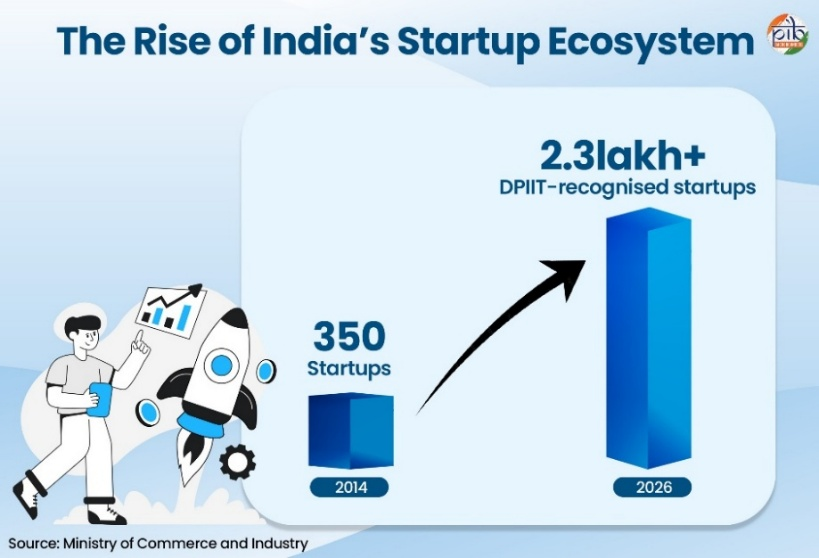
Between 2014 and 2026, the Government introduced and expanded several programmes to support young people in areas like education, skill development, entrepreneurship, sports, health, and community participation. Guided by the National Education Policy (NEP) 2020, the focus has been on empowering youth to lead India’s growth. Access to quality education has improved, higher education has become more accessible, and new opportunities for skills training and employment have been created. India’s startup ecosystem has also grown rapidly, with more than 2.3 lakh recognised startups. Through digital platforms, inclusive initiatives, and active community involvement, young people are playing a key role in nation-building as the Amrit Peedhi, helping India move towards the goal of Viksit Bharat by 2047.
The Rise of the Amrit Peedhi
With nearly 65% of its population below the age of 35, India has one of the youngest populations in the world. This gives the country a unique opportunity to drive economic growth and development. Over the past 12 years, the Government has focused on empowering young people by investing in education, skill development, sports, and entrepreneurship. The approach has shifted from treating youth as beneficiaries of government schemes to recognising them as active partners in building the nation. Today, India’s youth, known as the Amrit Peedhi, are playing a leading role in innovation, economic progress, and social development, contributing to the vision of Viksit Bharat @ 2047.
Focus on Youth-led Development
India’s approach to youth development has changed significantly over the last decade to match the aspirations of its young population. The National Youth Policy (NYP) 2014 laid the foundation by defining youth as people between the ages of 15 and 29. It focused on improving education, employment, skill development, healthcare, sports, social participation, and overall empowerment, with an emphasis on equal opportunities and stronger institutions.
Building on this, the Government has shifted its focus from seeing young people only as beneficiaries of welfare schemes to recognising them as active contributors to the country’s development. This youth-led approach encourages young Indians to take part in innovation, leadership, and nation-building.
The proposed National Youth Policy 2025 takes this vision a step further by focusing on future-ready skills, entrepreneurship, leadership, digital participation, civic responsibility, and sustainable development. It aims to prepare India’s youth to meet the challenges of a rapidly changing world while helping achieve the goal of Viksit Bharat @ 2047.
Education: Quality, Access, and Empowerment for Every Young Indian
India’s education system has undergone major changes in the last decade. Earlier, the main focus was on increasing the number of schools and colleges so that more children could study. Today, the emphasis is not only on providing education but also on improving its quality and making it accessible to every child, including those living in remote and disadvantaged areas. The goal is to prepare young people with the knowledge and skills needed for the future.
National Education Policy (NEP) 2020
The National Education Policy (NEP) 2020 is the biggest education reform in recent years. It was developed after consulting teachers, students, parents, and education experts across the country. The policy encourages practical learning, critical thinking, creativity, and multidisciplinary education instead of rote memorisation. It aims to equip India’s Amrit Peedhi with the skills required to build a Viksit Bharat by 2047.
Improving School Education
The Government has strengthened school education by improving infrastructure and making education more inclusive.
School education is now treated as one continuous system, from pre-primary to Class 12.
By 2025–26, more than 1.49 lakh schools had been covered under digital education programmes.
Over 1.76 lakh smart classrooms and 1.79 lakh ICT laboratories have been approved to promote technology-based learning.
Residential schools such as Kasturba Gandhi Balika Vidyalayas (KGBVs) and Netaji Subhash Chandra Bose Awasiya Vidyalayas (NSCBAVs) have helped girls and students from disadvantaged communities continue their education.
Hostel facilities under PM-JANMAN and Dharti Aaba Janjatiya Gram Utkarsh Abhiyan (DAJGUA) have expanded educational opportunities for tribal students living in remote areas.
These initiatives have improved school enrolment and reduced dropout rates, allowing more students to complete secondary and higher secondary education.
Making Higher Education More Flexible
NEP 2020 has introduced several reforms to make higher education more student-friendly and flexible.
The National Credit Framework (NCrF) allows students to earn academic credits from classroom learning, skill training, and practical experience.
The Academic Bank of Credits (ABC) enables students to store and transfer their academic credits if they change institutions or programmes. More than 32 crore student IDs have been created under this system.
The APAAR ID provides every student with a lifelong digital academic identity that records their educational achievements. By March 2026, more than 15.48 crore verified APAAR IDs had been generated.
Around 153 universities now offer multiple entry and exit options and conduct admissions twice a year, giving students greater flexibility in completing their degrees.
These reforms support the Government’s goal of achieving a 50% Gross Enrolment Ratio (GER) in higher education by 2035.
Technology and Digital Learning
The Government has also expanded digital education to make quality learning available to everyone.
SWAYAM, India’s online learning platform, offers over 18,580 courses, with more than 6.1 crore enrolments and 53.7 lakh certificates issued by June 2026.
SWAYAM PRABHA, PM e-VIDYA, and DIKSHA provide learning through television, radio, online platforms, and digital content.
DIKSHA hosts more than 3.66 lakh digital learning resources in 135 languages, making education accessible to students from diverse linguistic backgrounds.
The One Nation One Subscription initiative provides nearly 99 lakh students and researchers across 7,414 institutions with access to quality academic journals and research materials.
Promoting Innovation and Entrepreneurship
Innovation has become an important part of education.
Under the Atal Innovation Mission, more than 10,000 Atal Tinkering Labs have been established in schools, benefiting over 1.1 crore students and supporting the development of 16 lakh innovation projects.
72 Atal Incubation Centres have supported over 6,700 startups and helped create more than 32,000 jobs, encouraging young entrepreneurs to turn their ideas into successful businesses.
Expansion of Higher Education
India has also significantly expanded its higher education system.
Student enrolment in higher education increased from 3.42 crore in 2014–15 to 4.46 crore in 2022–23.
India now has one of the world’s largest school systems, with 14.71 lakh schools, 24.69 crore students, and over 1.01 crore teachers.
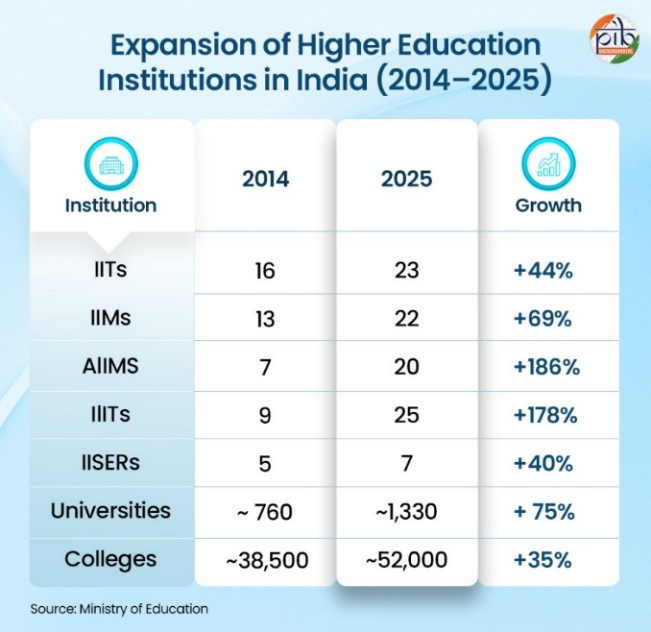
The number of medical colleges has increased from 431 in 2014 to 818 in 2025–26, while MBBS and postgraduate medical seats have also expanded significantly.
Five newer Indian Institutes of Technology (IITs)—located in Tirupati, Palakkad, Bhilai, Jammu, and Dharwad—have increased their combined student capacity by adding over 6,500 seats.
India’s global presence in higher education is growing, with IIT campuses established in Zanzibar and Abu Dhabi, and IIM Ahmedabad opening a campus in Dubai. Around 15 foreign universities are also expected to establish campuses in India.
The number of Higher Education Institutions (HEIs) has grown from about 51,000 in 2014–15 to over 70,000 by June 2025, providing students with greater access to quality education and international collaborations.
Skilling: Building a Future-Ready Workforce
Over the last 12 years, the Government has worked to build a strong skill development system that prepares young people for today’s jobs and future careers. Instead of focusing only on traditional vocational training, the emphasis is now on industry-based, technology-driven, and employment-oriented skills. The aim is to make India’s youth globally competitive and improve their chances of getting good jobs or starting their own businesses.
Skill India Mission (SIM)
Launched in 2015, the Skill India Mission is India’s flagship programme for providing skill training, reskilling, and upskilling. It helps young people gain practical skills that match industry needs through thousands of training centres across the country.
Some of the major programmes under the Skill India Mission are:
Pradhan Mantri Kaushal Vikas Yojana (PMKVY)
Jan Shikshan Sansthan (JSS)
National Apprenticeship Promotion Scheme (NAPS)
Craftsmen Training Scheme (CTS) through Industrial Training Institutes (ITIs)
Pradhan Mantri Kaushal Vikas Yojana (PMKVY)
Launched in 2015, PMKVY is the Government’s flagship short-term skill training programme. It provides industry-relevant training and connects young people with employment and entrepreneurship opportunities.
The programme has evolved over four phases:
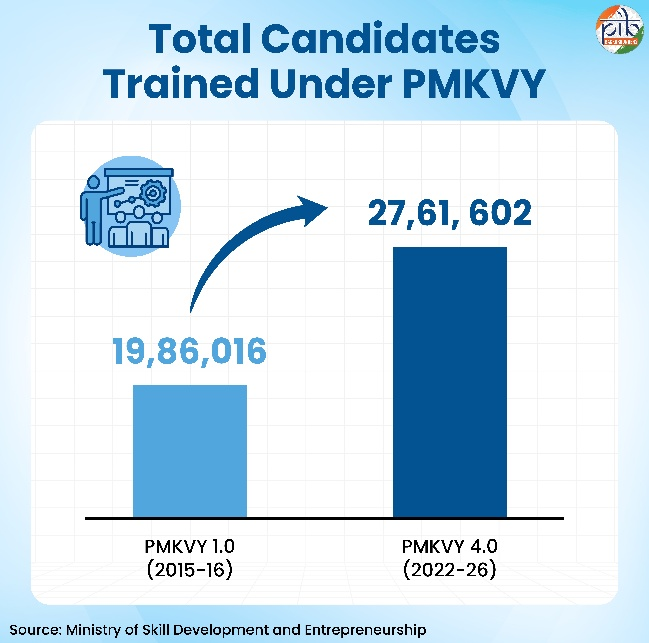
PMKVY 1.0 (2015–16): More than 19 lakh people received training.
PMKVY 2.0 (2016–20): Over 1.10 crore candidates were trained or oriented.
PMKVY 3.0 (2020–22): More than 7 lakh candidates received training.
During PMKVY 3.0, special programmes such as the Customized Crash Course for COVID Warriors and the Skill Hub Initiative were introduced. These initiatives promoted vocational education and integrated skill development with mainstream education under the National Education Policy (NEP) 2020.
PMKVY 4.0 (2022–26)
The latest phase focuses on practical and future-ready skills.
Training is based on the National Skill Qualification Framework (NSQF) and includes practical workplace experience. Courses cover emerging fields such as:
Artificial Intelligence (AI)
Drone Technology
Green Energy
Electronics
These courses are designed with the help of Sector Skill Councils (SSCs) to match industry requirements.
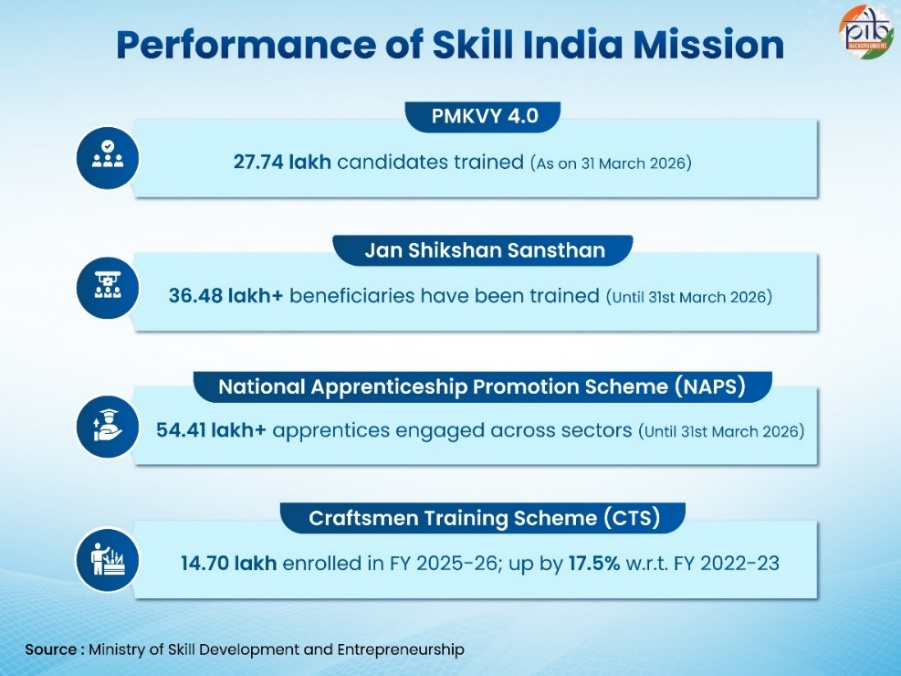
By June 2026, more than 27 lakh candidates had been trained across 40 sectors, covering 741 districts in all 36 States and Union Territories.
Jan Shikshan Sansthan (JSS)
Since 2018, Jan Shikshan Sansthans have been transformed into inclusive skill development centres, especially for rural and disadvantaged communities.
Training is provided in locally relevant skills such as:
Tailoring
Embroidery
Handicrafts
Food Processing
Health-related services
These courses help people become self-employed and improve their livelihoods.
Achievements
More than 36.48 lakh people trained between 2018 and March 2026.
Over 26,500 tribal beneficiaries completed training.
Since December 2024, products made by trainees are sold through the UdyamKart portal, helping artisans directly reach customers.
National Apprenticeship Promotion Scheme (NAPS)
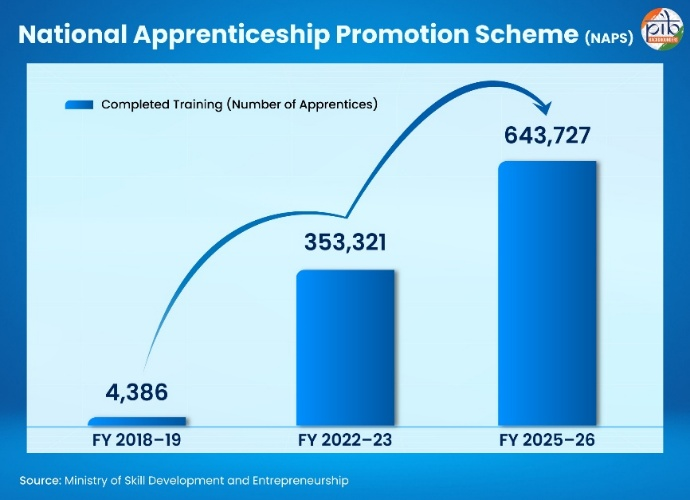
Launched in 2016, NAPS promotes the “Earn While You Learn” model.
Under the scheme, apprentices receive practical training in industries while earning a stipend. The Government pays 25% of the stipend (up to ₹1,500 per month) directly into the apprentice’s bank account.
By March 2026, more than 54.41 lakh apprentices had been trained in industries such as:
Automobile
Information Technology (IT)
Electronics
Retail
Manufacturing
In September 2025, the Government introduced the Certificate of Proficiency (CoP) for apprentices who successfully complete their training and assessment. By March 2026, over 67,700 certificates had been issued.
Craftsmen Training Scheme (CTS)
The Craftsmen Training Scheme (CTS) provides long-term technical training through Industrial Training Institutes (ITIs).
Its main objective is to create skilled workers for industries while reducing unemployment among young people.
Key highlights include:
Training offered in 169 trades
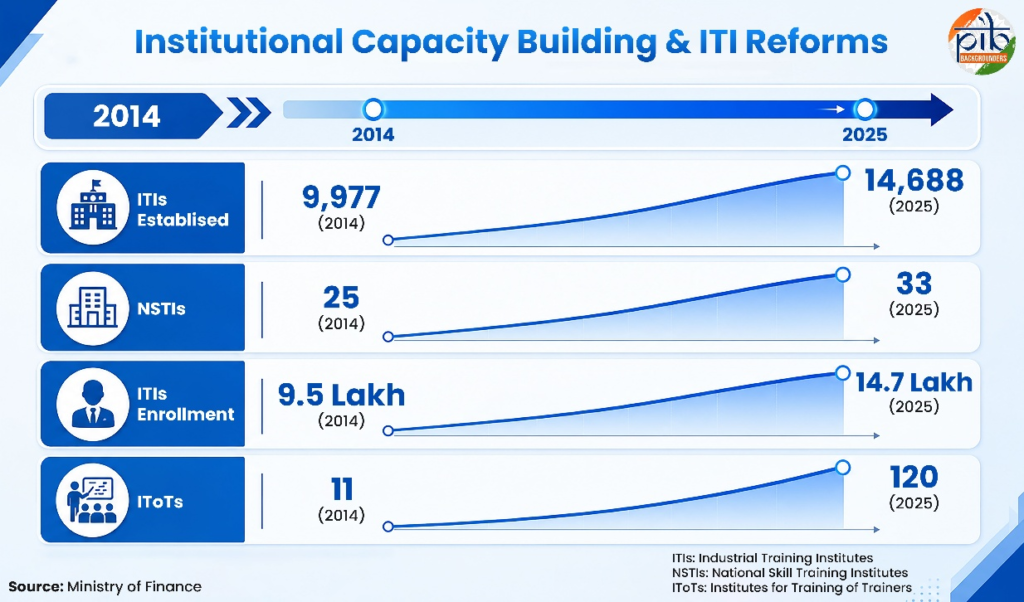
Available through 14,688 ITIs
3,345 Government ITIs
11,343 Private ITIs
By March 2026, 14 new courses had been introduced and 22 existing courses updated to match changing industry requirements.
Modernisation of Industrial Training Institutes (ITIs)
ITIs continue to play a major role in vocational education and technical skill development.
To modernise them, the Government launched PM–SETU (Pradhan Mantri Skilling and Employability Transformation through Upgraded ITIs) in October 2025 with an estimated investment of ₹60,000 crore.
Major features include:
Upgrading 1,000 Government ITIs with modern infrastructure and equipment.
Developing a Hub-and-Spoke Model, where advanced ITIs support nearby institutes.
Partnering with industries through Special Purpose Vehicles (SPVs).
Designing new courses based on labour market demand.
Upgrading traditional trades using modern technology.
Several states, including Haryana, Karnataka, and Tamil Nadu, are participating in this initiative.
The programme also upgrades five National Skill Training Institutes (NSTIs) into Centres of Excellence with global collaborations.
A special 45-hour course for teachers covers topics such as Artificial Intelligence and Machine Learning.
Short-term courses are also being offered in partnership with global technology companies like IBM, Microsoft, and Cisco, helping students develop future-ready digital skills.
Prime Minister Internship Scheme (PMIS)
Launched in October 2024, the Prime Minister Internship Scheme (PMIS) aims to bridge the gap between classroom learning and industry requirements by providing paid internships.
Key Features
More than 63,000 internship opportunities available (May 2026).
Monthly financial assistance of ₹9,000 through Government and company contributions.
One-time grant of ₹6,000 for incidental expenses.
Joint digital certificate issued by the Ministry of Corporate Affairs and the host company.
Insurance coverage under:
Pradhan Mantri Jeevan Jyoti Bima Yojana
Pradhan Mantri Suraksha Bima Yojana
Internship opportunities available across 25+ sectors in 730+ districts across all States and Union Territories.
The scheme gives students practical work experience, improves their confidence, and increases their chances of getting employment.
Skill India Digital Hub
Launched in 2023, the Skill India Digital Hub is a single online platform connecting learners, training providers, employers, and Government skill programmes.
It offers services related to:
Skill training
Employment opportunities
Apprenticeships
Entrepreneurship
As of May 2026:
Over 1.89 crore users had registered.
About 1.38 crore e-KYC verifications had been completed.
The platform provides services in 23 languages.
More than 1,000 online courses are available.
SIDH is linked with important Government digital platforms such as DigiLocker, e-Shram, National Career Service (NCS), UIDAI, and PFMS, making access to services easier.
SANKALP Programme
The Skills Acquisition and Knowledge Awareness for Livelihood Promotion (SANKALP) programme was launched in 2018 with World Bank support and continued until March 2025.
Its main objective was to improve the quality, governance, and inclusiveness of India’s skill development system.
Major Achievements
District Skill Committees increased from 248 to 776, covering almost the entire country.
District Skill Development Plans expanded to 746 districts, ensuring training matched local employment needs.
Under the AMBER Project, over 24,000 candidates received certification and more than 18,000 secured jobs.
More than 21,600 new enterprises were established, creating over 20,500 employment opportunities.
A Global Skill Gap Study covering 16 countries helped place over 25,000 skilled Indians in overseas jobs.
Six advanced AR/VR-based E-Skill Labs were developed to provide immersive training in trades such as solar technology and electronics.
Over the past decade, India’s skill development ecosystem has expanded significantly through programmes like Skill India Mission, PMKVY, NAPS, CTS, PM–SETU, PMIS, SIDH, and SANKALP. The Government has shifted from traditional vocational education to industry-oriented, technology-driven, and future-ready skill training. By focusing on digital skills, apprenticeships, entrepreneurship, and industry partnerships, these initiatives are helping millions of young Indians become job-ready, self-reliant, and globally competitive, contributing to the vision of Viksit Bharat @ 2047.
Building Pathways to Employment for India’s Youth
Over the past 12 years, the Government has focused on creating more employment opportunities and helping young people become part of India’s formal workforce. Through job creation schemes, digital employment platforms, manufacturing initiatives, and defence recruitment, the aim has been to make India’s young population a major driver of economic growth.
More Young People Joining the Formal Workforce
One of the biggest changes in recent years has been the growth of the formal economy, where workers receive benefits such as provident fund, job security, and social security.
According to Employees’ Provident Fund Organisation (EPFO) data, more than 3.45 crore young people aged 18–28 years joined the formal workforce between April 2020 and June 2025. This reflects increasing formal employment opportunities for India’s youth.
Announced in August 2025, the Pradhan Mantri Viksit Bharat Rozgar Yojana is one of India’s largest employment schemes, with a budget of ₹1 lakh crore.
The scheme provides financial incentives to both employers and first-time employees entering the formal sector. Its objective is to create 3.5 crore jobs within two years, encouraging businesses to hire more young workers.
Rozgar Melas
The Government launched Rozgar Melas in October 2022 to speed up recruitment into various Government departments and organisations.
These employment fairs provide appointment letters directly to selected candidates.
So far:
18 Rozgar Melas have been organised.
More than 12 lakh appointment letters have been distributed to young people across the country.
The initiative helps connect eligible candidates with Government jobs while strengthening public services.
National Career Service (NCS) Portal
The National Career Service (NCS) Portal, launched in 2015, is an online employment platform that connects job seekers with employers across India.
It acts as a digital job marketplace where young people can search for employment opportunities, career guidance, and skill development programmes.
By January 2026:
More than 78.86 lakh job seekers had registered.
Over 12.36 lakh employers were using the portal.
Around 3.43 crore job vacancies had been listed during the financial year 2025–26.
The portal has made it easier for employers and job seekers to find each other, especially through digital services.
Atmanirbhar Bharat Rojgar Yojana (ABRY)
The Atmanirbhar Bharat Rojgar Yojana (ABRY) was launched during the COVID-19 pandemic to protect existing jobs and encourage companies to hire new employees.
Under the scheme, the Government paid the employer’s share of the Employees’ Provident Fund (EPF) contribution for newly recruited workers, reducing hiring costs.
The scheme operated from October 2020 to March 2024 and benefited over 60.49 lakh employees, helping businesses recover from the economic impact of the pandemic.
Employment Opportunities in Defence
Agnipath Scheme
The Agnipath Scheme, launched in June 2022, recruits young people aged 17½ to 21 years into the armed forces as Agniveers for a four-year service period.
Apart from military training, Agniveers develop:
Discipline
Leadership qualities
Technical skills
Teamwork and decision-making abilities
After completing their service, they receive a Seva Nidhi financial package to support their future education, employment, or entrepreneurship.
By early 2025, around 1.5 lakh Agniveers had been recruited.
To improve post-service employment opportunities, the Government has introduced:
10% reservation for former Agniveers in recruitment to the Central Armed Police Forces (CAPFs) and Assam Rifles.
Age relaxation during recruitment.
In 2026, Indian Railways and the Indian Army also signed a cooperation framework to provide more employment opportunities to Agniveers.
Under existing Railway recruitment rules:
10% of Level-1 posts
5% of Level-2 and higher posts
are reserved for former Agniveers, helping them transition smoothly into civilian careers.
Manufacturing and Industrial Employment
Make in India Initiative
The Make in India programme was launched on 25 September 2014 to transform India into a global manufacturing hub and create large-scale employment.
Today, Make in India 2.0 covers 27 sectors, including:
Electronics
Automobiles
Pharmaceuticals
Aerospace
Textiles
Food Processing
Information Technology
Drones
These sectors provide significant employment opportunities for India’s growing skilled workforce.
Production Linked Incentive (PLI) Scheme
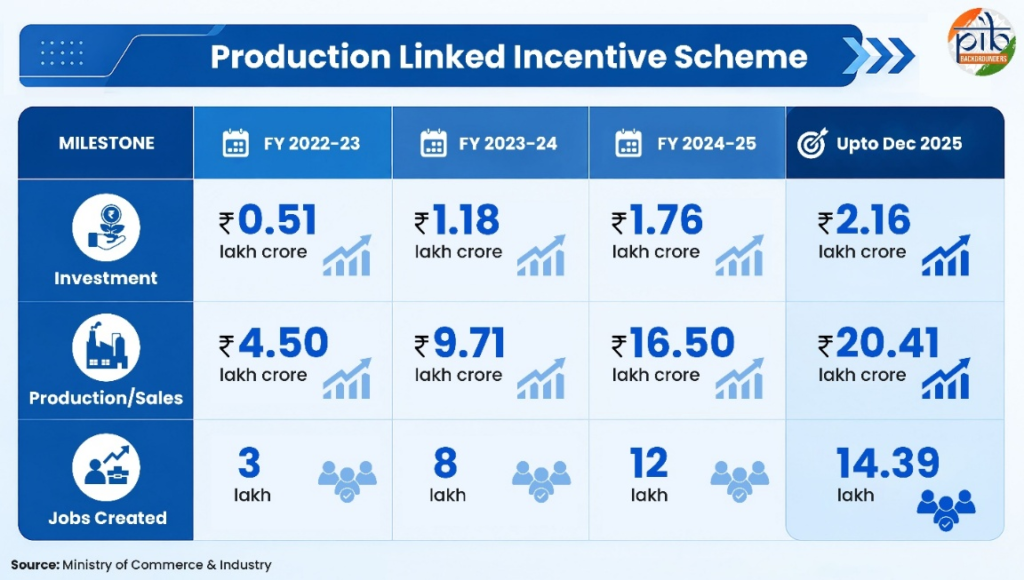
To strengthen manufacturing, the Government launched the Production Linked Incentive (PLI) Scheme in March 2020.
The scheme encourages companies to manufacture more products in India by providing financial incentives based on their production.
The PLI Scheme covers 14 major sectors, including:
Electronics
Pharmaceuticals
Automobile manufacturing
Telecom
Food Processing
One of its biggest achievements has been making India one of the world’s leading mobile phone manufacturing hubs, with large-scale smartphone production taking place within the country.
Achievements (As of 31 March 2026)
More than ₹2.40 lakh crore invested.
Production and sales worth over ₹22.66 lakh crore.
More than 14.15 lakh direct and indirect jobs created.
Exports exceeding ₹15.20 lakh crore.
The PLI Scheme has helped increase domestic manufacturing, attract investments, reduce imports, promote exports, and generate employment across multiple industries.
Entrepreneurship: Enabling Youth-Led Enterprise and Innovation
Over the last 12 years, the Government has worked to create an environment where young Indians can turn their ideas into successful businesses. Instead of only looking for jobs, many young people are now creating jobs for others through startups and small enterprises. This transformation has been supported through easier access to finance, business-friendly policies, digital platforms, and innovation-focused programmes.
Startup India: Driving India’s Startup Revolution
Launched on 16 January 2016, the Startup India Initiative has become one of the biggest drivers of entrepreneurship in the country. It has encouraged innovation across sectors and helped India become the world’s third-largest startup ecosystem.
The initiative has simplified regulations, improved access to funding, promoted innovation, and created a supportive ecosystem where startups can grow from ideas into successful businesses. Today, startups are emerging not only from major cities but also from Tier-2 and Tier-3 towns, making entrepreneurship more inclusive than ever before.
A Strong Funding Ecosystem for Every Stage of a Startup
One of the biggest achievements over the past decade has been the creation of a funding system that supports entrepreneurs throughout their journey—from the initial idea to business expansion.
Pradhan Mantri MUDRA Yojana (PMMY)
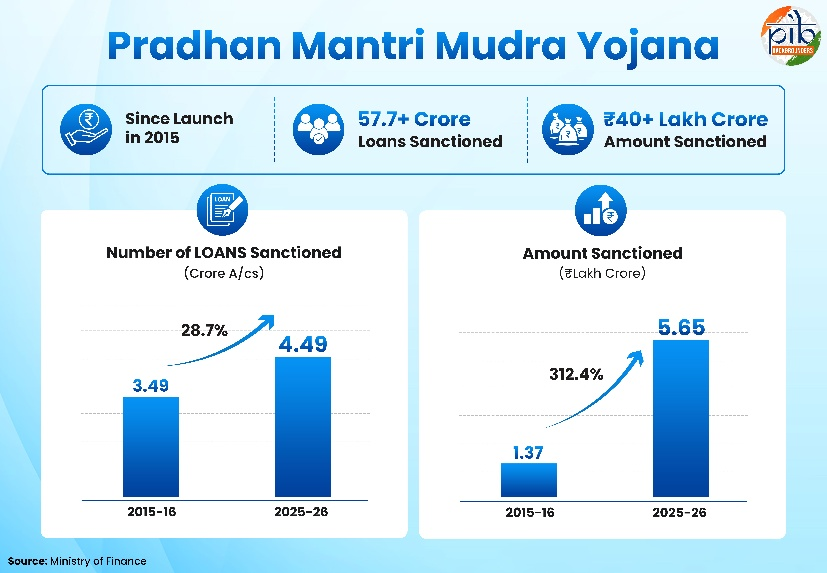
Launched in 2015, the Pradhan Mantri MUDRA Yojana (PMMY) provides collateral-free loans of up to ₹20 lakh to micro and small enterprises. The scheme has enabled millions of aspiring entrepreneurs, especially first-time business owners, to start or expand their businesses without the need for large assets as security.
Startup India Seed Fund Scheme (SISFS)
Introduced in April 2021, the Startup India Seed Fund Scheme (SISFS) helps startups during their most challenging early stages. It provides financial support for:
Proof of Concept (PoC)
Prototype development
Product testing
Market entry
Commercialisation
The Government has approved a corpus of ₹945 crore, which has been allocated to more than 215 incubators to support promising early-stage startups across the country.
Fund of Funds for Startups (FFS)
Launched in 2016, the Fund of Funds for Startups (FFS) provides long-term investment support to growing startups.
Managed by the Small Industries Development Bank of India (SIDBI) with a corpus of ₹10,000 crore, the fund invests in SEBI-registered Alternative Investment Funds (AIFs), which then invest in Indian startups.
So far:
The corpus has been committed to 145+ AIFs.
These AIFs have invested over ₹25,500 crore in more than 1,370 startups across India.
Credit Guarantee Scheme for Startups (CGSS)
Many startups struggle to get loans because they cannot provide collateral. The Credit Guarantee Scheme for Startups (CGSS) addresses this challenge by offering collateral-free credit through financial institutions.
Till now:
More than 330 startup loans have been guaranteed.
Loans worth over ₹800 crore have received support under the scheme.
This has made it much easier for young entrepreneurs to access formal credit.
Startup India Investor Connect Portal
Launched in March 2023, the Startup India Investor Connect Portal helps startups connect directly with investors through a single online platform.
As of June 2026:
10,836+ startups have registered.
126 investors are part of the platform.
44 active investment opportunities are available.
More than 6,800 startups have responded to investor requirements.
The platform has opened new opportunities for first-time founders to access venture capital and angel investors.
Promoting Inclusive Entrepreneurship Through Stand-Up India
The Stand-Up India Scheme encourages entrepreneurship among women, Scheduled Castes (SCs), and Scheduled Tribes (STs) by providing institutional finance.
The scheme offers bank loans ranging from ₹10 lakh to ₹1 crore for setting up businesses in manufacturing, services, trading, and agriculture-related sectors.
Its impact has grown significantly over the years. The total amount sanctioned under the scheme increased from ₹14,431.14 crore (as of 31 October 2018) to ₹61,020.41 crore (as of 17 March 2025), reflecting the increasing participation of underrepresented entrepreneurs in India’s growth story.
Conclusion
Over the past 12 years, India has created a strong ecosystem to support the overall development of its youth. Instead of working through isolated schemes, the Government has adopted a more connected approach that focuses on education, skill development, employment, entrepreneurship, healthcare, sports, and leadership. The aim has been to give young people the opportunities and support they need to succeed in every aspect of life.
The results of this approach are visible across the country. More young people are completing school and higher education, while millions have gained industry-relevant skills through various training programmes. Employment opportunities have expanded, and many young Indians are choosing entrepreneurship by starting their own businesses. At the same time, Indian athletes have brought pride to the nation through outstanding performances in international sporting events. Better healthcare services have also helped young people lead healthier lives, while leadership and exchange programmes have encouraged them to participate confidently at both national and global levels.
Over the years, India’s youth have moved beyond being beneficiaries of development to becoming active contributors to the country’s progress. They are driving innovation, creating employment, excelling in sports, participating in governance, and contributing to economic growth. Today, young Indians are not just preparing for the future—they are helping shape it.
The journey from 2014 to 2026 reflects a significant transformation. The focus has shifted from simply providing access to creating opportunities for empowerment and leadership. Through sustained policy support, investment in human capital, and inclusive development initiatives, the Government has worked to remove barriers and help young people realise their full potential.
As India moves towards the vision of Viksit Bharat 2047, the country has laid a strong foundation for its next generation. The Amrit Peedhi is better educated, more skilled, healthier, more confident, and equipped with the opportunities needed to lead India’s growth story in the decades ahead.
Source: PIB Context: The Ministry of Panchayati Raj called for nationwide public participation under the ‘DAANVEER’ initiative — encouraging citizens,...
C4S Courses is one of India’s fastest-growing ed-tech platform, dedicated to helping students prepare for premier entrance exams such as NABARD Grade A and RBI Grade B.