All exams GA
In one line
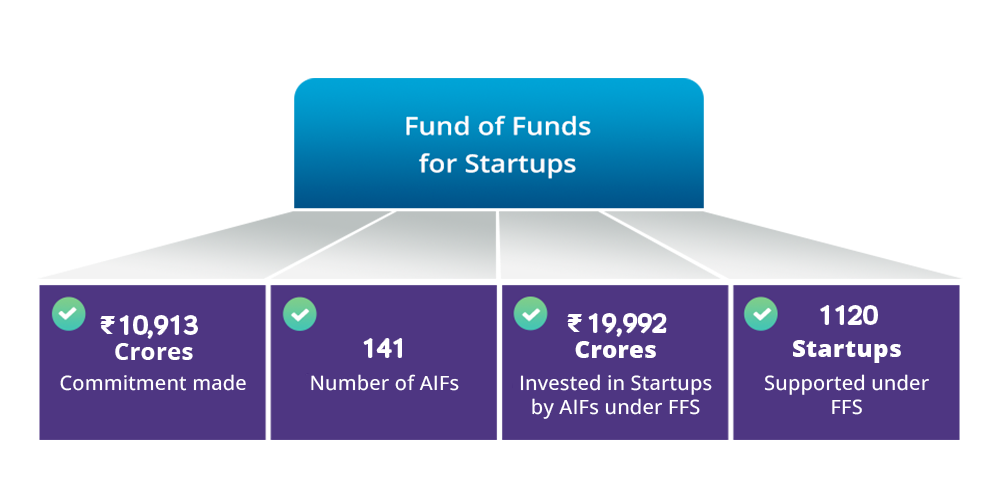
Recently, the Government of India has committed Rs. 7,385 crores under Fund of Funds for Startup India Investment, launched in 2016, for 88 Alternative Investment Funds (AIFs).
Why in News?
- These AIFs, in turn, have invested Rs. 11,206 crores in 720 startups.
What is Fund of Funds for Startup?
In 5 daysNABARD Grade A 2026: what the 2025 cut-offs changed, and the 90-day planRegister free →NABARD 2021-2024 Cutoff Analysis | What we can Learn? #nabard_grade_a_exam #nabard_cutoffTap to play · from the C4S channel
- Fund of Funds (FoF) is a type of mutual fund that does not invest directly in stocks or bonds. Instead, it invests in other mutual fund schemes. This means the fund manager builds a portfolio made up of different mutual funds rather than investing directly in financial assets.
- In India, under the Fund of Funds for Startups (FFS), financial support is provided to Alternative Investment Funds (AIFs) that are registered with the Securities and Exchange Board of India (SEBI). These AIFs then invest the money in startups, helping them grow and expand.
- The FFS was launched with a total planned corpus of ₹10,000 crore. This fund has been built over the 14th and 15th Finance Commission periods (2016–2020 and 2021–2025) through budget support from the Department for Promotion of Industry and Internal Trade (DPIIT) under the Ministry of Commerce and Industry.
- The scheme helps startups at different stages — including early, seed, and growth stages — by providing access to funding. It also supports the development of domestic investment sources, reduces reliance on foreign funding, and encourages the growth of India’s own venture capital ecosystem.
Free PDF · print or read offline
Download this page as a PDF
A clean PDF of this page with the C4S header — it opens right away, and the link comes to your WhatsApp too.
Performance
- Since the launch of the Fund of Funds for Startups (FFS), the total amount of funding committed under the scheme has grown steadily, with an average annual growth rate of more than 21%. This shows that the scheme has been expanding and supporting more investments over time.
- The Small Industries Development Bank of India (SIDBI), which manages and implements the scheme, has recently introduced several reforms to make fund disbursement faster and smoother. These changes have helped Alternative Investment Funds (AIFs) receive funds more quickly, leading to a 100% year-on-year increase in fund drawdowns.
- FFS has played an important role in supporting the venture capital ecosystem. Out of 88 AIFs supported, it has acted as an anchor investor in 67 funds, helping them raise additional investments. Notably, 38 of these funds are managed by first-time fund managers, which supports the scheme’s goal of encouraging new venture capital players in India.
- Startups funded through FFS have shown strong growth. Many have seen their valuations increase more than ten times, and several have even become unicorns, meaning they are valued at over USD 1 billion. This reflects the scheme’s positive impact on the growth and success of Indian startups.
What is Alternate Investment Funds AIF?
- Alternative Investment Fund or AIF means any fund established or incorporated in India, which is a privately pooled investment vehicle which collects funds from sophisticated investors, whether Indian or foreign, for investing it in accordance with a defined investment policy for the benefit of its investors.
- Regulation 2(1)(b) of Securities and Exchange Board of India (SEBI) Regulations (AIFs), 2012 lays down the definition of AIFs.
- Through a company, or a Limited Liability Partnership (LLP), an Alternative Investment Fund can be established.
What is the State of Startups in India?
- About Startup:
- The term startup refers to a company in the first stages of operations. Startups are founded by one or more entrepreneurs who want to develop a product or service for which they believe there is demand.
- These companies generally start with high costs and limited revenue, which is why they look for capital from a variety of sources such as venture capitalists.
- Status in India:
- National Figure:
- India has become the 3rd largest start-up ecosystem in the world after the US and China.
- India is home to as many as 75,000 Startups.
- 49% of start-ups are from tier-2 and tier-3 cities.
- There are currently 105 unicorns, out of which 44 were born in 2021 and 19 in 2022.
- Startups are also emerging in the fields like IT, agriculture, aviation, education, energy, health and space sectors.
- Global Innovation Index:
- India has been ranked in its global ranking of Global Innovation Index (GII) from 81st in the year 2015 to 46th in 2021 among 130 economies of the world.
- India ranks 2nd among 34 lower-middle-income economies and 1st among 10 Central and Southern Asian economies in terms of GII.
- Other Rankings:
- Publications:
- Globally ranked 3rd (2021) from 6th in 2013 based on the National Science Foundation database.
- Patents:
- Globally ranked 9th (2021) in terms of resident patent filing.
- Quality of Research Publications:
- Globally ranked 9th (2021) from 13th in 2013.
- Publications:
- National Figure:
- Initiatives for Startup:
- National Initiative for Developing and Harnessing Innovations (NIDHI)
- Startup India Action Plan (SIAP)
- Ranking of States on Support to Startup Ecosystems (RSSSE)
- Startup India Seed Fund Scheme (SISFS): It aims to provide financial assistance to startups for proof of concept, prototype development, product trials, market entry and commercialization.
- National Startup Awards: It seeks to recognize and reward outstanding startups and ecosystem enablers that are contributing to economic dynamism by spurring innovation and injecting competition.
How Does FFS Work?
- The Government Allocates Funds
- The Department for Promotion of Industry and Internal Trade (DPIIT) allocates funds to SIDBI, which manages FFS.
- Selection of Venture Capital (VC) and AIFs
- SIDBI identifies and invests in SEBI-registered Alternative Investment Funds (AIFs).
- VC Funds Invest in Startups
- These AIFs then provide funding to DPIIT-recognized startups in various sectors.
- Startup Growth & Returns
- As startups grow, they generate returns, which benefit the funds and indirectly support further investments.
Future Prospects of FFS
- Faster Fund Deployment
- The government is working on simplifying procedures for quicker fund disbursement.
- Increased Corpus Allocation
- More Support for Deep-Tech & AI Startups
- Future investments may focus more on sectors like AI, robotics, biotech, and clean energy.
Conclusion
The Fund of Funds for Startups (FFS) is a significant initiative to boost Indian startups by ensuring better access to capital. While there are challenges in implementation, its impact on fostering innovation, entrepreneurship, and employment is undeniable.
As India’s startup ecosystem grows, FFS will continue to play a crucial role in making India a global startup powerhouse.