Grade A result, it is Agriculture and Rural Development (ARD). Reasoning and quant get you through the gate. ARD is what separates a selection from a near miss. The subject appears in both stages. ARD carries 40 questions as a merit section in Phase 1, and there is a descriptive ARD paper in Phase 2. A candidate who prepares ARD properly collects marks twice. This guide covers what ARD includes, how to study it from scratch, the sources worth your time, a month-wise plan and how to write ARD answers that score.
Why ARD Decides the NABARD Grade A Result
Three reasons make ARD the deciding subject:
- It is unique to NABARD. You will not find it in other banking exams, so general banking preparation does not cover it.
- It counts in both phases. Time spent on ARD pays off in the objective test and again in the descriptive paper.
- It rewards depth. Question setters can tell the candidate who read the actual scheme guidelines and reports from the one who memorised one-liners.
For agriculture graduates, ARD is a chance to build a lead. For everyone else, it is the subject that most often decides the result, so it needs an earlier start.
ARD Syllabus: Topic-Wise Breakdown
NABARD 2021-2024 Cutoff Analysis | What we can Learn? #nabard_grade_a_exam #nabard_cutoffTap to play · from the C4S channel
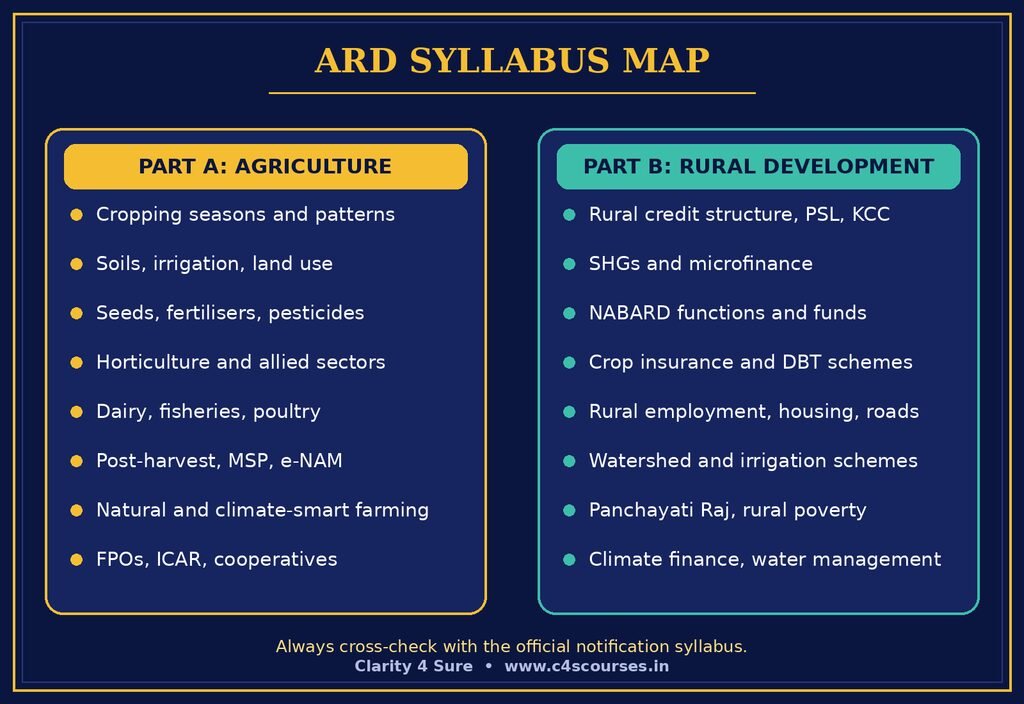
ARD splits into two connected halves. These are the topic clusters to cover. Use the official syllabus as the final checklist.
Part A: Agriculture
- Indian agriculture basics: cropping seasons and patterns, major crops and their regions, soils, irrigation, land use
- Inputs: seeds, fertilisers, pesticides, farm mechanisation, soil health management
- Allied sectors: horticulture, animal husbandry, dairying, fisheries, poultry, forestry
- Post-harvest and marketing: storage, warehousing, food processing, MSP, e-NAM, agri-marketing reforms
- Modern and sustainable farming: natural and organic farming, precision agriculture, climate-resilient agriculture, agri-tech and digital agriculture
- Institutions: ICAR, agricultural universities, commodity boards, FPOs and cooperative structures
Part B: Rural Development
- Rural credit and finance: institutional structure of rural credit, priority sector lending, Kisan Credit Card, SHG-Bank Linkage, microfinance
- NABARD itself: functions, funds and facilities, refinance, development role, annual reports
- Government schemes: crop insurance, direct benefit schemes, rural employment, rural livelihoods, rural housing and roads, watershed and irrigation schemes
- Rural governance: Panchayati Raj, rural infrastructure, rural poverty and employment
- Climate and sustainability: climate finance, water management, natural resource management
Where a topic is a scheme, learn four things: objective, beneficiary, funding or structure, and latest update. That one habit covers most scheme questions.
A clean PDF of this page with the C4S header — it opens right away, and the link comes to your WhatsApp too.
Step 1: Build Your Base
Start with understanding, not memorising.
- Read basic agriculture concepts from beginner-level books or class notes. Non-agriculture candidates can start with school-level agriculture material and move up.
- Make a one-page map of ARD with the two halves above and every topic under them. Tick things off as you finish them.
- Learn the vocabulary: kharif, rabi, zaid, MSP, FRP, FPO, SHG, JLG, RIDF and so on. Keep a running glossary.
- Begin a single notes file for ARD. Everything you learn from now on goes into it.
The goal of this stage is that no ARD term sounds unfamiliar.
Go Deep on Schemes and Institutions
This is where most of your marks are made.
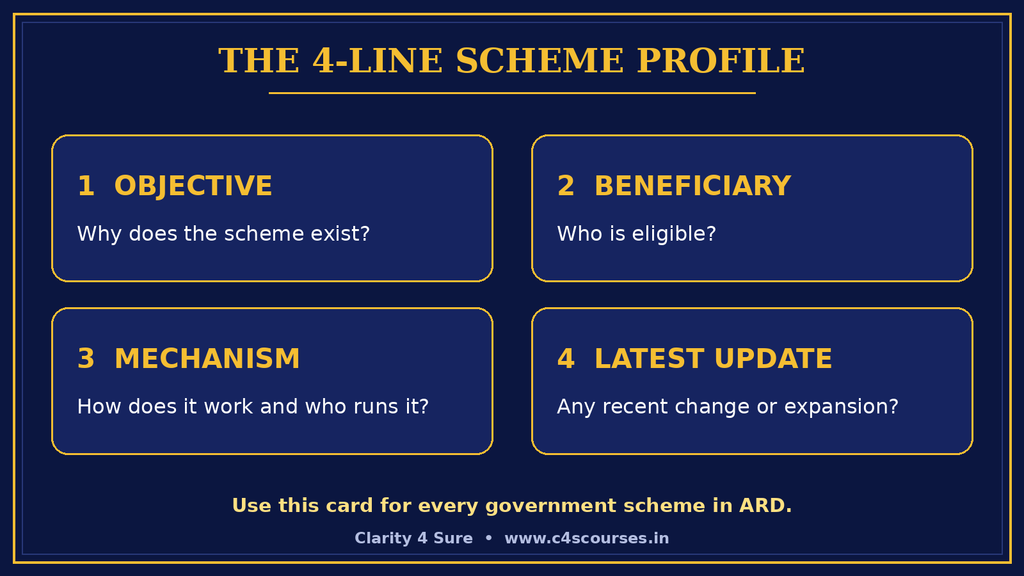
For every government scheme, build a quick profile:
| Field | What to note |
|---|---|
| Objective | Why it exists |
| Beneficiary | Who is eligible |
| Mechanism | How it works and who implements it |
| Latest update | Recent change, expansion or issue |
For NABARD, go beyond definitions. Learn its role in refinance, development, supervision of cooperative banks and RRBs, and its major funds and initiatives. Questions often come from the NABARD annual report and from its flagship publications.
Add data carefully. Keep a short list of key figures (production trends, credit flow, scheme coverage) from the Economic Survey and ministry releases. Update it every time you read a new report, and keep numbers in your notes with their source and year.
Fold Current Affairs Into Your ARD Notes
Do not keep current affairs in a separate file. Add each update under the relevant ARD topic.
- A new crop-insurance change goes under crop insurance.
- A new FPO programme goes under FPOs.
- A new agri-tech initiative goes under modern farming.
This is exactly what ARD questions test: a static concept with a recent example attached. Your notes should look the same way.
Best Sources for NABARD ARD Preparation
You do not need many sources. You need the right ones, revised often.
- NABARD annual report and key publications
- Economic Survey (agriculture and rural chapters)
- Ministry of Agriculture and Rural Development websites and PIB
- Previous year questions
How to Prepare ARD Specifically for Phase 1 (Objective)
- Practise topic-wise MCQs right after finishing each topic.
- Maintain an error log. Write down every wrong answer and the reason: concept gap, careless error or missing fact.
- Learn to eliminate options. Many ARD questions can be narrowed down with solid basics.
- Take sectional ARD tests weekly, then full-length mocks that include ARD under time pressure.
- Revise facts in short cycles. Scheme details and figures fade fast, so revisit them weekly.
How to Prepare ARD for Phase 2 (Descriptive)
Phase 2 asks you to explain, analyse and suggest. A strong ARD answer has a clear structure.
A reliable answer format:
- Introduction: define the topic and set the context with one fact or figure
- Body: challenges, causes, government initiatives, institutional role
- Way forward: practical, specific suggestions
- Conclusion: a forward-looking close
Practice habits that work:
- Write one ARD answer every day, even if short.
- Time yourself. Phase 2 punishes slow writers.
- Get answers evaluated. You cannot see your own structural weaknesses.
- Rewrite your weakest answers. The second draft teaches more than a new topic.
- Build a fodder bank of facts, examples and schemes for common themes: farmer income, credit access, climate resilience, FPOs, women in agriculture, digital agriculture, rural employment.
A Month-Wise ARD Plan
| Period | Focus |
|---|---|
| Months 1 to 2 | Basics, vocabulary, one-page syllabus map, start single notes file |
| Months 3 to 4 | Agriculture and allied sectors in depth, topic-wise MCQs |
| Months 5 to 6 | Rural credit, schemes, NABARD and institutions, begin daily answer writing |
| Months 7 to 8 | Current affairs integration, first full revision, sectional tests |
| Months 9 to 10 | Descriptive intensification, evaluated answers, second revision |
| Final 6 weeks | Revision only, full-length mocks, no new sources |
ARD Preparation for Non-Agriculture Students
You can crack ARD without an agriculture degree. Adjust the approach:
- Start earlier and give ARD more weekly hours than agriculture graduates need.
- Learn the science in plain language. You need to understand crops, soils and irrigation at a working level, not research level.
- Lean on schemes, credit and institutions first. These are the most scoreable areas for any background.
- Ask for simple explanations of unfamiliar concepts instead of skipping them.
- Be consistent. Thirty focused minutes daily beats a weekend marathon.
Common ARD Mistakes to Avoid
- Studying ARD only after the notification. The window between notification and exam is short, so the base must already exist.
- Memorising lists without understanding. You will forget them, and descriptive answers need reasoning.
- Ignoring NABARD’s own publications. The institution’s reports are a direct source.
- Keeping current affairs separate. Integrated notes save time and match the question style.
- Never writing answers. Reading builds knowledge. Writing builds the ability to use it.
- Collecting too many resources. More material is not more preparation.
- Skipping revision. ARD has a large factual load, and only repeated revision keeps it in memory.
A Simple Daily Routine for ARD
- 60 to 90 minutes: new topic study
- 30 minutes: MCQs on that topic
- 30 minutes: current affairs added to ARD notes
- 30 minutes: one descriptive answer
- 15 minutes: quick revision of yesterday’s notes
Adjust the hours to your schedule, but keep all five elements.
Frequently Asked Questions
Is ARD tough for non-agriculture students?
It is manageable with an early start. Focus first on schemes, credit and institutions, then build the agriculture basics around them.
How long does it take to prepare ARD for NABARD Grade A?
Plan for at least six to eight months of steady study for a comfortable result. Less is possible with a focused plan, but depth suffers.
Which book is best for NABARD ARD?
No single book covers everything. Combine a good set of ARD master notes with the NABARD annual report, Economic Survey chapters and ministry or PIB updates.
Should I study ARD and ESI together?
Study them side by side. They overlap in rural economy, poverty, employment and policy, and a combined current affairs file serves both.
How should I revise ARD notes?
Revise in cycles: weekly for new facts, monthly for each unit, and a full revision twice before mocks begin.
Is ARD preparation useful for other exams?most asked
Yes. Agriculture, rural economy and policy overlap with IBPS AFO, UPSC IFoS and other agriculture-facing exams.
Conclusion
ARD rewards the aspirant who starts early, reads fewer sources more often, folds current affairs into one set of notes and writes answers under evaluation. The syllabus is public. What decides the result is how many times you have revised it and how many answers you have written.
Start your ARD map this week, and when the NABARD Grade A 2027 notification arrives, you will already be ahead.