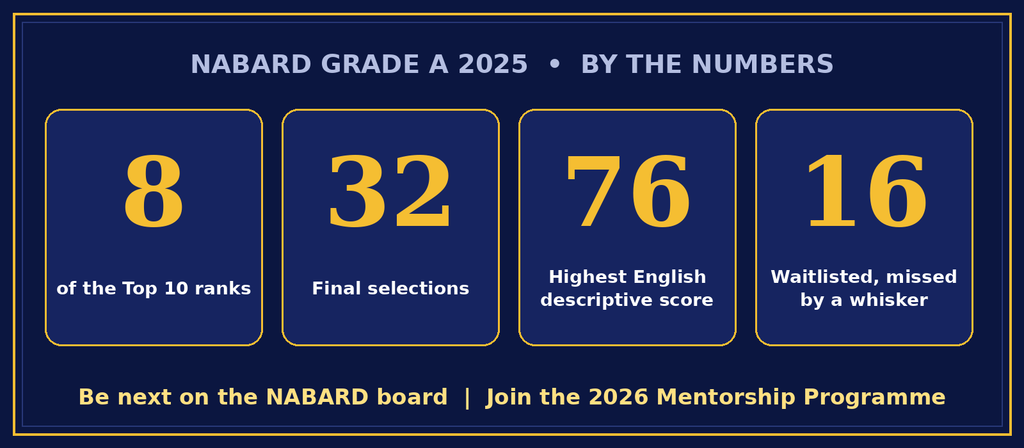
In NABARD Grade A 2025, the “giants” were the long syllabus, the descriptive paper and the Phase I cutoff. The giant killers were aspirants with a schedule and the discipline to follow it. When the final result was declared in May 2026, eight of the top ten ranks (Ranks 1, 2, 3, 5, 6, 7, 8 and 9) belonged to students of Clarity4Sure (C4S), along with 32 final selections as Assistant Manager. Here is who they are and what they did differently.
NABARD Grade A at a Glance
NABARD Grade A (Assistant Manager) is one of the most respected entry points into rural and agricultural finance in India. The selection runs in three stages:
- Phase I: an objective online test that screens candidates for the next stage. Reasoning and quantitative aptitude are non-merit sections, while ARD, ESI, English and computer knowledge carry the weight.
- Phase II: descriptive papers, including English writing and a subject-focused descriptive paper on ESI and ARD.
- Interview: a personality and knowledge round that, together with Phase II, decides the final rank.
NABARD Grade A 2025 Toppers: The Top-10 Roll of Honour
NABARD 2021-2024 Cutoff Analysis | What we can Learn? #nabard_grade_a_exam #nabard_cutoffTap to play · from the C4S channel
| Rank | Name |
|---|---|
| 1 | Suraj Ravindra Jatkar |
| 2 | Lokesh Ram Chandran |
| 3 | Vivek Ghadge |
| 5 | Kapil Patlya |
| 6 | Mohit Soni |
| 7 | Siddhant Kesharwani |
| 8 | Nithin Chacko |
| 9 | Lalit Kumar |
Most of them came through the NABARD Mentorship Programme. They did not start with a secret syllabus, only with a better routine: daily targets, daily MCQs, evaluated descriptive answers and a fixed revision cycle.
A clean PDF of this page with the C4S header — it opens right away, and the link comes to your WhatsApp too.
What Does a 182+ Score Really Take?
Free live session
NABARD Grade A 2026: 45-Day Final Revision Plan + Daily Targets
 🔒 Register to watchLast Sunday’s session · recording
In 8 days · Sun, 25 Oct at 7:30 PM IST
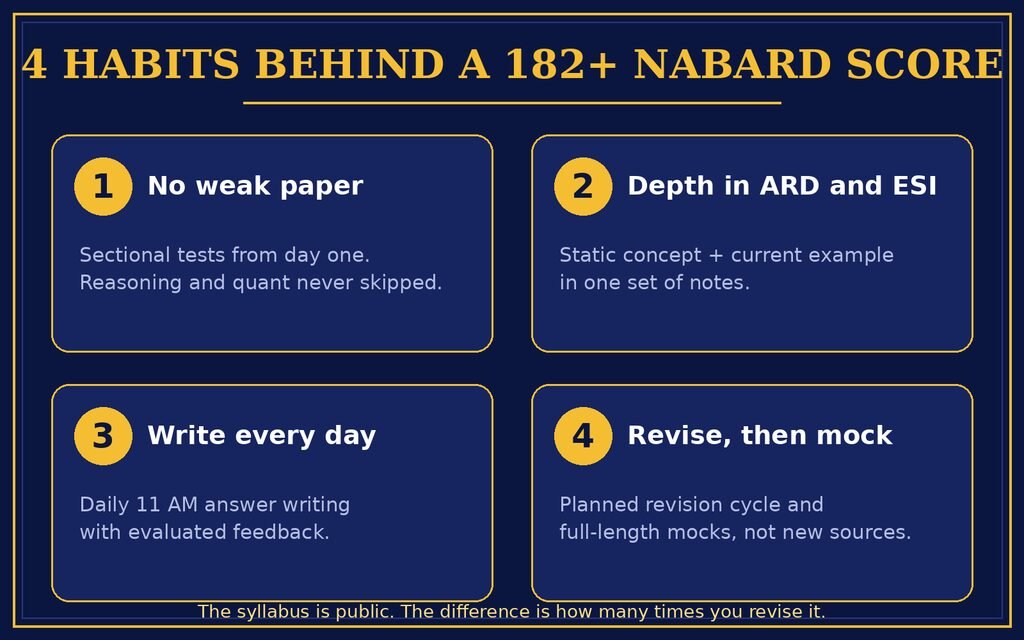
A score this high is rarely the result of one brilliant paper. It comes from having no weak paper. When the top ranks are separated by a few marks, the candidate who slips is usually the one who treated a section as optional.
1. Don’t Ignore the Sections Nobody Enjoys
Reasoning and quantitative aptitude are non-merit, but they decide who reaches the next stage. The toppers cleared them early and kept them sharp with regular sectional tests instead of panicking in the last month.
2. Go Deep on ARD and ESI
Agriculture and Rural Development (ARD) carries the largest specialised weight and appears in both phases. Read the NABARD model projects, schemes and reports, and cover rural credit, SHGs, FPOs and cooperatives. Don’t depend on one-liners.
Economic and Social Issues (ESI) rewards the candidate who attaches a current example, a budget figure or a survey number to a static concept. That is why reading economics and current affairs separately doesn’t work. Fold them into one set of notes.
3. Treat Descriptive Writing as a Skill
Phase II punishes anyone who starts writing only after Phase I results. The toppers wrote daily, got feedback and reworked their answers until the structure held. Essays and letters need fodder collected over months, not assembled in a week.
4. Choose Revision Over New Material
In the last six weeks, a new source usually costs more than it returns. Chapter-wise tests and full-length mocks in the real exam pattern are what turn reading into recall under time pressure.
The syllabus is public. The difference is how many times you have revised it and how many answers you have written under evaluation.
Stories That Prove the System
Prashant Nagar, 76 in English descriptive. Most aspirants fear the English descriptive paper. Prashant scored 76, the highest in the C4S cohort, by writing at the daily 11 AM session, submitting for evaluation and rewriting the same essay until it worked. He is now a NABARD Grade A officer and also converted IBPS AFO and DDA Section Officer.
Amit Kumar, two services in one year. He cleared NABARD Grade A 2025 and UPSC IFoS 2025 in the same cycle. Agriculture, rural economy, environment and current affairs overlap across both exams, so a deep base serves more than one goal.
Siddhi Pandurang Jagdale, a double selection. She cleared NABARD Grade A and IBPS AFO in the same cycle. Her shared ARD base, current affairs reading and writing practice meant the work compounded instead of splitting.
How to Score High in English Descriptive
English descriptive is the paper where many candidates lose marks they assumed were safe. Prashant Nagar’s 76 shows what steady practice can do. These habits make the difference:
- Plan before you write. Spend the first two minutes on a skeleton: introduction, two or three body points, conclusion.
- Keep paragraphs short. A checker scans quickly, and clear paragraphs make your structure visible.
- Use simple, correct language. Clarity scores better than ornate vocabulary used wrongly.
- Collect fodder over months. Keep a notebook of facts, examples and short quotes for common essay themes such as agriculture, climate, financial inclusion, technology and rural development.
- Rewrite the same essay. The second and third drafts teach more than ten new topics.
- Practise letters and precis too. They are shorter, but they reward format discipline.
The Full Scoreboard
- 32 final selections from the mentorship and test series
- 12 more from the interview programme
- 16 on the waitlist, “missed by a whisker”
What a Complete NABARD Grade A Course Should Include
If you are still choosing where to prepare, check for these:
- Mentorship: daily targets, live lectures with recordings, concise notes, ARD master notes and mentor support
- Phase I: a three-level MCQ test series, 200-mark full-length mocks, PYQ analysis and non-merit mocks
- Phase II: daily answer writing, brainstorming sessions, individual evaluation and essay and letter fodder
- Current affairs: ARD, PIB and report coverage, plus a decision-making master class
Five Mistakes That Cost NABARD Aspirants Marks
- Skipping the non-merit sections. They do not add to your merit score, but a weak paper can still stop you from reaching Phase II.
- Reading current affairs and static topics separately. ESI and ARD questions reward candidates who connect a concept to a recent scheme, report or figure.
- Starting descriptive practice after Phase I. The gap between Phase I and Phase II is short. Writing speed and structure take months to build.
- Collecting resources instead of revising them. Three sources read three times beat ten sources read once.
- Taking mocks without analysis. A mock is only useful if you study why each mistake happened.
FAQs
- How do I choose the best coaching for NABARD Grade A?
Look for verifiable results with candidate names, in-depth ARD and ESI teaching, individually evaluated descriptive answers, and a test series that follows the actual exam pattern. - How important is ARD in NABARD Grade A?
Very. It carries the largest specialised weight and appears in both Phase I and Phase II. - Can preparation help with other exams?
Yes. Agriculture, rural economy and current affairs overlap with exams like IBPS AFO and UPSC IFoS, as the double selections above show. - What should a complete course for NABARD Grade A include? It should cover Phase I and Phase II together: ARD and ESI in depth, a test series that follows the exam pattern, daily descriptive writing with individual evaluation, current affairs integration, revision and interview preparation.
- How important is ARD in the NABARD Grade A exam? ARD carries the largest specialised weight and appears in both phases. Agriculture graduates can build a strong lead here, and non-agriculture candidates need to give it extra time from the start.
- What is ESI in the NABARD exam? ESI stands for Economic and Social Issues. It covers growth, inflation, fiscal and monetary policy, poverty, employment, social sector schemes and environmental topics. Questions usually link a static concept with a current example.
- How many marks are needed to clear NABARD Grade A? Cutoffs change every year by category and stage, so there is no fixed number. Review the previous years’ official cutoffs and aim to score comfortably above them in every section, not just the strong ones.
- Can working professionals prepare for NABARD Grade A? Yes. A fixed daily schedule, recorded lectures, weekend mocks and a single set of notes make it manageable alongside a job.
- Is NABARD Grade A preparation useful for other exams? Yes. Agriculture, rural economy, environment and current affairs overlap with IBPS AFO, UPSC IFoS, DDA Section Officer and other agriculture-facing exams, as the double selections in this blog show.
- When should I start descriptive practice? From the beginning. Even a few lines a day builds the speed and structure Phase II demands.
- How many mock tests should I take? Quality matters more than count. Take regular sectional tests, then full-length mocks in the last weeks, and analyse each one in detail.
Your Name Could Be Next
Selection is not built in one perfect day. It is built through ordinary days of discipline: one test, one revision and one improved answer at a time. If you are aiming for the NABARD Grade A 2026 exam, start the routine today and let the system carry you.
Join the NABARD Grade A 2026 Mentorship Programme at C4S.