India’s agricultural sector plays a vital role in supporting rural livelihoods, strengthening economic resilience, and ensuring national food security. Agriculture and allied activities contribute nearly one-fifth of India’s Gross Value Added (GVA) at current prices, employ around 46.1% of the workforce, and support nearly 55% of the population, highlighting the sector’s major socio-economic importance. Over the past five years, the sector has recorded an average annual growth rate of around 4.4% at constant prices, driven by improved farming practices, greater use of technology, better input management, and more resilient agricultural production systems.
Key Takeaways
- Record Foodgrain Production: India recorded an all-time high foodgrain production of 357.73 million tonnes (MMT) in 2024-25. Horticulture production also reached 362.08 million tonnes, highlighting the growing importance of high-value crops in Indian agriculture.
- Strong Position in Global Food Production: India continues to be one of the world’s leading agricultural producers. In 2024-25, the country produced around 150.18 million tonnes of rice, 117.94 million tonnes of wheat, 25.68 million tonnes of pulses, and 18.59 million tonnes of millets, strengthening India’s contribution to global food security.
- Growth in Agricultural Exports: India’s agricultural exports increased from USD 34.5 billion in FY 2020 to USD 51.1 billion in FY 2025. The share of processed food products also increased to 20.4%, showing a shift towards value-added agricultural products and food processing.
- Higher Government Spending on Agriculture: The government’s budget allocation for agriculture has increased significantly, from ₹21,933 crore in 2013-14 to ₹1.30 lakh crore in 2026-27. This reflects the continued focus on improving agricultural infrastructure, farmer welfare, productivity and rural development.
- PM-KISAN and Crop Insurance Support: Under PM-KISAN, more than ₹4.27 lakh crore has been disbursed through 22 instalments, providing direct financial support to farmers. At the same time, crop insurance claims have crossed ₹1.90 lakh crore, strengthening farmers’ protection against crop losses and agricultural risks.
Introduction
In 4 daysNABARD Grade A 2026: what the 2025 cut-offs changed, and the 60-day planRegister free →NABARD 2021-2024 Cutoff Analysis | What we can Learn? #nabard_grade_a_exam #nabard_cutoffTap to play · from the C4S channel
In the agricultural year 2024-25, India recorded a record foodgrain production of 357.73 million metric tonnes (MMT), an increase of 25.43 MMT over the previous year. This growth reflects improvements in agricultural productivity, input management, and institutional support for farmers. The increase was mainly driven by higher production of rice, wheat, maize, and coarse cereals, including millets, which are promoted as Shree Anna.
At the same time, horticulture has emerged as a key driver of agricultural growth and value addition. Total horticulture production reached 362.08 million tonnes (MT) in 2024-25, reflecting the growing importance of high-value crops. According to the second advance estimates, horticulture production increased from 280.70 million tonnes in 2013-14 to 367.72 million tonnes in 2024-25. This includes approximately 114.51 million tonnes of fruits, 219.67 million tonnes of vegetables, and 33.54 million tonnes of other horticultural crops. The steady growth in foodgrain and horticulture production highlights India’s strengthening agricultural base and its growing role in the global agri-food system.
India in Global Agricultural Markets
India’s agricultural exports have grown steadily in recent years. Agricultural export earnings increased from USD 34.5 billion in FY20 to USD 51.1 billion in FY25, registering a CAGR of 8.2%. In FY25, agri-food exports, including processed food products, stood at USD 49.43 billion, accounting for around 11.2% of total exports. The share of processed food exports has also increased consistently, rising from 14.9% in FY18 to 20.4% in FY25. This reflects a gradual shift towards higher value-added agricultural products in India’s export basket.
These trends highlight the growing importance of processed and diversified agricultural products in improving India’s export competitiveness while creating new opportunities in agricultural production, food processing, and global market integration. India holds a strong position in global agriculture, supported by diversified production systems and region-specific strengths across cereals, pulses, horticulture, and plantation crops. With the second-largest agricultural land area in the world, India is a major global producer of several agricultural commodities, reflecting the scale and diversity of its agricultural production.
Rice and Wheat: India is the world’s second-largest producer of rice and wheat, with production reaching 150.18 million tonnes of rice and 117.94 million tonnes of wheat in 2024-25. Rice production is mainly concentrated in Uttar Pradesh, Telangana, and West Bengal, while Uttar Pradesh, Madhya Pradesh, and Punjab are among the leading wheat-producing states. This highlights the geographical concentration of cereal production in India.
Pulses and Millets: India is the world’s leading producer of pulses, recording 25.68 million tonnes of pulse production in 2024-25. Madhya Pradesh, Maharashtra, and Rajasthan are the major pulse-producing states. India also ranks first globally in millet production, producing approximately 18.59 million tonnes in 2024-25, with Rajasthan, Maharashtra, and Karnataka being major producing states.
In terms of agricultural trade, rice exports reached USD 12.95 billion in 2024-25, while exports of pulses and millets stood at USD 855 million and USD 59.20 million, respectively. These figures highlight the growing global demand for diversified and climate-resilient crops and reinforce India’s important role in global food and nutrition security.
India’s Global Position in Horticulture
Fruits and Vegetables: India is the world’s second-largest producer of fruits and vegetables, with production reaching 114.51 million tonnes of fruits and 219.67 million tonnes of vegetables in 2024-25. Fruit production is mainly concentrated in Andhra Pradesh, Maharashtra, Uttar Pradesh, Gujarat, Karnataka, and Tamil Nadu, while Uttar Pradesh, West Bengal, Madhya Pradesh, Bihar, and Gujarat are the leading vegetable-producing states. Fruit and vegetable exports stood at USD 1,818.56 million in 2024-25, highlighting the growing contribution of high-value horticultural crops to India’s agricultural exports and global market integration.
Dry Onion: India ranks first globally in dry onion production, contributing nearly 25% of the world’s total output. Major production comes from Maharashtra, Madhya Pradesh, and Gujarat.
Sugarcane: India is the world’s second-largest producer of sugarcane, with production reaching 454.61 million tonnes in 2024-25. Uttar Pradesh and Maharashtra are the major sugarcane-producing states.
Cotton: India is the world’s second-largest cotton producer, with output estimated at around 5.05 million tonnes (converted from bales) in 2024-25. Cotton production is mainly concentrated in Karnataka, Maharashtra, and Gujarat. On the trade front, despite global tariff-related challenges, India’s cotton exports to the USA during January-October 2025 were valued at USD 31.31 billion, indicating relative stability in export performance amid changing international market conditions.
Tea: India ranks second globally in tea production, with output reaching 1.203 million tonnes during April-December 2024-25. Tea production is concentrated in Assam, West Bengal, Tamil Nadu, Kerala, and Karnataka. Tea exports during April-October 2025-26 stood at USD 605.90 million, registering a 15.16% increase over the corresponding period of the previous year.
Spices: India continues to be the world’s leading producer of spices, with total production reaching 12 million metric tonnes in 2023-24. Major spice-producing states include Madhya Pradesh, Gujarat, and Andhra Pradesh. India’s spice exports reached USD 4.52 billion in FY25, highlighting the country’s strong presence in the global spice market.
Coconut: India ranks first globally in coconut production, with annual output of approximately 21.3 billion nuts. Coconut exports were valued at USD 513 million in 2024-25, reflecting continued international demand for Indian coconut products.
Coffee: India produces around 0.36 million tonnes of coffee annually, with nearly 70% of production exported to 128 countries. Karnataka, Kerala, and Tamil Nadu are the principal coffee-producing states. During April-October FY 2025-26, India’s coffee exports reached USD 1,176.31 million, an increase of approximately 12% compared with the corresponding period of the previous year.
Therefore, India’s diversified commodity base and geographically balanced production systems strengthen its role in stabilising global food supply chains. The integration of improved production practices with expanding export markets reflects a transition towards resilient agriculture that boosts economic growth while promoting long-term environmental balance.
From Input Support to Resilient Growth: India’s Productivity-Led Agricultural Strategy
India’s agricultural development strategy is increasingly focused on improving productivity through efficient use of farm inputs, adoption of modern technology, and sustainable farming practices. Key government initiatives such as the National Food Security and Nutrition Mission, Mission for Aatmanirbharta in Pulses, and National Mission on Edible Oils–Oil Palm and Oilseeds, along with better agricultural extension services and institutional credit support, are helping transform the sector. These initiatives aim to increase farm productivity, reduce import dependence, improve farmer incomes, and build a more resilient and sustainable agricultural sector.
The National Food Security and Nutrition Mission (NFSNM), formerly known as the National Food Security Mission (NFSM), is a centrally sponsored scheme focused on increasing the production of rice, wheat, pulses, and nutri-cereals/coarse cereals in India.
The Mission for Aatmanirbharta in Pulses (2025–31) aims to make India self-sufficient in pulses by increasing domestic production, reducing dependence on imports, and strengthening the country’s goal of an Aatmanirbhar Bharat in pulses.
The National Mission on Edible Oils (NMEO), which includes National Mission on Edible Oils–Oil Palm (NMEO-OP) and National Mission on Edible Oils–Oilseeds (NMEO-Oilseeds), aims to increase India’s self-reliance in edible oil production by 2030-31. The initiatives focus on expanding cultivation, improving productivity through quality seeds and modern technology, increasing farm incomes, and reducing the country’s dependence on edible oil imports.
Quality Seeds and Soil Health:
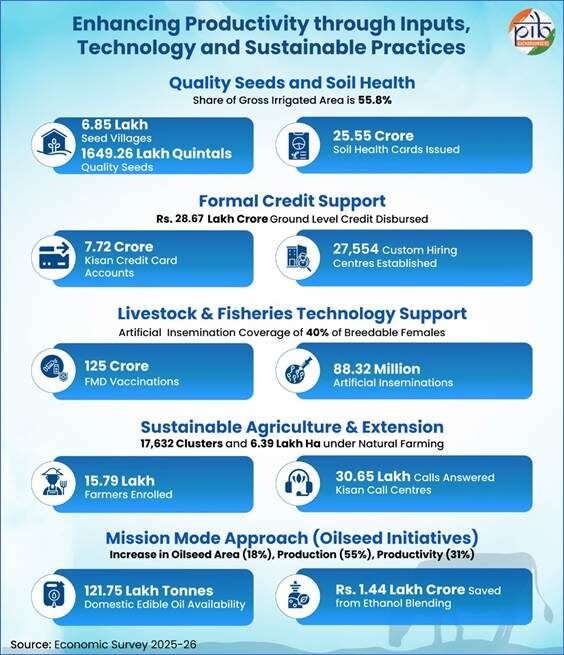
- Under the Sub-Mission on Seeds and Planting Materials (SMSP), a centrally sponsored scheme under the Green Revolution – Krishonnati Yojana, around 6.85 lakh Seed Villages have been established, leading to the production of approximately 1,649.26 lakh quintals of quality seeds.
- As of mid-November 2025, around 25.55 crore Soil Health Cards had been issued to farmers, helping promote balanced and site-specific nutrient management and improve long-term soil health.
- Under the Pradhan Mantri Krishi Sinchayee Yojana (PMKSY), the share of gross irrigated area has increased to 55.8%, reflecting progress in expanding irrigation coverage and improving water-use efficiency in agriculture.
The Sub-Mission on Seeds and Planting Materials (SMSP) aims to increase the availability of certified and quality seeds, improve the seed replacement rate, and strengthen the quality of farm-saved seeds. It also focuses on modernising seed production, processing, testing, and storage infrastructure while promoting advanced technologies across the seed value chain.
A Soil Health Card provides farmers with information about the condition of their soil based on 12 key parameters, including Nitrogen, Phosphorus, Potassium, Sulphur, Zinc, Iron, Copper, Manganese, Boron, pH, Electrical Conductivity, and Organic Carbon. Issued once every two years, it helps farmers choose suitable fertilisers and soil treatments, supporting better nutrient management and long-term soil health.
The Pradhan Mantri Krishi Sinchayee Yojana (PMKSY) focuses on improving water-use efficiency on farms by promoting irrigation methods such as drip and sprinkler irrigation. It also supports small-scale water storage, water conservation, and micro-irrigation measures to improve water availability and promote sustainable agriculture.
Credit, Mechanisation and Technology
- Agricultural credit disbursement reached ₹28.67 lakh crore in FY 2024-25, reflecting the continued expansion of institutional finance and formal credit support for the farm sector.
- As of 31 March 2025, around 7.72 crore operative Kisan Credit Card (KCC) accounts were in operation, improving farmers’ access to timely, affordable, and flexible agricultural credit.
- Between 2014-15 and 2025-26, a total of 27,554 Custom Hiring Centres (CHCs) were established to improve small and marginal farmers’ access to agricultural machinery and farm mechanisation services. A Custom Hiring Centre is a facility equipped with farm machinery, implements, and equipment that farmers can hire as required.
- The livestock sector has also benefited from large-scale technology and animal health interventions. Around 125 crore vaccinations against Foot and Mouth Disease (FMD) have been administered since 2020, while 88.32 million artificial inseminations were carried out during 2024-25, supporting livestock productivity and improving animal health.
The Kisan Credit Card (KCC) Scheme helps meet the financial needs of farmers at different stages of agricultural activities. It provides adequate and timely credit through the banking system under a single-window facility, with a flexible and simplified process. KCC credit covers various needs, including crop cultivation, post-harvest expenses, investment in agriculture and allied activities, produce marketing loans, household consumption requirements, and working capital for maintaining farm assets and allied agricultural activities.
Sustainable Agriculture, Extension, and Mission Mode Initiatives
- Natural farming has expanded to 17,632 clusters covering around 6.39 lakh hectares, with 15.79 lakh farmers enrolled, supporting the adoption of more sustainable and resource-efficient farming practices.
- Kisan Call Centres handled approximately 30.65 lakh farmer queries during 2024-25, providing farmers with timely access to agricultural information, advice, and technical support.
- The oilseed mission recorded significant growth between 2014-15 and 2024-25, with oilseed cultivation area increasing by more than 18%, production rising by nearly 55%, and productivity improving by around 31%.
- Domestic edible oil availability reached 121.75 lakh tonnes in 2023-24, reflecting improvements in domestic oilseed production and edible oil availability.
- Ethanol blending helped save more than ₹1.44 lakh crore in foreign exchange as of August 2025, highlighting the contribution of biofuel adoption towards reducing import dependence.
These initiatives reflect India’s growing shift towards technology-driven, resource-efficient, and sustainable agricultural practices, helping improve farm productivity, reduce resource dependence, and strengthen the resilience of the agriculture sector.
A clean PDF of this page with the C4S header — it opens right away, and the link comes to your WhatsApp too.
Integrated Support for Farmers’ Welfare, Risk Management, and Collective Action
Securing stable farm incomes, reducing agricultural risks, and strengthening cooperative institutions are important for improving farmer resilience and sustaining agricultural growth amid increasing climate and market-related challenges.
Price and Income Support
- Minimum Support Price (MSP) is announced for 22 mandated crops and is fixed at least 1.5 times the cost of production. MSPs have also been increased for the Kharif Marketing Season (KMS) 2025-26 and Rabi Marketing Season (RMS) 2026-27.
- Under Pradhan Mantri Kisan Samman Nidhi (PM-KISAN), more than ₹4.27 lakh crore has been disbursed through 22 instalments as of 17 March 2026, providing direct income support to eligible farmers.
- The Pradhan Mantri Kisan Maandhan Yojana (PMKMY) had enrolled 24.95 lakh farmers as of 2 February 2026, expanding social security coverage for small and marginal farmers.
The Pradhan Mantri Kisan Samman Nidhi (PM-KISAN) is a Central Sector Scheme that provides annual financial assistance of ₹6,000 to each eligible farmer family. The amount is transferred through Direct Benefit Transfer (DBT) in three equal instalments of ₹2,000 into Aadhaar-seeded bank accounts.
The Pradhan Mantri Kisan Maandhan Yojana (PMKMY) provides a social security and pension support system for small and marginal farmers. Under the scheme, eligible farmers receive a minimum fixed pension of ₹3,000 per month after attaining 60 years of age, subject to applicable conditions. It is a voluntary and contributory pension scheme for farmers entering between 18 and 40 years of age.
Crop Insurance Protection
- The Pradhan Mantri Fasal Bima Yojana (PMFBY) insured 4.19 crore farmers during 2024-25, covering approximately 6.2 crore hectares of farmland.
- Since 2016-17, more than 86 crore applications have been processed under the scheme, with crop insurance claims exceeding ₹1.90 lakh crore being disbursed.
- Crop insurance coverage increased by 32% compared with 2022-23, strengthening farmers’ protection against climate-related and agricultural risks.
The Pradhan Mantri Fasal Bima Yojana (PMFBY) provides financial protection to farmers against crop losses caused by natural disasters, drought, hailstorms, floods, pests, and diseases. The scheme offers crop insurance at affordable premiums through a network of insurance companies and banks.
Strengthening Cooperatives and Collective Systems
- Out of 67,930 Primary Agricultural Credit Societies (PACS) identified for computerisation, 54,150 have been onboarded onto Enterprise Resource Planning (ERP) platforms, with 43,658 PACS operational.
- A total of 18,183 new multipurpose cooperative societies were registered by March 2025, strengthening grassroots-level cooperative institutions.
- A decentralised grain storage programme is operational in 11 PACS, while 500 new godowns were announced in 2024 to expand local agricultural storage capacity.
- Institutional initiatives such as the National Cooperation Policy and Tribhuvan Sahkari University aim to improve cooperative governance, institutional capacity, and skill development.
Together, these measures are helping strengthen farmer income security, crop insurance coverage, cooperative institutions, and collective market access, thereby improving the resilience and long-term sustainability of India’s agricultural economy.
Market Reforms, Value-Chain Modernisation, and Public Food Distribution
India is focusing on improving food management, market infrastructure, storage, food processing, and value addition to make the journey from farm to market more efficient. Investments in storage facilities, processing units, digital agricultural markets, and public distribution reforms are helping improve supply chains, control price fluctuations, and ensure better returns for farmers. Together, these measures are creating a more efficient, transparent, and integrated food system that benefits both farmers and consumers.
Market Linkages and Infrastructure
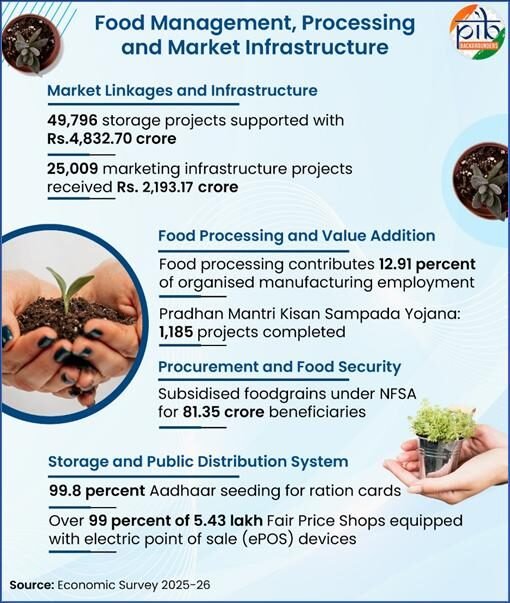
Investment in agricultural markets and post-harvest infrastructure has helped strengthen supply chains and connect farmers with formal markets. As of 28 February 2026, 49,796 storage projects had received financial assistance of ₹4,832.70 crore, while 25,009 marketing infrastructure projects received subsidies of ₹2,193.17 crore.
The e-National Agriculture Market (e-NAM) has expanded to 1.8 crore farmers, 2.72 lakh traders, and 4,724 Farmer-Producer Organisations (FPOs) across 1,656 mandis in 23 States and 4 Union Territories. It helps farmers get better access to markets, transparent price information, digital bidding, and online payments.
The e-NAM is a pan-India digital platform that connects existing Agricultural Produce Market Committee (APMC) mandis through a common online marketplace. It supports the vision of “One Nation, One Market” by providing services such as commodity arrivals, quality testing, e-bidding, and direct e-payment. This improves transparency and efficiency in agricultural marketing while helping farmers access wider markets.
Under the Formation and Promotion of 10,000 FPOs Scheme, launched in 2020, 10,000 Farmer-Producer Organisations had been registered by 28 February 2026. In the fisheries sector, 2,195 Farmers’ Fisheries Producer Organisations (FFPOs) have been formed, while 4.39 lakh fishers have received access to Kisan Credit Card benefits, improving institutional credit access and strengthening the sector.
Food Processing and Value Addition
The food processing sector is an important part of India’s manufacturing economy and accounts for 12.91% of organised manufacturing employment. Under the Pradhan Mantri Kisan Sampada Yojana (PMKSY), 1,185 projects had been completed as of 30 November 2025, strengthening modern food processing and cold-chain infrastructure.
The Production Linked Incentive Scheme for the Food Processing Industry (PLISFI) approved 169 applications, attracting investments of ₹9,207 crore. Incentives worth ₹2,162.55 crore had been disbursed by 31 December 2025, supporting investment and competitiveness in the food processing industry.
The Pradhan Mantri Formalisation of Micro Food Processing Enterprises Scheme (PMFME) supported 4,04,062 applications and facilitated 1,72,707 loans, with term lending of ₹14.19 thousand crore. It also provided ₹1,277.45 crore in seed capital assistance to women Self-Help Groups as of 31 December 2025, helping promote local food processing, value addition, and small-scale entrepreneurship.
The Pradhan Mantri Kisan Sampada Yojana (PMKSY) focuses on developing modern infrastructure for the food processing sector and creating an efficient supply chain from the farm gate to retail markets. It helps reduce post-harvest losses, improve farmers’ price realisation, promote value addition, create rural employment, and strengthen India’s processed food exports.
The Production Linked Incentive Scheme for the Food Processing Industry (PLISFI) provides financial incentives to encourage investment, modernisation, and greater competitiveness in food processing, particularly in food products with high growth and value-addition potential.
The Pradhan Mantri Formalisation of Micro Food Processing Enterprises Scheme (PMFME) is a Centrally Sponsored Scheme that supports the formalisation and upgradation of micro food-processing enterprises and promotes the role of groups, Self-Help Groups, and cooperatives in developing the sector.
Procurement and Food Security
The Central Government procures foodgrains to maintain food security and provide price support to farmers through the Minimum Support Price (MSP) system. Recent procurement figures include:
- RMS 2025-26 (Wheat): 300.35 LMT procured, benefiting 25.13 lakh farmers.
- KMS 2024-25 (Paddy): 832.17 LMT procured, benefiting 118.59 lakh farmers.
- KMS 2025-26 (Paddy), as of 17 November 2025: 243.48 LMT procured, benefiting 21.22 lakh farmers.
- Coarse Grains/Millets 2024-25: 11.72 LMT procured.
- KMS 2025-26 (Coarse Grains/Millets), as of 16 November 2025: 64,365 MT procured, with procurement ongoing.
The government maintains adequate foodgrain stocks to meet buffer stock requirements, ensure regular supplies through the Public Distribution System (PDS), and intervene in the market when necessary to help stabilise food prices.
Under the National Food Security Act (NFSA), subsidised foodgrains are provided to 81.35 crore beneficiaries, covering up to 75% of the rural population and 50% of the urban population.
Storage and Public Distribution System
The One Nation One Ration Card (ONORC) system has achieved 99.8% Aadhaar seeding of ration cards and is operational across all 36 States and Union Territories. This allows eligible beneficiaries to access their foodgrain entitlements from different locations, improving portability and inclusion.
More than 99% of the 5.43 lakh Fair Price Shops are equipped with electronic Point of Sale (ePoS) devices), helping digitise more than 98% of transactions and improve transparency in foodgrain distribution. In FY24, around ₹267.6 crore was transferred through Direct Benefit Transfer (DBT) to more than 10 lakh beneficiaries.
Overall, these reforms are helping improve agricultural market access, food processing, storage, procurement, and public distribution. They are also reducing inefficiencies, improving transparency, and strengthening food security and farmer-market integration across India.
Conclusion
India’s agricultural transformation reflects a balanced approach that combines strong production growth, rising agricultural exports, and targeted government policies across the entire farm-to-market value chain. Record foodgrain and horticulture production, growing global exports, and India’s strong position in diverse agricultural commodities highlight the sector’s sustainability and ability to adapt to changing economic and climatic conditions.
Government initiatives focused on quality inputs, farmer income support, risk protection, market infrastructure, food processing, and digital agricultural systems are helping improve farm productivity, strengthen farmer welfare, and enhance food security. As India’s agricultural sector continues to adopt more resilient and sustainable production practices, its growing connection with allied activities, food processing, value addition, and global markets can further support rural livelihoods and contribute to long-term economic growth and stability.