PM-AASHA is a government initiative aimed at helping farmers get fair and remunerative prices for their crops. It strengthens the implementation of the Minimum Support Price (MSP) and helps protect farmers from having to sell their produce at very low prices. Under the scheme, pulses, oilseeds and copra are procured by the Central and State Governments through agencies such as NAFED and NCCF.
Introduction
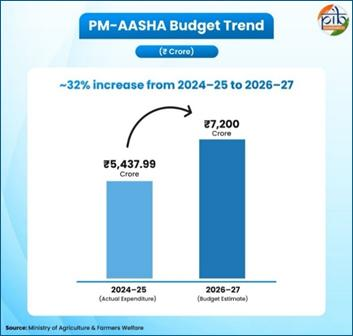
For 2026–27, ₹7,200 crore has been allocated to PM-AASHA to strengthen price-support measures and improve procurement. The use of digital systems such as Aadhaar-based authentication, e-NAM, e-Samriddhi and e-Samyukti has made the procurement process more transparent, faster and efficient. Support from the Agriculture Infrastructure Fund and wider procurement coverage have also helped strengthen the scheme. PM-AASHA helps farmers get better price support for their crops, reduces distress selling, and makes the MSP procurement system more transparent and effective.
Ensuring Remunerative Prices to Farmers
NABARD 2021-2024 Cutoff Analysis | What we can Learn? #nabard_grade_a_exam #nabard_cutoffTap to play · from the C4S channel
The Government has introduced several measures to make sure that farmers, especially small and marginal farmers, get the benefit of the Minimum Support Price (MSP). One of the important initiatives is the Pradhan Mantri Annadata Aay Sanrakshan Abhiyan (PM-AASHA), launched in September 2018. The main aim of PM-AASHA is to help farmers get a fair price for their produce while also keeping food prices stable for consumers.
PM-AASHA brings together different price-support mechanisms under one framework. These mechanisms are used depending on the type of crop and prevailing market conditions. The scheme helps improve MSP procurement and reduces the need for farmers to sell their crops at very low prices due to lack of buyers.
The scheme also helps protect farmers’ incomes while maintaining a balance in food prices for consumers. Before every marketing season, procurement preparations are made in advance. Central agencies and State Governments arrange the necessary infrastructure, staff and procurement facilities so that farmers can sell their produce at the supported price when the crop reaches the market. PM-AASHA is designed to make MSP support more effective by ensuring that procurement arrangements are ready on time, farmers receive better price support, and distress selling is reduced.
A clean PDF of this page with the C4S header — it opens right away, and the link comes to your WhatsApp too.
Policy design and institutional framework
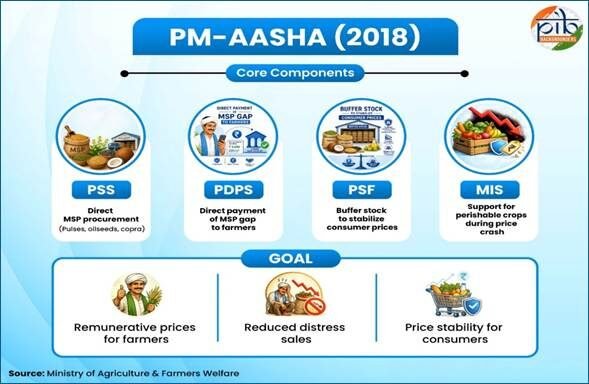
PM-AASHA works through four main components. Each component has a different role in protecting farmers from low prices and helping maintain stability in agricultural markets.
1. Price Support Scheme (PSS)
The Price Support Scheme (PSS) helps farmers when the market price of their crops falls below the MSP during the harvesting season.
It mainly covers pulses, oilseeds and copra. Government agencies such as NAFED and NCCF procure these crops when requested by State Governments.
Farmers must be registered and have valid land records to receive the benefit. This helps ensure that the support reaches genuine farmers and reduces the role of middlemen.
From the 2024–25 procurement year, procurement of pulses, oilseeds and copra under PSS is generally allowed up to 25% of a State/UT’s production. Additional procurement can be approved by the Committee of Secretaries, subject to the specified national limit. For Tur, Urad and Masur, procurement can cover up to 100% of a State’s production to encourage domestic pulse production and reduce dependence on imports.
2. Price Stabilization Fund (PSF)
The Price Stabilization Fund (PSF) aims to protect consumers from sudden increases in the prices of essential agricultural commodities.
Under PSF, commodities such as pulses, onions and potatoes can be purchased and stored as buffer stocks during the harvest season, when prices are usually lower. These stocks can then be released when supplies are low and prices start rising.
PSF has been brought under the broader PM-AASHA framework, while it continues to be managed by the Department of Consumer Affairs.
3. Price Deficiency Payment Scheme (PDPS)
Under the Price Deficiency Payment Scheme (PDPS), the government does not physically purchase the farmer’s produce.
Instead, when the market price is lower than the MSP, eligible farmers receive a payment for the price difference, subject to the applicable limit. The payment is transferred directly to the farmer’s bank account.
The scheme mainly focuses on oilseeds and reduces the need for large-scale government procurement and storage.
4. Market Intervention Scheme (MIS)
The Market Intervention Scheme (MIS) is meant for perishable agricultural and horticultural products for which MSP is generally not applicable.
It can cover commodities such as tomatoes, onions and potatoes when their market prices fall significantly. The scheme is particularly useful when there is a glut, meaning farmers produce more than the market can absorb.
The Centre and State Governments share the cost of intervention, with procurement operations carried out through Central Nodal Agencies such as NAFED and NCCF.
Enhanced Financial Support Under PM-AASHA
The government’s spending on PM-AASHA has increased over the years, showing greater financial support for price-assurance measures.
| Financial Year | Allocation/Expenditure |
|---|---|
| 2024–25 | ₹5,437.99 crore actual expenditure |
| 2025–26 | ₹6,941.36 crore |
| 2026–27 | ₹7,200 crore |
This increasing financial support is aimed at strengthening price protection for farmers, improving procurement operations and reducing the risk of distress sales.
From Cost to Confidence: Strengthening Farmer Remunerative Returns
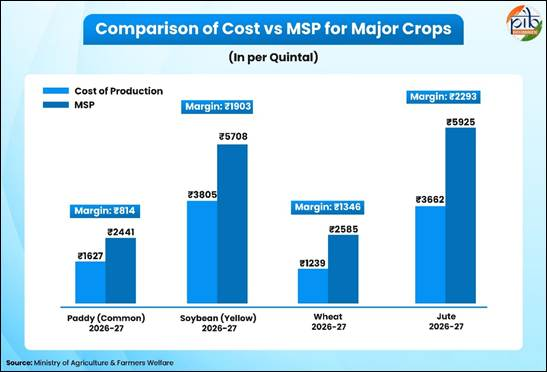
The Minimum Support Price (MSP) is generally kept above the estimated cost of production so that farmers can earn a reasonable return for their crops. Along with schemes such as PM-AASHA, this price support helps farmers deal with falling market prices and provides greater income security.
In 2026–27, the difference between the cost of production and MSP is significant for several major crops:
| Crop | Production Cost (₹/quintal) | MSP (₹/quintal) | Difference |
|---|---|---|---|
| Paddy (Common) | ₹1,627 | ₹2,441 | ₹814 |
| Soybean (Yellow) | ₹3,805 | ₹5,708 | ₹1,903 |
| Wheat | ₹1,239 | ₹2,585 | ₹1,346 |
| Jute | ₹3,662 | ₹5,925 | ₹2,293 |
For example, the MSP of paddy is ₹2,441 per quintal compared with a production cost of ₹1,627, giving a difference of ₹814. For soybean, the difference is ₹1,903 per quintal.
Similarly, wheat has a production cost of ₹1,239 per quintal and an MSP of ₹2,585, resulting in a difference of ₹1,346. Jute has the largest difference among these four crops, with an MSP of ₹5,925 against a production cost of ₹3,662—a difference of ₹2,293 per quintal.
MSP provides farmers with a price cushion above the estimated cost of producing their crops. PM-AASHA further supports this system by improving price assurance and reducing the risk of distress sales. Together, these measures can provide farmers with greater income stability and confidence in continuing agricultural production.
Strengthening Farm-to-Market Connectivity
The Government is taking several steps to improve agricultural markets, storage facilities and post-harvest infrastructure so that farmers can get better prices and reduce losses after harvesting. Two important initiatives are the Agriculture Infrastructure Fund (AIF) and e-NAM.
The Agriculture Infrastructure Fund (AIF) has sanctioned loans of ₹96,426 crore for 2,14,437 projects, helping mobilise investments of more than ₹1,66,179 crore. These investments support the development of facilities such as warehouses, cold storage, processing units and other agricultural infrastructure.
The e-NAM (National Agriculture Market) platform has connected 1,656 mandis across 23 States and 4 Union Territories. It has facilitated agricultural trade worth around ₹4,94,847 crore. The platform has also registered 4,776 Farmer Producer Organisations (FPOs). In addition, 7,334 FPOs have been connected to the Open Network for Digital Commerce (ONDC).
The Government has also sanctioned 50,249 warehouses with a total storage capacity of around 992.6 lakh metric tonnes, along with 25,081 agricultural marketing infrastructure projects. Better storage facilities can help farmers avoid selling their produce immediately after harvest when prices may be low.
Recent PM-AASHA Reforms
PM-AASHA has also introduced several measures to make procurement more transparent and farmer-friendly, including:
- Biometric authentication to verify farmers.
- Direct procurement from farmers who are registered in advance.
- Transportation support for Tomato, Onion and Potato (TOP) crops.
- Price-difference payments under the Market Intervention Scheme when market prices fall significantly.
Securing Farmer Incomes, Strengthening Markets
PM-AASHA has become an important government initiative for helping farmers get better and more stable prices for their produce. Through assured procurement, price support and market interventions, it helps farmers deal with situations where market prices fall sharply.
Under the scheme, important crops such as pulses, oilseeds and copra are procured through agencies like NAFED and NCCF. The expansion of procurement centres has also made it easier for farmers to access markets and sell their produce at supported prices. The use of digital technology and better agricultural infrastructure has made procurement more transparent, efficient and accessible across different states.