Latest current affairs · 14 Oct
Enrol · ₹3,500
Latest current affairs14 Oct
Free live webinar · NABARD Sprint 60: the 2025 cut-offs and your 60-day Phase I plan · Sun, 18 Oct at 7:30 PM ISTJoin free
Skip to content

International Financial Services Centres Authority

5 min read
All exams GA
In one line

In an increasingly globalized world, financial services have expanded beyond national borders, creating a need for dedicated regulatory frameworks to govern cross-border financial transactions. Recognizing this necessity, India established the International Financial Services Centres Authority (IFSCA) to regulate and promote financial services within International Financial Services Centres (IFSCs). This move positions India as a major player in the global financial landscape, attracting investors, businesses, and financial institutions to its shores.

Introduction

What is IFSCA?

NABARD 2021-2024 Cutoff Analysis | What we can Learn? #nabard_grade_a_exam #nabard_cutoffTap to play · from the C4S channel

More on this exam

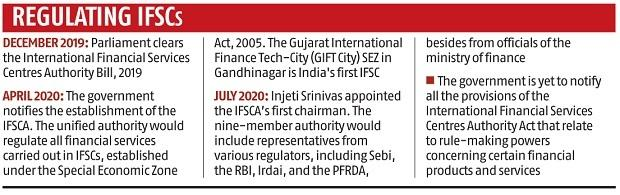
The International Financial Services Centres Authority (IFSCA) is a statutory regulatory body established by the IFSCA Act, 2019. It serves as the unified authority to regulate financial services, products, and institutions in India’s International Financial Services Centres (IFSCs), the first and foremost being GIFT City (Gujarat International Finance Tec-City) in Gujarat.

Prior to IFSCA, multiple regulators such as SEBI, RBI, IRDAI, and PFRDA governed different aspects of financial services in IFSCs. With IFSCA in place, there is now a single-window regulatory approach, ensuring efficiency and streamlined governance.

Free PDF · print or read offline Download this page as a PDF

A clean PDF of this page with the C4S header — it opens right away, and the link comes to your WhatsApp too.

The link opens at once. After that, only study material and course updates. No spam.

Objectives of IFSCA

IFSCA’s primary goal is to establish a world-class financial ecosystem that fosters international trade, innovation, and economic growth. Its key objectives include:

  1. Developing a Global Financial Hub –
    • Positioning IFSCs as competitive global financial centers akin to Singapore, Dubai, and London.
  2. Regulating Financial Services in IFSCs –
    • Supervising banking, insurance, capital markets, asset management, and other financial activities.
  3. Enhancing Ease of Doing Business –
    • Simplifying regulations, ensuring transparency, and reducing compliance burdens for financial institutions.
  4. Encouraging Innovation –
    • Promoting FinTech, green finance, digital banking, and sustainable investment solutions.
  5. Integrating with the Global Financial Market –
    • Facilitating seamless cross-border transactions and collaborations.
  6. Promoting Indian Financial Institutions –
    • Encouraging Indian banks, insurers, and asset managers to expand their global footprint.

Key Functions of IFSCA
International Financial Services Centres Authority 1

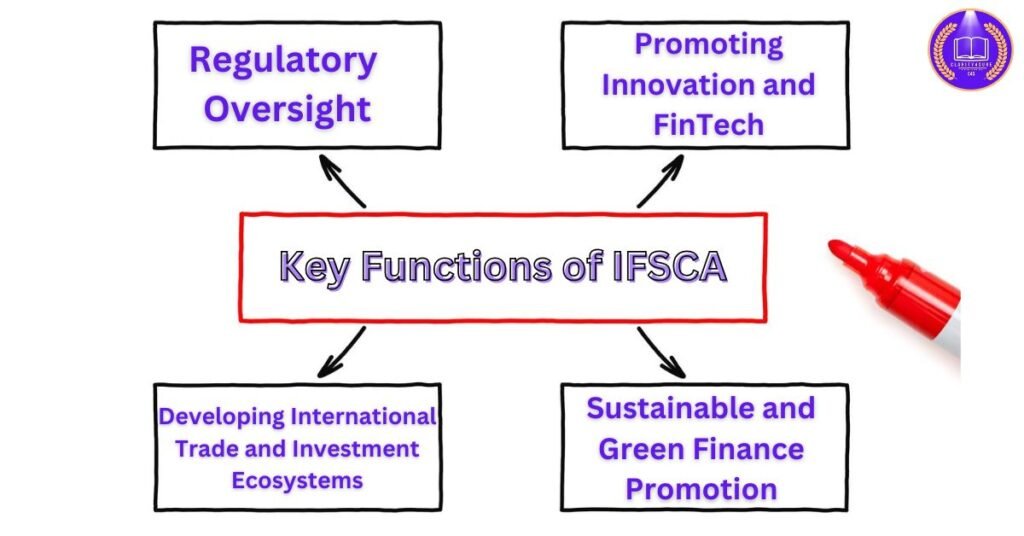
IFSCA is responsible for regulating and promoting financial services within IFSCs. Its key functions include:

1. Regulatory Oversight

  • Formulating and implementing regulations for banking, insurance, securities, and fund management in IFSCs.
  • Ensuring adherence to global best practices in compliance and governance.
  • Issuing licenses to financial institutions operating within IFSCs.

2. Promoting Innovation and FinTech

  • Facilitating the development of FinTech and RegTech (Regulatory Technology) solutions.
  • Establishing regulatory sandboxes for startups to test new financial products.
  • Encouraging the use of blockchain, AI, and big data in financial services.

3. Developing International Trade and Investment Ecosystems

  • Creating a favorable tax regime for global investors.
  • Enhancing cross-border investment flows by reducing capital restrictions.
  • Collaborating with international financial regulators to enhance global integration.

4. Sustainable and Green Finance Promotion

  • Encouraging green bonds and ESG (Environmental, Social, and Governance) investments.
  • Supporting renewable energy and climate finance projects.
  • Partnering with global financial institutions to drive sustainable economic growth.

GIFT City: India’s First IFSC

GIFT City (Gujarat International Finance Tec-City) is India’s first operational IFSC and serves as a hub for offshore banking, capital markets, insurance, and asset management services. IFSCA governs all financial activities within GIFT City, making it a strategic destination for global investors.

Advantages of GIFT City IFSC

  • 100% foreign ownership permitted for financial institutions.
  • Liberalized currency regulations, allowing transactions in foreign currencies.
  • Tax incentives, including exemptions from GST, MAT (Minimum Alternate Tax), and dividend distribution tax.
  • State-of-the-art infrastructure with advanced digital connectivity and smart city features.
  • Strategic location, offering connectivity to global financial hubs.

Key Sectors Regulated by IFSCA

Free live session

NABARD Sprint 60: the 2025 cut-offs and your 60-day Phase I plan

In 3 days · Sun, 18 Oct at 7:30 PM IST

Register free →

IFSCA regulates multiple financial segments, ensuring a comprehensive financial ecosystem within IFSCs. The key sectors include:

1. Banking

  • Permits foreign and domestic banks to set up offshore banking units.
  • Allows financial transactions in foreign currencies without restrictions.
  • Enables trade financing, treasury operations, and global banking services.

2. Capital Markets

  • Oversees stock exchanges, brokerage firms, and commodity trading.
  • Regulates derivative trading, debt markets, and alternative investment funds (AIFs).
  • Facilitates international investment in equity and debt securities.

3. Insurance and Reinsurance

  • Encourages global insurance companies to establish reinsurance businesses.
  • Offers tax and regulatory incentives for offshore insurance operations.
  • Develops a specialized framework for captive insurance companies.

4. Asset and Wealth Management

  • Provides a regulatory framework for mutual funds, portfolio management, and wealth advisory services.
  • Supports the setup of offshore investment funds and alternative investment vehicles.
  • Promotes cross-border investment opportunities.

5. FinTech and Digital Banking

  • Establishes a sandbox environment for testing new financial technologies.
  • Encourages blockchain-based trade finance and digital asset management.
  • Regulates digital banks and neo-banking platforms.

Recent Developments and Initiatives by IFSCA

IFSCA has introduced several initiatives to boost IFSCs in India:

1. IFSCA (Banking) Regulations, 2020

  • Allows Indian and foreign banks to set up International Banking Units (IBUs) in IFSCs.
  • Provides operational flexibility for offshore banking activities.

2. IFSCA FinTech Regulatory Sandbox

  • Enables startups and financial firms to test new FinTech solutions under relaxed regulations.
  • Encourages AI-driven financial services, digital lending, and blockchain adoption.

3. Aircraft Leasing and Financing

  • Promotes aircraft leasing from IFSCs, reducing dependency on global leasing hubs like Ireland and Dubai.
  • Provides tax incentives for aviation finance companies.

4. Unified Regulator for IFSC Capital Markets

  • Consolidates regulatory functions for capital markets under one authority.
  • Ensures seamless market operations and investor protection.

Challenges and Future Prospects

Despite its rapid growth, IFSCA faces certain challenges:

  • Limited Awareness –
    • Global investors and financial institutions need more awareness about India’s IFSC framework.
  • Competition from Global IFSCs –
    • Singapore, Dubai, and Hong Kong offer established financial ecosystems.
  • Regulatory Harmonization –
    • Need for stronger coordination with global financial regulators.

Future Roadmap

  • IFSCA aims to:
    • Expand IFSCs beyond GIFT City to other regions.
    • Enhance tax incentives and ease of business policies.
    • Strengthen international collaborations with leading financial centers.
    • Promote sustainable finance and digital asset management.

Conclusion

The International Financial Services Centres Authority (IFSCA) plays a pivotal role in shaping India’s financial landscape, making the country a global hub for offshore banking, investment, and FinTech innovation. With progressive regulations, state-of-the-art infrastructure, and government support, IFSCA is poised to drive India’s emergence as a key player in the international financial sector.

As India continues to position itself as a preferred destination for global financial services, IFSCA will be instrumental in bridging domestic financial markets with international investors, ensuring long-term economic growth and stability.

Related on Clarity 4 Sure

International Financial Services Centres Authority

International Financial Services Centres Authority 2
Pic Credit: Wikipedia

About

The International Financial Services Centres Authority (IFSCA) is a regulatory body established by the Government of India to oversee and develop financial services in India’s International Financial Services Centres (IFSCs), with the primary focus on promoting and regulating cross-border financial activities. The IFSCA was set up in April 2020 through the enactment of the International Financial Services Centres Authority Act, 2019.

  • Chairperson:
    • Shri K. Rajaraman
  • Ministry:
    •  Ministry of Finance
  • Headquarter:
    • GIFT City, Gandhinagar, Gujarat, India

Origin

NABARD 2021-2024 Cutoff Analysis | What we can Learn? #nabard_grade_a_exam #nabard_cutoffTap to play · from the C4S channel

More on this exam

The International Financial Services Centres Authority (IFSCA) was established on April 27, 2020. The IFSCA was created by the International Financial Services Centres Authority Act, 2019, which was passed by the Government of India.

Free · RBI Grade B Want the free material for your exam?

ESI-FM notes, the monthly current affairs PDF and essay topics — all free, on WhatsApp.

Only study material and course updates. No spam.

Background of IFSCs in India

  • An International Financial Services Centre (IFSC) is a jurisdiction that provides financial services to international clients, serving as a hub for the global financial market.
  • The concept of IFSCs is not new, and several countries have established such centers (e.g., Dubai International Financial Centre, Singapore Financial Centre) to attract international business.
  • In India, the Gift City (Gujarat International Finance Tec-City), located near Gandhinagar, Gujarat, has been designated as the first and primary IFSC.
International Financial Services Centres Authority 3
Pic Credit: Business Standard

Aims of IFSCA

  • Provide a platform for conducting offshore financial services.
  • Attract global financial players.
  • Facilitate the growth of the financial sector in India.
  • Encourage cross-border transactions and capital flows.
  • Reduce the burden of regulatory restrictions for businesses seeking to operate internationally.

Purpose and Objectives of IFSCA

  • Regulate Financial Activities:
    • The IFSCA is tasked with framing and enforcing regulations to govern financial services in IFSCs, ensuring consistency, transparency, and competitiveness in the international financial market.
  • Promote Development:
    • The IFSCA seeks to establish India as an international hub for financial services by promoting business-friendly policies, ease of operations, and global connectivity.
  • Develop a Robust Ecosystem:
    • The authority aims to create an ecosystem that attracts international capital and businesses, including banks, insurance companies, capital markets, and wealth management firms.
  • Enhance Cross-border Financial Flows:
    • By offering a range of international services, the IFSCA hopes to promote free cross-border financial flows, investments, and capital movement between India and the rest of the world.

Key Functions of IFSCA

  • Regulation of Financial Services:
    • The authority ensures that all financial services provided in the IFSC adhere to the highest standards and regulatory norms. It issues guidelines and frameworks for activities like capital market operations, banking, insurance, and asset management.
  • Supervision of Financial Entities:
    • The IFSCA supervises entities operating in IFSCs such as banks, asset managers, stock exchanges, and clearing corporations. It ensures compliance with operational and regulatory standards.
  • Policy Formulation and Implementation:
    • The authority formulates policies to make IFSCs competitive on the global stage. This includes providing attractive fiscal and regulatory incentives to international players.
  • Facilitating Innovation:
    • The IFSCA fosters innovation in financial services by encouraging the development of new financial products, services, and technologies, including fintech solutions.
  • Issuance of Licenses and Approvals:
    • The IFSCA is responsible for issuing licenses to financial institutions and market intermediaries that wish to operate in IFSCs.
  • Dispute Resolution:
    • The authority also plays a role in resolving disputes between parties involved in financial services activities within the IFSCs.

IFSCA and its Regulatory Environment

The IFSCA has established a robust regulatory framework that caters to the distinct needs of IFSCs. It harmonizes international best practices while ensuring the necessary flexibility to accommodate global financial standards. Some of the key areas of regulation include:

  • Capital Markets:
    • The IFSCA has introduced provisions to streamline and strengthen capital market operations, making it easier for foreign investors to participate in Indian markets through the IFSC route.
  • Banking and Financial Products:
    • Regulations are in place to facilitate cross-border banking, wealth management, and private equity operations in the IFSCs.
  • Foreign Investment:
    • The IFSCA has incentivized foreign investments by relaxing certain norms, including tax benefits and compliance exemptions for foreign investors operating through the IFSCs.
  • Fintech Regulations:
    • The IFSCA aims to promote innovation in the financial technology (fintech) sector, providing a favorable regulatory environment for the development of new financial technologies.

Achievements and Developments

  • Growth of GIFT City:
    • Since the establishment of IFSCA, GIFT City has seen significant growth, attracting numerous financial institutions and investors. The city has been actively developing the necessary infrastructure, including data centers, financial services hubs, and residential facilities, to support IFSC operations.
  • Enhanced Foreign Investor Participation:
    • The introduction of favorable policies and regulations has made it easier for foreign investors to access Indian markets through the IFSC, resulting in increased foreign investment inflows.
  • Global Partnerships:
    • The IFSCA has developed relationships with global financial institutions and other international regulatory bodies, further positioning India as a global financial services hub.
  • Financial Instruments and Products:
    • New financial instruments, including derivatives, debt instruments, and structured products, have been developed and introduced in the IFSC, catering to the needs of international investors.
  • Tax and Regulatory Incentives:
    • The IFSCA has worked with the Indian government to provide tax incentives, exemptions from certain regulations, and other benefits to attract global financial businesses.

Challenges Faced by IFSCA

  • Global Competition:
    • IFSCs worldwide are competing for global financial business. GIFT City and other Indian IFSCs must offer more competitive policies and attractive incentives to stand out against established financial hubs like Singapore, Hong Kong, and Dubai.
  • Infrastructure Development:
    • While GIFT City has made significant progress, further infrastructure development is required to match the scale of global financial hubs.
  • Regulatory Gaps:
    • Balancing global standards with India’s domestic regulatory framework remains a challenge. The IFSCA must continuously update its policies to keep pace with global developments and financial innovations.
  • Talent Acquisition:
    • Attracting skilled professionals to work in the IFSC ecosystem is crucial. To remain competitive, India must ensure the availability of highly qualified financial professionals.

Conclusion

  • The International Financial Services Centres Authority (IFSCA) plays a pivotal role in positioning India as a global financial services hub.
  • By developing a strong regulatory framework, offering tax incentives, and fostering innovation, the IFSCA is helping to make India’s IFSCs more attractive to international investors and businesses.
  • With sustained policy reforms, infrastructure development, and global partnerships, the IFSCA is poised to elevate India’s status as a key player in the international financial market.
WhatsApp