A special package of ₹4,800 crore has been dedicated to oil palm cultivation under the NMEO-Palm Oil (NMEO-OP) initiativ
Introduction
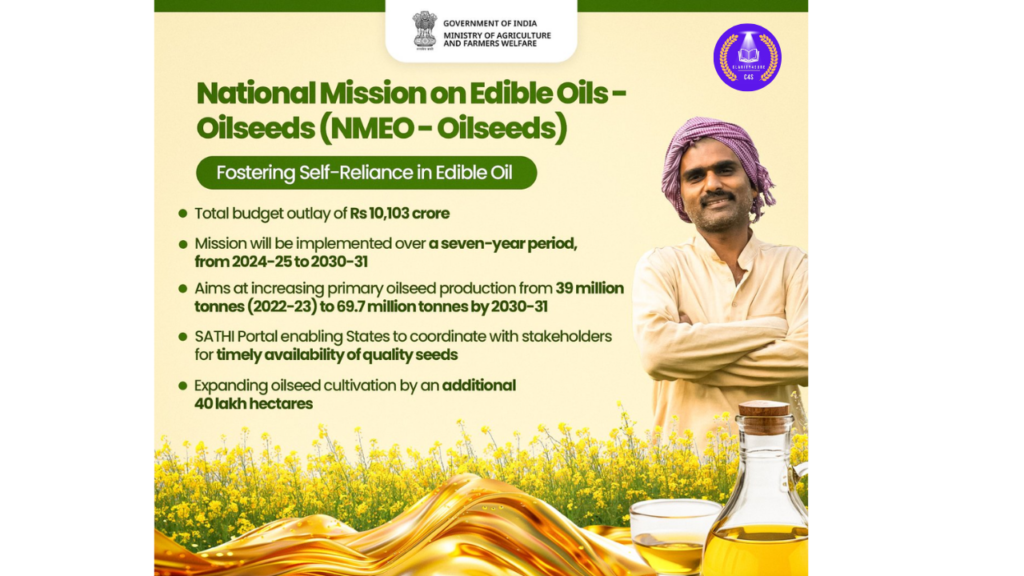
- The National Mission on Edible Oils – Oilseeds (NMEO-Oilseeds) is an initiative by the Government of India aimed at increasing the production of edible oils and oilseeds within the country.
- India is one of the largest consumers of edible oils in the world but heavily relies on imports (around 55-60% of total demand).
- The NMEO-Oilseeds mission seeks to make India self-sufficient in edible oils by enhancing the productivity of oilseed crops such as mustard, soybean, groundnut, sunflower, safflower, sesame, and oil palm.
Budget Allocation and Funding
Free live session
NABARD Grade A 2026: what the 2025 cut-offs changed, and the 90-day plan
The 2025 cycle was the toughest on record at every stage. This session reads those numbers properly and turns them into a week-by-week plan for Phase 1.
In 8 days · Sun, 4 Oct at 7:30 PM IST · 75 minutes · free
NABARD 2021-2024 Cutoff Analysis | What we can Learn? #nabard_grade_a_exam #nabard_cutoffTap to play · from the C4S channel
- The Government of India has allocated ₹11,040 crore for NMEO-Oilseeds in the Union Budget 2025-26 under a five-year plan.
- The mission follows a centrally sponsored scheme (CSS) model, where funding is shared between the central and state governments:
- 60:40 ratio for general states
- 90:10 ratio for northeastern states
- 100% central funding for union territories
ARD notes, the monthly current affairs PDF and a descriptive English sample — all free, on WhatsApp.
Get it on WhatsApp — one tap or just leave your numberObjectives of NMEO-Oilseeds
- The NMEO-Oilseeds aims to achieve the following key objectives:
- Increase domestic production of oilseeds to reduce import dependence.
- Expand oilseed cultivation area through better farming practices.
- Improve productivity and yield through the adoption of high-yielding varieties (HYVs) and advanced technologies.
- Enhance farmers’ income by supporting oilseed growers with better market access.
- Promote research and development (R&D) to create superior seed varieties and efficient processing techniques.
- Improve post-harvest management and value addition in the oilseed sector.
- Encourage sustainable farming practices for long-term agricultural resilience.
Key Features of NMEO-Oilseeds
- Financial Assistance to Farmers
- nThe government provides financial support to farmers for procuring quality seeds, fertilizers, and adopting advanced technologies like micro-irrigation and precision farming.
- Research and Development (R&D)
- The mission emphasizes collaboration with research institutions like the Indian Council of Agricultural Research (ICAR) and State Agricultural Universities (SAUs) to develop high-yield and disease-resistant oilseed varieties.
- Seed Production and Distribution
- A special seed multiplication and distribution program ensures farmers get access to high-quality seeds of oilseeds like mustard, sunflower, groundnut, and soybean.
- Focus on Water-Efficient Crops
- Given the water-intensive nature of some oilseed crops, NMEO-Oilseeds promotes the use of drought-resistant and water-efficient varieties.
- Value Addition and Processing Infrastructure
- The mission encourages investment in modern processing units to reduce wastage and increase the efficiency of oil extraction.
- Public-Private Partnerships (PPP)
- The mission seeks to engage private players and farmer producer organizations (FPOs) to strengthen the oilseed value chain.
- Use of Technology
- Advanced agriculture technology, including AI, drones, and satellite monitoring, is promoted for better crop health management and yield prediction.
Target Crops Under NMEO-Oilseeds
The NMEO-Oilseeds focuses on nine major oilseeds, classified into three categories:
- Traditional Oilseeds
- Groundnut
- Soybean
- Rapeseed & Mustard
- Non-Traditional Oilseeds
- Sunflower
- Safflower
- Sesame
- Niger seed
- Tree-borne Oilseeds (TBOs)
- Coconut
- Palm oil
Challenges in Oilseed Production
- Oilseed production faces several challenges that impact yield, quality, and profitability.
- These challenges can be grouped into agronomic, environmental, economic, and policy-related issues.
- Below are some key challenges:
- Agronomic Challenges
- Pest and Disease Pressure:
- Oilseed crops (e.g., soybean, sunflower, canola, and groundnut) are susceptible to various pests (e.g., aphids, whiteflies) and diseases (e.g., rust, powdery mildew, blights).
- Weed Management:
- Weeds compete with oilseed crops for nutrients, water, and sunlight, reducing yields.
- Soil Fertility and Nutrient Deficiency:
- Many oilseeds require specific nutrients (e.g., sulfur for canola) for optimal growth.
- Drought and Water Stress:
- Oilseeds are often grown in rain-fed conditions, making them vulnerable to water shortages.
- Seed Quality and Availability:
- Access to high-yielding, pest-resistant, and climate-resilient seeds is crucial but often limited.
- Pest and Disease Pressure:
- Environmental Challenges
- Climate Change:
- Rising temperatures, erratic rainfall, and extreme weather events (floods, droughts) affect oilseed productivity.
- Soil Degradation:
- Continuous monocropping, poor land management, and soil erosion reduce land productivity.
- Pollination Issues:
- Some oilseeds (e.g., sunflower) rely on pollinators like bees, but declining pollinator populations can negatively impact yields.
- Climate Change:
- Economic Challenges
- High Production Costs:
- Inputs like fertilizers, pesticides, and machinery are costly, reducing profit margins.
- Market Volatility:
- Oilseed prices fluctuate due to global supply-demand dynamics and trade policies.
- Post-Harvest Losses:
- Poor storage facilities lead to losses from spoilage, mold, and pest infestations.
- Limited Value Addition:
- In many regions, oilseeds are exported as raw materials rather than processed locally, reducing profitability.
- High Production Costs:
- Policy and Institutional Challenges
- Subsidy and Support Issues:
- Some countries lack proper government support for oilseed farmers.
- Trade Barriers and Tariffs:
- Import-export restrictions affect market access.
- Lack of Research and Extension Services:
- Farmers need better access to agronomic knowledge, improved varieties, and modern farming techniques.
- Subsidy and Support Issues:
- Technological Challenges
- Limited Mechanization:
- Many smallholder farmers rely on traditional farming methods, reducing efficiency.
- Poor Irrigation Infrastructure:
- Water management remains a challenge in semi-arid and arid regions.
- Slow Adoption of Improved Varieties:
- Genetically improved or hybrid oilseeds could boost yields but are not widely adopted due to cost and availability constraints.
- Limited Mechanization:
Expected Outcomes of NMEO-Oilseeds
- The successful implementation of NMEO-Oilseeds is expected to:
- Increase oilseed production from 32-33 million tonnes to 47-50 million tonnes.
- Reduce edible oil imports from 60% to 30-40%.
- Boost farmers’ incomes through better productivity and price realization.
- Strengthen India’s self-reliance in edible oil production and reduce the foreign exchange burden.
- Improve processing efficiency and infrastructure, leading to higher value addition.
Conclusion
- The National Mission on Edible Oils – Oilseeds (NMEO-Oilseeds) is a significant step toward achieving Atmanirbhar Bharat (self-reliant India) in the edible oil sector.
- By improving oilseed productivity, supporting farmers, and encouraging sustainable practices, this initiative aims to reduce India’s dependence on imports and ensure long-term food security.
While challenges remain, technological advancements, policy support, and public-private partnerships will play a crucial role in making India a global leader in oilseed production.
FAQs on NMEO-Oilseeds
1. When was NMEO-Oilseeds launched?
It was launched in August 2021 by the Government of India.
2. What is the budget allocation for NMEO-Oilseeds?
The government has allocated ₹11,040 crore, with a special ₹4,800 crore package for palm oil.
3. Which oilseeds are covered under NMEO-Oilseeds?
The mission covers groundnut, soybean, mustard, sunflower, safflower, sesame, niger, coconut, and palm oil.
4. What is the main goal of NMEO-Oilseeds?
To increase domestic oilseed production, reduce edible oil imports, and enhance farmers’ income.
5. How does NMEO-Oilseeds benefit farmers?
It provides financial support, high-quality seeds, better processing infrastructure, and market access to farmers.