
A New Chapter in Offshore Exploration
Energy is the foundation of modern life. It powers our homes, runs factories, supports farming, moves vehicles, and keeps the economy growing. As India develops rapidly, the demand for energy is increasing every year. To meet this growing demand, the country needs a steady, affordable, and secure supply of energy. However, India still imports a large portion of the crude oil and natural gas it consumes. This dependence on imports increases costs and makes the country vulnerable to global price fluctuations and supply disruptions. Increasing domestic production is therefore essential to improve energy security, reduce import bills, and save valuable foreign exchange.
One of the most important sources of energy is hydrocarbons, which are natural compounds made up of hydrogen and carbon. These resources are found deep beneath the earth’s surface, both on land and under the sea. The two most important hydrocarbons are crude oil and natural gas. They are used to produce petrol, diesel, LPG, aviation fuel, fertilisers, plastics, petrochemicals, and many other products that are essential for daily life and industrial development.
India has significant hydrocarbon reserves hidden beneath its offshore regions. These resources are located in offshore sedimentary basins, which are large geological formations beneath the seabed where oil and natural gas accumulate over millions of years. Many of these reserves remain unexplored because offshore exploration requires advanced technology, accurate geological surveys, skilled manpower, and heavy investment.
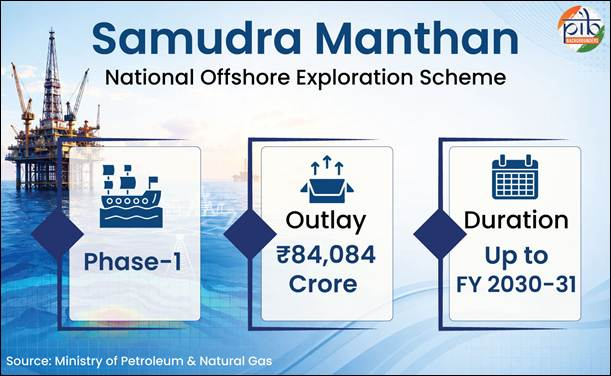
To unlock this untapped potential, the Government of India approved Samudra Manthan – the National Offshore Exploration Scheme on 31 July 2026. The scheme represents a major step towards increasing domestic oil and gas production and strengthening India’s long-term energy security. With a Phase-I investment of ₹84,084 crore up to FY 2030–31, the initiative aims to expand offshore hydrocarbon exploration, improve geological data collection, adopt modern drilling technologies, and build a stronger domestic ecosystem for exploration and production. By developing India’s offshore energy resources, the scheme is expected to reduce dependence on imported oil and gas, attract investment, generate employment, and support the country’s vision of achieving greater energy self-reliance.
Why The Seas Hold the Key for India
India is the third-largest consumer of crude oil in the world, reflecting its fast-growing economy and rising energy needs. Every year, the country spends nearly USD 144 billion (around ₹13 lakh crore) on importing crude oil and natural gas. This huge import bill places significant pressure on the economy and makes India vulnerable to international price fluctuations and global supply disruptions. Recent geopolitical conflicts and energy crises have highlighted the importance of having a stable and secure domestic energy supply. As a result, increasing oil and gas production within the country has become a key national priority to improve energy security, reduce import dependence, and save valuable foreign exchange.
The Offshore Opportunity
A large share of India’s untapped oil and natural gas reserves lies beneath the sea, in its offshore sedimentary basins. Offshore exploration involves searching for hydrocarbon resources beneath the seabed using advanced technology and specialised drilling equipment.
Some of the most promising areas are deepwater and ultra-deepwater regions, where the sea is several thousand metres deep. India’s eastern and western offshore basins extend to water depths of up to 3,000 metres and are believed to contain more than 5,600 MMTOE (Million Metric Tonnes of Oil Equivalent) of hydrocarbon resources. This represents a vast energy reserve that could significantly strengthen the country’s domestic oil and gas production.
In recent years, encouraging discoveries in the Cauvery, Mahanadi, and Andaman offshore basins have further increased confidence in India’s offshore potential. These discoveries indicate that India’s seas still hold substantial untapped reserves, offering an opportunity to reduce dependence on imports, enhance energy security, create employment, attract investment, and support long-term economic growth. By developing these offshore resources, India can move closer to becoming more energy self-reliant while meeting the growing energy demands of its people and industries.
The Challenge of Deepwater Exploration
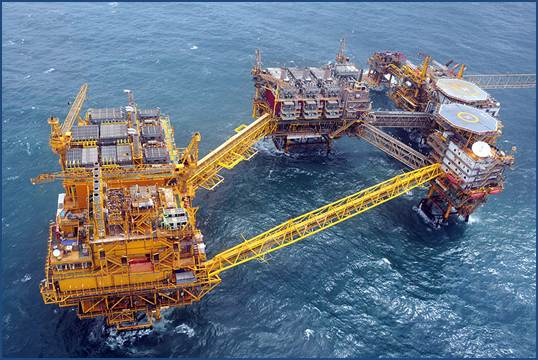
Exploring for oil and natural gas in deepwater areas is one of the most difficult and expensive activities in the energy sector. It requires advanced technology, highly skilled professionals, specialised drilling equipment, and large financial investments. Even after an exploration area is allotted, it usually takes 5 to 10 years before oil or gas can be produced commercially. This long timeline includes geological surveys, drilling, testing, environmental clearances, and the development of production infrastructure.
The financial risks are also very high. Drilling just one exploratory well in deepwater can cost around USD 125–150 million. Since there is no guarantee that every well will discover commercially viable oil or gas, companies often face significant uncertainty. These high costs and risks can discourage investment in offshore exploration.
Another major challenge is that existing oil and gas fields naturally produce less over time. On average, production from these fields declines by 6–7% every year as reserves are gradually depleted. This means that even if India wants to maintain its current level of oil and gas production, it must continuously discover and develop new reserves.
Therefore, regular exploration is not just about finding additional energy resources—it is essential for replacing declining production, ensuring a stable domestic energy supply, reducing dependence on imports, and moving India closer to long-term energy self-reliance. Continuous investment in offshore exploration today will help secure the country’s energy needs for the future.
Inside the Samudra Manthan Mission
Samudra Manthan represents an important step in India’s journey towards achieving greater energy security. Instead of focusing only on policy changes, the government has now moved to mission-mode implementation, where reforms are translated into large-scale action on the ground—or, in this case, at sea.
The scheme follows a risk-sharing model, under which the government helps reduce some of the financial and technical risks involved in offshore oil and gas exploration. Since deepwater exploration is expensive and uncertain, sharing these risks makes it more attractive for both public and private companies to invest in new exploration projects.
By reducing the risks associated with offshore ventures, Samudra Manthan aims to attract long-term private investment, encourage the use of advanced exploration technologies, and strengthen India’s domestic capabilities in the entire hydrocarbon value chain—from geological surveys and drilling to production, transportation, and supporting industries.
In essence, the scheme transforms years of policy reforms into concrete action by accelerating offshore exploration, promoting investment, creating jobs, strengthening the domestic energy ecosystem, and helping India make better use of its own natural resources. This marks a significant step towards reducing import dependence and building a more secure and self-reliant energy future.
Components of Samudra Manthan
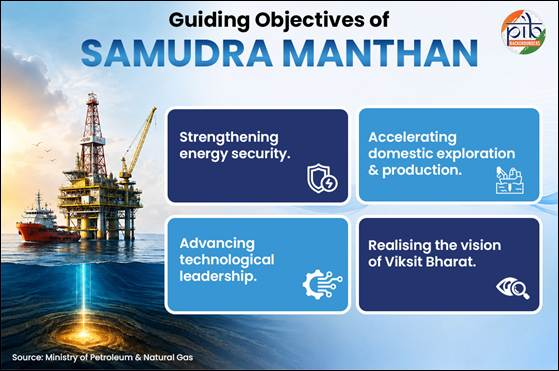
Successful offshore oil and gas exploration requires accurate geological data, advanced technology, modern infrastructure, and a strong domestic support system. Samudra Manthan brings all these elements together through four major components that aim to make offshore exploration faster, more efficient, and more attractive for investors.
1. Seismic Data Acquisition, Processing, and Interpretation
Finding oil and natural gas beneath the seabed begins with collecting detailed information about the underground rock formations. In the past, India had limited seismic data for many offshore areas, making it difficult to identify promising locations for drilling.
To address this, the government has allocated ₹28,534 crore to carry out large-scale 2D and 3D seismic surveys across offshore regions. These surveys create detailed images of the subsurface, helping scientists identify areas that may contain oil and gas. The scheme will also use Artificial Intelligence (AI) and other advanced technologies to analyse the collected data more quickly and accurately. In addition, older geological data stored in the National Data Repository will be reprocessed using modern software so that previously overlooked hydrocarbon prospects can also be identified.
2. Accelerated Offshore Exploration
Drilling in deepwater and ultra-deepwater areas is highly expensive and involves significant financial risk. A single exploratory well can cost hundreds of crores of rupees, and there is no guarantee of finding commercially viable oil or gas.
To encourage more exploration, the scheme has allocated ₹43,200 crore to support the drilling of 60 deepwater and ultra-deepwater exploratory wells. The government will provide financial assistance of up to 50% of the eligible drilling cost or ₹675 crore per well, whichever is lower. This support is available to both public sector and private Exploration and Production (E&P) companies. By reducing financial risks, the scheme is expected to attract more investment, increase oil and gas discoveries, and strengthen India’s domestic energy reserves.
3. Common Offshore Infrastructure
Even when oil and gas are discovered, production cannot begin without expensive infrastructure such as offshore platforms, pipelines, processing facilities, and transportation systems. In many cases, discoveries remain unused because building separate infrastructure for each project is not economically viable.
To solve this problem, Samudra Manthan provides ₹10,000 crore to develop shared offshore infrastructure in selected basins, particularly the Mahanadi and Kutch basins. These common facilities will allow multiple projects to use the same production and transportation infrastructure, reducing costs and making previously unviable discoveries commercially productive. This will help bring more offshore resources into production faster.
4. Oil and Gas Manufacturing and Services Zone
India currently imports many of the specialised equipment, machinery, and services required for offshore exploration and production. This increases project costs and leads to a significant outflow of foreign exchange.
To reduce this dependence, the government will establish an integrated Oil and Gas Manufacturing and Services Zone with an investment of ₹2,000 crore. The zone will promote domestic manufacturing of exploration equipment and support industries involved in engineering, repairs, maintenance, warehousing, logistics, and technical services. This initiative supports the Make in India programme by creating a stronger domestic supply chain, generating employment, and reducing reliance on imported technology.
Additionally, ₹350 crore has been allocated for activities such as project monitoring, digital technologies, evaluation, capacity building, human resource development, public awareness campaigns, outreach programmes, industry events, and media communication. These efforts will ensure the effective implementation of the scheme and increase awareness about India’s offshore energy initiatives.
Together, these four components create a comprehensive framework for boosting offshore oil and gas exploration. By improving geological data, reducing investment risks, developing shared infrastructure, and strengthening domestic manufacturing, Samudra Manthan aims to unlock India’s offshore hydrocarbon potential, enhance energy security, attract investment, create employment, and move the country closer to long-term energy self-reliance.
An Integrated Enabling Ecosystem
Apart from providing financial assistance, Samudra Manthan also focuses on building a strong and efficient ecosystem for India’s offshore oil and gas sector. The scheme recognises that long-term success depends not only on investment but also on better management, skilled professionals, advanced technology, and strong collaboration among all stakeholders.
Some of the key supporting measures under the scheme include:
- Digital Programme Management: Modern digital platforms and monitoring systems will be used to track the progress of projects, improve transparency, ensure timely implementation, and make decision-making more efficient.
- Capacity Building: The scheme will invest in training and skill development for scientists, engineers, technicians, and other professionals working in the offshore energy sector. This will help create a highly skilled workforce capable of using advanced exploration and production technologies.
- Adoption of Advanced Technologies: Samudra Manthan encourages the use of cutting-edge technologies such as Artificial Intelligence (AI), data analytics, automation, advanced seismic imaging, and digital monitoring systems. These technologies will improve exploration accuracy, reduce operational risks, and increase overall efficiency.
- Stakeholder Engagement: The government will work closely with public sector companies, private firms, research institutions, technology providers, and industry experts. Regular consultations and collaboration will help address challenges, encourage innovation, and ensure the smooth implementation of the scheme.
- International Outreach: The scheme also aims to attract leading global energy companies, technology providers, and investors. By encouraging international partnerships, India can gain access to advanced technologies, global expertise, and additional investment, which will further strengthen the country’s offshore exploration and production capabilities.
Through these initiatives, Samudra Manthan goes beyond simply funding exploration projects. It creates a supportive environment that promotes innovation, develops skilled manpower, improves project management, attracts global collaboration, and strengthens every stage of the offshore oil and gas value chain. This comprehensive approach will help India build a modern, competitive, and self-reliant energy sector.
What Samudra Manthan Will Deliver
Samudra Manthan is not just an exploration programme—it is a long-term investment in India’s energy future. If exploration activities are successful, the scheme is expected to deliver significant economic, industrial, and strategic benefits that will strengthen the country’s energy security and support sustainable growth.
1. Increase in Oil and Gas Reserves
One of the main objectives of the scheme is to discover new offshore hydrocarbon reserves. It is expected to add more than 600 MMTOE (Million Metric Tonnes of Oil Equivalent) to India’s existing reserves. As a result, the country’s total hydrocarbon resource base is projected to grow from 1.6 billion Tonnes of Oil Equivalent (TOE) to around 2.2 billion TOE. Larger reserves will help ensure a more reliable domestic energy supply in the coming decades.
2. Higher Domestic Production
With new discoveries and improved offshore production, India’s annual oil and gas output is expected to increase from around 62 MMTOE to nearly 80 MMTOE. The scheme aims to generate an additional 10–15 MMTOE of production every year, with the potential to reach 20 MMTOE at its peak. Higher domestic production will reduce dependence on imported crude oil and natural gas while improving the country’s energy security.
3. Reduction in the Import Bill
India currently spends a huge amount of money importing crude oil. By increasing domestic production, Samudra Manthan can significantly reduce this dependence. The additional oil and gas produced under the scheme could lower India’s annual crude oil import bill by around ₹1 lakh crore. This would save valuable foreign exchange and strengthen the country’s economy.
4. More Investment and Faster Economic Growth
The scheme is expected to attract large investments from both public and private companies in exploration, drilling, manufacturing, infrastructure, engineering, and related services. These investments will boost industrial activity, encourage technological innovation, and contribute to higher GDP growth, creating long-term economic benefits.
5. Employment Generation
Samudra Manthan will create thousands of employment opportunities across different sectors. Jobs will be generated not only in offshore exploration and oil and gas production but also in engineering, manufacturing, logistics, equipment maintenance, research, technology, and other supporting industries. This will benefit both skilled professionals and local communities.
6. Strengthening Domestic Manufacturing
The scheme supports the government’s Make in India and Atmanirbhar Bharat initiatives by encouraging the domestic production of equipment, machinery, and specialised services needed for offshore exploration. This will reduce dependence on imported technology, strengthen India’s industrial base, and help develop a globally competitive ecosystem for offshore energy technologies.
A Stronger and More Self-Reliant Energy Future
Taken together, these expected outcomes will make India’s energy sector stronger, more resilient, and less dependent on imports. Samudra Manthan will not only increase the country’s oil and gas reserves but also promote technological advancement, attract investment, create employment, and strengthen domestic industries. In the long run, the scheme will help India build a secure, modern, and self-reliant energy ecosystem while supporting innovation, industrial growth, and sustainable economic development for future generations.
A Series of Reforms
Reforms That Strengthened India’s Hydrocarbon Sector
Over the past few years, India has introduced several important reforms to make its oil and natural gas exploration sector more modern, transparent, and attractive for investment. These reforms aim to encourage both public and private companies to explore more oil and gas reserves, increase domestic production, and reduce the country’s dependence on imports.
Opening More Offshore Areas for Exploration
Earlier, a large part of India’s offshore region was classified as “No-Go” areas, where exploration was not allowed due to various restrictions. To encourage exploration, the government removed restrictions from more than 99% of these areas.
As a result, over one million square kilometres of India’s Exclusive Economic Zone (EEZ) has been opened for exploration. The EEZ is the sea area where India has exclusive rights to explore and use natural resources such as oil, natural gas, and minerals. Opening these areas has significantly expanded opportunities for discovering new hydrocarbon reserves.
A Modern Licensing System
In 2016, the government introduced the Hydrocarbon Exploration and Licensing Policy (HELP) to replace the older and more restrictive system. Under HELP, the Open Acreage Licensing Programme (OALP) was launched.
Unlike the previous nomination-based system, OALP allows companies to choose the exploration blocks they are interested in and submit bids throughout the year. HELP also introduced several investor-friendly measures such as:
- A single licence for exploring different types of hydrocarbons.
- Lower government levies.
- A transparent revenue-sharing system.
- Incentives for early production.
These reforms have made the exploration process simpler, faster, and more attractive for investors.
Simpler and More Transparent Contracts
Before 2016, India followed the Production Sharing Contract (PSC) system. Under this model, companies first recovered their exploration and production costs, and then shared the remaining profits with the government. This often resulted in complex procedures and frequent disputes over cost calculations.
To simplify the system, India shifted to the Revenue Sharing Contract (RSC) model. Under RSC, companies bear all exploration and development costs themselves and directly share a fixed portion of their revenue with the government. This system is easier to administer, improves transparency, reduces government intervention, and provides greater certainty to investors.
A Modern Legal Framework
The Oilfields (Regulation and Development) Amendment Act, 2025 further strengthened the sector by creating a more modern legal framework. The law provides greater contractual stability, improves dispute resolution mechanisms, and recognises integrated petroleum operations, making the regulatory environment more predictable and investor-friendly.
New Petroleum Rules
To support these legal reforms, the government introduced the Petroleum and Natural Gas Rules, 2025. These rules simplify the process of granting petroleum leases, reduce unnecessary paperwork, and improve the ease of doing business in India’s oil and gas sector.
Equal Treatment for All Operators
The government also standardised the powers and responsibilities of the Empowered Committee of Secretaries across all petroleum contracts. This ensures that every exploration company—whether it signed its contract years ago or recently—receives the same treatment under government policies. Such consistency improves investor confidence and creates a fair business environment.
Greater Focus on Exploration
India’s two major public sector oil companies—Oil and Natural Gas Corporation (ONGC) and Oil India Limited (OIL)—have also been given a stronger focus on exploration activities. Their performance targets now place greater emphasis on discovering new oil and gas reserves, reflecting the government’s commitment to increasing domestic energy production.
Building a Strong Scientific Foundation
Successful oil and gas exploration begins with accurate geological information. One of the most important tools used for this purpose is a seismic survey, which sends sound waves deep into the earth to create detailed images of underground rock formations beneath the seabed. These images help scientists identify areas that may contain oil and natural gas.
Over the years, India has invested heavily in improving its geological knowledge through several national initiatives, including:
- Mission Anveshan
- National Seismic Programme
- Extended Continental Shelf Survey
- National Data Repository (NDR)
- Hydrocarbon Resource Assessment Study
Together, these initiatives have created one of the world’s most comprehensive geoscientific databases, providing valuable information for future offshore exploration.
Positive Results of the Reforms
The reforms have significantly improved investor confidence and increased exploration activity across the country.
- Around 81% of India’s active exploration areas have been awarded since 2014, showing the rapid expansion of exploration efforts.
- Under the Open Acreage Licensing Programme (OALP), the government has awarded 172 exploration blocks covering nearly 3.8 lakh square kilometres.
- Companies have committed investments of more than USD 4.3 billion in these exploration blocks.
Exploration activity has also accelerated on the ground.
During FY 2025–26:
- Around 674 exploratory wells were drilled across the country.
- Five new oil and gas discoveries were made.
- Seven previously discovered fields were brought into commercial production (monetised).
These achievements demonstrate that India’s policy reforms are delivering tangible results. By opening more exploration areas, simplifying regulations, modernising laws, and strengthening scientific capabilities, the country has created a more competitive and investor-friendly hydrocarbon sector. These reforms provide the foundation for initiatives like Samudra Manthan, which aims to unlock India’s vast offshore energy potential and move the country closer to long-term energy security and self-reliance.
Towards a Secure Energy Future
India is entering a new phase in its journey towards energy security and self-reliance. Meeting the country’s growing energy needs will not depend on a single oil or gas discovery but on continuous exploration, scientific research, technological innovation, and well-planned government policies. The progress achieved so far reflects years of reforms and the dedicated efforts of geologists, engineers, researchers, and thousands of professionals working in the offshore energy sector.
Samudra Manthan brings together all the key elements needed for successful offshore exploration. By combining advanced geological data, financial risk-sharing, modern infrastructure, cutting-edge technology, and stronger domestic manufacturing, the scheme creates a comprehensive framework for unlocking India’s offshore hydrocarbon potential.
As exploration expands into deeper waters, India is taking important steps towards reducing its dependence on imported oil and natural gas. The scheme is expected to strengthen energy security, attract investment, generate employment, encourage innovation, and support initiatives such as Make in India and Atmanirbhar Bharat.
More importantly, Samudra Manthan is an investment in the country’s future. Every successful survey, every new discovery, and every offshore project will help build a stronger, more resilient, and more self-reliant energy sector. By making better use of its own natural resources, India is laying the foundation for sustainable economic growth, greater technological capability, and a secure energy future for generations to come.