

Context
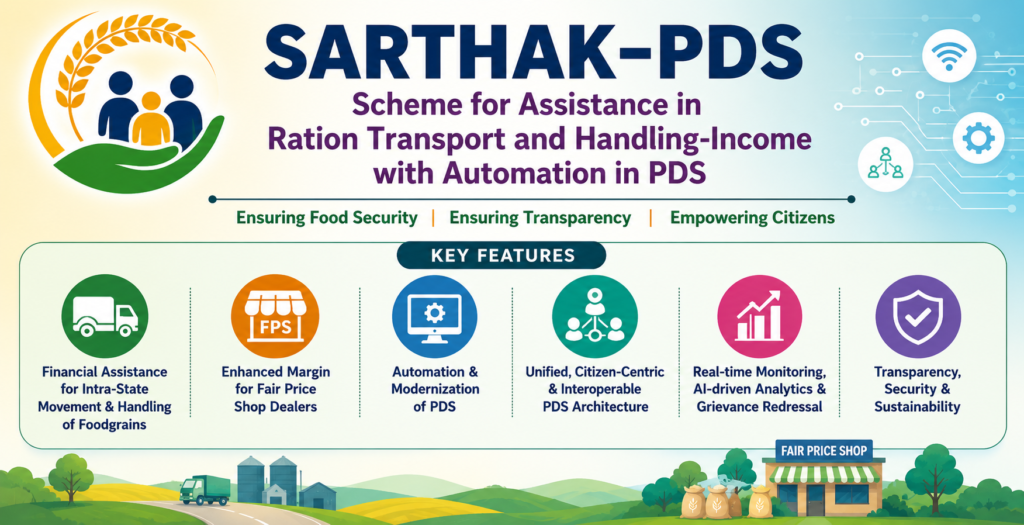
The Cabinet Committee on Economic Affairs (CCEA) has approved the continuation and merger of two important food distribution schemes into a single programme called SARTHAK-PDS (Scheme for Assistance in Ration Transport and Handling-Income with Automation in Public Distribution System).
About
The SARTHAK-PDS scheme combines two existing government programmes into one:
- A scheme that helps states transport food grains within the state and provides commission (margin) to Fair Price Shop (ration shop) dealers under the National Food Security Act (NFSA).
- The SMART-PDS scheme, which focuses on bringing technology-based reforms to the Public Distribution System (PDS).
SARTHAK-PDS aims to make the ration distribution system more efficient, transparent, and reliable. It supports the movement of food grains to ration shops, ensures fair compensation for ration dealers, and uses modern technology to reduce errors, leakages, and fraud.
The scheme plans to use advanced technologies such as Artificial Intelligence (AI), Machine Learning (ML), Natural Language Processing (NLP), and Blockchain to improve ration management, track food grain movement, verify beneficiaries more accurately, and make the entire PDS system faster and more transparent.
What is a PDS System?
The Public Distribution System (PDS) is India’s food security programme that provides essential food grains to eligible families at highly subsidised prices through government-authorised ration shops, known as Fair Price Shops (FPSs).
The system mainly supplies rice, wheat, and coarse grains to poor and vulnerable sections of society to help ensure food security.
The Central Government and State Governments jointly run the PDS:
- The Central Government, through the Food Corporation of India (FCI), purchases food grains from farmers, stores them, transports them, and allocates them to different states.
- The State Governments distribute these food grains within their states, identify eligible beneficiaries, issue ration cards, and oversee the functioning of ration shops.
Evolution of the Public Distribution System (PDS) in India
- PDS in the 1960s:
- The modern PDS emerged during the food shortages of the 1960s and after the Green Revolution, the system expanded to tribal, remote and poverty-prone regions during the 1970s and 1980s.
- The Revamped Public Distribution System (RPDS) was launched in 1992 to strengthen food distribution in remote, hilly and tribal areas.
- The Targeted Public Distribution System (TPDS) was launched in 1997 to direct food subsidies specifically towards Below Poverty Line (BPL) families.
- The Antyodaya Anna Yojana (AAY) was launched in 2000 to provide highly subsidised food grains to the “poorest of the poor” households.
Constitutional and Global Commitments
- Right to Food Under Article 21:
- The Supreme Court has interpreted the Right to Food as an essential component of Article 21, which guarantees the Right to Life.
- Sustainable Development Goals:
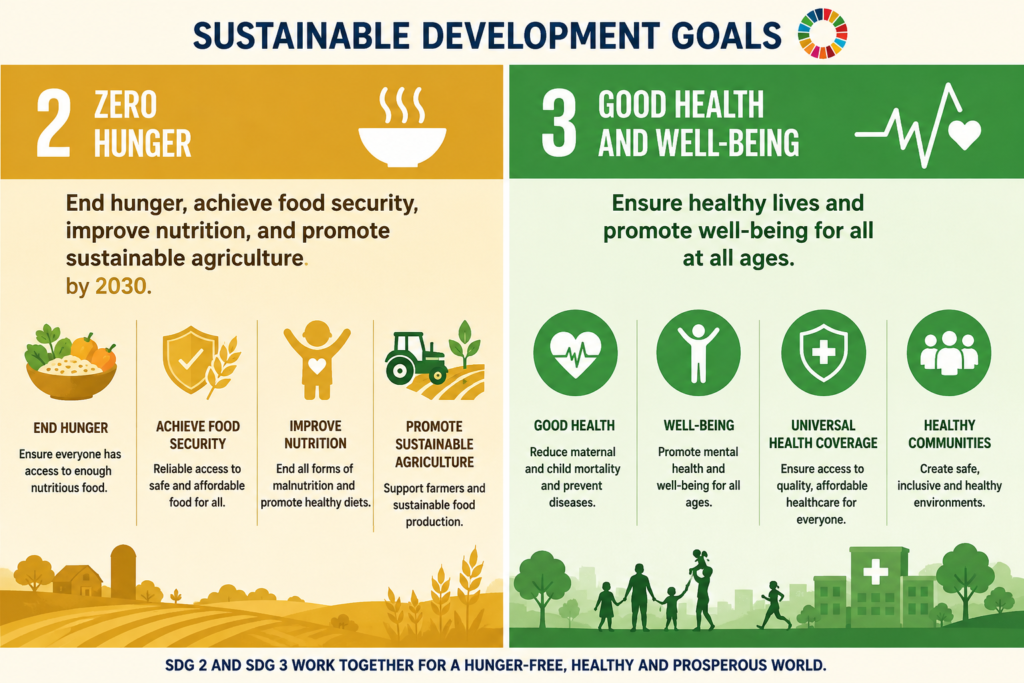
- SDG 2 (Zero Hunger) aims to end hunger, achieve food security, improve nutrition, and promote sustainable agriculture globally by 2030.
- SDG 3 (Good Health and Well-being) aims to ensure healthy lives and promote well-being for all at all ages.
Challenges with the PDS System
- Leakage and Diversion of Food Grains: A large quantity of food grains meant for beneficiaries is often stolen or diverted to the black market while being transported, preventing it from reaching the intended people.
- Problems with Biometric Verification: Some genuine beneficiaries lose access to their ration because their biometric authentication fails or their names are removed from the beneficiary list. They then have to go through the lengthy process of applying for a new ration card.
- Errors in Identifying Beneficiaries: Sometimes families that are not eligible receive ration benefits, while deserving families are left out due to mistakes in the identification process.
- Corruption at Ration Shops: Some Fair Price Shop (FPS) dealers engage in unfair practices such as giving less food grain than entitled, selling poor-quality grains, or charging more than the prescribed price.
- Poor Storage Facilities: Inadequate warehouses and storage infrastructure lead to food grains getting damaged, spoiled, or wasted before they can be distributed.
- Limited Nutritional Support: The PDS mainly provides cereals like rice and wheat. It does not sufficiently include nutritious foods such as pulses, millets, and protein-rich items, which are important for a balanced diet.
Reforms and Modernization Efforts
- National Food Security Act (NFSA), 2013:
- This law gives eligible people a legal right to receive food grains at subsidized prices. It covers about 75% of the rural population and 50% of the urban population, ensuring food security for nearly two-thirds of India’s citizens.
- Targeted Public Distribution System (TPDS) Control Order, 2015:
- Issued by the government to clearly define the responsibilities of both the Central and State Governments in implementing the PDS. It also created a system through which citizens can register complaints and seek solutions to their problems.
- Digital Ration Cards and Aadhaar Authentication:
- The government has introduced digital ration cards and Aadhaar-based biometric verification to prevent fake or duplicate ration cards and ensure that benefits reach genuine beneficiaries.
- Direct Benefit Transfer (DBT):
- In some areas, instead of providing food grains directly, the government transfers the subsidy amount into beneficiaries’ bank accounts, allowing them to purchase food on their own.
- Citizen-Friendly Digital Platforms:
- Mobile applications and online platforms such as Mera Ration, Anna Mitra, Rightful Targeting Dashboard, and Anna Sahayata have been launched to improve transparency, make services more accessible, and help beneficiaries access information and resolve issues easily.
The government has introduced legal protections, digital technology, direct cash transfers, and citizen-focused applications to make the Public Distribution System more transparent, efficient, and beneficiary-friendly.
Way Forward
To make the Public Distribution System (PDS) more effective, the government should invest in better warehouses, storage facilities, and transportation networks so that food grains can be stored safely and delivered efficiently without losses. Modern technologies such as Artificial Intelligence (AI) and Blockchain can be used to track food grains in real time, improve transparency, and reduce leakages and inefficiencies. Regular social audits and strong grievance redressal mechanisms should also be implemented so that citizens can report problems and officials and ration dealers remain accountable for their actions. Additionally, the PDS should move beyond supplying only rice and wheat by including pulses, fortified foods, and other nutritious items to ensure that beneficiaries receive a more balanced and healthy diet, thereby improving overall nutritional security.







