

Daily Current Affairs Quiz
04 July , 2026
National Affairs
1. Nameri Tiger Reserve
Source: Telegraph
Context
The Nameri Tiger Reserve (NTR) in north-central Assam’s Sonitpur district has recorded a four-fold increase in tiger population — from just 3 tigers in 2022 to 12 tigers by the end of 2025. This estimation by the Assam State Forest Department has been validated by the Wildlife Institute of India (WII). Assam’s Forest and Environment Minister Jayanta Malla Baruah made the announcement on Friday, 3 July 2026, attributing the “extraordinary results” to conservation efforts under Chief Minister Himanta Biswa Sarma. In a parallel achievement, tigers have returned to the Sonai-Rupai Wildlife Sanctuary — Nameri’s satellite core — where the species had been locally extinct since the early 2000s. Nameri is one of four tiger reserves in Assam and shares a boundary with the 1,276.95 sq km Pakke Tiger Reserve in Arunachal Pradesh.
What is the Nameri Tiger Reserve?
- Notified as Tiger Reserve: 1 March 2000 (Assam’s 2nd Tiger Reserve after Manas).
- History: Declared Wildlife Sanctuary in 1985; upgraded to National Park in 1998; declared Tiger Reserve in 1999-2000.
- Core area: Nameri National Park — 200 sq km.
- Interstate boundary: Shares northern boundary with Pakke Tiger Reserve, Arunachal Pradesh.
- Nearest town: Tezpur (35 km), nearest airport: Tezpur (Salonibari); nearest railway station: Balipara (15 km).
- Rivers: Jia Bhoreli (Kameng) — main lifeline, a tributary of the Brahmaputra; and Bor-Dikorai.
- Landscape: Tropical evergreen, semi-evergreen, moist deciduous forests + riverine grasslands + cane brakes.
- Elephant reserve status: Part of Sonitpur Elephant Reserve (Kameng Elephant Reserve system).
- Signature bird: White-winged wood duck (endangered) — one of India’s last strongholds.
- Ecotourism USP: Jia Bhoreli river rafting + mahseer angling + birdwatching.
What are Assam’s four tiger reserves?
- Kaziranga Tiger Reserve — Golaghat/Nagaon districts; UNESCO World Heritage Site; famed for rhinos + high tiger density.
- Manas Tiger Reserve — Baksa/Chirang/Barpeta districts, on the Bhutan border; UNESCO World Heritage Site; Biosphere Reserve; Project Tiger Reserve since 1973 (among the original 9); notable for pygmy hog, hispid hare, golden langur.
- Nameri Tiger Reserve — Sonitpur district; declared 2000; shares boundary with Pakke.
- Orang Tiger Reserve — Darrang/Sonitpur districts; declared 2016; smallest tiger reserve in India by core (~79 sq km core).
What is the Wildlife Institute of India (WII)?
- Full form: Wildlife Institute of India.
- Established: 1982.
- Where: Chandrabani, Dehradun (Uttarakhand).
- Under which ministry: Ministry of Environment, Forest and Climate Change (MoEFCC).
- Role: Premier wildlife research and training institute; validates tiger estimation data; conducts the quadrennial All India Tiger Estimation (AITE) jointly with NTCA and State Forest Departments.
What is the National Tiger Conservation Authority (NTCA)?
- Established: 2005.
- Statutory backing: Wild Life (Protection) Act, 1972 (as amended in 2006).
- Under which ministry: MoEFCC.
- Chair: Union Minister of Environment, Forest & Climate Change.
- Vice-Chair: MoS, MoEFCC.
- Role: Statutory body overseeing Project Tiger; monitors tiger reserves; conducts AITE with WII; approves state tiger conservation plans.
- Member Secretary (2026): Dr. G. S. Bhardwaj.
What is Project Tiger?
- Launched: 1 April 1973, by then PM Indira Gandhi at Jim Corbett National Park, Uttarakhand.
- Initial reserves: 9 tiger reserves (Corbett, Manas, Ranthambore, Palamau, Kanha, Simlipal, Bandipur, Melghat, Sundarbans).
- 50th anniversary: April 2023 — PM Narendra Modi released “Amrit Kaal Ka Vision for Tiger Conservation” and “Status of Tigers 2022”.
- Objective: Conserve Bengal Tiger (Panthera tigris tigris) and its ecosystems.
What is the conservation status of the Bengal Tiger?
- Scientific name: Panthera tigris tigris.
- National animal of India (declared 1973, replacing the lion).
- IUCN Red List: Endangered (species-level).
- CITES: Appendix I.
- Wildlife (Protection) Act, 1972: Schedule I — highest protection.
- Global population estimate: ~5,500 wild tigers (India accounts for ~70%).
Practice MCQs
Q1. With reference to the Nameri Tiger Reserve, consider the following statements:
- It is located in the Sonitpur district of Assam.
- Its total area is approximately 344 sq km, with 200 sq km as core.
- It shares its northern boundary with the Pakke Tiger Reserve in Arunachal Pradesh.
- The Sonai-Rupai Wildlife Sanctuary serves as its satellite core.
How many of the above statements are correct?
(a) Only one (b) Only two (c) Only three (d) All four (e) None
(All four statements are correct.)
Q2. With reference to the recent tiger population update at Nameri Tiger Reserve, consider the following statements:
- The tiger population at Nameri increased from 3 in 2022 to 12 by the end of 2025.
- The estimation was validated by the Wildlife Institute of India (WII).
- Tigers have returned to the Sonai-Rupai Wildlife Sanctuary, which is Nameri’s satellite core.
- The Sonai-Rupai sanctuary had never previously recorded a tiger population.
How many of the above statements are correct?
(a) Only one (b) Only two (c) Only three (d) All four (e) None
(Statement 4 is wrong; tigers were present in Sonai-Rupai earlier but became locally extinct in the early 2000s — hence the current sighting is described as a “return” after more than two decades.)
Q3. With reference to Assam’s tiger reserves, consider the following statements:
- Assam has four tiger reserves — Kaziranga, Manas, Nameri, and Orang.
- Kaziranga and Manas are both UNESCO World Heritage Sites.
- Kaziranga is famous for the Great One-horned Rhinoceros and has one of India’s highest tiger densities.
- Nameri Tiger Reserve was the first tiger reserve to be notified in Assam.
How many of the above statements are correct?
(a) Only one (b) Only two (c) Only three (d) All four (e) None
(Statement 4 is wrong; Manas was Assam’s first tiger reserve (declared under Project Tiger in 1973, among the original 9); Nameri became Assam’s second tiger reserve in 2000.)
Q4. With reference to the All India Tiger Estimation (AITE) 2022, consider the following statements:
- India recorded an average of 3,682 tigers, with an upper limit of 3,925.
- India accounts for approximately 70–75% of the global wild tiger population.
- Madhya Pradesh recorded the highest tiger population at 785, followed by Karnataka, Uttarakhand, and Maharashtra.
- AITE is conducted every year by the Ministry of Home Affairs.
How many of the above statements are correct?
(a) Only one (b) Only two (c) Only three (d) All four (e) None
(Statement 4 is wrong; AITE is conducted every 4 years (quadrennial) — NOT every year — jointly by the NTCA and WII under the Ministry of Environment, Forest and Climate Change (MoEFCC) — NOT the Ministry of Home Affairs.)
Q5. With reference to Project Tiger and NTCA, consider the following statements:
- Project Tiger was launched on 1 April 1973 by PM Indira Gandhi at Jim Corbett National Park.
- The National Tiger Conservation Authority (NTCA) is a statutory body established in 2005 under the Wild Life (Protection) Act, 1972 (as amended in 2006).
- India currently has 58 notified tiger reserves, with Madhav Tiger Reserve of Madhya Pradesh being the 58th (March 2025).
- The Bengal Tiger is listed as “Least Concern” on the IUCN Red List.
How many of the above statements are correct?
(a) Only one (b) Only two (c) Only three (d) All four (e) None
(Statement 4 is wrong; the Bengal Tiger (Panthera tigris tigris) is listed as “ENDANGERED” on the IUCN Red List — NOT “Least Concern”. The species is also listed under CITES Appendix I and Schedule I of the Wild Life (Protection) Act, 1972.)
Answer Key
- (d) — All four correct.
- (c) — Statement 4 wrong: Tigers were earlier present at Sonai-Rupai but locally extinct since early 2000s.
- (c) — Statement 4 wrong: Manas was Assam’s first TR, not Nameri.
- (c) — Statement 4 wrong: AITE is quadrennial, done by NTCA + WII under MoEFCC (not MHA).
- (c) — Statement 4 wrong: Bengal Tiger is Endangered (IUCN), not Least Concern.
Exam Relevance
- UPSC Prelims & Mains: Very High — GS-III (Environment, Biodiversity, Conservation); Prelims (species/reserves/institutions); Essay on wildlife.
- NABARD Grade A: Very High — ESI + ARD papers (biodiversity, protected areas, forest economy); Phase II descriptive on conservation.
- State PCS (Assam, Arunachal Pradesh, Uttarakhand, MP, Karnataka): Very High — State-specific wildlife/biodiversity.
2. Captive-Bred Radio-Tagged White-Rumped Vulture Electrocuted at Mudumalai
Source: The Hindu
Context
A captive-bred, radio-tagged female white-rumped vulture (Gyps bengalensis) — tagged ‘Z25’ — was electrocuted on Sunday, 28 June 2026 after coming into contact with a power transmission line near Ebbanad / Kallatti village on the Sigur plateau, close to the Mudumalai Tiger Reserve (MTR) in the Nilgiris district of Tamil Nadu. The bird had been captive-bred at the Jatayu Conservation Breeding Centre (JCBC), Pinjore, Haryana (a joint BNHS–Haryana Forest Department facility). It was one of five white-rumped vultures radio-tagged at Tadoba on 22 December 2025 and released at the Tadoba-Andhari Tiger Reserve, Maharashtra on 30 December 2025. Z25 flew south, was captured in Kalaburagi (Karnataka), briefly kept at the Kalaburagi Zoological Park, and then released at Mudumalai on 7 April 2026 where a wild white-rumped vulture population already existed. Radio telemetry data monitored by the Bombay Natural History Society (BNHS) at Tadoba-Andhari showed the bird was “slipping out of the wild” and BNHS was reportedly considering relocating it to a breeding centre — but the bird died before that decision could be actioned. The case demonstrates the power and limits of radio telemetry in the reintroduction of critically endangered species.
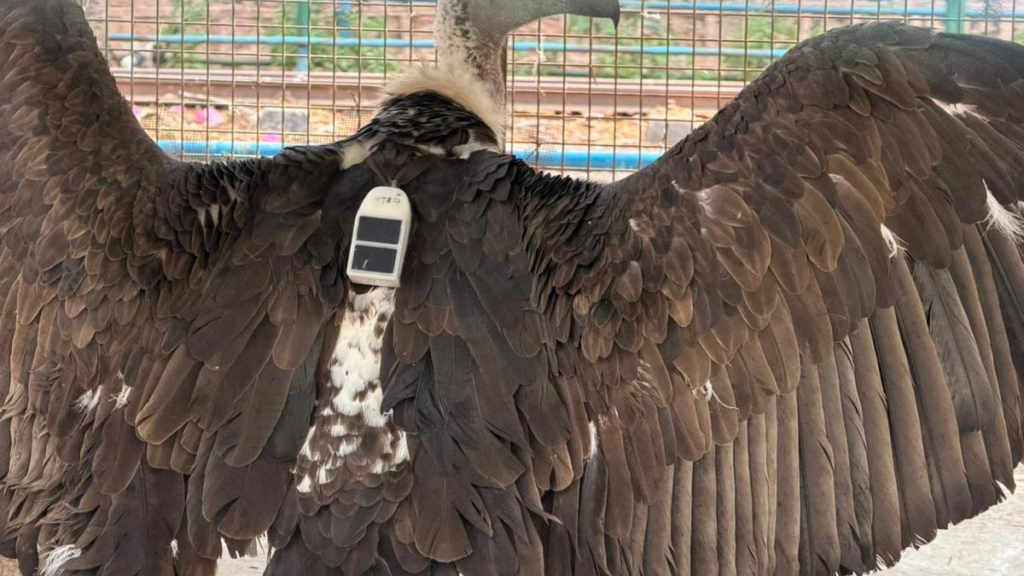
The story of Z25
- Species: White-rumped vulture (Gyps bengalensis) — Critically Endangered (IUCN).
- Identity: Z25 (its radio-tagged code).
- Sex: Female.
- Origin: Captive-bred at Jatayu Conservation Breeding Centre (JCBC), Pinjore, Haryana (BNHS + Haryana Forest Department).
What is radio telemetry?
- A technique that fits an animal with a radio transmitter (transmitter emits radio waves at specific frequency); movements are tracked via receivers/antennas or satellite links.
- Used to monitor movement patterns, home ranges, dispersal, migration routes, survival, and cause of death of wildlife.
- In vulture conservation: enables real-time tracking of released captive-bred birds to check whether they are adapting to the wild.
- Types: VHF radio telemetry (line-of-sight), satellite/PTT telemetry (GPS), and GSM telemetry (cellular network based).
- -15-9+
What is the White-Rumped Vulture (Gyps bengalensis)?
- Also called Oriental White-backed Vulture or Indian White-backed Vulture.
- Family: Accipitridae; Genus: Gyps.
- Native to South Asia — India, Nepal, Bangladesh, Pakistan (was earlier abundant across the Indo-Gangetic plains).
- IUCN Red List: Critically Endangered (since 2000).
- CITES: Appendix II.
- Wildlife (Protection) Act, 1972: Schedule I.
- Population decline: Lost 99.7% of its population between 1993 and 2002 — one of the fastest recorded declines of any bird species in history.
- Cause: Diclofenac poisoning — a veterinary NSAID (non-steroidal anti-inflammatory drug) used to treat cattle; vultures that fed on treated carcasses died of kidney failure due to visceral gout (uric acid crystallisation).
- Ecological role: Nature’s clean-up crew — a group of vultures can strip a large carcass to bone in under 40 minutes; their strong stomach acid destroys anthrax, rabies, tuberculosis bacteria.
- Estimated South-Asia population (1980s): ~40 million Gyps vultures across 3 species.
- 2017 population estimate: Only ~6,000 white-rumped vultures.
- Smallest among the Gyps species; feeds exclusively on carrion; gregarious and colonial; monogamous; one nestling per year.
What are India’s 9 vulture species?
- Resident species (6):
- White-rumped Vulture (Gyps bengalensis) — CR.
- Indian Long-billed Vulture (Gyps indicus) — CR.
- Slender-billed Vulture (Gyps tenuirostris) — CR.
- Red-headed Vulture (Sarcogyps calvus) — CR.
- Egyptian Vulture (Neophron percnopterus) — EN.
- Bearded Vulture / Lammergeier (Gypaetus barbatus) — NT (globally); Schedule I in India.
- Migratory species (3):
- Himalayan Vulture / Himalayan Griffon (Gyps himalayensis) — NT.
- Eurasian Griffon (Gyps fulvus) — LC.
- Cinereous Vulture (Aegypius monachus) — NT.
What is the Jatayu Conservation Breeding Centre (JCBC), Pinjore?
- Established: September 2001 — Asia’s first vulture breeding facility.
- Where: Village Jodhpur, on the edge of Bir Shikargah Wildlife Sanctuary, ~8 km from Pinjore, Haryana.
- Named after: The mythical vulture Jatayu from the Hindu epic Ramayana.
Where are the four JCBCs / Vulture Conservation Breeding Centres (VCBCs) in India?
- JCBC Pinjore, Haryana — 2001; joint BNHS + Haryana Forest Department + RSPB.
- VCBC Rajabhatkhawa, West Bengal — inside Buxa Tiger Reserve.
- VCBC Rani, Assam — near Guwahati (established 2008; ~90 vultures as of Dec 2018).
- VCBC Kerwa, Bhopal, Madhya Pradesh — inside Van Vihar National Park; established 2014.
- Together, these 4 JCBCs/VCBCs house ~740 vultures (as of 2026), of which ~110 have been released.
What is SAVE?
- Full form: Saving Asia’s Vultures from Extinction.
- Launched: 2011.
- Goal: Restore at least 40% (~16 million) of the vanished white-backed, long-billed, and slender-billed vulture populations.
- Plan: Set up 8 vulture breeding centres across India (JCBC + 7 more), each housing ~25 vultures/species, releasing 600 vultures across 3 million sq km.
- Partners: BNHS, RSPB (UK), BirdLife International, Zoological Society of London (ZSL), Bird Conservation Nepal, National Trust for Nature Conservation (Nepal), International Centre for Birds of Prey (UK), and 7 others (14 partner organisations + 14 Indian government agencies).
Practice MCQs
Q1. With reference to the recent electrocution of the radio-tagged white-rumped vulture ‘Z25’, consider the following statements:
- Z25 was captive-bred at the Jatayu Conservation Breeding Centre (JCBC), Pinjore, Haryana.
- It was first released at the Tadoba-Andhari Tiger Reserve, Maharashtra on 30 December 2025.
- It was electrocuted near Ebbanad village on the Sigur plateau, close to Mudumalai Tiger Reserve, on 28 June 2026.
- Z25 was one of five white-rumped vultures radio-tagged at Tadoba on 22 December 2025.
How many of the above statements are correct?
(a) Only one (b) Only two (c) Only three (d) All four (e) None
(All four statements are correct.)
Q2. With reference to the White-Rumped Vulture (Gyps bengalensis), consider the following statements:
- It is classified as Critically Endangered on the IUCN Red List.
- It is listed under Schedule I of the Wildlife (Protection) Act, 1972.
- Its primary cause of population decline has been the veterinary use of diclofenac and other NSAIDs.
- It is endemic to the South American continent.
How many of the above statements are correct?
(a) Only one (b) Only two (c) Only three (d) All four (e) None
(Statement 4 is wrong; the White-Rumped Vulture is native to South Asia (India, Nepal, Bangladesh, Pakistan) — NOT endemic to South America.)
Q3. With reference to the Jatayu Conservation Breeding Centre (JCBC), Pinjore, consider the following statements:
- It was established in 2001 and is Asia’s first vulture breeding facility.
- It is jointly run by the Bombay Natural History Society (BNHS) and the Haryana Forest Department, with support from the Royal Society for the Protection of Birds (RSPB), UK.
- It is located on the edge of the Bir Shikargah Wildlife Sanctuary in Haryana.
- It is named after a mythical vulture from the Hindu epic Mahabharata.
How many of the above statements are correct?
(a) Only one (b) Only two (c) Only three (d) All four (e) None
(Statement 4 is wrong; JCBC is named after the mythical vulture Jatayu from the RAMAYANA — NOT the Mahabharata.)
Q4. With reference to the Bombay Natural History Society (BNHS), consider the following statements:
- BNHS was founded in 1883 and is headquartered at Hornbill House, Mumbai.
- BNHS is the Indian partner of BirdLife International.
- BNHS leads India’s vulture conservation breeding programme in collaboration with state forest departments and RSPB (UK).
- BNHS is a statutory body created under an Act of Parliament.
How many of the above statements are correct?
(a) Only one (b) Only two (c) Only three (d) All four (e) None
(Statement 4 is wrong; BNHS is a NON-GOVERNMENTAL scientific research organisation (autonomous society) — NOT a statutory body created under an Act of Parliament.)
Q5. With reference to diclofenac and vulture conservation in India, consider the following statements:
- Diclofenac is a non-steroidal anti-inflammatory drug (NSAID) used to treat cattle.
- It caused kidney failure and visceral gout in vultures that fed on treated carcasses.
- Veterinary use of diclofenac was banned in India on 11 March 2006.
- Meloxicam has been identified as a vulture-safe alternative to diclofenac.
How many of the above statements are correct?
(a) Only one (b) Only two (c) Only three (d) All four (e) None
(All four statements are correct.)
Answer Key
- (d) — All four correct.
- (c) — Statement 4 wrong: WRV is native to South Asia, not South America.
- (c) — Statement 4 wrong: JCBC is named after Jatayu (Ramayana), not Mahabharata.
- (c) — Statement 4 wrong: BNHS is a private NGO, not a statutory body.
- (d) — All four correct.
Exam Relevance
- UPSC Prelims & Mains: Very High — GS-III (Environment, Biodiversity, Conservation, IUCN Red List categories); Prelims (species, drugs, breeding centres, key acts); the diclofenac question has appeared in UPSC Prelims (2011: “Which drug is responsible for vulture decline?”).
- NABARD Grade A: High — ESI + ARD papers on ecology, biodiversity, conservation programmes; Phase II descriptive on environment.
- State PCS (Haryana, Maharashtra, Tamil Nadu, Karnataka, MP, Assam, WB): Very High — State-specific breeding centres, tiger reserves, and vulture habitats.
3. 16th India–Japan Annual Summit
Source: The Hindu
Context
Japanese Prime Minister Ms. Sanae Takaichi — Japan’s first female Prime Minister — paid her first Official State Visit to India from 1–3 July 2026, at the invitation of PM Narendra Modi, for the 16th India–Japan Annual Summit in New Delhi. She was accompanied by senior officials, CEOs, and industry leaders (a ~120-strong business delegation with ~2 trillion yen (~$13 billion) of investment announcements). The two leaders adopted three landmark joint statements — on Economic Security, Artificial Intelligence, and Energy Resilience — and released a 16-point roadmap. The summit formally aligned Japan’s Updated Free and Open Indo-Pacific (FOIP) strategy with India’s MAHASAGAR doctrine and Indo-Pacific Oceans’ Initiative (IPOI). Set against a backdrop of maritime security tensions, energy volatility, and Chinese economic coercion (Japan-linked entities put on Beijing’s export-restriction list), the summit strengthened the India–Japan Special Strategic and Global Partnership. The two sides agreed to celebrate 2027 — marking 75 years of diplomatic relations — as the “Year of Shared Horizons“.
The visit at a glance
- Visitor: Prime Minister Sanae Takaichi, Japan’s first female PM.
- Host: PM Narendra Modi.
- Dates: 1–3 July 2026.
- Venue: New Delhi (ceremonial reception at Rashtrapati Bhavan; talks at Hyderabad House).
- Summit edition: 16th India–Japan Annual Summit.
- Nature: Takaichi’s first Official State Visit to India since taking office as PM.
- Delegation: Senior officials + CEOs + industry leaders (~120 Japanese companies).
- Modi’s warm gesture: Called Takaichi “meri chhoti behen” (my younger sister); Takaichi described a “brother–sister” relationship in reply. Modi is 76; Takaichi turned 65 in March 2026.
- Next Summit: 17th Annual Summit to be hosted by Japan in 2027; PM Modi accepted the invitation.
Three landmark joint statements adopted
- India–Japan Joint Declaration on Economic Security — identifies economic security as a foundational pillar; cooperation in 5 priority sectors: semiconductors, critical minerals, ICT, clean energy, and pharmaceuticals.
- Joint Statement on Cooperation in the Field of Artificial Intelligence — establishes a new AI Strategic Dialogue for safe, trusted, inclusive AI cooperation.
- Joint Statement on Energy Resilience — bilateral dialogue on India’s petroleum stockpiling under Japan’s “Power Asia” initiative + support for India’s International Energy Agency (IEA) membership.
What is the MAHASAGAR doctrine?
- Full form: Mutual and Holistic Advancement for Security And Growth Across Regions.
- Announced by PM Modi in March 2025 in Mauritius, as an expanded successor to SAGAR (Security And Growth for All in the Region — first articulated in March 2015 in Mauritius).
- From SAGAR to MAHASAGAR: Expands India’s Indian Ocean Region (IOR) vision into a broader, global-south-oriented maritime doctrine covering the entire Indo-Pacific + Africa.
- Core idea: Ocean as a shared space; countries defend their sovereignty through their own efforts; freedom of navigation; rules-based order; capacity-building of smaller states.
- Aligned engagements: Modi’s outreach to Mauritius, Maldives, Trinidad & Tobago, Ghana, Philippines in 2025–26.
What is Japan’s FOIP?
- Full form: Free and Open Indo-Pacific — first articulated by former PM Shinzo Abe in his “Confluence of the Two Oceans” speech in the Indian Parliament (August 2007).
- Updated FOIP (2026): Announced by PM Takaichi; shifts focus to self-reliance, autonomy, and resilience of Indo-Pacific nations — empowering regional partners to withstand external coercion.
- Alignment with MAHASAGAR: Both emphasise rule of law + freedom of navigation + inclusive growth + autonomy of smaller states.
What is IPOI?
- Full form: Indo-Pacific Oceans’ Initiative.
- Announced by PM Modi at the East Asia Summit in Bangkok, November 2019.
- Seven pillars: Maritime Security; Maritime Ecology; Maritime Resources; Capacity Building & Resource Sharing; Disaster Risk Reduction & Management; Science, Technology & Academic Cooperation; Trade Connectivity & Maritime Transport.
- Japan is the lead partner on the Connectivity pillar of IPOI.
What is the India–Japan Special Strategic and Global Partnership?
- Established: September 2014 by PM Modi + then-PM Shinzo Abe.
- Foundation of India–Japan ties: elevated from “Global Partnership” (2000) → “Global and Strategic Partnership” (2006) → “Special Strategic and Global Partnership” (2014).
- Anchored on shared values of democracy, rule of law, freedom of navigation, market economy.
What is the Mumbai–Ahmedabad High-Speed Rail (MAHSR)?
- India’s first bullet train project — jointly funded/technically supported by JICA (Japan International Cooperation Agency).
- Route: Mumbai (Bandra Kurla Complex) → Sabarmati (Ahmedabad).
- Technology: Japanese Shinkansen E5 (initially) → E10 (upcoming next-gen).
Practice MCQs
Q1. With reference to the 16th India-Japan Annual Summit (2026), consider the following statements:
- Japanese Prime Minister Sanae Takaichi paid her first Official State Visit to India from 1-3 July 2026.
- Ms. Takaichi is Japan’s first female Prime Minister.
- The two sides adopted three landmark joint statements — on Economic Security, Artificial Intelligence, and Energy Resilience.
- The two Prime Ministers agreed to celebrate 2027 as the “Year of Shared Horizons” marking 75 years of diplomatic relations.
How many of the above statements are correct?
(a) Only one (b) Only two (c) Only three (d) All four (e) None
(All four statements are correct.)
Q2. With reference to the MAHASAGAR doctrine, consider the following statements:
- Its full form is ‘Mutual and Holistic Advancement for Security and Growth Across Regions’.
- It was announced by PM Modi in March 2025 in Mauritius.
- It expands the earlier SAGAR (Security and Growth for All in the Region) doctrine of 2015.
- It is fundamentally aligned with the Belt and Road Initiative of China.
How many of the above statements are correct?
(a) Only one (b) Only two (c) Only three (d) All four (e) None
(Statement 4 is wrong; MAHASAGAR is presented as an ALTERNATIVE to China’s Belt and Road Initiative, not aligned with it. Japan’s FOIP and India’s MAHASAGAR together offer the Global South a democratic, autonomy-preserving alternative to the BRI.)
Answer Key
- (d) — All four correct.
- (c) — Statement 4 wrong: MAHASAGAR is an alternative to BRI, not aligned with it.
Exam Relevance
- UPSC Prelims & Mains: CRITICAL — Direct subject: GS-II (International Relations, Bilateral Ties, Groupings involving India); Prelims (institutions, doctrines, agreements); Mains-Essay on Indo-Pacific.
- NABARD Grade A: Very High — ESI on foreign trade, CEPA, FDI, agri biogas cooperation; Phase II descriptive on economic security.
4. Employees’ Provident Funds (EPF) Scheme, 2026
Source: Business Standard
Context
The Ministry of Labour and Employment has notified the Employees’ Provident Funds (EPF) Scheme, 2026, which came into force on 29 June 2026 and replaces the seven-decade-old EPF Scheme, 1952. Framed under the Code on Social Security, 2020, the new scheme is described as the biggest overhaul of India’s provident fund framework in over 70 years. While the core structure — the 12% mandatory contribution, ₹15,000 statutory wage ceiling, and 8.25% interest rate for FY 2025-26 — remains unchanged, the new scheme introduces significant changes: partial withdrawal categories consolidated from 13 to 3, a new mandatory 25% minimum balance rule, an explicit Principal Employer concept for contract worker protection, an emergency deferment provision (for pandemics/disasters), and formal recognition of digital services (Aadhaar-linked UAN, UPI withdrawals, WhatsApp services). Existing subscribers automatically continue as members — no fresh enrolment or transfer of balances is required. Three transition initiatives — Employees’ Enrolment Campaign 2026, VISHWAS 2026, and AMNESTY 2026 — have also been launched.
What is the aim of the scheme?
- Provide financial security and retirement savings for salaried workers.
- Modernise India’s provident fund framework.
- Implement the Code on Social Security, 2020 through EPF administration.
- Formally embed digital-first governance into the statutory PF framework.
What has NOT changed?
- Interest rate: 8.25% p.a. for FY 2025-26 (approved by Ministry of Labour and Employment; unchanged).
- Contribution rate: 12% each by employer and employee (10% for notified establishments like startups, sick units, and units with <20 employees).
- Statutory wage ceiling: ₹15,000/month (unchanged).
- EPS split: 8.33% of employer contribution goes to EPS; 3.67% to EPF.
- Tax treatment, nomination rules, transfer of PF balances — all unchanged.
- Existing EPF member accounts — continue seamlessly with no fresh enrolment.
What are the mandatory contribution rules?
- Both employer + employee contribute 12% of wages.
- Mandatory contribution capped at ₹1,800/month each (i.e., 12% of ₹15,000 wage ceiling).
- Wages above ₹15,000/month — mandatory contribution restricted to ceiling; extra is now explicitly voluntary.
- 10% contribution rate — continues for certain notified establishments.
- Emergency deferment provision: Central Government may temporarily reduce or defer contributions (employer’s, employee’s, or both) for up to 3 months during a pandemic, epidemic, or national disaster (via separate notification).
What are Voluntary Higher Contributions?
- Employees may voluntarily contribute above the ₹15,000 wage ceiling or at rates exceeding 12%.
- Employers may make matching voluntary contributions (optional).
- Such additional contributions can be reduced or discontinued later — providing flexibility.
- Continues the traditional Voluntary Provident Fund (VPF) facility.
How have Withdrawal Categories been simplified?
The earlier 13 withdrawal categories consolidated into 3:
- Essential Needs — illness, education, marriage.
- Housing Needs — purchase, construction, home loan repayment, renovation.
- Special Circumstances — specified emergencies (natural disasters, pandemics, etc.).
What are the New Withdrawal Provisions?
- Illness: Up to 100% of eligible balance after 12 months of membership.
- Education: Withdrawal permitted after 12 months — maximum 10 times in service life.
- Marriage: Up to 100% of eligible balance — maximum 5 withdrawals.
- Housing: Up to 75% of total balance after 12 months — maximum 5 withdrawals.
- Unemployment: Full withdrawal permitted after remaining unemployed for 1 year.
What is the new Minimum Balance Requirement?
- Members must retain at least 25% of aggregate fund balance as a minimum retirement corpus.
- Applies to both employee and employer contributions combined.
- Example: If total balance = ₹1 lakh → ₹25,000 must be retained; only ₹75,000 available for withdrawal subject to scheme rules.
- “Eligible member balance” = amount available AFTER deducting the compulsory 25% minimum balance.
What is the Principal Employer concept?
- New provision in the 2026 Scheme.
- Explicitly recognises Principal Employer’s ultimate responsibility for PF contributions of contract workers where contractors fail to comply.
- Prevents employers from avoiding social security obligations by outsourcing labour.
- Contractor must generally deposit PF within 15 days of close of every month.
- If contractor defaults → principal employer becomes liable.
How is Digital Governance embedded?
- Aadhaar-linked UAN + bank accounts mandatory.
- UPI-based withdrawals enabled.
- WhatsApp-based member services launched.
- Online claim submission, digital records, electronic annual account statements, digital inspections — now legally recognised.
- Formally embeds the EPFO 3.0 digital transformation into statute.
- Supports 72-hour claim settlements (recently launched).
What about International Workers?
- Existing provisions continue.
- International members under the 1952 Scheme automatically continue under the 2026 framework.
- Coverage remains for eligible international workers in covered establishments.
- India’s bilateral Social Security Agreements (SSAs) with 20+ countries continue.
Special provision for Exempted Establishments (Private PF Trusts)
- Some employers run their own PF Trusts instead of depositing with EPFO — these are called exempted establishments.
- New rule: Exempted trusts cannot declare an annual interest rate more than 200 basis points (2 percentage points) higher than the EPF rate declared by Central Government.
- Objective: Consistency in returns + flexibility based on investment performance.
What are the 3 Transition Initiatives launched?
- Employees’ Enrolment Campaign 2026 — enable employers to regularise past employee registration gaps.
- VISHWAS 2026 — settlement of legacy disputes with EPFO.
- AMNESTY 2026 — help employers close past compliance gaps without penal action.
What is EPFO?
- Full form: Employees’ Provident Fund Organisation.
- Established: 1952 (initially under the EPF Act, 1952).
- Headquarters: New Delhi.
- Statutory backing: Now under the Code on Social Security, 2020 (earlier under EPF & MP Act, 1952).
- Parent Ministry: Ministry of Labour and Employment.
- Chair of Central Board of Trustees: Union Minister of Labour and Employment.
- Scale: One of the world’s largest social security organisations by membership and financial transactions.
- Regional presence: 135+ regional offices across India.
- Three schemes managed by EPFO:
- Employees’ Provident Fund Scheme, 1952 (now replaced by EPF Scheme, 2026).
- Employees’ Pension Scheme (EPS), 1995.
- Employees’ Deposit Linked Insurance (EDLI) Scheme, 1976.
Practice MCQs
Q1. With reference to the Employees’ Provident Funds (EPF) Scheme, 2026, consider the following statements:
- It was notified by the Ministry of Labour and Employment and came into force on 29 June 2026.
- It replaces the Employees’ Provident Funds Scheme, 1952.
- It has been framed under the Code on Social Security, 2020.
- It abolishes the mandatory Employees’ Pension Scheme (EPS), 1995.
How many of the above statements are correct?
(a) Only one (b) Only two (c) Only three (d) All four (e) None
(Statement 4 is wrong; the EPS, 1995 continues unchanged — it has NOT been abolished. Only the 1952 Scheme has been replaced by the 2026 Scheme.)
Q2. With reference to the contribution rules under the EPF Scheme, 2026, consider the following statements:
- Both employers and employees continue to contribute 12% of wages, with 10% applicable for notified establishments.
- Mandatory contribution is capped at ₹1,800 per month (i.e., 12% of the ₹15,000 statutory wage ceiling).
- Employees may voluntarily contribute above the wage ceiling or at rates exceeding 12%.
- Any voluntary contribution once made cannot be reduced or discontinued later.
How many of the above statements are correct?
(a) Only one (b) Only two (c) Only three (d) All four (e) None
(Statement 4 is wrong; voluntary contributions CAN be reduced or discontinued later — the scheme specifically provides this flexibility.)
Answer Key
- (c) — Statement 4 wrong: EPS, 1995 continues.
- (c) — Statement 4 wrong: Voluntary contributions CAN be reduced/discontinued.
4. Borjuli Wetland — Assam’s 3rd Biodiversity Heritage Site (BHS)
Context
The Borjuli wetland in Sonitpur district of Assam has been officially notified as a Biodiversity Heritage Site (BHS) by the Assam State Government on the recommendation of the Assam State Biodiversity Board (ASBB) and recognition by the National Biodiversity Authority (NBA). Spread over a mere 0.41 hectare (coordinates: 26.810888°N, 92.623559°E), the wetland harbours a globally significant wild rice population — Oryza rufipogon, the wild ancestor (progenitor) of cultivated rice (Oryza sativa). This wild rice variety is disease- and pest-resistant and can tolerate flooding and saline conditions — making it invaluable for developing climate-resilient rice varieties. The BHS notification is the outcome of the project “In-situ Conservation and Management of Wild Rice (Oryza rufipogon) in Sonitpur District of Assam” — funded by the National Rainfed Area Authority (NRAA) since 2022 and implemented by the ICAR-National Bureau of Plant Genetic Resources (ICAR-NBPGR) in collaboration with the ASBB. Borjuli is Assam’s 3rd BHS (after Majuli and Hajong Tortoise Lake) and India’s 55th BHS (as of 3 July 2026).
Which BHS is this?
- India’s 55th BHS (as of 3 July 2026).
- Assam’s 3rd BHS — following:
- Majuli BHS — the world’s largest inhabited river island; ~875 sq km.
- Hajong Tortoise Lake BHS — preserves rare freshwater tortoises.
- First BHS specifically for wild rice conservation in India.
What is the Borjuli wetland?
- A biologically unique freshwater swamp and marshy ecosystem.
- Acts as a natural gene sanctuary for crop wild relatives (CWR).
- Nested within the fertile, flood-prone plains of the Brahmaputra river valley.
- Fed by seasonal monsoonal runoff + alluvial water channels.
- Undergoes cycles of intense flooding and waterlogged conditions.
What is Oryza rufipogon?
- The wild ancestor / progenitor of cultivated rice (Oryza sativa).
- Perennial plant; native to marshes and aquatic habitats across eastern and southern Asia.
- Genetic significance: Reservoir of ancient, unaltered rice genes; critical for future crop improvement.
- Natural traits:
- Disease and pest resistance — evolved over millennia in the wild.
- Tolerance to flooding (submergence tolerance).
- Tolerance to saline water conditions.
- Use in crop breeding: Source of genes for developing climate-resilient, high-yielding, and nutritionally superior rice varieties.
What is a Biodiversity Heritage Site (BHS)?
- A legally protected geographic area notified for its unique, ecologically fragile ecosystem.
- Statutory basis: Section 37 of the Biological Diversity Act, 2002.
- Notified by: State Governments in consultation with local Biodiversity Management Committees (BMCs).
- What qualifies as a BHS:
- Rich biodiversity — wild or domesticated species.
- Unique crop varieties / crop wild relatives.
- Rare or threatened wildlife.
- Sacred groves.
- Valuable fossil beds.
- Wetlands and other ecosystems outside the National Park or Wildlife Sanctuary network.
- Purpose: Protects fragile ecosystems that would otherwise fall outside the traditional Protected Area (PA) system.
Who governs a BHS?
- Community-led: Managed by Biodiversity Management Committees (BMCs) at the panchayat/local level.
- Financing + technical oversight: Guidance from the National Biodiversity Authority (NBA).
- Central funding: Can come from agencies like the National Rainfed Area Authority (NRAA) — as seen with Borjuli.
- Ensures conservation supports (rather than replaces) traditional community access + sustainable farming methods.
What is the National Biodiversity Authority (NBA)?
- Full form: National Biodiversity Authority.
- Established: 2003 (under the Biological Diversity Act, 2002).
- Headquarters: Chennai, Tamil Nadu.
- Parent Ministry: Ministry of Environment, Forest and Climate Change (MoEFCC).
- Type: Statutory autonomous body.
- Role: Regulates access to India’s biological resources; provides guidance to State Biodiversity Boards (SBBs); oversees BHS designations.
- Chairperson (2026): Dr. C. Achalender Reddy (since 2024).
Practice MCQs
Q1. With reference to the Borjuli wetland, consider the following statements:
- It is located in the Sonitpur district of Assam.
- It has been notified as a Biodiversity Heritage Site (BHS) for its unique wild rice population.
- It hosts Oryza rufipogon, the wild progenitor of cultivated rice Oryza sativa.
- It covers an area of approximately 1,000 hectares.
How many of the above statements are correct?
(a) Only one (b) Only two (c) Only three (d) All four (e) None
(Statement 4 is wrong; the Borjuli wetland covers only ~0.41 hectare — NOT 1,000 hectares. It is a very small but ecologically critical site.)
Q2. With reference to Biodiversity Heritage Sites (BHS) in India, consider the following statements:
- BHSs are notified under Section 37 of the Biological Diversity Act, 2002.
- They are notified by State Governments in consultation with local Biodiversity Management Committees.
- They are managed under the guidance of the National Biodiversity Authority (NBA).
- The Nallur Tamarind Grove in Karnataka was the first BHS to be notified in India.
How many of the above statements are correct?
(a) Only one (b) Only two (c) Only three (d) All four (e) None
(All four statements are correct.)
Answer Key
- (c) — Statement 4 wrong: Area is 0.41 ha, not 1,000 ha.
- (d) — All correct.
Agriculture
1. ‘Pashujanya Yudh Abhyas (PYA)’
Source: PIB
Context
The Department of Animal Husbandry & Dairying (DAHD), under the Ministry of Fisheries, Animal Husbandry & Dairying, on 3 July 2026 successfully concluded Pashujanya Yudh Abhyas (PYA) — the 3rd national-level mock drill under the National One Health Mission (NOHM). The 5-day exercise (29 June – 3 July 2026) was held at Khari village, Vidisha District, Madhya Pradesh and simulated an outbreak of Influenza A (H1N1) in animals with spillover potential to humans and wildlife. Built around the One Health approach, the drill tested the full response chain — disease surveillance, early warning, sample collection + transport, laboratory diagnosis, risk assessment, biosecurity, containment, movement control, and public communication — with participation from DAHD, ICAR, NCDC, ICMR, Office of the Principal Scientific Advisor (PSA), ICAR-NIHSAD Bhopal, AIIMS Bhopal, MoEF&CC, and Madhya Pradesh’s state + district departments, under the coordination of the National Joint Outbreak Response Team (NJORT). DAHD Secretary Shri Naresh Pal Gangwar described the exercise as “the One Health approach in action.”
The exercise at a glance
- Name: Pashujanya Yudh Abhyas (PYA).
- Meaning: “Zoonotic Warfare Exercise” (Sanskrit-origin: Pashu = animal + Janya = originated from + Yudh Abhyas = war exercise/drill).
- Edition: 3rd national-level mock drill under the National One Health Mission.
- Organiser: Department of Animal Husbandry & Dairying (DAHD), Ministry of Fisheries, Animal Husbandry & Dairying.
- Duration: 29 June – 3 July 2026 (5 days).
- Venue: Khari village, Vidisha District, Madhya Pradesh.
- Framework: One Health approach.
- Simulated outbreak: Influenza A (H1N1) in animals with potential spillover to humans + wildlife.
- Concluding debrief: 3 July 2026 under the Chairmanship of the Animal Husbandry Commissioner, DAHD, with the Director, NCDC and Director, Animal Husbandry, MP in attendance.
What was tested during the drill?
The full “first alert to containment” response chain:
- Disease surveillance — active + passive.
- Early warning + outbreak reporting — chain-of-communication.
- Outbreak investigation + field epidemiology — case tracing.
- Sample collection + transportation — cold chain, biosafety.
- Laboratory diagnosis — RT-PCR, sequencing.
- Risk assessment — public health + wildlife impact.
- Incident management — Incident Command System.
- Biosecurity — PPE, quarantine, disinfection.
- Containment operations — culling, ring vaccination.
- Movement control — animal + human movement restrictions.
- Public communication — risk messaging, media briefings.
What is the One Health approach?
- An integrated, unifying approach recognising that the health of people, animals, plants, and the shared environment are interconnected.
- Approximately 75% of emerging infectious diseases in humans originate in animals (zoonoses).
- Enables cross-sectoral collaboration between human health, veterinary health, wildlife, and environment sectors.
- Endorsed globally by the Quadripartite Alliance — FAO + UNEP + WHO + WOAH.
- One Health Joint Plan of Action (OH-JPA) 2022–2026 — global framework by the Quadripartite.
What is the National One Health Mission (NOHM)?
- Approved by: The Prime Minister’s Science, Technology, and Innovation Advisory Council (PM-STIAC) at its 21st meeting in July 2022.
- Nodal Coordinator: Office of the Principal Scientific Advisor (PSA) to the Government of India.
- Anchor Institution: National Institute of One Health (NIOH), Nagpur — foundation stone laid by PM Modi in December 2022.
- Vision: Build an integrated disease control and pandemic preparedness system in India by unifying human, animal, and environmental sectors.
- Ministries involved: 13+ ministries and departments — Health, Animal Husbandry, Environment, Defence, DBT, CSIR, AYUSH, ICMR, ICAR, MoHFW, MoEFCC etc.
What is Influenza A (H1N1)?
- Also known as swine flu (in its 2009 pandemic strain).
- Caused the 2009-10 global H1N1 pandemic — first pandemic of the 21st century.
- A zoonotic virus — originally emerged in pigs; transmits to humans through respiratory droplets.
- Structure: RNA virus of the Orthomyxoviridae family; “H” = hemagglutinin, “N” = neuraminidase surface proteins.
- Symptoms: Fever, cough, sore throat, body ache, fatigue (like seasonal flu but potentially severe).
- Currently: H1N1 has become part of seasonal flu; monitored via India’s Integrated Disease Surveillance Programme (IDSP).
What is DAHD?
- Full form: Department of Animal Husbandry and Dairying.
- Parent Ministry: Ministry of Fisheries, Animal Husbandry and Dairying.
- Union Minister: Rajiv Ranjan Singh (Lalan Singh) (2024-present).
- Secretary: Shri Naresh Pal Gangwar.
- Role: Overall development of livestock, dairy, and animal husbandry sector.
- Key programmes: National Livestock Mission, Rashtriya Gokul Mission, National Digital Livestock Mission.
Practice MCQs
Q1. With reference to Pashujanya Yudh Abhyas (PYA), consider the following statements:
- It was the third national-level mock drill under the National One Health Mission.
- It was conducted from 29 June to 3 July 2026 at Khari village in Vidisha District, Madhya Pradesh.
- It simulated an outbreak of Influenza A (H1N1) in animals with spillover potential to humans and wildlife.
- It was organised by the Ministry of Home Affairs.
How many of the above statements are correct?
(a) Only one (b) Only two (c) Only three (d) All four (e) None
(Statement 4 is wrong; PYA was organised by the Department of Animal Husbandry & Dairying (DAHD) under the Ministry of Fisheries, Animal Husbandry & Dairying — NOT the Ministry of Home Affairs.)
Q2. With reference to the National One Health Mission (NOHM), consider the following statements:
- It was approved by the Prime Minister’s Science, Technology, and Innovation Advisory Council (PM-STIAC) in 2022.
- It is anchored by the Office of the Principal Scientific Advisor to the Government of India.
- Its anchor institution is the National Institute of One Health, Nagpur.
- It is a single-ministry initiative led entirely by the Ministry of Health and Family Welfare.
How many of the above statements are correct?
(a) Only one (b) Only two (c) Only three (d) All four (e) None
(Statement 4 is wrong; NOHM is a multi-ministerial initiative involving 13+ ministries and departments — including Health, Animal Husbandry, Environment, Defence, DBT, CSIR, AYUSH, ICMR, ICAR etc. — NOT a single-ministry initiative.)
Answer Key
- (c) — Statement 4 wrong: Organised by DAHD, not MHA.
- (c) — Statement 4 wrong: NOHM is multi-ministerial, not single-ministry.
Exam Relevance
- NABARD Grade A: Very High — ESI + ARD papers on livestock, animal health, zoonotic disease impact on rural economy.
Facts To Remember
1. Digital India Programme Completes 11 Years
Digital India completed 11 years on 1 July 2026. Launched by Narendra Modi in 2015, the programme aims to build a digitally empowered society and knowledge economy. Its focus now includes Artificial Intelligence and semiconductor manufacturing.
2. Tourism Ministry Signs MoU with Google India
The Ministry of Tourism signed an MoU with Google India to boost digital tourism promotion. The partnership will use AI, analytics, and digital platforms to enhance global visibility of Indian tourism. It supports the Incredible India initiative through technology-driven outreach.
3. PM Modi Visits Seychelles
Narendra Modi visited Seychelles from 27–29 June 2026. India and Seychelles signed 9 MoUs covering defence, healthcare, maritime cooperation, and digital payments. PM Modi also received Seychelles’ highest honour, “Guardian of the Blue Horizon.”
4. Bank of Baroda Partners with Mizuho Bank
Bank of Baroda partnered with Mizuho Bank for M&A financing. The collaboration covers acquisition finance, co-underwriting, syndication, and advisory services. It strengthens cross-border financing capabilities.
5. NPCI Partners with HSBC and JP Morgan for Cross-Border UPI
National Payments Corporation of India (NPCI) partnered with HSBC India and JP Morgan Payments. The collaboration enables real-time forex settlement for cross-border UPI transactions. It improves speed, transparency, and payment efficiency for global users.
6. Himachal Pradesh Gets 8 New GI Tags
Himachal Pradesh received eight new Geographical Indication tags, taking its total GI products to 17. Newly tagged products include Kinnauri Apple, Seabuckthorn, and Chamba Metal Art. The recognition boosts traditional products and rural livelihoods.
7. HDFC Bank Appoints Rajiv Kumar as Chairman
HDFC Bank appointed Rajiv Kumar as part-time Chairman for three years. He succeeds Keki Mistry. He has also been appointed Additional Independent Director.
8. RBI Appoints Ravi Shankar as Executive Director
Reserve Bank of India (RBI) appointed Ravi Shankar as Executive Director from 1 July 2026. He will head the Department of Statistics and Information Management. He brings over 30 years of central banking experience.
9. CCI Clears Major Acquisition Deals
Competition Commission of India (CCI) approved two major deals. These include DWS Group’s stake acquisition in Nippon Life India AIF and Aditya Birla-led acquisition of RCB. The approvals strengthen India’s asset management and sports sectors.
10. Kotak Mahindra Bank to Acquire Deutsche Bank India Business
Kotak Mahindra Bank will acquire Deutsche Bank India retail and wealth business for ₹281.7 crore. The acquisition includes loans, deposits, and assets under management. It strengthens Kotak’s affluent banking segment.
11. BPCL Acquires Stake in Tiki Tar–Shell India JV
Bharat Petroleum Corporation Limited (BPCL) signed a deal to acquire 40% stake in Tiki Tar–Shell India JV. The ₹85 crore acquisition boosts BPCL’s bitumen and road materials business. It will make BPCL an equal joint venture partner.
12. MoEFCC Launches Animal Taxonomy Summit 4.0
Ministry of Environment, Forest and Climate Change (MoEFCC) launched ATS 4.0 in Kolkata. The summit marked the 111th Foundation Day of Zoological Survey of India. New biodiversity records and annual discovery reports were released.
13. Former Governor MM Lakhera Passes Away
Madan Mohan Lakhera passed away at 88. He served as Governor of Mizoram and Lieutenant Governor of Puducherry. He was decorated with PVSM, AVSM, and VSM for military service.
14. Tamil Poet Puviyarasu Passes Away
Puviyarasu passed away at 96 in Coimbatore. He authored over 120 books and translated global literary works into Tamil. He was a two-time Sahitya Akademi Award winner.
15. GST Day Observed on July 1
GST Day is observed annually in India on 1 July. The day marks the rollout of Goods and Services Tax in 2017. GST taxpayers increased from 66.5 lakh to 1.65 crore by 2026.
16. World Sports Journalists Day Observed
World Sports Journalists Day is observed on 2 July. It honors sports journalists for promoting fair and quality sports reporting. The day commemorates the founding of International Sports Press Association in 1924.
17. Biswanath Sinha Becomes Kerala Chief Secretary
Biswanath Sinha assumed charge as Chief Secretary of Kerala. He succeeds Dr. A. Jayathilak. His tenure will continue until September 2028.
18. Mylswamy Annadurai Appointed TN Curriculum Chairman
Mylswamy Annadurai was appointed Chairman of Tamil Nadu’s Curriculum Design Committee. He will lead curriculum modernization for 1.3 crore students. The initiative focuses on AI, science, and critical thinking.
Here are the news items converted into your preferred format with serial numbers continuing from 19, one-line headings, and 3-line concise descriptions:
19. PM Modi Dedicates Greenfield Refinery Project in Rajasthan
Narendra Modi dedicated India’s first greenfield integrated refinery-cum-petrochemical complex at Balotra. He also inaugurated the new terminal building of Jodhpur Airport. Development projects worth ₹1.06 lakh crore across energy, transport, and infrastructure were launched.
20. Jal Shakti Ministry Launches 7th National Water Awards
Ministry of Jal Shakti launched the 7th National Water Awards on the Rashtriya Puraskar portal. The awards aim to encourage water conservation, efficient water management, and public participation. They recognize individuals, institutions, and states for best water practices.
21. India’s First Export-Import Shipping Container Unveiled
Sarbananda Sonowal unveiled India’s first export-import shipping container manufactured in Dadri. The container was built for A.P. Moller–Maersk. The initiative strengthens India’s manufacturing and global shipping capabilities.
22. Third Batch of DAKSH Leadership Programme Inaugurated
Jitendra Singh inaugurated the third batch of the DAKSH leadership programme. The programme focuses on strengthening leadership, governance, and administrative capacity among public officials. It promotes the Whole-of-Government approach through institutional collaboration.







