

In the news4
Context:
Prime Minister Narendra Modi launched the Nasha Mukt Yuva for Viksit Bharat Sankalp Abhiyan through video conferencing — a nationwide campaign to build a drug-free youth population as the foundation of Viksit Bharat@2047.
What It Is
A nationwide mass awareness and behavioural change campaign to prevent drug abuse among youth through community participation (Jan Bhagidari), sustained public engagement and healthy lifestyle promotion.
Aim: to build a drug-free, physically and mentally healthy youth population able to contribute to the vision of Viksit Bharat by 2047.
Key Features
- 100-week national campaign — activities organised every Sunday across the country, rather than as a one-time observance.
- Mass community participation — supported by 125+ spiritual, educational, industrial and public organisations, covering 28,000+ locations nationwide.
- Youth-centric activities — sports events, walkathons, meditation sessions, cultural programmes, nukkad nataks, discussion forums, art competitions, yoga and community engagement.
- Public pledge movement — over one crore youth took a nationwide anti-drug pledge, committing both to personal sobriety and to spreading the message in schools, colleges and communities.
- Rehabilitation and social reintegration — encourages seeking professional help through rehabilitation centres and promotes giving recovering individuals a second chance.
Context:
Union Minister for Environment, Forest and Climate Change Bhupender Yadav announced the designation of Glaw Lake (also known as Glow Lake) in Arunachal Pradesh as India’s 101st Ramsar Site — marking Arunachal Pradesh’s very first Ramsar Site and taking India’s tally of internationally protected wetlands past the 100 mark.
What It Is
A high-altitude, pristine, natural freshwater lake in the Eastern Himalayas, spread over an estimated 8 sq km at an elevation of about 1,168 metres above sea level, and a major source of the perennial Kamlang River.
| Aspect | Detail |
|---|---|
| District | Lohit District, Arunachal Pradesh (near the town of Wakro) |
| Protected area | Lies deep inside the Kamlang Tiger Reserve and Wildlife Sanctuary, bounded by the Lang River to the north and Namdapha National Park to the south |
| Indigenous communities | Surrounded by traditional territories of the Miju Mishmi, Digaro Mishmi and Idu Mishmi tribes |
Origin
- Hydrological: fed by multiple perennial high-altitude mountain streams flowing down from Eastern Himalayan glaciated ridges.
- Geomorphological: formed through natural tectonic activity and land-block warping typical of the Eastern Himalayan structural fold belt, creating a high-altitude depression that impounds alpine run-off.
Ecological Significance
- A biodiversity hotspot, surrounded by lush vegetation supporting rich floral diversity.
- Over 150 tree species and 49 orchid species recorded within the site and its catchment.
- Located in the Eastern Himalaya biodiversity hotspot, one of the world’s most species-rich and least-explored regions.
- Its perennial feed to the Kamlang River makes it a water security asset for downstream communities.
Background: The Ramsar Convention
| Feature | Detail |
|---|---|
| Full name | Convention on Wetlands of International Importance, especially as Waterfowl Habitat |
| Signed | 2 February 1971 at Ramsar, Iran; in force from 1975 |
| World Wetlands Day | 2 February |
| India’s accession | 1982; first sites — Chilika Lake (Odisha) and Keoladeo National Park (Rajasthan) |
| India’s tally | 101 — the highest in Asia and among the highest in the world |
| Montreux Record | A register of Ramsar sites where ecological character has changed or is likely to change. India’s entries: Keoladeo National Park and Loktak Lake (Manipur) |
Exam Relevance
UPSC — Prelims (GS-III, Environment): Ramsar sites are among the most reliably tested current-affairs items. Retain: Glaw Lake — 101st Ramsar Site — Arunachal Pradesh’s first — Lohit district — Kamlang Tiger Reserve — Kamlang River. Also fix the standing facts: Convention signed 1971 at Ramsar, Iran; India acceded 1982 with Chilika and Keoladeo; Montreux Record entries — Keoladeo and Loktak; Wetland City Accreditation — Indore and Udaipur; World Wetlands Day 2 February. Note the adjacency of Namdapha National Park, itself a frequently asked site. Mains (GS-III): usable in answers on wetland conservation and ecosystem services, on the gap between international designation and domestic legal protection, and on community-based conservation — the Mishmi territories here illustrate why “wise use” rather than exclusionary protection is the Ramsar approach.
NABARD Grade A — Moderate relevance for Phase I General Awareness and the environment component of Phase II. Retain the site name, state, district and India’s tally. Wetlands connect to NABARD’s watershed development and natural resource management work, and the ecosystem services framing — groundwater recharge, flood moderation, fisheries livelihoods — is the useful angle.
Context:
During the 16th Indian Organ Donation Day (IODD) event in New Delhi, Union Minister of State for Health and Family Welfare Anupriya Patel unveiled the e-Pratyaropan Digital Platform, along with the NOTTO Mobile App and the “Angdaan Karo, Jug Jug Jiyo” year-long national awareness campaign.
What It Is
An integrated, national-level unified digital platform to digitise and streamline India’s organ donation and transplantation ecosystem — a central interface connecting hospitals, transplant surgeons, organ donors, waiting-list recipients and regulatory bodies into a single technology-enabled framework.
| Parameter | Detail |
|---|---|
| Nodal Ministry | Ministry of Health and Family Welfare (MoHFW) |
| Implementing Agency | National Organ and Tissue Transplant Organisation (NOTTO) |
Aim: to establish a transparent, fair and efficient organ donation framework that eliminates manual delays, prevents malpractice, maintains real-time organ registries, and speeds up matching and allocation.
Key Features
- Unified national registry and waitlist management — real-time digital databases for transplant waiting lists, deceased and living donors, tissue banks and donation pledges. Waiting lists are generated automatically at hospital, state, regional and national levels from data uploaded by transplant centres.
- Automated and transparent allocation — protocol-based algorithms aligned with THOTA (Transplantation of Human Organs and Tissues Act) guidelines, allocating retrieved organs strictly on medical priority, geography and urgency, eliminating discretionary bias.
- Hospital and stakeholder integration — registered hospitals, ROTTOs and SOTTOs log transplant procedures, organ retrieval alerts and recipient updates within mandatory timeframes (e.g. 48 hours post-procedure).
- Digital identity verification — integrates mobile and digital ID platforms for pledges and issues authentic digital pledge certificates.
- Real-time organ tracking — interoperable with the NOTTO Mobile App to monitor movement of retrieved organs along green corridors and transport routes.
Context:
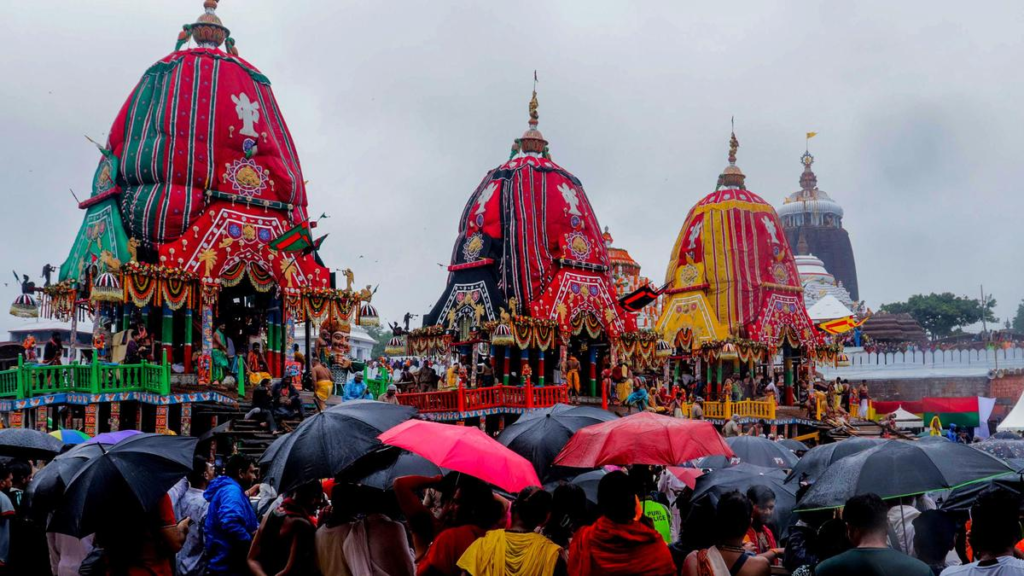
The Odisha Chief Minister urged the Centre to nominate Puri’s Shree Jagannath Rath Yatra for inclusion in UNESCO’s Representative List of the Intangible Cultural Heritage of Humanity.
Origin and Antiquity
- Puranic and historical roots: textual descriptions appear in the Brahma Purana, Padma Purana, Skanda Purana and Kapila Samhita.
- European accounts: documented by European travellers since the 13th century, with detailed accounts from the 17th century onward.
- Annual occurrence: during the bright fortnight (Shukla Paksha) of the lunar month of Ashadha (June–July).
Key Features
Annual reconstruction of chariots. Three massive, distinct wooden chariots are newly built every year:
| Chariot | Deity |
|---|---|
| Nandighosha | Lord Jagannath |
| Taladhwaja | Lord Balabhadra |
| Darpadalana | Goddess Subhadra |
- Built from specific timber types — Phassi and Dhausa — traditionally brought from the ex-princely state of Dasapalla along the Mahanadi River.
- Hereditary artisan guilds. Construction follows ancient architectural canons (Shilpa Shastras), executed by hereditary teams of carpenters (Maharanas), blacksmiths, painters and tailors.
- The divine procession. The deities are brought out of the 12th-century Jagannath Temple in the grand Pahandi Bije procession and placed on chariots aligned on the Bada Danda (Grand Avenue), where millions of devotees pull them to the Gundicha Temple.
Exam Relevance
UPSC — Prelims (GS-I, Art and Culture): the three chariots and their deities, the Ashadha timing, Gundicha and Mausi Maa temples, and — most importantly — the distinction between the 2003 ICH Convention and the 1972 World Heritage Convention, with India’s inscribed ICH elements. UPSC has asked directly about ICH elements before. Mains (GS-I): usable on cultural heritage as a resource for diplomacy and livelihoods, and on the argument that intangible heritage safeguarding protects craft communities and skills — the Maharana carpenters, weavers and painters — rather than merely a festival.
Banking/Finance3
Context:
Parliament passed the Taxation and Other Laws (Amendment) Bill, 2026, replacing the Income-tax (Amendment) Ordinance, 2026 and amending the Income-tax Act, 2025, the Finance Act, 2026, and the Payment and Settlement Systems Act, 2007. The Bill seeks to attract foreign investment, promote Make in India, enhance ease of doing business, and strengthen India’s digital and financial ecosystem.
What It Is
An omnibus amending Bill introduced by Finance Minister Nirmala Sitharaman, using targeted tax exemptions to onshore four value chains — electronics manufacturing, diamond trading, cloud computing and fund management — while creating enabling power over charges on digital payments. The Lok Sabha passed it; the Rajya Sabha returned it, the procedure applicable to a Money Bill under Article 109.
Key Provisions
| Area | Provision |
|---|---|
| Electronics manufacturing | Tax holiday for foreign companies supplying capital goods or using Indian factories for contract manufacturing extended from 5 years to 15 years (up to 2040-41); eligible goods explicitly defined as mobile phones, laptops, servers, wearables |
| Diamonds and electronics storage | Exemption for eligible foreign diamond companies on rough diamond sales in notified special zones, and for income from storage of electronic components in customs bonded warehouses |
| Government securities | FIIs and the Bank for International Settlements exempted from income tax on interest and capital gains from G-secs |
| Foreign fund managers | Rules simplified to allow relocation to India without the foreign fund becoming taxable here, with safeguards against tax avoidance and round-tripping retained |
| Data centres | Removes multi-layered government approval requirements for foreign cloud companies claiming exemptions; allows Indian data centres to operate on a leased basis, not only direct ownership |
| REITs and InvITs | Restores tax-free dividend income for unit holders; raises surcharge on SPVs of business trusts from 10% to 25% |
| UPI / MDR | Amends the PSS Act, 2007 to empower the Central Government to permit banks and PSPs to levy charges on UPI and other notified electronic payment modes, replacing the existing prohibition |
The Tax Rates Displaced
Before the exemption, income of FIIs from government securities was taxed at:
| Head | Earlier rate |
|---|---|
| Interest income | 20% |
| Short-term capital gains | 30% |
| Long-term capital gains | 12.5% |
The exemption applies to income arising on or after 1 April 2026.
The UPI / MDR Question
- What the Bill does: creates the legal power for the Centre to permit charges. It does not itself impose any charge.
- The existing bar: banks and payment system providers are currently prohibited from levying any charge, directly or indirectly, on notified electronic payment modes, operating through Section 269SU of the Income-tax Act read with the PSS Act.
Exam Relevance
RBI Grade B — Highest-value item for Phase II Paper III. Master the MDR debate end to end: what MDR is, why it was zeroed, the sustainability problem for acquirers and PSPs, budgetary incentives as the current substitute, and the tiered-MDR proposal. Also note the FII exemption on G-secs for bond market development and global index inclusion, the fund manager provision for GIFT City and onshoring financial services, and REITs/InvITs for infrastructure financing.
Context:
The Monetary Policy Committee voted unanimously on 5 August 2026 to keep the policy repo rate under the Liquidity Adjustment Facility unchanged at 5.25%, after assessing evolving macroeconomic and financial developments.
The Decision
| Parameter | Outcome |
|---|---|
| Repo rate | 5.25% — unchanged, unanimous (6-0) |
| Standing Deposit Facility (SDF) | 5.00% |
| Marginal Standing Facility (MSF) and Bank Rate | 5.50% |
| Stance | Neutral — continued |
| CPI inflation, FY27 | 5.0% (lowered 10 bps) — Q1 5.3%, Q2 4.7%, Q3 5.9%, Q4 5.5% |
| Real GDP growth, FY27 | Raised to 6.7% from 6.6% |
| Last rate revision | December 2025 |
| Next meeting | 5–7 October 2026 |
Background Concepts
Liquidity Adjustment Facility (LAF) — the RBI’s principal instrument for managing day-to-day liquidity in the banking system, operating through a corridor of rates:
| Rate | Function |
|---|---|
| SDF (5.00%) | Floor of the corridor. Banks park surplus funds with the RBI without collateral; introduced in April 2022, replacing the fixed reverse repo as the effective floor |
| Repo (5.25%) | The policy rate. Rate at which the RBI lends to banks against government securities for short periods |
| MSF (5.50%) | Ceiling of the corridor. Banks borrow overnight beyond their normal limits, dipping into the SLR portfolio |
| Bank Rate (5.50%) | Rate for RBI’s long-term lending, without collateral; aligned to MSF and used for penal purposes |
The corridor is symmetric — 25 basis points on either side of the repo rate. Its width signals how tightly the RBI wants to anchor overnight money market rates; a narrower corridor means tighter control.
Policy stance — the forward guidance signal, distinct from the rate itself:
- Accommodative — bias toward easing, supporting growth.
- Neutral — no directional bias; the MPC may move either way as data evolves.
- Withdrawal of accommodation / Tightening — bias toward raising rates or draining liquidity.
Practice MCQs
Q1. With reference to the Monetary Policy Committee decision of August 2026, consider the following statements:
- The Committee unanimously decided to keep the policy repo rate unchanged at 5.25 per cent.
- It decided to continue with the neutral policy stance.
- The Standing Deposit Facility rate stood at 5 per cent, while the Marginal Standing Facility rate and the Bank Rate stood at 5.5 per cent.
- The policy repo rate is fixed under the Liquidity Adjustment Facility.
How many of the above statements are correct? (a) Only one (b) Only two (c) Only three (d) All four (e) None
Q2. With reference to the liquidity adjustment facility corridor, consider the following statements:
- The Standing Deposit Facility rate forms the floor of the corridor.
- Under the Standing Deposit Facility, banks park surplus funds with the Reserve Bank without providing collateral.
- The Marginal Standing Facility rate forms the ceiling of the corridor.
- The repo rate is the rate at which the Reserve Bank lends to banks against government securities.
How many of the above statements are correct? (a) Only one (b) Only two (c) Only three (d) All four (e) None
Answer Key
- (d) — All four are correct. The unanimity of the vote and the retention of the neutral stance indicate that the pause reflected shared judgement rather than a divided committee.
- (d) — All four are correct. The key distinction is collateral: the SDF is uncollateralised, whereas the repo and MSF involve government securities — the MSF specifically allowing banks to dip into their SLR holdings.
Exam Relevance
RBI Grade B — Highest-priority current-affairs item. Expect direct questions on the August 2026 numbers and descriptive questions on monetary policy transmission, the neutral stance and managing external shocks. Master the statutory scaffolding: Section 45ZB (constitution), 45ZA (target), 45ZN (failure report), and the corridor mechanics. The strongest analytical themes are (i) why monetary policy is a blunt instrument against supply shocks; (ii) the rupee–capital flows–US yields channel; and (iii) the “neither dovish nor hawkish” framing as an articulation of what a neutral stance means in practice.
Context:
Announced alongside the August 2026 monetary policy, the RBI will resume licensing of Urban Cooperative Banks (UCBs) on an “on tap” basis after a pause of more than two decades, as part of developing a vibrant cooperative sector. Governor Sanjay Malhotra said draft guidelines would be issued shortly for stakeholder consultation.
What It Is
Three developmental and regulatory measures announced alongside the monetary policy:
1. On-tap licensing of UCBs
- A discussion paper on Licensing of UCBs was published on 13 January 2026 for stakeholder feedback; the decision follows that feedback.
- There are 1,457 urban cooperative banks as per RBI and NABARD.
- Fresh UCB licensing had been paused since 2004, following governance failures and bank collapses in the sector.
- “On tap” means the application window stays continuously open — applicants may apply at any time rather than only in specific rounds. The RBI already follows this for universal banks and small finance banks.
Indicative eligibility criteria proposed in the draft for credit cooperative societies seeking conversion:
| Criterion | Threshold |
|---|---|
| Minimum deposit base | ₹10,000 crore |
| Minimum net worth | ₹300 crore |
| Years in existence | At least 10 years |
| CRAR | At least 12% |
| Net NPA ratio | Not more than 3% |
| Registration | Multi-State Co-operative Societies Act, 2002 |
Multi-state societies will be considered first; select uni-state societies with a wider footprint may follow. No member may hold more than 5% of share capital; directors may not hold executive positions. Applications will be made through the RBI’s PRAVAAH portal; in-principle approval is valid for 18 months.
2. Review of concentration risk norms for RCBs
- Currently governed by the Credit Monitoring Arrangement (CMA) instructions of 2008.
- The banking sector generally, and cooperative banking in particular, have expanded and changed significantly over 18 years, requiring a fresh look at prudential norms.
- Objective: develop a vibrant cooperative sector while addressing prudential concerns arising from concentrated lending.
- Draft amendment directions to be issued for wider consultation.
Background: Cooperative Banking Structure
| Tier | Institutions |
|---|---|
| Urban Cooperative Banks | Single-state and multi-state; urban and semi-urban areas |
| Rural Cooperative Banks (short-term) | State Cooperative Banks → District Central Cooperative Banks → Primary Agricultural Credit Societies |
| Rural Cooperative Banks (long-term) | State and Primary Cooperative Agriculture and Rural Development Banks |
- Dual regulation: the RBI regulates banking functions under the Banking Regulation Act, 1949; incorporation, management and audit rest with the Registrar of Cooperative Societies (State) or the Central Registrar (multi-state).
- The Banking Regulation (Amendment) Act, 2020 expanded RBI powers over cooperative banks after the PMC Bank crisis.
- DICGC deposit insurance of ₹5 lakh per depositor per bank covers cooperative banks.
- NABARD supervises State Cooperative Banks and District Central Cooperative Banks.
Exam Relevance
NABARD Grade A — Very high relevance. NABARD supervises State Cooperative Banks and District Central Cooperative Banks, and the review of concentration risk norms for RCBs falls squarely in its domain. Know the CMA instructions of 2008, the rural cooperative structure, PACS computerisation, and NABARD’s refinance role. Expect direct questions on the UCB count (1,457) and on the RCB concentration-risk review.
RBI Grade B — Highest-priority item alongside the policy decision itself.
ARD notes, the monthly current affairs PDF and a descriptive English sample — all free, on WhatsApp.
Get it on WhatsApp — one tap or just leave your numberAgriculture2
Context:
A new digital platform for transparent and farmer-centric fertiliser distribution has been implemented on a pilot basis in 56 districts across 23 states, Minister of State for Chemicals and Fertilisers Anupriya Patel informed the Rajya Sabha on 4 August 2026 in a written reply. The pilot has expanded rapidly — it covered 40 districts across 20 states as of late July 2026.
What It Is
The “Framework for Fertilizer Sale” (FFS) is jointly developed by the Ministry of Chemicals and Fertilisers (Department of Fertilizers) and the Ministry of Agriculture and Farmers Welfare, with the consent of state governments, and rolled out in a staggered pilot manner.
Objective: to make fertiliser distribution more transparent, organised, farmer-centric, land- and crop-data integrated, and demand-driven.
How It Works
- Registration — the farmer or an authorised representative registers through a mobile application, entering land and crop details.
- Pre-booking — advance booking of fertiliser requirements against those details.
- Token generation — a QR code-based token is generated on successful booking.
- Retail verification — the retailer scans the QR code through a Point of Sale (PoS) machine.
- Distribution — fertiliser is released after Aadhaar-based biometric authentication, per existing procedure.
Supporting Digital Infrastructure
- Integrated Fertilizer Management System (iFMS) — an online platform for real-time monitoring and management of fertiliser movement across the country, tracking dispatches, allocation, rake placement, stock position and state-wise supply status by states and stakeholders. FFS purchase reports feed into iFMS dashboards.
- AgriStack / Farmer Registry — a registry of about 102.8 million (10.28 crore) farmer IDs is being integrated with PM-KISAN, the Jan Samarth platform for Kisan Credit Card loans, and MSP-based crop procurement systems.
Exam Relevance
NABARD Grade A — Very high relevance for Phase II Paper II. Know the DBT mechanics, the 2025-26 figures (746.57 LMT, 8.4 crore farmers, 2.87 lakh retailers, ₹2.17 lakh crore subsidy), the 50-bag limit and state variations, and AgriStack’s three registries (farmer registry, geo-referenced village maps, crop-sown registry). The Jan Samarth–KCC linkage is directly relevant to NABARD’s credit mandate, as is the exclusion risk for tenant farmers — connect to Joint Liability Groups as the standard workaround for landless cultivators.
Context:
The Agricultural and Processed Food Products Export Development Authority (APEDA), under the Ministry of Commerce & Industry, in collaboration with Nuernberg Messe India, is organising BIOFACH INDIA 2026 from 6–8 August 2026 at the India Expo Centre & Mart, Greater Noida, Delhi-NCR — a platform for trade, knowledge exchange and business networking across the organic, natural and sustainable food sectors.
Key Features
- 200+ exhibitors, including 60+ under APEDA Pavilion — exporters, women entrepreneurs, FPOs/FPCs, startups and organic enterprises.
- Organic products: cereals, pulses, millets, spices, tea, coffee, fruits, vegetables, processed foods, medicinal plants, honey, edible oils and nutraceuticals.
- 35+ international buyers from 13 countries, including Taiwan, Japan, South Korea, Australia and Egypt, through Buyer-Seller Meets.
- Technical sessions on organic certification, traceability, sustainability, market access and international quality standards.
About APEDA
- Established under the Agricultural and Processed Food Products Export Development Authority Act, 1985, functioning under the Ministry of Commerce & Industry; headquartered in New Delhi.
- Mandated to develop and promote exports of scheduled products — fruits and vegetables, meat and poultry, dairy, confectionery, cereals, floriculture, herbal and medicinal plants, and organic products.
- Note: basmati rice is under APEDA; spices are handled by the Spices Board, tea by the Tea Board, coffee by the Coffee Board, and marine products by MPEDA.
- APEDA is the National Accreditation Body under the National Programme for Organic Production (NPOP).
Background: India’s Organic Ecosystem
Certification systems
| System | Scope |
|---|---|
| NPOP (National Programme for Organic Production) | Third-party certification for exports; implemented by APEDA; recognised as equivalent by the EU, Switzerland and others |
| PGS-India (Participatory Guarantee System) | Peer-appraisal-based certification for domestic markets and small farmers; under the Ministry of Agriculture |
| Jaivik Bharat | The unified organic logo of FSSAI, which regulates organic food sold domestically |
- Supporting schemes: the Paramparagat Krishi Vikas Yojana (PKVY) and the Mission Organic Value Chain Development for North Eastern Region (MOVCDNER) — the latter explaining the strong North-East presence at the event, and why the DoNER Secretary was Chief Guest.
- India’s position: the country has the largest number of organic producers in the world, though a relatively modest share of global organic area. Sikkim is the world’s first fully organic State (2016). Major organic exports include organic soybean, rice, oilseeds, cereals, millets, medicinal plants, tea, spices and processed foods, with the United States and European Union as principal destinations.
- IFOAM – Organics International is the global umbrella body for the organic movement, founded in 1972 and headquartered in Bonn, Germany.
Facts To Remember26
Tata Sons Continues as Upper-Layer NBFC
RBI Governor Sanjay Malhotra indicated that Tata Sons, the holding company of the Tata Group, will continue to be classified as an Upper-Layer NBFC under RBI’s principle-based regulatory framework.
DSC A24 Launched as India’s Fifth Diving Support Craft
The Indian Navy launched DSC A24, the fifth and final Diving Support Craft, at Titagarh, Kolkata. Built by Titagarh Rail Systems Limited, the catamaran-hulled vessel has around 70% indigenous content and will support diving, salvage and coastal operations.
PM Modi Inaugurates Development Projects Worth ₹17,900 Crore in Andhra Pradesh
Prime Minister Narendra Modi visited Andhra Pradesh and Karnataka on 1 August 2026. In Andhra Pradesh, he inaugurated and launched projects worth over ₹17,900 crore covering aviation, semiconductors, renewable energy, power transmission, roads and youth development.
CCI Launches ‘Kapas Darshan’ Bulletin on 56th Foundation Day
Union Minister Giriraj Singh launched the Kapas Darshan Bulletin during the 56th Foundation Day of the Cotton Corporation of India. The event also highlighted the ₹5,659-crore Cotton Productivity Mission–Kapas Kanti and saw the signing of four MoUs to improve cotton quality, traceability and market access.
REC and PFC Sign ₹26,850 Crore Loan Agreement for Meja Power Project
REC Limited and Power Finance Corporation signed a ₹26,850-crore common loan agreement with Meja Urja Nigam for the expansion of the Meja Thermal Power Project in Uttar Pradesh. The project will add 2,400 MW through three 800-MW ultra-supercritical units.
SEBI Extends Digital Accessibility Audit Deadline to October 2026
SEBI extended the deadline for regulated entities to complete digital accessibility audits and remediation to 31 October 2026. It also introduced the GARUDA framework to streamline the processing of Alternative Investment Fund placement memorandums.
SBI Research Projects Around 7% GDP Growth in Q1 FY27
SBI Research projected India’s GDP growth at around 7% in Q1 FY27, above the RBI’s 6.6% projection. The estimate was supported by stronger vehicle sales, electricity demand, exports and industrial activity.
Gujarat’s Pithora Painting Receives GI Tag
The Geographical Indications Registry granted a GI tag to Gujarat’s traditional Pithora Painting, associated with the Rathwa, Bhil, Bhilala and Nayaka communities. The tribal art form traditionally uses natural colours and features horses representing gods, ancestors and nature.
K. Rajaraman’s Tenure as IFSCA Chairman Extended Till 2028
The Government extended K. Rajaraman’s tenure as Chairperson of the International Financial Services Centres Authority until 24 October 2028. He is a retired 1989-batch IAS officer and became IFSCA’s first full-time Chairperson in 2023.
Vice Admiral AN Pramod Assumes Charge as Deputy Chief of Naval Staff
Vice Admiral AN Pramod assumed charge as Deputy Chief of Naval Staff, succeeding Vice Admiral Tarun Sobti. A communication and electronic warfare specialist, he previously served as Director General Naval Operations and received the AVSM and YSM.
Indian Navy Launches DSC A24, Fifth and Final Diving Support Craft
The Indian Navy launched DSC A24, the fifth and final vessel under the Diving Support Craft project at Titagarh, Kolkata. The indigenously built vessel features a twin-hull catamaran design, approximately 300–400 tonnes displacement and around 70% indigenous content.
New Catfish Species ‘Pseudolaguvia khairii’ Discovered in Odisha
A new freshwater catfish species, Pseudolaguvia khairii, was discovered in the Budhabalanga River of Odisha’s Mayurbhanj district. It was named after Khairi, the famous Royal Bengal tigress of Similipal Tiger Reserve.
India Finishes Fourth at 2026 Commonwealth Games with 39 Medals
India finished fourth at the 2026 Commonwealth Games in Glasgow with 39 medals, including 13 gold, 17 silver and 9 bronze. Australia topped the medal table with 171 medals, followed by England and Canada.
Nirmal Purja Dies in Avalanche on Broad Peak
Renowned Nepali-British mountaineer Nirmal Purja died in an avalanche on Broad Peak in Pakistan. He was famous for completing all 14 eight-thousanders in 6 months and 6 days under Project Possible 14/7 in 2019.
Indian Organ Donation Day was observed on 3 August to raise awareness about organ and tissue donation. In 2026, the government launched the ‘Jug Jug Jiyo’ campaign, e-Pratyaropan platform and NOTTO mobile application.
World Breastfeeding Week was observed from 1–7 August 2026 to promote breastfeeding and support systems for mothers. The 2026 theme was “Breastfeeding for a sustainable start in life: strengthen what works.”
Andhra Pradesh and Australia Sign Four MoUs
Andhra Pradesh and Australia signed four MoUs to strengthen cooperation in clean energy, advanced manufacturing, inclusive education, student mental health and skill development. The agreements include a partnership to establish a Centre of Excellence for Solar Manufacturing at IIT Tirupati.
Got it. Starting from Sl. No. 1 and keeping exactly the concise format you want:
Cabinet Approves GOBARdhan Scheme with ₹23,731 Crore Outlay
The Union Cabinet approved the GOBARdhan – National Circular Bioenergy Scheme with a total outlay of ₹23,731 crore. The scheme aims to promote clean energy, strengthen the rural economy and create around 1.5 lakh jobs through the conversion of organic waste into bioenergy.
India Successfully Test-Fires Agni-4 Ballistic Missile
India successfully test-fired the Agni-4 medium-range ballistic missile from the Integrated Test Range at Chandipur, Odisha. The Defence Ministry stated that the launch successfully validated the missile’s operational and technical parameters, strengthening India’s strategic defence capabilities.
Lok Sabha Passes Bankers’ Books Evidence Bill, 2026
The Lok Sabha passed the Bankers’ Books Evidence Bill, 2026, which seeks to modernise the legal framework governing evidence related to bankers’ books. The Bill provides for the recognition and use of electronic and digital records of banking transactions as evidence.
India Launches Clouded Leopard Conservation Action Plan
On International Clouded Leopard Day, India launched a dedicated Clouded Leopard Conservation Action Plan to strengthen the protection of this elusive wild cat. The initiative focuses on habitat conservation, scientific monitoring and coordinated efforts to protect clouded leopard populations.
4th Tri-Services Future Warfare Course Begins in New Delhi
The 4th edition of the Tri-Services Future Warfare Course commenced in New Delhi under the Headquarters Integrated Defence Staff. The four-week course brings together officers from the three armed forces to develop a deeper understanding of future warfare, emerging technologies and joint military operations.
India Wins 39 Medals at Glasgow Commonwealth Games 2026
India finished the 2026 Commonwealth Games with 39 medals, including 13 gold, 17 silver and 9 bronze, securing fourth position in the overall medal tally. Glasgow also formally handed over the Commonwealth Games baton to India, which will host the 2030 edition in Ahmedabad.
SBI Research Projects Around 7% GDP Growth in Q1 FY27
SBI Research projected that India’s economy could grow by around 7% in Q1 FY27, supported by stronger high-frequency indicators, improved industrial activity and a recovery in exports. The estimate is higher than the RBI’s earlier 6.6% projection for the quarter.
Air Marshal Tejpal Singh Takes Charge as Deputy Chief of Air Staff
Air Marshal Tejpal Singh assumed charge as the Deputy Chief of the Air Staff (DCAS) of the Indian Air Force. His appointment comes as part of the IAF’s senior leadership transition and strengthening of its operational and strategic capabilities.
Army Chief Launches Indigenous Xtreme Weather Grade Diesel
Chief of Army Staff General Dhiraj Seth launched indigenously developed Xtreme Weather Grade (XWG) Diesel in New Delhi. Developed jointly by the Indian Army and oil marketing companies, the specialised fuel is designed to improve the mobility, safety and operational readiness of military vehicles in extreme weather conditions.