Daily Current Affairs (DCA) 17 & 18 April, 2026
Free live session
NABARD Grade A 2026: 45-Day Final Revision Plan + Daily Targets
 🔒 Register to watchLast Sunday’s session · recording
Tomorrow · 7:30 PM IST
National Affairs6
The National Rural Livelihood Mission (NRLM)
Context:
The National Rural Livelihood Mission (NRLM), launched in 2011, has transitioned from a domestic poverty alleviation scheme into a cornerstone of India’s development diplomacy. By exporting its institutional architecture—specifically the Self-Help Group (SHG) model—India is providing a contextually relevant alternative to Western development templates for the Global South.
The Scale of Success
The NRLM has achieved unprecedented scale, particularly in integrating rural women into the formal economy:
- Outreach: Active in 742 districts, reaching over 100 million households.
- Mobilization: More than 9 million SHGs established.
- Financial Inclusion: Over ₹12 lakh crore in bank linkages enabled.
- The “Lakhpati Didi” Effect: Over 20 million women now earn an annual income exceeding ₹1,00,000.
- Fiscal Backing: The Union Budget 2026-27 allocated ₹19,200 crore to the mission, cementing its status as a flagship initiative.
Why the Model is “Portable” to Africa
Policymakers from nations such as Ethiopia, Tanzania, Malawi, Kenya, and Rwanda are increasingly adopting the Indian model for several key reasons:
- Cost-Effectiveness: The model relies on community-driven processes and local cadres rather than heavy capital investment.
- Informal Economy Alignment: SHGs thrive in environments where microenterprise and livelihood diversification are essential.
- Trust-Based Credit: The system uses pooled savings and peer learning, creating financial discipline without traditional collateral.
- Institutional Building: Unlike simple cash-transfer schemes, the NRLM builds long-term community capacity and strengthens local governance.
Impact on South-South Cooperation
The NRLM marks a shift in India’s foreign policy, moving from providing resources to exporting institutional knowledge:
- Peer Learning: African delegations focus on “operational mechanics”—how to scale cadres and sustain credit linkages.
- Diplomatic Entry Points: The SHG framework opens doors for collaboration in digital governance, agriculture, and financial architecture.
- Strategic Suggestion: The establishment of a Rural Livelihoods Knowledge Exchange Platform could further institutionalize these linkages between Indian state missions and African governments.
Multiple Choice Questions (MCQs)
1. What is the proposed allocation for the NRLM in the Union Budget 2026-27?
- A) ₹10,000 crore
- B) ₹15,500 crore
- C) ₹19,200 crore
- D) ₹25,000 crore
2. As of mid-2025, how many households has the NRLM reached?
- A) 50 million
- B) 75 million
- C) 100 million
- D) 150 million
3. Which of the following African countries was NOT mentioned as having sent delegations to study the NRLM?
- A) Ethiopia
- B) Nigeria
- C) Rwanda
- D) Malawi
4. What is a “Lakhpati Didi” in the context of the NRLM?
- A) A woman who has borrowed ₹1 lakh from a bank.
- B) An SHG member earning an annual income of over ₹1,00,000.
- C) A woman banking correspondent serving 1,000 households.
- D) A government official managing rural credits.
Answers
- C) ₹19,200 crore
- C) 100 million
- B) Nigeria (Delegations from Ethiopia, Tanzania, Malawi, Kenya, and Rwanda were specifically cited.)
- B) An SHG member earning an annual income of over ₹1,00,000.
The National Backward Classes Finance & Development Corporation (NBCFDC)
Context:
The National Backward Classes Finance & Development Corporation (NBCFDC) has achieved a significant milestone by recording its highest-ever disbursement of ₹613 crore in FY 2025-26. This 16% year-on-year growth underscores the government’s intensifying focus on financial inclusion and self-reliance for marginalized communities.
Institutional Framework
The NBCFDC is a specialized vehicle designed to provide low-cost credit to those who typically lack access to mainstream banking.
- Legal Status: A Not-for-Profit Government of India Undertaking (Section 8 Company).
- Nodal Ministry: Operating under the Ministry of Social Justice and Empowerment.
- Established: January 13, 1992.
- Operational Model: It functions as an apex lending body, routing funds through State Channelizing Agencies (SCAs) and partner banks to reach the end-borrowers.
Core Functions & Assistance
The corporation focuses on two main pillars: Financial Credit and Skill Empowerment.
A. Credit Schemes
NBCFDC provides loans at highly concessional interest rates for:
- Agriculture & Allied Activities: Purchase of equipment, livestock, or irrigation tools.
- Small Business & Artisans: Support for traditional occupations and micro-enterprises.
- Education Loans: Financing for technical and professional courses in India and abroad.
- Micro Finance: Small-ticket loans specifically targeting Self-Help Groups (SHGs).
B. Skill Development (PM-DAKSH)
Under the PM-DAKSH Yojana, the corporation facilitates vocational training and upskilling. This ensures that beneficiaries do not just receive capital, but also the technical competence to run a sustainable business.
Beyond OBCs: An Expanded Mandate
While its name suggests a focus only on Other Backward Classes (OBCs), the NBCFDC has evolved into a broad social safety net. Its target groups now include:
- Economically Backward Classes (EBCs): Based on income criteria.
- DNTs: De-notified, Nomadic, and Semi-Nomadic Tribes.
- Vulnerable Groups: Senior Citizens, Transgender persons, and Persons in Destitution (Beggars).
Key Implementation Schemes
The corporation is the implementing agency for several high-impact welfare programs:
- VISVAS Scheme: An interest subvention scheme that provides a direct 5% interest waiver to SHGs and individual beneficiaries.
- National Fellowship for OBCs: Financial assistance for students pursuing higher education (M.Phil/Ph.D.).
Multiple Choice Questions (MCQs)
1. What is the legal status of the NBCFDC under the Companies Act?
- A) For-profit Public Limited Company
- B) Section 8 Not-for-Profit Company
- C) Statutory Body created by an Act of Parliament
- D) Cooperative Society
2. Which ministry oversees the functioning of the NBCFDC?
- A) Ministry of Finance
- B) Ministry of Skill Development and Entrepreneurship
- C) Ministry of Social Justice and Empowerment
- D) Ministry of Minority Affairs
3. Through which primary channel does the NBCFDC provide credit to individual beneficiaries at the state level?
- A) Direct Cash Transfers (DBT)
- B) State Channelizing Agencies (SCAs)
- C) Post Offices
- D) Foreign Institutional Investors (FIIs)
4. The NBCFDC facilitates vocational training and upskilling under which flagship government scheme?
- A) PM-Kisan
- B) PM-DAKSH
- C) PM-GatiShakti
- D) PM-Svanidhi
5. Which of the following groups is NOT included in the expanded target mandate of the NBCFDC?
- A) De-notified and Nomadic Tribes
- B) Transgender Persons
- C) Persons in Destitution (Beggars)
- D) Group A Gazetted Officers
Answers
- B) Section 8 Not-for-Profit Company
- C) Ministry of Social Justice and Empowerment
- B) State Channelizing Agencies (SCAs)
- B) PM-DAKSH (Pradhan Mantri Dakshta Aur Kushalta Sampann Hitgrahi.)
- D) Group A Gazetted Officers (The corporation focuses strictly on marginalized and economically weaker sections.)
The Union Territories Laws (Amendment) Bill, 2026
Context:
The Union Territories Laws (Amendment) Bill, 2026 is a critical legislative bridge that ensures the reforms of the 131st Constitutional Amendment and the Delimitation Bill, 2026 are effectively implemented in Union Territories (UTs) with their own legislatures.
Without this Bill, the seat increases and women’s reservation would only apply to full states, leaving a legal vacuum in the UTs of Delhi, Puducherry, and Jammu & Kashmir.
The Core Objective: Legislative Uniformity
The primary goal is to synchronize the governance of UTs with the new national standards established for the expansion of Parliament.
- Women’s Reservation: It implements the Nari Shakti Vandan Adhiniyam, mandating 33% reservation for women in the Legislative Assemblies of Delhi, Puducherry, and Jammu & Kashmir.
- Expansion of Representation: It integrates the constitutional increase of UT representation in the Lok Sabha, which has been raised from 20 to 35 members.
Strategic Policy Shifts
The 2026 Bill introduces specific deviations from previous legal frameworks to expedite these reforms:
- The Census Pivot: Traditionally, women’s reservation and delimitation were expected to follow the first census after 2023. This Bill removes that wait-time, allowing for changes to proceed based on the 2011 Census data.
- Delimitation Authority: It grants the Delimitation Commission of 2026 the specific power to redraw assembly constituencies within these UTs.
- Rotational Mechanism: To ensure fairness, seats reserved for women in these UT assemblies will be rotated across different constituencies in successive election cycles.
Multiple Choice Questions (MCQs)
1. Which specific Union Territories are primarily covered under the Union Territories Laws (Amendment) Bill, 2026?
- A) Chandigarh, Ladakh, and Lakshadweep
- B) Delhi, Puducherry, and Jammu & Kashmir
- C) Daman & Diu and Dadra & Nagar Haveli
- D) All 8 Union Territories equally
2. The Bill increases the maximum number of UT representatives in the Lok Sabha from 20 to how many members?
- A) 25
- B) 30
- C) 35
- D) 45
3. According to the Bill, the delimitation and women’s reservation in UTs will be based on which census data?
- A) 2001 Census
- B) 2011 Census
- C) 2021 Census
- D) 2027 Census
4. What is the primary purpose of the “Rotational Reservation” feature mentioned in the Bill?
- A) To ensure men and women alternate as Chief Ministers.
- B) To ensure reserved seats for women are moved to different constituencies in successive elections.
- C) To rotate the capital of the Union Territory every five years.
- D) To change the total number of seats in every election.
5. The Bill is designed to extend the provisions of which major Constitutional Amendment?
- A) 101st Amendment (GST)
- B) 128th Amendment (Women’s Reservation in States)
- C) 131st Amendment (Parliamentary Expansion & Reservation)
- D) 73rd Amendment (Panchayati Raj)
Answers
- B) Delhi, Puducherry, and Jammu & Kashmir (These are the UTs with Legislative Assemblies.)
- C) 35 (Aligning with the broader parliamentary expansion.)
- B) 2011 Census (The Bill delinks the process from the future 2027 census to allow immediate implementation.)
- B) To ensure reserved seats for women are moved to different constituencies in successive elections.
- C) 131st Amendment (It serves as the enabling legislation for this amendment at the UT level.)
CAFE-III (Corporate Average Fuel Efficiency Phase III)
Context:
The consensus on CAFE-III (Corporate Average Fuel Efficiency Phase III) marks a decisive step in India’s automotive policy, balancing aggressive decarbonization targets with industry feasibility. These norms shift the focus from individual vehicle performance to a manufacturer’s total fleet impact, effectively forcing a portfolio-wide transition toward electrification and hybridization.
Understanding CAFE-III Mechanics
Unlike emission standards like BS-VI (which focus on pollutants like $NO_x$ or particulate matter), CAFE norms target $CO_2$ efficiency and fuel consumption.
- The Formula: It is a mass-based target. The heavier a manufacturer’s average fleet, the more $CO_2$ they are technically allowed to emit, but the overall “slope” of this allowance is being tightened.
- The “Flatter Curve” Strategy: By removing the 3g/km relief for lightweight cars, the government has created a “flatter” regulatory slope. This prevents small-car makers from having an unfair advantage while ensuring that heavier SUVs face stricter pressure to adopt hybrid or electric powertrains.
The Power of “Super Credits”
To help manufacturers meet the steep reduction from 113 g/km to 78.9 g/km, the government utilizes a multiplier system. This makes every “green” sale significantly more valuable for regulatory compliance.
| Technology | Multiplier | Strategic Impact |
| Battery EV (BEV) | 3.0 | Selling 1 EV “cancels out” the high emissions of 3 traditional petrol cars. |
| Plug-in Hybrid (PHEV) | 2.5 | Encourages vehicles with significant electric-only range. |
| Strong Hybrid | 1.6 | Incentivizes the transition for mass-market buyers not yet ready for full EVs. |
Multiple Choice Questions (MCQs)
1. What is the target fleet-average $CO_2$ emission level for automakers by the end of CAFE-III (FY32)?
- A) 113 g/km
- B) 95.5 g/km
- C) 78.9 g/km
- D) 50.0 g/km
2. Which vehicle category is covered under the CAFE-III norms?
- A) L-category (Two-wheelers)
- B) M1-category (Passenger vehicles < 3,500kg)
- C) N3-category (Heavy commercial trucks)
- D) Agricultural Tractors
3. Under the Super Credit Scheme, what is the multiplier for a Battery Electric Vehicle (BEV)?
- A) 1.5
- B) 2.0
- C) 2.5
- D) 3.0
4. Why was the proposed “3g/km relief” for small petrol cars (under 909kg) scrapped in the final consensus?
- A) Small cars were found to be more polluting than SUVs.
- B) To ensure a “flatter curve” and a fairer playing field for all manufacturers.
- C) Because small cars are being banned from cities.
- D) To encourage the export of small cars.
5. Which body is responsible for establishing and monitoring the CAFE standards in India?
- A) NITI Aayog
- B) Bureau of Indian Standards (BIS)
- C) Bureau of Energy Efficiency (BEE)
- D) Central Pollution Control Board (CPCB)
Answers
- C) 78.9 g/km
- B) M1-category (Passenger vehicles < 3,500kg)
- D) 3.0
- B) To ensure a “flatter curve” and a fairer playing field for all manufacturers.
- C) Bureau of Energy Efficiency (BEE) (Under the Ministry of Power.)
Context:
The Urban Challenge Fund (UCF) and its companion, the Credit Repayment Guarantee Sub-Scheme (CRGSS), represent a fundamental shift in how India finances its urban future. By moving away from purely grant-based models, the government is pushing Urban Local Bodies (ULBs) to become financially disciplined and “market-ready.”
The Strategy: “De-risking” Over “Grant-giving”
The UCF functions as a catalytic instrument. Instead of the Union Government funding the entire project, it provides just enough capital (25%) to make the project “bankable” for private investors and commercial banks.
- Implementation Window: FY 2025–26 to FY 2030–31.
- The 4x Leverage Principle: With a seed investment of ₹1 lakh crore, the government aims to trigger a total infrastructure spend of ₹4 lakh crore.
Funding Architecture & Allocation
The central outlay is divided into three distinct buckets to ensure projects are not just funded, but also well-planned and secure for lenders.
| Component | Allocation | Strategic Purpose |
| Project Funding | ₹90,000 Crore | Direct capital for infrastructure (limited to 25% of total cost). |
| Capacity Building | ₹5,000 Crore | Preparing Detailed Project Reports (DPRs) and improving city credit ratings. |
| CRGSS | ₹5,000 Crore | Acting as a safety net for lenders in smaller or higher-risk cities. |
The CRGSS: Empowering Tier-II & Tier-III Cities
A major hurdle for smaller cities is their perceived risk by banks. The Credit Repayment Guarantee Sub-Scheme (CRGSS) solves this by:
- Providing guarantees to lenders (banks/financial institutions).
- Encouraging credit flow to cities in hilly areas, the North-East, and smaller urban centers that lack the high credit ratings of metros like Mumbai or Hyderabad.
Multiple Choice Questions (MCQs)
1. What is the maximum percentage of a project’s cost that can be covered by Central Assistance under the UCF?
- A) 15%
- B) 25%
- C) 50%
- D) 75%
2. Which ministry is responsible for the implementation of the Urban Challenge Fund?
- A) Ministry of Finance
- B) Ministry of Rural Development
- C) Ministry of Housing and Urban Affairs (MoHUA)
- D) Ministry of Home Affairs
3. What is the primary purpose of the Credit Repayment Guarantee Sub-Scheme (CRGSS)?
- A) To provide direct cash transfers to urban residents.
- B) To offer guarantees to lenders to help smaller cities access market credit.
- C) To pay off the existing debts of all municipal corporations.
- D) To fund the construction of new government offices.
4. How much of the total ₹1 lakh crore outlay is earmarked for project preparation and capacity building?
- A) ₹1,000 crore
- B) ₹5,000 crore
- C) ₹10,000 crore
- D) ₹90,000 crore
5. Under the UCF, what is the minimum percentage of funding that MUST be mobilized through municipal bonds, bank loans, or PPPs?
- A) 25%
- B) 33%
- C) 50%
- D) 100%
Answers
- B) 25%
- C) Ministry of Housing and Urban Affairs (MoHUA)
- B) To offer guarantees to lenders to help smaller cities access market credit.
- B) ₹5,000 crore
- C) 50% (This ensures the projects are market-linked and not solely dependent on government grants.)
Banking/Finance4
How & Why Farmers Producers Organization are formed? FPO #fpo #upsc #nabardgradea #agriculturenotesTap to play · from the C4S channel
Context:
It is a bit of a paradox: how can an economy be the “fastest-growing” but still lose its spot on the leaderboard? According to the IMF’s April 2026 World Economic Outlook, India has indeed slipped to the 6th spot, falling behind the United Kingdom and Japan.
However, this isn’t due to a domestic slowdown. It’s the result of a “statistical storm” where currency math and data updates collided.
The “Dollar vs. Rupee” Math
Global GDP rankings are calculated in US Dollars. Even if India’s economy grows significantly in Rupee terms, that growth can be erased in the rankings if the Rupee loses value against the Dollar.
- Nominal Growth: India recorded a healthy ~9% nominal growth in Rupee terms.
- Currency Depreciation: The Rupee weakened from 84.6 per USD in 2024 to 88.5 in 2025.
- The Result: When you convert those trillions of Rupees into Dollars at a weaker exchange rate, the final “Dollar GDP” looks smaller. Meanwhile, the British Pound remained relatively stable, allowing the UK to “leapfrog” back into 5th place.
The Base Year Revision
In February 2026, India updated its GDP base year from 2011–12 to 2022–23. While this ensures data reflects modern economic realities, it had a surprising side effect:
- The Downward Adjustment: The new methodology revealed that previous estimates had slightly overstated the size of the economy.
- The Shrinkage: Nominal GDP for FY26 was revised downward from ₹357 trillion to ₹345.5 trillion.
- Impact: This 2.8% to 3.8% reduction in the “base” size made it easier for Japan and the UK to stay ahead in the rankings.
The Numbers at a Glance (2025 Estimates)
| Country | GDP (US$ Trillion) | Status |
| Japan | $4.44 | 4th Largest |
| UK | $4.00 | 5th Largest |
| India | $3.92 | 6th Largest |
Is this a long-term setback?
Economists view this as a statistical shift rather than a structural failure. India remains the fastest-growing major economy, and the IMF projections suggest this “slip” is temporary:
- 2027: India is forecast to regain the 4th spot, reaching $4.58 trillion.
- 2028: India is projected to surpass Japan to become the 3rd largest economy.
Multiple Choice Questions
1. According to the IMF’s April 2026 report, what is India’s current GDP ranking?
A) 4th
B) 5th
C) 6th
D) 3rd
2. Which currency factor primarily contributed to India’s drop in the dollar-denominated GDP ranking?
A) Rupee appreciation
B) Rupee depreciation
C) Stability of the Japanese Yen
D) Hyperinflation in the US
3. What was the new base year adopted for India’s GDP calculation in 2026?
A) 2011–12
B) 2015–16
C) 2022–23
D) 2024–25
4. By which year is India projected to surpass Japan to become the world’s 3rd largest economy?
A) 2026
B) 2027
C) 2028
D) 2035
5. Why did the GDP base revision affect India’s ranking?
A) It increased the nominal GDP by 10%
B) It led to a downward adjustment in the estimated size of the economy
C) It changed the currency from Rupee to Dollar
D) It excluded the service sector from calculations
Answers
- C) 6th
- B) Rupee depreciation
- C) 2022–23
- C) 2028
- B) It led to a downward adjustment in the estimated size of the economy
Context:
The Life Insurance Corporation of India (LIC) has taken a major digital leap by launching two specialized mobile applications: MyLIC and Super Sales Saathi. These apps are designed to modernize India’s largest insurer by creating a seamless, paperless interface for both its vast customer base and its massive network of agents.
MyLIC: The Customer’s Digital Hub
This application serves as a comprehensive self-service portal for policyholders, aiming to reduce the need for physical visits to LIC branches.
- Policy Management: A unified dashboard allows users to monitor multiple policies, track survival benefits, and check maturity dates in real-time.
- Financial Transactions: Facilitates instant premium payments, applications for policy loans, and the revival of lapsed policies.
- e-KYC Integration: Streamlines the verification process, making it entirely paperless and significantly faster.
- Claims Support: Provides a digital pathway for filing and tracking the status of insurance claims.
Super Sales Saathi: Empowering the Field Force
Recognizing that agents are the backbone of its business, LIC developed this app to optimize the efficiency of its intermediaries and sales teams.
- Sales Enablement: Includes AI-driven “customer nudges,” digital product kits, and interactive explainers to help agents pitch the right products to the right clients.
- Operational Efficiency: Real-time tracking of policy status and automated follow-up reminders ensure that agents stay connected with their customers.
- Performance Analytics: A dedicated dashboard helps agents monitor their sales targets, achievements, and commissions, fostering a data-driven approach to their work.
Strategic Significance
By launching these apps, LIC is addressing several modern insurance challenges:
- Digital Accessibility: Bringing insurance services to the fingertips of a younger, tech-savvy demographic.
- Paperless Initiatives: Aligning with broader environmental and administrative goals by digitizing documentation and KYC.
- Operational Speed: Shifting from “branch-first” to “mobile-first” allows for quicker policy issuance and faster claim settlements.
Multiple Choice Questions (MCQs)
1. What is the primary target audience for the “Super Sales Saathi” app?
- A) High-net-worth investors
- B) LIC agents and intermediaries
- C) Medical examiners for insurance
- D) Corporate HR departments
2. Which of the following features is NOT a part of the MyLIC application?
- A) Unified Policy Dashboard
- B) Online Premium Payments
- C) e-KYC for verification
- D) Real-time tracking of global stock markets
3. How does the “Super Sales Saathi” app assist agents in customer outreach?
- A) By providing free insurance coupons.
- B) Through AI-based customer nudges and digital product kits.
- C) By allowing them to bypass mandatory KYC.
- D) By automatically deducting premiums from agent bank accounts.
4. What is a key goal of LIC’s paperless service initiative through these apps?
- A) To increase the cost of insurance.
- B) To improve customer convenience and speed of service.
- C) To eliminate the need for any insurance agents.
- D) To restrict services to metro cities only.
5. Which feature of MyLIC allows a policyholder to restore a policy that has stopped due to non-payment of premiums?
- A) Policy Loan
- B) Revival of lapsed policies
- C) e-KYC Update
- D) Claims-related support
Answers
- B) LIC agents and intermediaries
- D) Real-time tracking of global stock markets (The app focuses strictly on LIC policy and benefit management.)
- B) Through AI-based customer nudges and digital product kits.
- B) To improve customer convenience and speed of service.
- B) Revival of lapsed policies
SEBI's Fit and Proper Person Criteria
Context:
The Securities and Exchange Board of India (SEBI) notified significant amendments to the “Fit and Proper Person” criteria on April 15, 2026. These changes represent a shift toward a more nuanced, evidence-based approach to regulatory disqualification, ensuring that market intermediaries are not penalized prematurely by the mere initiation of legal proceedings.
Shift from “Automatic” to “Conviction-Based” Disqualification
The primary goal of the amendment is to prevent the “weaponization” of legal complaints and to protect the business continuity of intermediaries during lengthy legal battles.
| Legal Status | Previous Norms | Revised Norms (April 2026) |
| Filing of FIR / Complaint | Could trigger automatic disqualification. | No automatic disqualification. |
| Filing of Chargesheet | Often led to “not fit and proper” status. | No automatic disqualification. |
| Conviction | Moral turpitude only. | Expanded: Conviction for any economic offence or securities law violation. |
Key Procedural Changes
- Principles of Natural Justice: SEBI has explicitly introduced a provision for a “reasonable opportunity of being heard.” This ensures that an intermediary can present their case before being officially declared “not fit and proper.”
- Winding-up Proceedings: Previously, the mere initiation of winding-up (liquidation) proceedings could disqualify a person. Under the new rules, only an actual winding-up order passed by a court or tribunal will attract disqualification.
- Securities Law Violations: The scope of disqualification upon conviction has been widened to include specific violations of the SEBI Act, SCRA (Securities Contracts Regulation Act), and the Depositories Act, even if they don’t involve “moral turpitude.”
Multiple Choice Questions (MCQs)
1. Which of the following will NO LONGER lead to automatic disqualification under the revised SEBI “Fit and Proper” norms?
- A) A final conviction for a securities law violation.
- B) The filing of an FIR or a criminal complaint.
- C) A court order for winding up a company.
- D) Being declared a “willful defaulter” by the RBI.
2. On which date did SEBI notify these revised amendments to the Fit and Proper framework?
- A) April 1, 2026
- B) April 9, 2026
- C) April 15, 2026
- D) September 30, 2026
3. Under the new norms, what specific legal threshold must be met for an economic offence to trigger disqualification?
- A) Filing of a complaint by a competitor.
- B) Mere mention in a chargesheet.
- C) An actual conviction.
- D) An inquiry by the local police.
4. What is the status of “winding-up proceedings” as a ground for disqualification under the April 2026 norms?
- A) Disqualification is triggered as soon as proceedings are initiated.
- B) Disqualification is only triggered once an actual winding-up order is issued.
- C) Winding-up is no longer a ground for disqualification even after a final order.
- D) Only the initiation of proceedings attracts disqualification, not the final order.
5. Which fundamental legal principle is reinforced by the requirement of a “reasonable opportunity of being heard” before a disqualification?
- A) Caveat Emptor (Buyer Beware)
- B) Principles of Natural Justice
- C) Double Jeopardy
- D) Res Judicata
Answers
- B) The filing of an FIR or a criminal complaint.
- C) April 15, 2026
- C) An actual conviction. (The scope now includes all economic offences and securities law violations.)
- B) Disqualification is only triggered once an actual winding-up order is issued.
- B) Principles of Natural Justice (Ensuring fairness in administrative and regulatory decisions.)
Context:
This CRISIL report (April 17, 2026) offers a critical update on the resilience of the Indian banking sector amidst the ongoing West Asia conflict. While the overall picture is stable, the report highlights a “two-speed” asset quality trend: corporate and retail sectors are holding firm, while MSMEs are entering a period of localized stress.
The Macro Picture: GNPA Trajectory
India’s banking sector has undergone a massive “cleanup” over the last decade. The Gross Non-Performing Assets (GNPA) ratio—a key measure of bad loans—is at its lowest in years.
- The Trend: From a peak of 11% in FY18, GNPAs dropped to 2.3% in FY25 and are projected to hit a decadal low of ~2% by March 2026.
- Conflict Impact: Even with the West Asia war approaching its second month, CRISIL expects GNPAs to only see a minor “settling” at 2.0–2.2% in FY27. This indicates that the shock is currently being absorbed by healthy bank balance sheets.
Where is the Risk?
The report breaks down the ₹170+ trillion Indian credit market into three primary buckets:
| Segment | Share of Credit | GNPA Forecast (FY27) | Status |
| Corporate | 36% | 1.2% – 1.3% | Stable: Healthy balance sheets provide a “buffer” against oil and gas shocks. |
| Retail | 33% | 1.1% – 1.3% | Stable: Secured loans (housing/auto) are solid; unsecured books are finally stabilizing. |
| MSME | 19% | 3.4% – 3.6% | Under Pressure: Vulnerable to supply chain disruptions and input cost hikes. |
The “Seasoning” of MSME Portfolios
CRISIL identifies two reasons why MSME bad loans might rise from 3.2% to 3.6%:
- Direct Conflict Impact: Small businesses lack the “financial muscle” to absorb the rise in crude oil and freight costs (as also noted in the UNDP poverty report).
- Portfolio Seasoning: Over the last three years, MSME lending grew at a massive 20% CAGR. “Seasoning” refers to the aging of these new loans. Statistically, the risk of default increases as a loan portfolio ages through its mid-cycle.
The RELIEF Framework
To prevent a “cascading impact” on banks, the government has introduced the RELIEF (Resilience & Logistics Intervention for Export Facilitation) framework.
- Purpose: To support exporters and MSMEs struggling with the Hormuz/Suez logistics crisis.
- Expected Measures: Extension of credit guarantee schemes (similar to the ECLGS used during the pandemic) and working capital support to manage “elongated” payment cycles.
Exam-Ready Revision MCQs
Q.1) According to CRISIL, what was the approximate GNPA level of Indian banks in FY18 compared to the FY27 projection?
[1] 2.3% in FY18; 11% in FY27
[2] 11% in FY18; 2-2.2% in FY27
[3] 5% in FY18; 5% in FY27
[4] 0% in FY18; 2% in FY27
Q.2) In the context of the CRISIL report, what does “Seasoning of the portfolio” refer to?
[1] Adding spices to agricultural export loans.
[2] The aging of a loan portfolio, which reveals its true risk profile over time.
[3] Reducing the interest rate on loans during the monsoon.
[4] The process of recovering bad debts through the IBC.
Q.3) Which segment of bank credit is expected to see the highest GNPA percentage (3.4-3.6%) in FY27?
[1] Corporate Segment
[2] Retail Segment
[3] MSME Segment
[4] Agriculture Segment
Q.4) What is the ‘RELIEF’ framework primarily designed to facilitate?
[1] Relief for bank employees’ working hours.
[2] Logistics and resilience for exporters and MSMEs during the conflict.
[3] Direct cash transfers to urban consumers.
[4] Debt waivers for large corporate houses.
Answers: Q.1: [2] | Q.2: [2] | Q.3: [3] | Q.4: [2]
Every day of the month in one file. Enter your details once — the download opens right away.
We already have your details, so no form: tap to open.
Download the April 2026 PDFDownload the April 2026 revision sheet PDFFacts To Remember18
Constitution Amendment Bill, part of delimitation package, defeated
A united Opposition on Friday defeated the Constitution (131st Amendment) Bill, 2026, which sought to redistribute Lok Sabha seats on the basis of the 2011 Census to expedite the implementation of women’s reservation.
PM Narendra Modi Visits Karnataka on April 15, 2026
Prime Minister Narendra Modi visited Karnataka on April 15, 2026. He inaugurated the Guru Bhairavaikya Mandira at Adichunchanagiri Mutt in Mandya. He also presented a nine-point agenda for “Viksit Karnataka” and released a spiritual book.
India’s First Chip Fabrication Plant Approved
The Ministry of Commerce and Industry notified India’s first semiconductor fabrication plant at Dholera SEZ. The project by Tata Group involves an investment of ₹91,000 crore. It aims to strengthen domestic semiconductor manufacturing and reduce import dependence.
MeitY Constitutes AI Governance Group
The Ministry of Electronics and Information Technology formed the Artificial Intelligence Governance and Economic Group (AIGEG). The body will guide AI policy and coordination across ministries. It will be chaired by Ashwini Vaishnaw.
Rajya Sabha Reconstitutes Vice-Chairpersons Panel
The Rajya Sabha reconstituted its panel of Vice-Chairpersons. Six MPs from different parties were nominated to ensure smooth functioning. The panel presides over proceedings in absence of the Chairman and Deputy Chairman.
FIU-IND Signs MoUs with SEBI & PFRDA
Financial Intelligence Unit – India signed MoUs with Securities and Exchange Board of India and Pension Fund Regulatory and Development Authority. The agreements enhance financial data sharing and fraud detection. They aim to curb money laundering and terror financing.
 Scheme to knowPM-KUSUM Scheme: Solar Pumps, Components A, B, C and Exam FactsPM-KUSUM (Pradhan Mantri Kisan Urja Suraksha evam Utthaan Mahabhiyan) is the Ministry of New and Renewable Energy's…
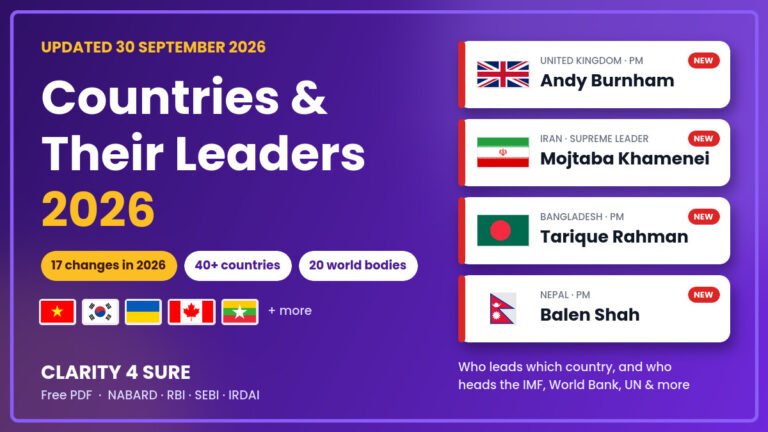 Free sheet · Static GKCountries & Their Leaders 2026Who leads which country in 2026, with all 17 changes marked. Get the article and the PDF free on WhatsApp.Get it free on WhatsApp →
BRICS Health Working Group Meeting Held
The Ministry of Health and Family Welfare hosted the BRICS Health Working Group Meeting 2026. The meeting focused on public health cooperation and digital health systems. India proposed initiatives on healthy lifestyles and mental wellness.
WEF Projects Strong Global Growth
World Economic Forum projected global GDP to grow by USD 56 trillion in five years. Growth will be driven by AI, quantum computing, and digital transformation. Asia is expected to contribute over 50% of global growth.
SEBI Relaxes Norms for Social Stock Exchange
Securities and Exchange Board of India extended NPO registration validity to 3 years. It also reduced minimum subscription for ZCZP instruments to 50%. The move enhances fundraising flexibility for non-profits.
World Bank Launches ‘Water Forward’ Initiative
World Bank launched ‘Water Forward’ to improve water security. The initiative targets 1 billion people by 2030. It focuses on sustainable water access and climate resilience.
N. Alim Yusuf Wins WWF Award
Indian botanist N. Alim Yusuf received the WWF National Award. He developed an AI-based app to detect invasive plant species. The innovation supports biodiversity conservation in Kerala.
Bloomberg Billionaires Index 2026
According to Bloomberg, Gautam Adani became Asia’s richest person. He surpassed Mukesh Ambani in net worth rankings. Globally, Elon Musk retained the top position.
ISRO SAC & ATREE Sign MoU
Indian Space Research Organisation partnered with ATREE for sustainable land management. The initiative will map ecosystems using satellite and field data. It supports climate action and land degradation neutrality goals.
New Reed Snake Species Discovered
A new species ‘Calamaria garoensis’ was discovered in Meghalaya. It belongs to the reed snake genus and is non-venomous. The discovery highlights biodiversity richness in Northeast India.
N. Ramachandran Passes Away
N. Ramachandran passed away at 77. He served as President of the Indian Olympic Association and World Squash Federation. He played a key role in promoting squash in India.
World Chagas Disease Day – April 14
World Chagas Disease Day raises awareness about a neglected tropical disease. It commemorates Carlos Chagas who discovered the disease. The 2026 theme focuses on protecting future generations.
National Fire Service Day – April 14
National Fire Service Day honours firefighters who died in the 1944 Bombay Dock Explosion. It promotes fire safety awareness across India. The week-long campaign emphasizes prevention and preparedness.
Odisha Signs MoU for Marine Spatial Planning
Odisha signed an MoU with National Centre for Coastal Research. The initiative focuses on sustainable coastal development and marine ecosystem protection. It is part of the India–Norway ocean management collaboration.