Daily Current Affairs (DCA) 22 April, 2026
Free live session
NABARD Grade A 2026: 45-Day Final Revision Plan + Daily Targets
 🔒 Register to watchLast Sunday’s session · recording
8 of the top 10 in NABARD Grade A 2025, Rank 1 included, and Rank 1 back to back before that in 2021 and 2022: all prepared with C4S. Watch last Sunday's session on the 45-day final revision plan now, then join the next one live on Zoom.
Tomorrow · 7:30 PM IST · 75 minutes · free
National Affairs5
Fourth India-Africa Forum Summit (IAFS) 2026
Context:
New Delhi is set to host the Fourth India-Africa Forum Summit (IAFS) 2026 in late May. This is a landmark event, occurring more than a decade after the third summit in 2015. The meeting arrives at a critical juncture as India seeks to solidify its role as a leader of the Global South amidst global supply chain disruptions caused by the West Asia conflict.
Strategic Objectives of the Summit
India’s approach toward Africa has evolved from a “development partner” to a “strategic investor.” The summit will focus on five core pillars:
- Diplomatic Expansion: Since 2018, India has opened 16 new missions in Africa, bringing its total diplomatic presence to 45 countries. The summit serves as a platform to consolidate this outreach.
- Capacity Building & Education: Highlighting the success of the IIT Madras Zanzibar campus, India aims to position itself as a hub for higher education and digital public infrastructure for African nations.
- Defence Cooperation: Moving beyond traditional peacekeeping, the agenda will include maritime security in the Indian Ocean and the export of indigenous defense hardware.
- Investment Shift: Moving away from the less popular Lines of Credit, Africa is now demanding Foreign Direct Investment (FDI) from Indian conglomerates, particularly in critical minerals and infrastructure.
- Supply Chain Resilience: Unlike the volatile Gulf region, African supply chains have remained remarkably stable despite regional conflicts. India views Africa as a “safe harbor” for critical resource security.
Key Concepts
Q: What is a “Line of Credit” (LoC) in diplomacy?
A: It is a soft loan provided by one government to another, usually to buy goods and services from the lending country. While India used this for years, many African nations now prefer FDI because LoCs often lead to increased sovereign debt.
Q: What is the “Global South”?
A: A term used to describe nations in Africa, Latin America, and developing Asia that are often excluded from high-level global decision-making. India positions itself as the “voice” of this group, especially after successfully inducting the African Union (AU) into the G20.
Q: Why is “Zanzibar” significant in India-Africa ties?
A: It is the location of the first-ever international campus of IIT Madras. This represents India’s “Soft Power” strategy—exporting high-quality education rather than just raw materials or finished goods.
Conceptual MCQs
Q1. When was the last India-Africa Forum Summit (IAFS-3) held before the upcoming 2026 meeting? A) 2018
B) 2020
C) 2015
D) 2022
Q2. According to analysts like Ajay Dubey, what is the current implementation rate of India’s commitments to Africa? A) 100%
B) 75%
C) 40%
D) 15%
Q3. Which major diplomatic milestone since 2018 has expanded India’s footprint to 45 African nations? A) The signing of a free trade agreement with the entire continent.
B) The opening of 16 new diplomatic missions.
C) The construction of a trans-continental railway.
D) Joining the African Union as a permanent member.
Answers
- Q1: C (There has been a 11-year gap between the 3rd and 4th summits.)
- Q2: C (The “Implementation Gap” remains a major hurdle for Indian diplomacy.)
- Q3: B (India has significantly scaled up its physical presence to provide direct diplomatic access.)
Exam Relevance
| Exam Focus Area | Relevance Level |
| UPSC CSE | GS-2 (Bilateral/Regional groupings, Effect of policies on India’s interests) |
| SSC / Banking | Current Affairs (Summits, MEA announcements, New Missions) |
Context:
India’s Samriddh Gram initiative has been nominated for the prestigious WSIS Prizes 2026 in the “Enabling Environment” category (AL C6), recognizing its role in leveraging ICT for sustainable rural development.
What is the Samriddh Gram Initiative?
Samriddh Gram (meaning “Prosperous Village”) is an integrated phygital (physical + digital) service delivery model. It is designed to turn the high-speed fiber backbone of BharatNet into a functional utility for rural citizens.
- Lead Agency: Department of Telecommunications (DoT), Ministry of Communications.
- The Hub: The initiative centers around Samriddhi Kendras (SK)—physical community hubs (800–1000 sq. ft.) that provide assisted digital services.
- First Milestone: The first official Samriddhi Kendra was recently inaugurated in Umri Village, Madhya Pradesh.
Key Service Pillars of Samriddhi Kendras
| Sector | Services Offered |
| Healthcare | Telemedicine via e-Sanjeevani; health kiosks for basic diagnostics and vitals monitoring. |
| Education | AR/VR smart classrooms; access to Diksha, Swayam, and vocational training labs. |
| Agriculture | Smart Farming: IoT sensors for soil health, smart pump controllers, and drone-based pesticide spraying. |
| Governance | Assisted access to e-schemes and integration with ONDC (Open Network for Digital Commerce) for local artisans. |
| Safety | Village-wide security through Smart CCTV and drone surveillance. |
| Connectivity | Deployment of PM-WANI public Wi-Fi hotspots and Fiber-to-the-Home (FTTH) connections. |
About the WSIS Prizes 2026
The World Summit on the Information Society (WSIS) Prizes are the global recognition platform for digital development, managed by the International Telecommunication Union (ITU).
- Aim: To honor projects that use Information and Communication Technologies (ICTs) to achieve the UN Sustainable Development Goals (SDGs).
- India’s Nomination: Samriddh Gram is nominated under Action Line C6: Enabling Environment, which focuses on creating the legal, policy, and infrastructure frameworks necessary for a digital society to thrive.
- Process: Winners are selected through a global multistakeholder process involving public voting and expert evaluation.
Key Concepts: Keyword Q&A
Q: What does “Phygital” mean in this context?
A: It refers to the combination of a physical space (the Samriddhi Kendra building) with digital tools (AR/VR, IoT, Broadband). This is crucial for rural India where people often need “assisted” digital access rather than just a standalone app.
Q: How does this link to BharatNet?
A: BharatNet provides the “highway” (the fiber optic cable). Samriddh Gram provides the “vehicles” (the actual services like healthcare and education) that run on that highway. Without initiatives like this, the fiber remains underutilized.
Q: What is PM-WANI?
A: The Prime Minister’s Wi-Fi Access Network Interface. It allows small shopkeepers or village centers to set up public Wi-Fi hotspots, democratizing internet access without requiring a massive telecom tower.
Conceptual MCQs
Q1. Under which “Action Line” category has India’s Samriddh Gram initiative been nominated for the WSIS Prizes 2026?
A) C1: Role of governments in ICT
B) C4: Capacity building
C) C6: Enabling environment
D) C7: E-health
Q2. Where was the first Samriddhi Kendra officially inaugurated?
A) Umri, Madhya Pradesh
B) Jamtara, Jharkhand
C) Punsari, Gujarat
D) Hiware Bazar, Maharashtra
Q3. Which digital commerce platform is Samriddh Gram integrated with to help rural entrepreneurs?
A) Amazon India
B) ONDC (Open Network for Digital Commerce)
C) GeM (Government e-Marketplace)
D) UPI
Answers
- Q1: C (Action Line C6 focuses on the environment created to enable ICT growth.)
- Q2: A (The pilot was recently inaugurated in Umri village.)
- Q3: B (ONDC allows local village businesses to list their products on a national digital network.)
Exam Relevance
| Exam Focus Area | Relevance Level |
| NABARD Grade A/B | Rural Development (ICT in Agriculture, Rural Infrastructure) |
| SSC / Banking | Current Affairs (Awards, International Organizations, New Schemes) |
3D Glass Semiconductor Packaging
Context:
The Indian government has laid the foundation stone for the country’s first 3D glass chip packaging facility in Bhubaneswar, Odisha. This marks a shift from traditional manufacturing toward mastering 3D Heterogeneous Integration (3DHI), a frontier technology in the global chip race.
What is 3D Glass Semiconductor Packaging?
Traditional chips are like single-story houses; 3D glass packaging turns them into high-tech skyscrapers. It uses glass substrates (the base layer) instead of traditional organic materials or silicon to stack multiple chip components—like logic, memory, and sensors—vertically.
- Lead Company: 3D Glass Solutions (3DGS), a US-based firm.
- Project Location: Bhubaneswar, Odisha, India.
- Capacity: Designed to produce 70,000 glass panels and 50 million units annually.
How it Works: The Vertical Shift
In standard 2D layouts, data has to travel long “horizontal” distances between components. 3D glass packaging changes the architecture:
- Vertical Stacking: Different “chiplets” (specialized functional pieces) are stacked on top of each other to save space and increase speed.
- Through-Glass Vias (TGV): These are tiny vertical holes drilled into the glass that act as “elevators” for data, allowing signals to travel instantly between layers.
- The Glass Advantage: Glass is more rigid than plastic and can withstand the extreme heat generated by AI processors without warping.
Key Features & Advantages
| Feature | Advantage |
| Thermal Stability | Glass handles high temperatures better, preventing AI chips from slowing down (throttling) due to heat. |
| High Precision | Glass allows for much denser electrical connections than traditional materials. |
| Low Signal Loss | Glass has superior electrical properties, meaning less energy is wasted as heat during data transfer. |
| Heterogeneous Integration | It allows engineers to mix different “generations” of chips (e.g., a 3nm logic chip with a 10nm memory chip) in one package. |
Key Concepts
Q: What is a “Substrate”?
A: Think of a substrate as the “motherboard” for the chip itself. It provides the mechanical support and the electrical connections that allow the chip to talk to the rest of the device.
Q: What are “Chiplets”?
A: Instead of making one giant, expensive chip, engineers make smaller, specialized pieces (chiplets) and “package” them together. It’s like building with LEGO blocks—it’s cheaper and more flexible.
Q: Why is “Thermal Stability” important for AI?
A: AI processing requires massive amounts of power, which generates intense heat. If the base material (substrate) expands or warps due to that heat, the connections can break. Glass stays stable under pressure.
Conceptual MCQs
Q1. Where is India’s first 3D glass chip packaging facility being established?
A) Bengaluru, Karnataka
B) Bhubaneswar, Odisha
C) Ahmedabad, Gujarat
D) Hyderabad, Telangana
Q2. What is the primary function of “Through-Glass Vias” (TGV) in 3D packaging?
A) To cool the chip using liquid nitrogen.
B) To act as a transparent window to see the chip’s interior.
C) To allow electrical signals to travel vertically between stacked layers.
D) To prevent the glass from shattering during manufacturing.
Q3. Why is 3D glass packaging considered a solution to the “end of Moore’s Law”?
A) Because it makes transistors even smaller than an atom.
B) Because it increases computing power through vertical stacking rather than just shrinking transistors.
C) Because it uses cheaper plastic instead of expensive silicon.
D) Because glass is faster than electricity.
Answers
- Q1: B (Bhubaneswar is becoming a strategic hub for this advanced technology.)
- Q2: C (TGVs are the vertical “highways” for data in 3D integration.)
- Q3: B (Vertical integration is the industry’s primary path forward as physical shrinking hits its limits.)
Exam Relevance
| Exam Focus Area | Relevance Level |
| UPSC CSE | GS-3 (Science & Technology, Indigenization of Technology, IT & Computers) |
| State PCS | Science & Technology (Odisha-specific infrastructure) |
Genetically Modified (GM) Mosquitoes
Context:
A landmark study conducted in Tanzania (published in Nature, December 2025/April 2026) has confirmed that genetically modified (GM) mosquitoes can effectively block malaria parasites from real-world human infections. This is a significant leap from laboratory-only success to testing against wild parasites circulating in local communities.
The Tanzanian Breakthrough
This research was a collaboration between the Ifakara Health Institute (IHI), Tanzania’s National Institute for Medical Research (NIMR), and Imperial College London.
- Local Success: This is the first time a gene-drive compatible mosquito strain was developed on African soil by African scientists.
- The “Frog & Bee” Strategy: Scientists modified Anopheles gambiae by introducing antimicrobial molecules naturally found in frogs (magainins) and honeybees (melittin).
- Real-World Test: To prove it works, modified mosquitoes were fed blood from local Tanzanian children naturally infected with malaria. The mosquitoes effectively destroyed the parasites in their midgut before they could mature.
Two Primary Genetic Strategies
| Strategy | Mechanism | Goal |
| Population Modification (Replacement) | Adds genes that trigger anti-parasite molecules (antibodies/peptides) when the mosquito bites. | Keep the mosquitoes alive but make them immune to malaria so they can’t pass it to humans. |
| Population Suppression | Targets the doublesex gene to make female offspring sterile. | Cause the local mosquito population to shrink or collapse. |
How Gene Drive Bypasses Nature?
In standard Mendelian genetics, a gene has a 50% chance of being passed on. A Gene Drive uses CRISPR-Cas9 to ensure the modified trait is “copied and pasted” onto the partner chromosome, resulting in over 90% inheritance. This allows a trait to spread through a wild population rapidly.
Key Concepts
Q: Why do we need GM mosquitoes if we have bed nets?
A: Traditional methods are failing. Mosquitoes are becoming resistant to insecticides, and they are changing their behavior (e.g., biting outdoors during the day to avoid indoor nets).
Q: What is the “Split Gene Drive” mentioned in the study?
A: It is a safety feature. The components (the “scissors” and the “template”) are kept in two different mosquito lines. They only work when they meet. This allows scientists to test the tech in a controlled way without it spreading uncontrollably in the wild during the trial phase.
Q: Is this safe for the ecosystem?
A: This is a major area of debate. “Modification” (Replacement) is generally considered safer than “Suppression” because it doesn’t aim to eliminate a species, preserving the mosquito’s role in the food chain as prey for birds and bats.
Conceptual MCQs
Q1. The landmark study in Tanzania used which genetic engineering tool to develop the modified mosquitoes?
A) PCR
B) CRISPR-Cas9
C) Gel Electrophoresis
D) DNA Fingerprinting
Q2. What is the main advantage of the “Population Modification” strategy over “Population Suppression”?
A) It kills all mosquitoes in a specific region.
B) It blocks the parasite while keeping the mosquito in the ecosystem.
C) It makes mosquitoes larger and easier to see.
D) It only works on male mosquitoes.
Q3. Which molecules were introduced into the Tanzanian mosquito strain to block the malaria parasite?
A) Human insulin
B) Synthetic insecticides
C) Molecules from frogs and honeybees
D) Anti-viral proteins from bats
Answers
- Q1: B (CRISPR is the “molecular scissors” used for gene drives.)
- Q2: B (It targets the disease-carrying ability rather than the existence of the species.)
- Q3: C (Specifically magainins and melittin which act as antimicrobial peptides.)
Exam Relevance
| Exam Focus Area | Relevance Level |
| UPSC CSE | GS-3 (S&T: Biotechnology, CRISPR, Gene Drive, Health issues) |
| State PCS | Science & Tech (Modern Biology and Disease Control) |
| SSC / Banking | Current Affairs (Recent breakthroughs, International trials) |
India Climbs to Global #2 in Wind Energy: BNEF 2025
According to the latest report from Bloomberg New Energy Finance (BNEF), India’s wind energy sector achieved a historic breakthrough in 2025. By commissioning a record-breaking 6.3 GW of capacity, India has officially become the largest wind market in the world outside of China, surpassing both the United States and Germany.
The 2025 Performance Surge
- Annual Growth: The 6.3 GW commissioned in 2025 represents a massive 85% increase over the 2024 additions.
- Global Standing: This surge makes India the Global #2 market for new wind installations in 2025 (trailing only China).
- Domestic Leadership: Adani Wind (the manufacturing arm of Adani Green Energy) has entered the global stage, ranking 15th among turbine makers worldwide.
The Khavda Renewable Energy Park
A significant portion of this growth is attributed to the massive 30 GW Renewable Energy Park currently under construction in Khavda, Kutch (Gujarat).
- Adani Green Energy alone deployed over 1 GW of wind turbines at this single site in 2025.
- The park is designed as a hybrid facility, combining solar and wind to ensure more stable power generation.
Key Concepts: Keyword Q&A
Q: What is a “Multi-Technology Complex Auction”?
A: Unlike traditional auctions for just one energy source, these auctions require developers to provide a mix of technologies (e.g., Wind + Solar + Battery Storage) to ensure the grid gets a steady supply of power even when the wind isn’t blowing or the sun isn’t shining.
Q: Why is Khavda significant for global energy?
A: Located in the Kutch district of Gujarat, Khavda is set to be the world’s largest renewable energy installation. Its scale (30 GW) is roughly equivalent to the entire power capacity of a mid-sized country like Belgium.
Q: What is “Commissioning”?
A: In the energy sector, commissioning is the final stage where a power plant is tested and officially connected to the national grid to begin commercial operations.
Conceptual MCQs
Q1. According to BNEF, which country was the only one to install more wind capacity than India in 2025?
A) USA
B) Germany
C) China
D) Brazil
Q2. Which specific geographic location is hosting the 30 GW renewable energy park mentioned in the report?
A) Ladakh
B) Khavda, Gujarat
C) Thar Desert, Rajasthan
D) Nellore, Andhra Pradesh
Q3. What percentage increase did India see in its wind turbine commissioning in 2025 compared to the previous year?
A) 25%
B) 50%
C) 85%
D) 100%
Answers
- Q1: C (India is the largest market outside China.)
- Q2: B (The Khavda park in Kutch is the primary engine of India’s current RE growth.)
- Q3: C (Capacity jumped from roughly 3.4 GW in 2024 to 6.3 GW in 2025.)
Exam Relevance
| Exam Focus Area | Relevance Level |
| UPSC CSE | GS-3 (Energy, Infrastructure, Environment) |
| NABARD Grade A/B | ESI (Renewable Energy Statistics, Rural Infrastructure) |
| SSC / Banking | Current Affairs (Corporate rankings, National records) |
Banking/Finance5
How & Why Farmers Producers Organization are formed? FPO #fpo #upsc #nabardgradea #agriculturenotesTap to play · from the C4S channel
Context:
The Indian Rupee declined by 28 paise on Tuesday, settling at 93.44 against the U.S. Dollar. Despite a rally in domestic stock markets, the local currency faced multiple headwinds from both global geopolitical tensions and recent regulatory shifts.
What are the Three Pillars of Depreciation?
1. West Asia Uncertainty
The primary driver remains the volatility in crude oil prices. As peace negotiations in West Asia face uncertain progress, oil markets have remained on edge. Since India is a massive net importer of crude, any spike in oil prices increases the demand for Dollars, putting downward pressure on the Rupee.
2. Steady U.S. Dollar (DXY)
The American currency remained resilient in global markets. A “steady” Dollar usually implies that investors are seeking the safety of U.S. assets amidst global instability, leading to a flight of capital away from emerging market currencies like the Rupee.
3. The “RBI Rollback” Effect
Forex analysts noted that the Rupee’s slide was partly influenced by the Reserve Bank of India’s (RBI) decision on Monday to partially lift emergency curbs.
- On April 1, the RBI had strictly capped speculative bets to prevent a free-fall.
- By easing these curbs and allowing more activity in the Non-Deliverable Forward (NDF) markets, the RBI has restored market flexibility, but this also allows for natural downward adjustments in currency value that were previously suppressed.
Key Concepts
Q: Why didn’t “Positive Domestic Equity Markets” help the Rupee?
A: Usually, when the stock market (Sensex/Nifty) goes up, it attracts foreign investment, which brings in Dollars and strengthens the Rupee. However, the current global “macro” factors—oil prices and geopolitical risk—are currently so strong that they have overshadowed the positive sentiment in the stock market.
Q: What is a “Non-Deliverable Forward” (NDF)?
A: It is a foreign exchange derivative contract used to hedge or speculate on currencies that are not internationally traded (like the Rupee). They are “non-deliverable” because the profit or loss is settled in a reserve currency like the USD rather than the physical delivery of Rupees.
Q: What are “Speculative Bets” in forex?
A: These are trades made by investors who are not necessarily buying currency for trade (like importing oil) but are instead betting on which way the currency’s value will move to make a profit. While speculation provides liquidity, “excessive speculation” can cause a currency to crash faster than its actual economic fundamentals suggest.
Conceptual MCQs
Q1. According to the report, what was the closing value of the Rupee against the U.S. Dollar on Tuesday?
A) 92.50
B) 93.12
C) 93.44
D) 95.22
Q2. What was the impact of the RBI’s Monday announcement on the Rupee’s performance on Tuesday?
A) It caused the Rupee to appreciate by 50 paise.
B) It helped stabilize the Rupee at 92.00.
C) It contributed to the decline by easing curbs on speculative activity.
D) It had no impact as it only affected the bond market.
Q3. Why does “volatile crude oil” typically lead to a weaker Rupee?
A) Because India exports more oil than it imports.
B) Because higher oil prices increase India’s import bill, leading to a higher demand for U.S. Dollars.
C) Because oil is traded in Rupees on the international market.
D) Because high oil prices make Indian stocks more attractive.
Answers
- Q1: C (The Rupee settled at 93.44, a 28-paise drop.)
- Q2: C (Easing curbs restored market function but allowed for more movement in currency value.)
- Q3: B (India’s status as an oil importer creates a direct link between energy prices and currency strength.)
Exam Relevance
| Exam Focus Area | Relevance Level |
| RBI Grade B | Finance (Forex Markets, NDF, Monetary Policy Interventions) |
| UPSC CSE | GS-3 (Indian Economy: Exchange Rate, External Sector) |
| Banking (PO/Clerk) | General Awareness (Current Forex Rates, RBI Directives) |
Context:
Bandhan Mutual Fund has become one of the first movers in the industry to utilize newly expanded SEBI guidelines, allowing equity and hybrid schemes to invest in precious metals. The fund house has tweaked the mandates for its Smallcap, Flexicap, and Aggressive Hybrid funds to include exposure to Gold and Silver.
What are Multi-Asset Diversification?
Traditionally, the “investable universe” for equity funds was limited to stocks and short-term debt. Following recent SEBI relaxations, these funds can now diversify into commodities via ETFs (Exchange Traded Funds).
- Gold/Silver Exposure: The schemes can now allocate up to 10% of their portfolio to Gold and Silver ETFs.
- The Rationale: Fund managers can now capture “Beta returns” (market-linked returns) from commodities, especially when there isn’t a suitable listed stock (equity play) to represent that sector.
- Opportunistic Use: The allocation is not mandatory; it provides fund managers the flexibility to hedge against volatility or capture commodity rallies when equity markets are stretched.
Key Concepts
Q: What is a “Covered Call” strategy?
A: This is an options strategy used to generate extra income and reduce risk. A fund manager holds a long position (owns the stock) and sells (writes) a Call Option on that same stock. The fund collects a “premium” from the buyer. If the stock price stays flat or rises only slightly, the fund keeps the premium, which cushions the portfolio against minor dips.
Q: What are InvITs (Infrastructure Investment Trusts)?
A: InvITs are like mutual funds but for infrastructure. They pool money from investors to invest in completed and revenue-generating infrastructure projects (like toll roads or power transmission lines). They are added to these funds to provide a steady stream of cash flow (dividends/interest).
Q: What is “Beta Return”?
A: Beta represents the baseline return of a specific market or asset class. By investing in Gold ETFs, the fund manager ensures they get the exact movement of gold prices (the Beta) without having to pick specific mining stocks.
Q: Why add Gold and Silver to an Equity Fund?
A: Gold and Silver often have a negative correlation with equities. When the stock market crashes due to geopolitical tension or inflation, precious metals usually rise. Adding them helps improve “Risk-Adjusted Returns”—meaning you get better returns for every unit of risk taken.
New Asset Allocation Framework (Smallcap & Flexicap)
| Asset Class | Minimum (%) | Maximum (%) |
| Equity & Equity Related | 65% | 100% |
| Debt Securities / Cash | 0% | 35% |
| Units of InvITs | 0% | 10% |
| Gold / Silver ETFs | 0% | 10% |
Conceptual MCQs
Q1. According to the new framework, what is the maximum percentage of a Bandhan Smallcap Fund that can be invested in Gold/Silver ETFs?
A) 5%
B) 10%
C) 35%
D) 65%
Q2. What is the primary purpose of adding a “Covered Call” mandate to an equity scheme?
A) To double the risk of the portfolio.
B) To generate income from option premiums and moderate volatility.
C) To invest only in gold and silver mining companies.
D) To guarantee that the fund will never lose money.
Q3. Why has Bandhan MF added InvITs to its asset mix?
A) To increase exposure to volatile technology stocks.
B) To focus exclusively on the real estate sector.
C) To enhance income generation potential and diversify the asset base.
D) Because SEBI has banned traditional debt investments.
Answers
- Q1: B (The framework allows for a range of 0% to 10%.)
- Q2: B (It is a defensive strategy designed to earn extra yield on existing holdings.)
- Q3: C (InvITs provide stable, long-term yields from infrastructure projects.)
Context:
The Reserve Bank of India (RBI) is currently evaluating industry feedback on its January discussion paper regarding the conversion of cooperative credit societies into Urban Cooperative Banks (UCBs). Industry bodies are pushing for more relaxed capital and lending norms to help these grassroots institutions transition into the formal banking fold.
The Capital Hurdle: ₹300 Cr vs. ₹200 Cr
The primary point of contention is the Entry Point Norms—the minimum capital required to start or convert into a UCB.
- RBI’s Proposal: A threshold of ₹300 crore.
- Industry Request: Lowering the requirement to ₹200 crore, arguing that the higher limit is too steep for smaller credit societies and does not align with “current economic realities.”
Key Demands & Proposed Changes
| Feature | RBI Proposal / Existing Rule | Industry “Tweak” Sought |
| Minimum Capital | ₹300 Crore | ₹200 Crore |
| Track Record | 10 years active / 5 years “good” financials | 5-year track record for mergers with existing UCBs |
| Unsecured Advances | 20% aggregate ceiling | 25% aggregate ceiling |
| Nominal Member Loans | ₹2.5 Lakh (Consumer durables) | ₹5 Lakh for Tier-3 and Tier-4 UCBs |
| Loan Tenure | 1 year (for nominal members) | Up to 5 years |
Key Concepts
Q: What is an Urban Cooperative Bank (UCB)?
A: UCBs are financial institutions registered under the Cooperative Societies Act of their respective states. Unlike commercial banks, they are owned and managed by their members and typically serve a specific urban or semi-urban community.
Q: What are “Unsecured Advances”?
A: These are loans given without any collateral (like property or gold). Because they are riskier for the bank, the RBI caps them. Industry bodies want a higher cap (25%) to help small-scale borrowers who lack assets.
Q: Who is a “Nominal Member”?
A: A nominal member is someone who has been admitted to the bank’s membership but does not have the same rights as regular members (like voting rights). They are usually individuals who need a small loan for consumer durables (fridges, bikes, etc.).
Q: Why the debate over “Track Record” (5 vs 10 years)?
A: The RBI believes 5 years is too short to judge the “character” and “stability” of a credit society before giving it a banking licence. The industry argues that a 5-year track record should at least be enough to allow a society to merge with an existing, stronger UCB.
Conceptual MCQs
Q1. What is the minimum capital threshold proposed by the RBI for a cooperative credit society seeking a UCB licence?
A) ₹100 crore
B) ₹200 crore
C) ₹300 crore
D) ₹500 crore
Q2. Industry bodies have requested the RBI to increase the aggregate ceiling on “unsecured advances” from 20% to what level?
A) 25%
B) 30%
C) 40%
D) 50%
Q3. According to the guidelines, the proposed amendments are expected to come into force by which date?
A) January 1, 2026
B) April 1, 2026
C) October 1, 2026
D) March 31, 2027
Answers
- Q1: C (RBI proposed ₹300 cr; industry is asking for ₹200 cr.)
- Q2: A (Increasing this cap allows banks more flexibility to lend to small-ticket borrowers.)
- Q3: C (October 1, 2026, or earlier if adopted in entirety by the UCB.)
Exam Relevance
| Exam Focus Area | Relevance Level |
| RBI Grade B | Finance (Banking Structure, UCB Regulations, Capital Adequacy) |
| NABARD Grade A/B | Agriculture & Rural Development (Role of Cooperatives) |
| Banking | Current Affairs (Banking norms, Regulatory deadlines) |
Context:
The Reserve Bank of India (RBI) has expanded the scope of its e-mandate (electronic mandate) framework. The revised rules now explicitly include cross-border recurring payments made via cards, UPI, and prepaid instruments (PPIs). The move is designed to curb digital fraud and give consumers more granular control over “auto-debit” transactions.
What are the New E-Mandate Framework?
An e-mandate allows a merchant to automatically debit a customer’s account for recurring services (like Netflix, insurance premiums, or SIPs) without requiring manual approval for every single payment.
1. AFA and The “Opt-Out” Right
- Additional Factor Authentication (AFA): Any creation, modification, or withdrawal of an e-mandate now strictly requires AFA (usually an OTP or biometric check).
- Flexibility: Customers must be given the facility to opt out of a specific upcoming transaction or the entire mandate at any time.
2. Transaction Limits (AFA-Exempt)
To balance security with convenience, the RBI allows small-value recurring payments to go through without an OTP, provided they stay within these limits:
- Standard Transactions: Up to ₹15,000 per transaction.
- Special Categories: Up to ₹1 lakh for credit card bills, insurance premiums, and mutual fund installments.
3. The 24-Hour Rule
Banks and financial institutions must send a notification to the customer at least 24 hours before the actual money is debited. This notification must include:
- Merchant name and transaction amount.
- Date/time of debit and the reason.
- A reference number for the e-mandate.
- Note: This is not required for auto-replenishing FASTag or NCMC (Common Mobility Card) balances.
Key Concepts: Keyword Q&A
Q: What is a “Variable E-Mandate”?
A: This is used when the monthly bill isn’t the same (e.g., an electricity bill). The RBI now mandates that for variable payments, the customer must be able to set a maximum cap for any single transaction to prevent being overcharged.
Q: How is “Liability” handled for unauthorized transactions?
A: The RBI’s “Limited Liability” rules now apply to recurring payments.
- Zero Liability: If the bank is at fault or if you report a third-party breach within 3 working days.
- Capped Liability: If reported within 4–7 days, your maximum loss is capped between ₹5,000 (savings account) and ₹25,000 (credit cards).
Q: What happens if I get a new credit card?
A: The RBI has simplified the process by allowing banks to map existing e-mandates to reissued or replaced cards, so you don’t have to set them up all over again.
Conceptual MCQs
Q1. According to the revised RBI rules, what is the minimum notice period a bank must give a customer before a recurring payment is debited?
A) 1 hour
B) 12 hours
C) 24 hours
D) 48 hours
Q2. For which of the following categories has the RBI set a higher AFA-exempt limit of ₹1 lakh per recurring transaction?
A) Grocery subscriptions
B) OTT platforms like Netflix
C) Mutual Fund installments and Insurance premiums
D) International travel bookings
Q3. Under what circumstance does a customer have “Zero Liability” for an unauthorized electronic transaction?
A) If they never check their bank statements.
B) If the unauthorized transaction is reported within 3 working days of a third-party breach.
C) Only if the transaction is under ₹100.
D) If the customer shared their OTP with the merchant.
Answers
- Q1: C (The 24-hour notification is mandatory to allow the customer time to “opt out” if they wish.)
- Q2: C (High-value utility/investment payments have a higher threshold to avoid frequent OTP hurdles.)
- Q3: B (Swift reporting is the key to total protection under RBI’s safety norms.)
Exam Relevance
| Exam Focus Area | Relevance Level |
| RBI Grade B | Finance (Payment Systems, Digital Fraud, Consumer Protection) |
| SEBI Grade A | Financial Awareness (Mutual Fund SIP mandates) |
| Banking (PO/Clerk) | General Awareness (UPI limits, E-mandate rules) |
Context:
The United Nations Economic and Social Commission for Asia and the Pacific (UNESCAP) released its Economic and Social Survey of Asia and the Pacific 2026 on Tuesday. The report highlights that while India remains a strong performer in the region, global headwinds—specifically the West Asia conflict—will likely moderate growth and push inflation higher in the coming fiscal year.
GDP and Inflation Projections
The report provides a multi-year trajectory for India’s economy, showing a “dip and recovery” pattern.
| Fiscal Year | GDP Growth Projection | Inflation (CPI) Projection |
| FY26 (Est.) | 7.4% (Strong expansion) | 2.3% (Period of low prices) |
| FY27 (Proj.) | 6.4% (Slowdown due to war) | 4.4% (Energy shock impact) |
| FY28 (Proj.) | 6.6% (Moderate recovery) | 4.3% (Stabilizing) |
Strategic Drivers & Headwinds
1. The “West Asia” Headwind
The primary cause for the projected slowdown from 7.4% to 6.4% is the ongoing conflict involving Iran. This has created global uncertainties and energy supply disruptions, which directly impact India’s production costs and fiscal health.
2. Domestic Demand & Services
The report expects growth to rebound slightly to 6.6% in FY28. This recovery is predicated on robust domestic consumption and the continued strength of India’s services sector, which acts as a buffer against global manufacturing slumps.
3. The Inflation “Double-Up”
Inflation is projected to nearly double from 2.3% in FY26 to 4.4% in FY27. Despite this sharp rise, the UN notes that it remains well within the RBI’s tolerance band of 2%–6%, suggesting that a full-scale monetary crisis is unlikely if tensions ease.
How others see India
The UN’s projection of 6.4% for FY27 is slightly more conservative than other major institutions:
- RBI: 6.9%
- Asian Development Bank (ADB): 6.9%
- World Bank: 6.6%
- UNESCAP: 6.4%
Key Concepts
Q: What is UNESCAP?
A: The United Nations Economic and Social Commission for Asia and the Pacific. It is the most inclusive intergovernmental platform in the Asia-Pacific region, focusing on sustainable development and economic cooperation.
Q: Why is the “Base Year” for GDP (2022-23) important?
A: India recently updated its GDP base year to 2022-23. A more recent base year captures the current structure of the economy more accurately (e.g., including new digital services or updated manufacturing tech) compared to older benchmarks.
Q: What is “Real GDP”?
A: It is the value of all goods and services produced by an economy in a year, adjusted for inflation. It tells us how much the economy actually grew in volume, not just because prices went up.
Conceptual MCQs
Q1. According to the UNESCAP report, what is the primary reason for India’s GDP growth slowing to 6.4% in FY27?
A) A sudden drop in the services sector.
B) Headwinds from the West Asia war and energy disruptions.
C) A change in the RBI’s leadership.
D) Rapidly declining domestic demand.
Q2. The report projects India’s inflation to reach 4.4% in FY27. How does this compare to the RBI’s mandated tolerance range?
A) It is significantly above the range.
B) It is below the minimum threshold.
C) It is within the 2%–6% target band.
D) It is exactly at the median point of 4%.
Q3. Which region’s growth was largely driven by India’s strong performance in 2025, according to the report?
A) South-East Asia
B) Central Asia
C) South and South-West Asia
D) East Asia
Answers
- Q1: B (Energy supply disruptions from the Iran conflict are cited as the main drag.)
- Q2: C (The RBI’s target is 4% ± 2%, meaning 2–6% is the “safe” zone.)
- Q3: C (India is the largest economy in the South and South-West Asia sub-region.)
Exam Relevance
| Exam Focus Area | Relevance Level |
| UPSC CSE | GS-3 (Indian Economy, Growth, Inflation, Multilateral Institutions) |
| RBI Grade B | Finance & Management (Global economic trends, GDP forecasting) |
| NABARD Grade A/B | ESI (Economic Growth and Development, Inflation metrics) |
| SSC / Banking | Current Affairs (GDP rankings and projections) |
Every day of the month in one file. Enter your details once — the download opens right away.
We already have your details, so no form: tap to open.
Download the April 2026 PDFDownload the April 2026 revision sheet PDFFacts To Remember16
Cabinet Approvals Boost Salaries, Infrastructure and Trade Support
The Union Cabinet chaired by Narendra Modi approved a 2% hike in Dearness Allowance (DA) and Dearness Relief (DR), raising it to 60% effective January 2026; it also cleared railway multitracking projects worth ₹24,815 crore in Uttar Pradesh and Andhra Pradesh; additionally, the RELIEF scheme was expanded to Egypt and Jordan to support exporters amid West Asia disruptions.
‘Prajna’ Satellite Imaging System Strengthens Internal Security
The Ministry of Home Affairs received ‘Prajna’, an AI-enabled satellite imaging system developed by DRDO; the system enables real-time monitoring of sensitive regions and supports counter-terrorism operations; it enhances decision-making capabilities for security agencies through advanced surveillance and analytics.
India’s First Petroglyph Conservation Park to be Built in Ladakh
India will set up its first Petroglyph Conservation Park at Sindhu Ghat in Leh, Ladakh; the project aims to preserve ancient rock carvings threatened by tourism and development; it will be developed in collaboration with the Archaeological Survey of India for scientific conservation and research.
Odisha Gets India’s First 3D Glass Semiconductor Packaging Unit
India’s first advanced 3D glass chip packaging unit will be set up in Bhubaneswar with an investment of ₹1,943 crore; the project is implemented by 3D Glass Solutions Inc. through its Indian subsidiary; it will support sectors like AI, 5G, defence and aerospace with production expected by 2028.
C-DOT Partners with Jumps Automation for Cybersecurity Platform
C-DOT signed an MoU with Jumps Automation LLP to develop a gamified cybersecurity awareness platform; the platform will use AI-driven simulations and training modules; it aims to enhance cyber preparedness through interactive learning and SaaS deployment.
 Scheme to knowKavach: Indian Railways’ Automatic Train Protection System – Versions, Deployment and FactsKavach (Hindi for "shield" or "armour") is the indigenous Automatic Train Protection (ATP) system of Indian Railways.…
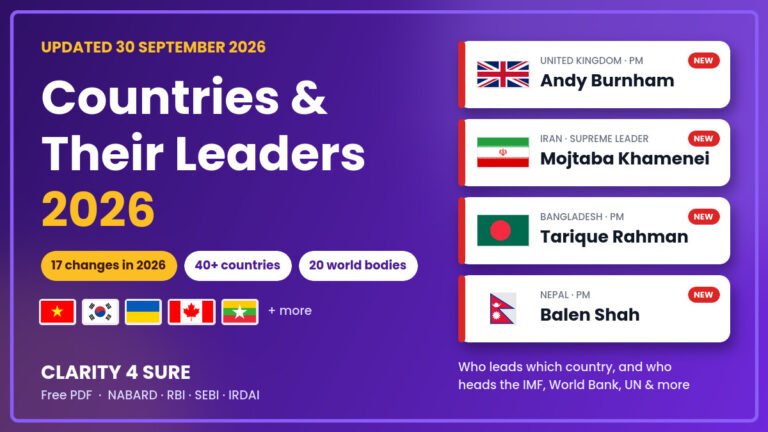 Free sheet · Static GKCountries & Their Leaders 2026Who leads which country in 2026, with all 17 changes marked. Get the article and the PDF free on WhatsApp.Get it free on WhatsApp →
MoMA and IIT Patna Collaborate Under PM VIKAS Scheme
The Ministry of Minority Affairs signed an MoU with IIT Patna under PM VIKAS; the initiative will train 600 minority youth in AI and business analytics roles; it focuses on improving employability through technology-driven skill development.
SBI Targets 25% of India’s GDP in Balance Sheet by 2030
State Bank of India aims to expand its balance sheet to 25% of India’s GDP by 2030; it plans district-level customized strategies to boost growth; currently, its balance sheet stands at ₹71.62 lakh crore with strong market share in deposits and advances.
UN Report Projects India’s GDP Growth at 6.4% in 2026
A report by UN ESCAP projects India’s growth at 6.4% in 2026 and 6.6% in 2027; inflation is expected to remain stable around 4.4%; India continues to lead in greenfield FDI inflows and remittance receipts globally.
NHA Concludes Chintan Shivir 2026 and Awards States
National Health Authority आयोजित Chintan Shivir 2026 in Pune to review AB PM-JAY and ABDM; states and UTs were awarded for excellence in healthcare implementation; discussions focused on digital health systems, interoperability, and governance reforms.
Santosh Kumar Honoured as ‘Global Green Icon’ in UK
Joginapally Santosh Kumar was awarded ‘Global Green Icon’ at the World Climate Leaders Conclave in London; he is known for launching the Green India Challenge; the award recognises his contribution to large-scale afforestation and sustainability efforts.
Apple Appoints John Ternus as Next CEO
Apple Inc. announced that John Ternus will become CEO from September 2026, succeeding Tim Cook; Cook will transition to Executive Chairman; Ternus has led major hardware innovations including Apple Silicon.
Indian Navy Gets Fourth Diving Support Craft DSC A23
Titagarh Naval Systems launched the fourth DSC A23 for the Indian Navy under the Make in India initiative; the vessel supports deep-sea diving and rescue operations; it features advanced indigenous systems for operational efficiency.
Aronyak Ghosh Becomes India’s 95th Chess Grandmaster
Aronyak Ghosh became India’s 95th Grandmaster at the Bangkok Chess Club Open 2026; he secured his final GM norm with an unbeaten performance; he is among the rising talents in Indian chess.
World Liver Day 2026 Observed on April 19
World Liver Day is observed globally on April 19 to raise awareness about liver health; the 2026 theme is “Solid Habits, Strong Liver”; it promotes preventive care and lifestyle changes to reduce liver diseases.
UN Chinese Language Day 2026 Celebrated on April 20
The United Nations observes Chinese Language Day on April 20 to promote multilingualism; the 2026 theme focuses on youth engagement and language learning; the day aligns with the traditional Chinese calendar event Guyu.
National Civil Services Day 2026 Observed on April 21
India celebrates National Civil Services Day on April 21 to recognise civil servants’ contribution; the 2026 theme is “Viksit Bharat: Citizen-Centric Governance”; the Prime Minister’s Awards for Excellence in Public Administration were conferred during the event.